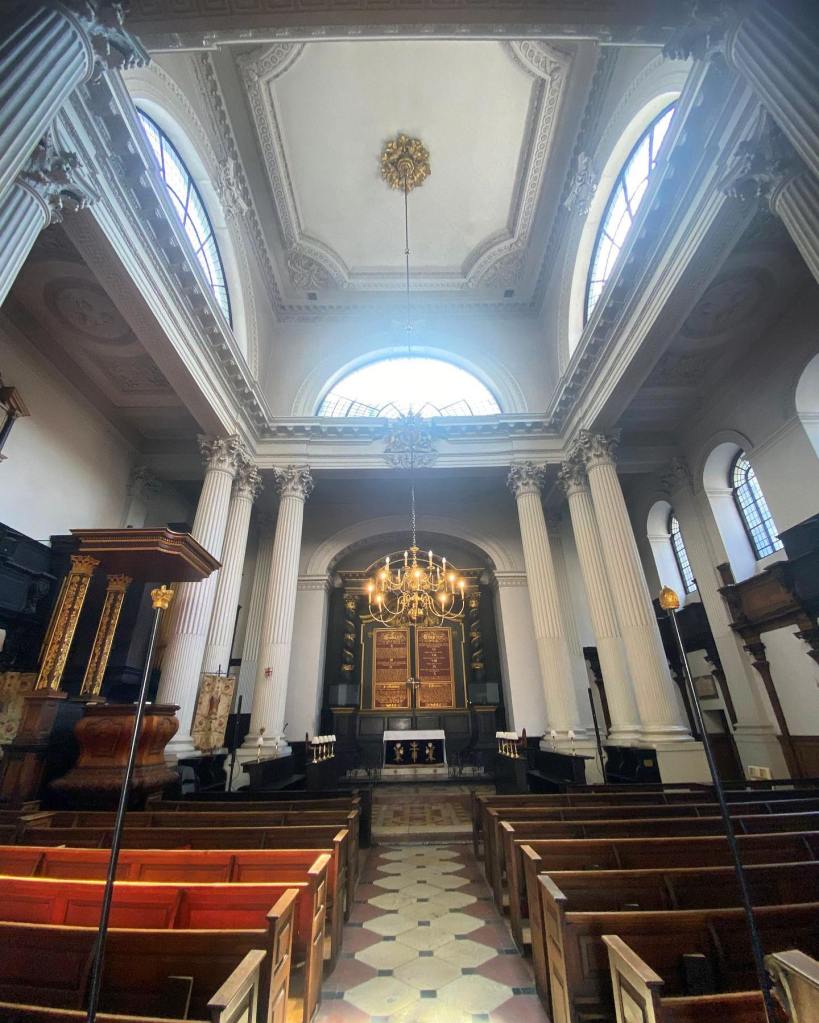
St Mary Woolnoth is the sole surviving City church designed by Nicholas Hawksmoor (1661–1736), pupil and later collaborator of Sir Christopher Wren (1632–1723). Built between 1716 and 1727, it formed part of the grand yet only partially realised scheme of Queen Anne’s reign to erect fifty new churches for London, financed through a levy on coal. The west façade makes plain Hawksmoor’s architectural formula: mass heaped upon mass, rustication confronting sharply cut classical detail, solidity pierced by voids that read as apertures carved into living stone. Its twin turreted towers, fortress-like in their bulk, generate a tension between vertical thrust and ponderous weight, a register wholly distinct from the light theatricality of the Baroque churches that rose elsewhere in the City.
The site itself carries the weight of long continuity. A Norman church is first recorded here, later rebuilt in 1445 and again in 1485. Damaged by the Great Fire of 1666, it was repaired by Wren, only to be swept away to make room for Hawksmoor’s radical new design. His scheme created a keystone monument at the intersection of Lombard Street, but the surrounding context has changed dramatically: where once the church held command over its urban setting, twentieth-century office blocks now dwarf its tower, muting the impact of Hawksmoor’s original vision.
The church is also bound to one of the most remarkable personal histories of the eighteenth century. John Newton (1725–1807), once a participant in the slave trade and later one of its most eloquent critics, served as rector here from 1780. From the pulpit of St Mary Woolnoth he gave voice to his abolitionist convictions, publishing tracts that exposed the brutal realities of the trade and aligning himself with the Committee for the Abolition of the Slave Trade. He and his wife were buried in the crypt until their remains were displaced during the construction of the Underground. Newton’s presence lends the church an added resonance: a place where architectural monumentality and moral reckoning converge.