The name of this church encodes a history that the building itself no longer shows. St Lawrence Jewry takes its suffix from Old Jewry, the street running north from Cheapside that marked the centre of medieval London’s Jewish quarter, a community whose presence in the city stretches back to the years immediately following the Norman Conquest. William the Conqueror had actively encouraged Jewish settlers from Rouen to establish themselves in England, and by the twelfth century the community around Old Jewry and the area near the Tower of London had become economically significant, supplying the credit networks on which the Norman and Angevin crowns depended. The church itself was founded around 1136, its dedication to Saint Lawrence suggesting an early date in the period when the Jewish quarter was already forming around it.
That presence ended with a decisiveness unusual even by medieval standards. On 18 July 1290, Edward I issued the Edict of Expulsion, ordering the removal of all Jews from the Kingdom of England and permanently prohibiting their return. The edict stood for 365 years. The first London synagogue, Bevis Marks, was built only at the end of the seventeenth century, after the readmission negotiated under Cromwell in 1656, and the question of what the city lost during those three and a half centuries, intellectually, commercially, culturally, is one historians continue to argue.
The church’s dedication to Saint Lawrence connects it to a different kind of refusal. Lawrence was a third-century deacon of Rome, executed in 258 AD under the Emperor Valerian during a period of systematic persecution of the Christian clergy. Serving under Pope Sixtus II, he was ordered by Roman authorities to surrender the wealth of the church. His response was to present the poor of the city as its true treasure, an act of defiance that cost him his life. He was martyred on a gridiron, and that instrument has remained his attribute in Christian iconography ever since. The metal gridiron on the church’s tower maintains the identification plainly.
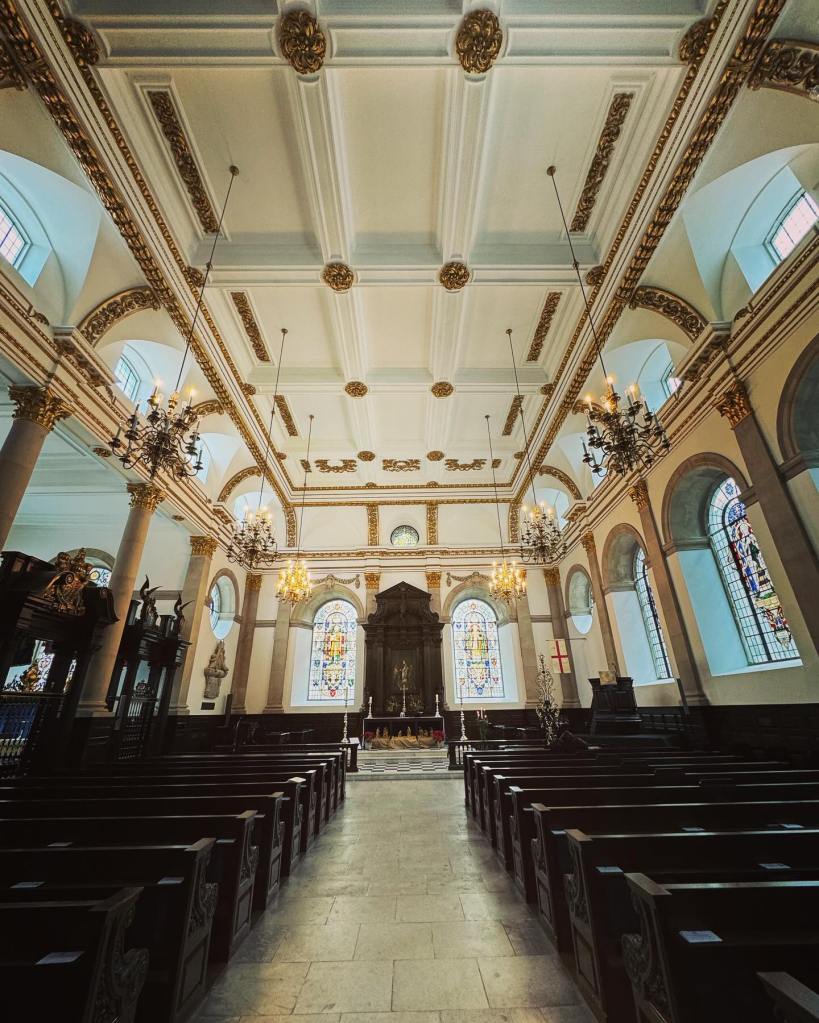
The medieval building did not survive the seventeenth century intact. The Great Fire of London in 1666 destroyed it along with most of the City’s parish churches, and the rebuilding fell to Christopher Wren as part of his vast programme of reconstruction across the square mile. St Lawrence Jewry was completed in 1677, its interior among the more elaborate of Wren’s City churches. That interior did not survive either. The Blitz of 1940 gutted the building, and the restoration carried out in the 1950s by Cecil Brown worked from Wren’s designs rather than from surviving fabric. What visitors enter today is therefore a careful reconstruction of a seventeenth-century rebuilding of a twelfth-century foundation, three historical layers compressed into a single space. Beneath Guildhall Gallery nearby, excavations have revealed the remains of a Roman amphitheatre and forum, pushing the sequence of occupation on this small patch of the City back another thousand years.
References
Hillaby, J. and Hillaby, C. (2013) The Palgrave Dictionary of Medieval Anglo-Jewish History. Basingstoke: Palgrave Macmillan
Jeffery, P. (1996) The City Churches of Sir Christopher Wren. London: Hambledon Press
Mundill, R.R. (2010) The King’s Jews: Money, Massacre and Exodus in Medieval England. London: Continuum
.