Église Saint-Sulpice, 6 Place Saint-Sulpice , 75006 Paris
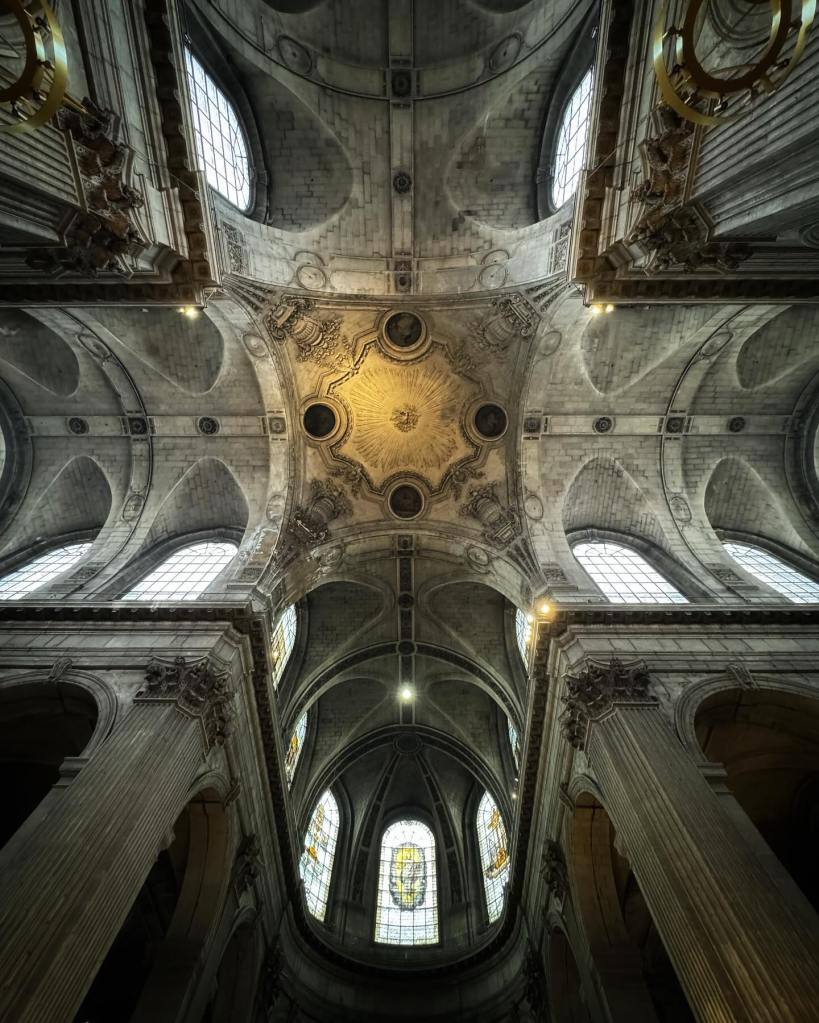
Église Saint-Sulpice, the third-largest church in Paris, dates back to the 12th century. Its construction began in 1646 and spanned 224 years, resulting in a distinctive and unusual design. This extended construction period led to a blend of Baroque and Neoclassical elements, with contributions from multiple architects, each adding their own touch.
The initial design by Christophe Gamard started in 1636, but only the Lady Chapel was completed by 1660 due to the disruptions of the Fronde. Daniel Gittard took over in 1660, contributing significantly to the sanctuary, ambulatory, apsidal chapels, transept, and north portal. Gilles-Marie Oppenord and Giovanni Servandoni resumed work from 1719 to 1745, focusing on the nave and side chapels and implementing unique design elements such as the north and south transept portals with concave walls and Corinthian columns. Italian architect Giovanni Niccolò Servandoni also designed the west façade, inspired by Christopher Wren’s Saint Paul’s Cathedral in London.
Servandoni’s design was continued after he died in 1766 by Oudot de Maclaurin, who erected the twin towers. Jean Chalgrin later rebuilt the north tower between 1777 and 1780, giving it a more neoclassical style. He also redesigned the monumental organ case. This case originally contained an instrument built in 1781 by Henry Clicquot (1732-1790), one of the best organ builders in history. During the 19th century, Aristide Cavaillé-Coll constructed a new instrument that conserved much of the previous organ and is considered one of Europe’s best organs.
The French Revolution interrupted plans to rebuild the south tower, leaving it unfinished. In the 19th century, particularly in the 1850s, the church received unique decorative elements, with major contributions by Eugène Delacroix.