Saint-Nicolas-des-Champs, 254 Rue Saint-Martin, Paris
At the edge of the old priory of Saint-Martin-des-Champs, the parish church of Saint-Nicolas-des-Champs offers a rare opportunity to trace the layered history of Parisian sacred architecture across four centuries. Rather than replacing one style with another, each generation built on what was already present, producing a structure where Gothic endurance, Renaissance enrichment, and Baroque restraint coexist in deliberate tension. This balance between inheritance and innovation lies at the heart of the French approach to architectural transformation.
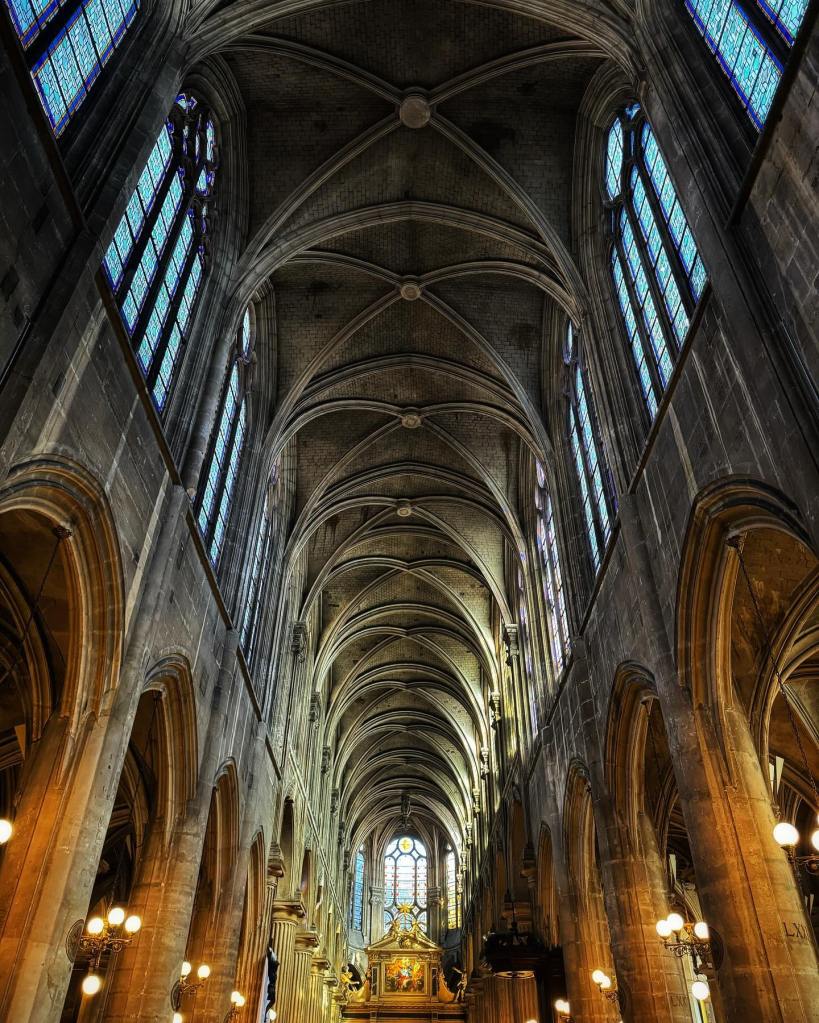
The medieval foundations are visible in the Flamboyant Gothic fabric of the west front and nave, constructed between about 1420 and 1480, whose soaring verticals and elaborate tracery still govern the church’s spatial character. Far from being demolished or suppressed, these Gothic elements remained the framework for later interventions. Their survival illustrates the continuity of medieval forms in French religious architecture, even at a moment when new ideas from Italy were beginning to influence Paris.
Renaissance entered the building most clearly with the south portal of 1576–1586, which adopts the triumphal arch vocabulary popularised in France by Philibert Delorme (1514–1570). This portal does not overwhelm the Gothic body but overlays it with measured classical articulation, showing how Paris absorbed Italian motifs through a filter of restraint. Recent restoration in 2020–2021 has revealed its finely cut stonework and clarified its role as a marker of late sixteenth-century civic pride as much as liturgical use.
The decisive transformation came in the early seventeenth century, when the high altar and surrounding chapels were conceived as a unified cycle of sacred imagery. The monumental altar screen, associated with Clément II Métezeau (c.1581–1652), is crowned by two canvases by Simon Vouet (1590–1649), The Apostles at the Tomb of the Virgin and The Assumption of the Virgin, both dated 1629. The ensemble, flanked by four kneeling angels sculpted by Jacques Sarazin (1592–1660), remains one of the very few complete Parisian high altars of this scale to survive the Revolution. Its purpose was not theatrical effect, as in Rome, but clarity and doctrinal emphasis, reflecting the preference of Henri IV (1553–1610) and Louis XIII (1601–1643) for sober magnificence and persuasive order that defines restrained, classicising Baroque in Paris.
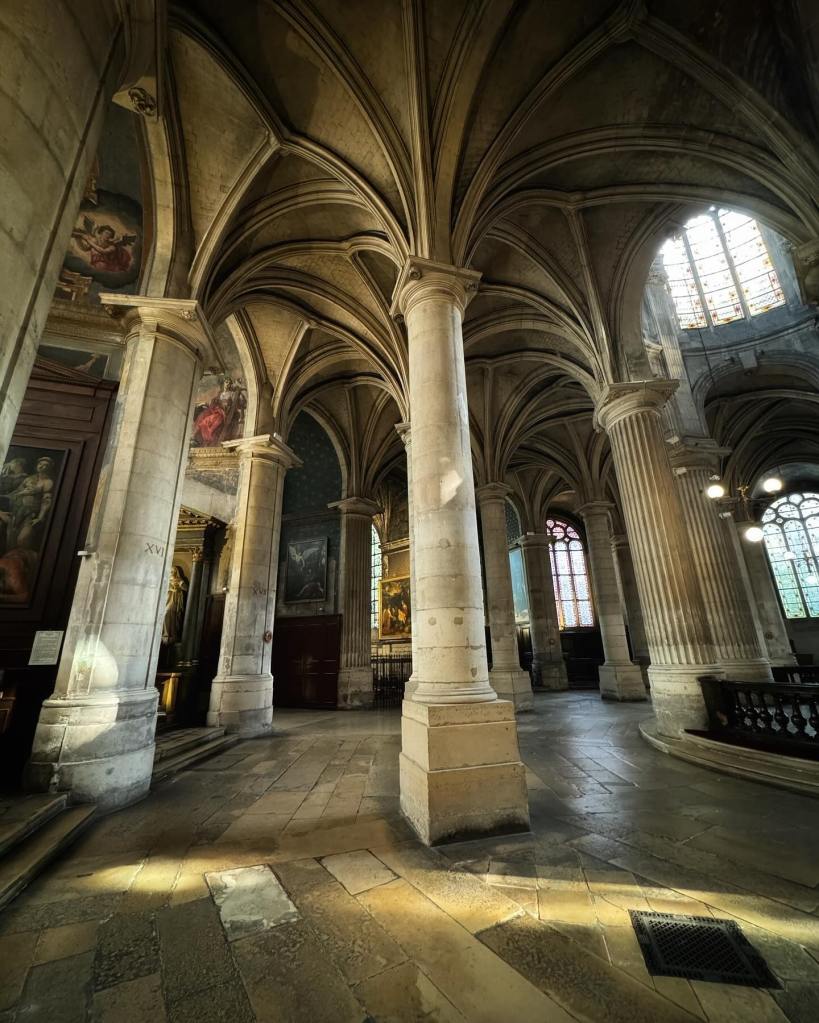
Around the same period, individual chapels were adorned with paintings that collectively form one of the richest decorative programmes in Paris. The chapel of Méry de Vic (d.1622), Keeper of the Seals, was furnished with Frans Pourbus the Younger’s (1569–1622) La Vierge de la famille de Vic (c.1617–1621), a work that combines Flemish precision with monumental French portraiture. Above, Georges Lallemant (c.1575–1636) frescoed an Assumption of the Virgin between about 1618 and 1622, creating a thematic ascent that leads the viewer’s eye toward Vouet’s great altar. In nearby chapels, Quentin Varin (c.1575–1634) produced La Chute des anges rebelles (1623), while Michel Corneille the Elder (1601–1664) added a Resurrection fresco in the mid-1640s, rediscovered and restored in 2010–2011. These works reflect the assimilation of Italianate composition and Flemish naturalism into a distinctly Parisian idiom.
Music and furnishing also testify to the church’s continuous enrichment. Organs are recorded from 1418, and a significant new instrument by Jacques Pigache was built in 1571. The seventeenth century saw further enlargement under Crépin Carlier (c.1567–1636) and the construction of a grand case by Guillaume Noyer in the 1630s, followed by later interventions by François-Henri Clicquot (1732–1790) and John Abbey (1785–1859). Despite modernisation in the mid-twentieth century, the instrument remains one of the most historically valuable organs in Paris, maintaining its layered character much like the church itself.

References
Dargaud, M. (1975) L’église Saint-Nicolas-des-Champs à Paris: étude historique et archéologique. Thèse d’École des chartes. Paris: Archives nationales, cote AB XXVIII 617. Available at: https://bibnum.chartes.psl.eu/s/thenca/item/47711 (Accessed: 15 April 2024).
Gray-Durant, D. (2015) Blue Guide Paris. 12th edn. London: Somerset Books