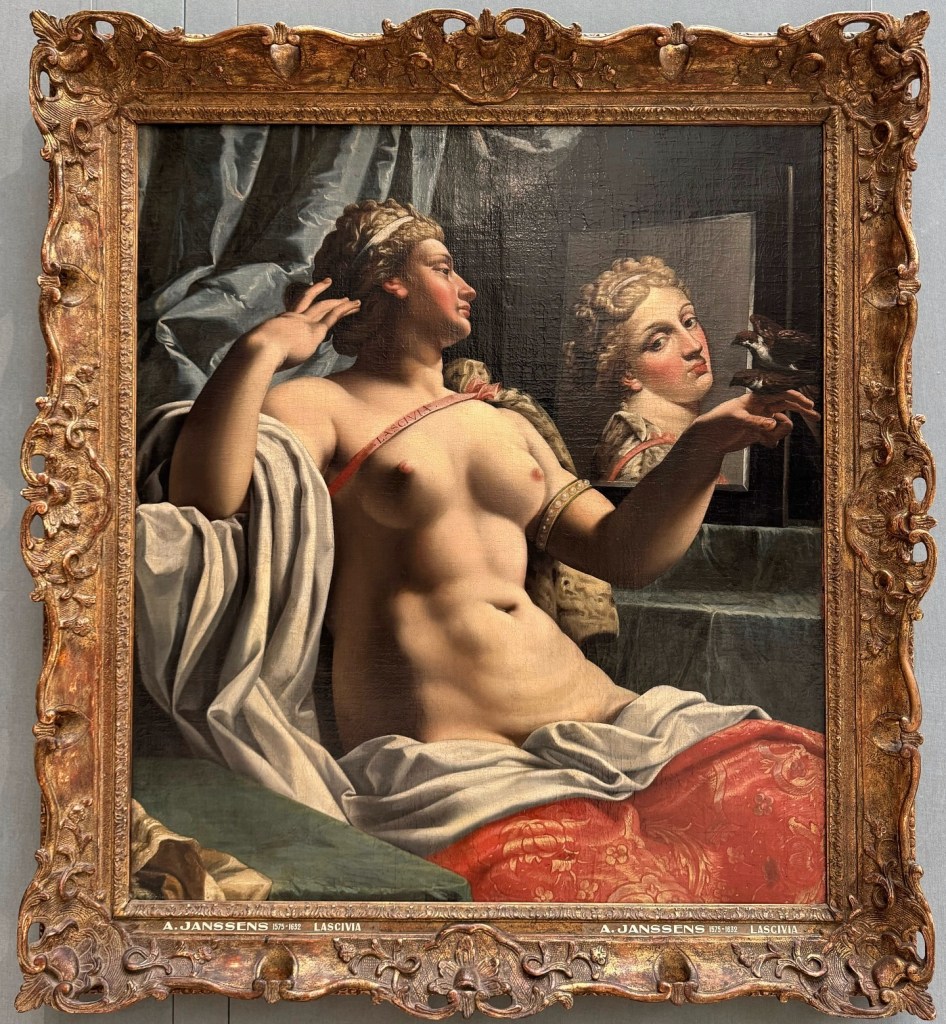
Abraham Janssens van Nuyssen ( c.1573- 1632), Lascivia, Oil on canvas, 107,5 cm x 97 cm, Musées royaux des Beaux-Arts, Brussels
Abraham Janssens van Nuyssen, also known as Abraham Janssens, exhibited a remarkable evolution in his artistic style throughout his career. Janssens initially embraced Netherlandish Mannerism, characterised by elaborate compositions and artificial elegance. Around 1610, after his return from Rome, his work began to reflect the dramatic realism and strong chiaroscuro of Caravaggesque influence, inspired by the works of Caravaggio. Later in his career, Janssens adopted more classicist trends, influenced by the Bolognese school, particularly the works of Carracci and Domenichino. Towards the end of his life, his style also showed the influence of Rubens, evident in the dynamism and richness of his compositions.
Lascivia is a painting that exemplifies Janssens’ mature adeptness at blending classicist trends. It depicts a young woman gazing at her reflection in a mirror, a timeless symbol of human vanity. This motif underscores the contemplation of her beauty and youth and invites the viewer to partake in her self-admiration. The title ‘Lascivia’ directly points to themes of sensual desire and lust, aligning the young woman with allegorical figures such as Venus or literary characters like the nymph Salmacis from Ovid’s ‘Metamorphoses’. These interpretations highlight the transient nature of beauty and the folly inherent in self-indulgence.
The painting is likely the first version of this composition, which Janssens later revisited, adding more intricate still-life elements and refined details to enhance the overall narrative and aesthetic complexity.
The provenance of ‘Lascivia’ is fascinating. Sold in 1941, it passed through several owners, including the infamous Hermann Göring, before being recovered by the American Monuments Men in 1945. Having survived the turmoil of World War II, the painting was eventually returned to Belgium and is now housed in the Musées royaux des Beaux-Arts in Brussels.