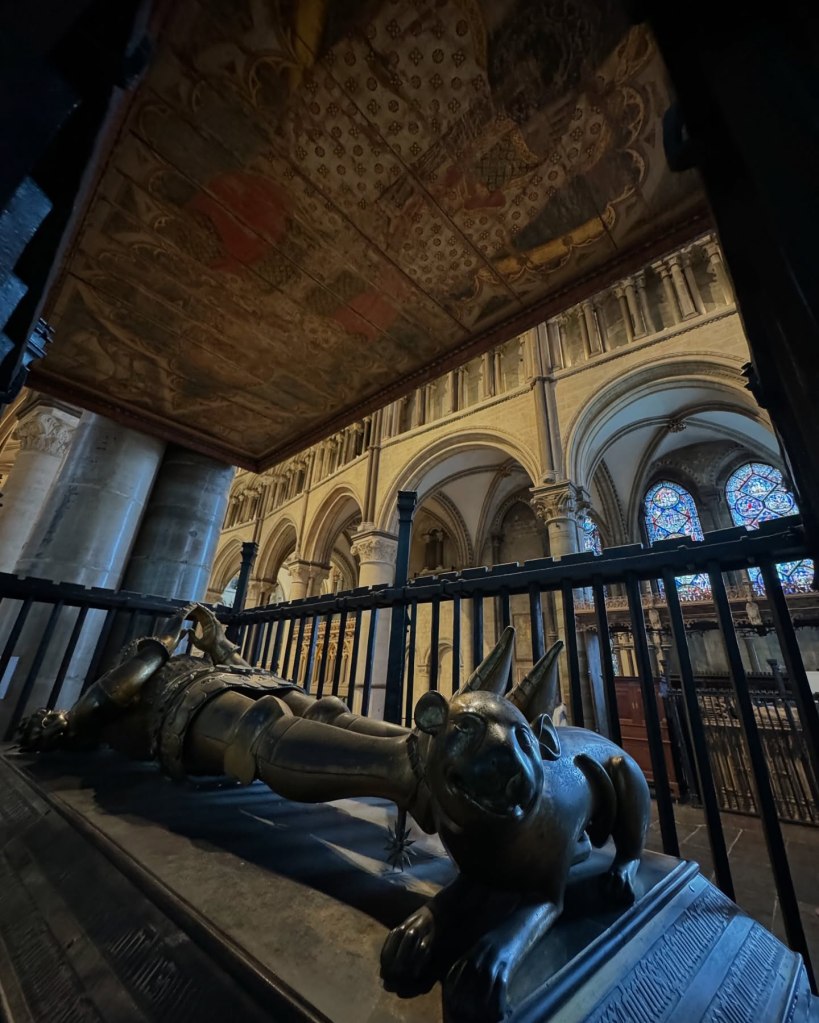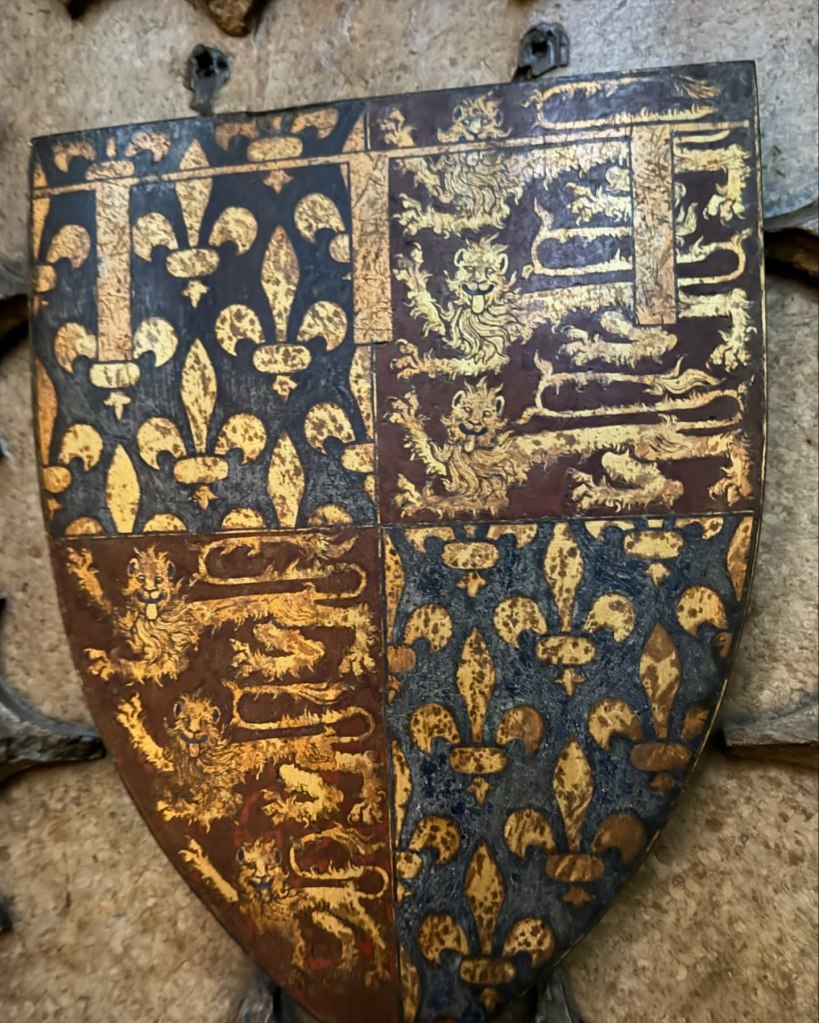
Circle of Henry Yevele (c. 1320–1400), The tomb of Edward of Woodstock, aka ‘the Black Prince,’ the mid-1380s, Canterbury Cathedral
Edward of Woodstock, remembered as the Black Prince, was the most celebrated English warrior of the fourteenth century. Born in 1330, the eldest son of Edward III (1312–1377) and Philippa of Hainault (1310–1369), his reputation was forged in the opening campaigns of the Hundred Years’ War. At Crécy in 1346, aged just sixteen, he commanded one of the English divisions and fought under relentless pressure until the French army collapsed before longbow fire. The victory opened the way to the siege of Calais, where Edward again distinguished himself during the eleven-month blockade that gave England its strongest continental foothold. In 1350 he fought at sea in the battle of Winchelsea, when his ship was rammed by Castilian allies of France; badly damaged, it nearly sank, but Edward fought on in brutal hand-to-hand combat. His greatest triumph came at Poitiers in 1356, where his chevauchée through Aquitaine forced King John II of France into battle. Edward captured the king, secured immense ransom payments, and compelled the Treaty of Brétigny. These victories made him the embodiment of English chivalry, though in later life illness left him bedridden, and he died in 1376 at the age of forty-five.
In his will Edward asked for a marble tomb with a gilt brass effigy showing him fully armed, his coat of arms displayed, his face visible beneath a helm with leopard crest, and his achievements suspended above. The monument at Canterbury Cathedral delivers on these instructions, but it was not built straight away. Technical and documentary evidence shows it was constructed in the mid-1380s under Richard II (1367–1400), alongside the effigy of Edward III at Westminster. Metallurgical tests confirm that both effigies share the same alloy composition, pointing to a single London workshop, likely linked with Henry Yevele’s circle. This deliberate pairing was no accident: it monumentalised father and son together, reinforcing Richard II’s dynastic legitimacy at a politically uncertain moment.
The effigy is a remarkable survival. Only six large-scale cast metal effigies from medieval England remain, and this is the only one to show a knight in full plate armour. Endoscopic inspection has revealed it is hollow, made from multiple sections joined with pins and bolts cleverly hidden beneath the armour’s natural seams. The precision of the casting shows the hand of armourers as well as founders, since the rivets, plates, and edging reproduce Edward’s actual harness. His surviving achievements — gauntlets, sword, shield, helm, maintenance cap, and heraldic jupon — confirm the link. The jupon has been reconstructed from its textile structure and quilting, while the helm shows the scars of use in battle. The effigy’s likeness is therefore not only facial, possibly taken from a death mask, but technological, a careful translation of the prince’s real war-gear into metal.
The tomb is built of Purbeck marble, while the effigy is gilded latten that once shone brilliantly in the choir’s light. Above, a painted timber tester canopy shows the Holy Trinity surrounded by the Evangelists, imagery that matched Edward’s Trinitarian devotion recorded in his will. Conservation has identified traces of vivid pigments — vermilion and organic lakes — proving that the canopy once carried the same strong colours used in Westminster painting of the 1380s. The imagery bound the monument to liturgical devotion while also serving Richard II’s wider use of sacred motifs in royal self-presentation.