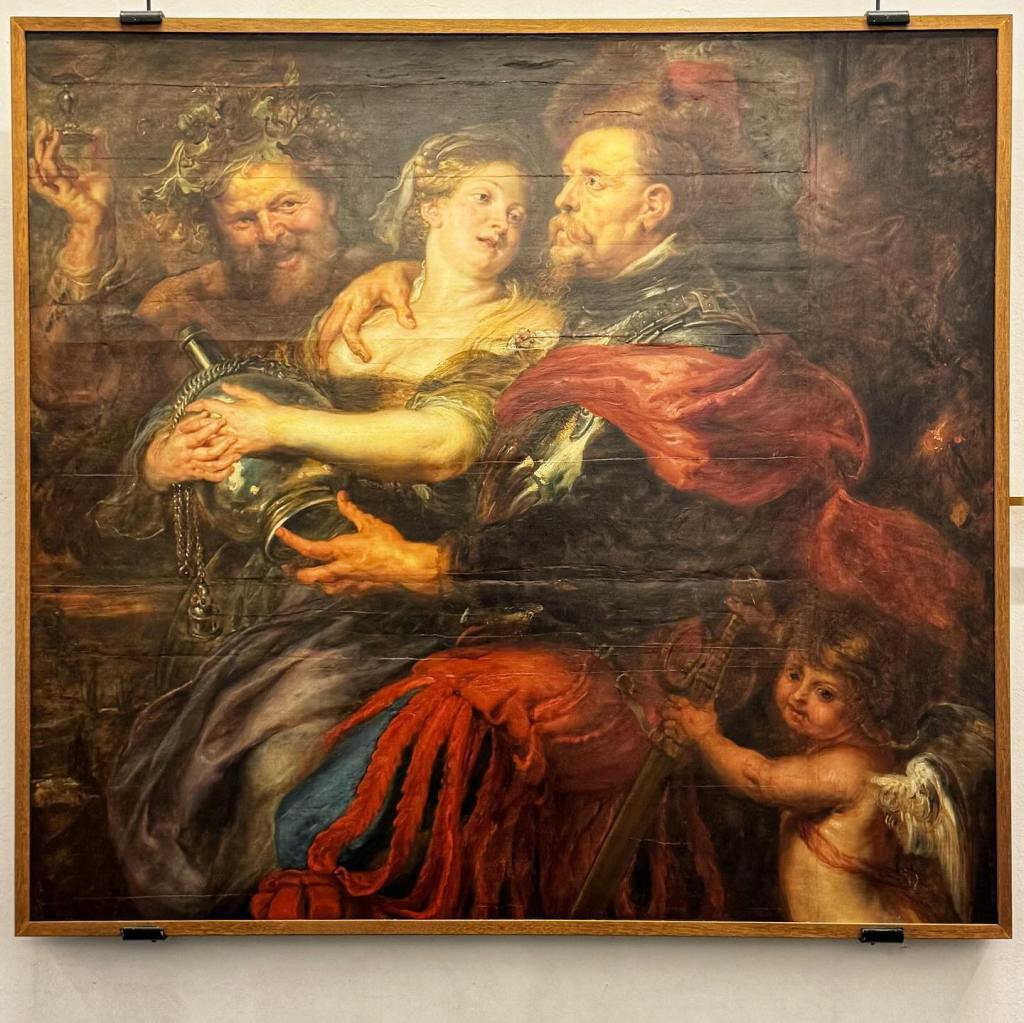
Peter Paul Rubens (1577 – 1640), Venus and Mars, Oil on panel, 133 x 142 cm, Palazzo Bianco, Genoa

Rubens was born in Siegen, Westphalia, in 1577, which is not where anyone expected the greatest Flemish painter of the seventeenth century to come from. His father, Jan Rubens (1530–1587), was an Antwerp lawyer who had fled the city in 1568 with his family when the Duke of Alba’s campaign against Protestants in the Spanish Netherlands made staying dangerous. Jan had converted to Calvinism in Antwerp, where a large part of the city’s bourgeoisie and professional class had aligned with the Reformation in the years before Alba’s crackdown, and this made him a marked man. He settled in Cologne with his wife Maria Pypelincks (1538–1608) and their children [the religious position of Maria is more complex than the standard account allows: she appears to have remained privately Catholic throughout the Cologne years, concealing her faith during her husband’s lifetime — the Catholic Encyclopedia records that she ‘had continued a Catholic, although she temporarily concealed the fact during her aggressive husband’s life’ and that she ‘formally received back into the Catholic Church immediately upon the death of the elder Rubens’ ; it was she who insisted on Peter Paul’s education at a Jesuit school even in Cologne, and the family’s return to Catholicism after 1587 was thus less a conversion than a public return to a faith that had never entirely been abandoned].
In Cologne, Jan found work as a lawyer among the city’s large refugee community. In 1570 he became legal adviser to Anna of Saxony (1544–1577), the troubled second wife of William the Silent (1533–1584), and subsequently her lover. When the affair produced a pregnancy in 1571, Jan was arrested and imprisoned in Dillenburg Castle, facing possible execution. Maria, who had known nothing, wrote so persistently to his captors that she secured his release after two years, on payment of a bail bond of 6,000 thalers. He was forbidden to practice law and required to remain in Siegen under supervision. It was in this household — a disgraced lawyer under house arrest in a Westphalian town, the family finances shattered — that Peter Paul was born. The family returned to Cologne in 1578, where Jan died in 1587. Two years later, Maria brought her remaining children back to Antwerp, and Peter Paul grew up in the city as a Catholic. She had done her best to bury the Siegen years. He almost never spoke of them.
By the time this Genoa panel was being painted, between 1632 and 1635, the Thirty Years War I. Europe had been under way for fourteen years and was entering its most destructive phase. The conflict had not begun as a simple confrontation between armies: it had accumulated in stages, each one drawing in new powers and re-framing what the war was actually about, until what had started as a Bohemian constitutional dispute had become a general European catastrophe.
The trigger in 1618 was political as much as religious. The Defenestration of Prague — Protestant Bohemian nobles throwing two Catholic Habsburg governors from a castle window in May 1618 — was a piece of theatrical provocation that expressed deeper grievances: the Bohemian estates feared that the new Habsburg king, the ardently Catholic Ferdinand of Styria (1578–1637), would undo the religious compromises they had held since the Peace of Augsburg in 1555. The Bohemian revolt was crushed decisively at the Battle of White Mountain in November 1620, and Ferdinand, now Emperor Ferdinand II, re-Catholicised Bohemia by force. That alone might have ended matters. It did not, because the Habsburgs pressed their advantage, the Edict of Restitution of 1629 demanding the return of all Protestant church properties seized since 1552, which radicalised Protestant resistance across the Empire and brought in new belligerents.
Denmark entered the war in 1625 under Christian IV (1577–1648), hoping to protect Protestant interests and extend Danish influence southward; his armies were routed, and he withdrew under the Treaty of Lübeck in 1629, having gained nothing and lost much. Sweden entered in 1630 under Gustavus Adolphus (1594–1632), whose motivations mixed Protestant solidarity with geopolitical ambition: Swedish control of the Baltic coast required influence over northern Germany. The Battle of Breitenfeld in September 1631 — the first significant Protestant victory after thirteen years of largely Catholic advances — temporarily shifted the balance. Then, at Lützen in November 1632, Gustavus Adolphus was killed in the fighting, which robbed the Protestant coalition of its most effective commander at the moment of apparent ascendancy. The Peace of Prague in 1635 brought the German civil-war aspect to a nominal close, but the conflict continued because France, Spain, and Sweden all had interests that overrode any settlement the German princes could reach. What had begun as a religious war had become a dynastic and territorial one.
The human consequences were concentrated in the German lands, which served as the primary battleground throughout. The sack of Magdeburg in May 1631 — in which Imperial and Catholic League forces under Tilly killed the great majority of the city’s population, estimated at between twenty and twenty-five thousand dead — was understood across Europe as a demonstration of what the war had become. Armies lived off the land, which meant systematically stripping territories of food and supplies; famine and disease followed; entire regions were depopulated. By the Peace of Westphalia in 1648, the German-speaking lands had lost between a quarter and a third of their population, some regions considerably more. Rubens was watching all of this, reading reports, and writing about it.
Rubens had been working as a diplomat and he was under no illusions about what that work had and had not achieved. From 1626 to 1628 he corresponded weekly with the French scholar Pierre Dupuy (1582–1651), Keeper of the Royal Library in Paris, and these letters are among the frankest documents he left. They discuss the war across Europe in a tone of increasing frustration. In August 1628, writing about Spanish trade policy, he observed that the losses fell not on the enemy but on the king’s own subjects: the friends perished while the foes endured. Between 1629 and 1630 he was in London as the personal envoy of Philip IV of Spain (1605–1665), brokering an Anglo-Spanish peace that had eluded both powers for five years. He succeeded, and was knighted by both Charles I (1600–1649) and Philip IV for his trouble. He returned to Antwerp in 1630, married the sixteen-year-old Helena Fourment (1614–1673), bought the Château de Steen in 1635, and began withdrawing from the diplomatic world he had come to find exhausting without resolution. The Genoa panels were painted across that transition: after London, during the Swedish phase of the war, as the Edict of Restitution was radicalising German Protestantism and the sack of Magdeburg was still recent. He was not painting in a vacuum.
The official catalogue entry for the Genoa painting, at the Musei di Strada Nuova, acknowledges some uncertainty in the title itself: the work is listed as Venus and Mars / Allegory of Intemperance, and recent scholarship has questioned whether the identification of the principal figures as the god of war and the goddess of love is as settled as older readings assumed. The alternative reading — a soldier seduced from duty by pleasure and wine, with destruction gathering in the background — is less mythologically specific but arguably more precise as a moral argument. Both readings are defensible, and they are not mutually exclusive; the painting’s power lies partly in its refusal to fix itself in one register.
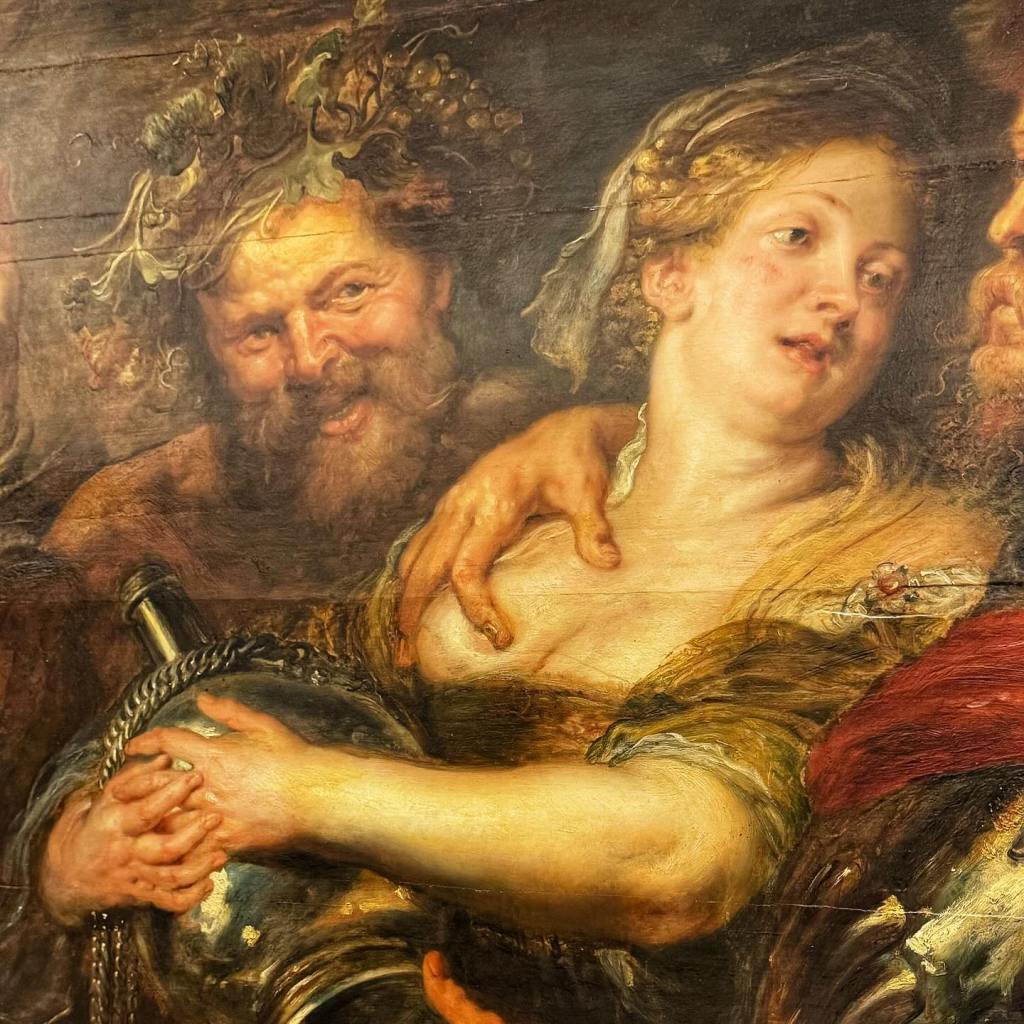
What is settled is the distinctly contemporary note that Rubens sounds in how he has painted Mars. The god of war wears the costume of a Landsknecht, the German mercenary infantryman: immediately legible to any viewer in 1632–5 as a figure drawn directly from the ongoing catastrophe in central Europe, not from classical antiquity. The museum’s research has established that the face of Mars was not, as the old Brignole-Sale family inventories romantically claimed, a self-portrait of the artist, but reproduces with considerable precision the physiognomy of a member of the Antwerp patrician Van den Wijngaerd family, whom Rubens painted on at least two other occasions. Venus’s face was similarly attributed in those inventories to Helena Fourment; this is now rejected.
The foreground figures are built in the Titianesque manner Rubens had absorbed in Venice and through decades of copying: luminous, sensuous impasto, the surfaces worked to make skin seem to generate its own light. The Fury breaking from the shadows at the right is painted entirely differently — rapid strokes of brown and black applied directly onto the reddish-brown preparation layer, with none of the foreground’s careful richness. Pleasure is rendered with all the attention of seduction; destruction is barely a sketch, arriving too quickly to properly see, which is the point. The burning, depopulated landscape at the left completes the sequence. Bacchus, offering wine from a silver cup, adds an intemperance that is neither simply erotic nor simply martial: it is the stupefaction of a man who has stopped being able to think about what he is doing.
The painting belongs to a sequence of allegories on war and peace that preoccupied Rubens in the 1630s. Minerva Protects Pax from Mars (1629–30, National Gallery, London), painted during the London diplomatic mission and given to Charles I as a gift and argument, is optimistic; it still believes peace is possible. The Consequences of War (1637–8, Palazzo Pitti, Florence), made for Ferdinand II de’ Medici (1610–1670) after Rubens had retired from diplomacy, is much darker. In a letter of 12 March 1638 to the painter Justus Sustermans (1597–1681), Rubens described the later work with unusual directness, explaining each figure in terms that left no ambiguity about what he understood the war to be doing to Europe. The Genoa panel sits between these two, painted as the peace Rubens had helped negotiate was collapsing under the Swedish phase of the conflict. The seduced soldier looking away from his sword is, from that vantage, not a moral fable but something closer to a portrait of the present.
References
Chmelinová, K. (2014) ‘On the Consequences of War by Peter Paul Rubens’, Quart, 31/1, pp. 24–38. Available at: https://www.academia.edu/33988746 (Accessed: 1 October 2024).
Jaffé, M. (1989) Rubens: Catalogue Complet. Milan: Rizzoli
Büttner, N. (2018) Allegories and Subjects from Literature. Corpus Rubenianum Ludwig Burchard, Part XII. 2 vols. London: Harvey Miller Publishers, an imprint of Brepols Publishers
Magurn, R.S. (ed.) (1955) The Letters of Peter Paul Rubens. Cambridge, MA: Harvard University Press
Beller, E.A. (1940) Propaganda in Germany during the Thirty Years War. London and Princeton: Princeton University Press
Duerloo, L. and Smuts, M. (eds.) (2016) The Age of Rubens: Diplomacy, Dynastic Politics and the Visual Arts in Early Seventeenth-Century Europe. Turnhout: Brepols
Musei di Strada Nuova, Palazzo Bianco (n.d.) Pieter Paul Rubens, Venus and Mars / Allegory of Intemperance, c. 1632–5, inv. PB 160. Genoa: Musei di Genova. Available at: https://www.museidigenova.it/en/pieter-paul-rubens-venus-and-mars (Accessed: 1 October 2024).
McGrath, E., Martin, G., Healy, F., Schepers, B., Van de Velde, C. and De Clippel, K. (2013) Mythological Subjects: Achilles to the Graces. Corpus Rubenianum Ludwig Burchard, Part XI(1). 2 vols. London: Harvey Miller Publishers, an imprint of Brepols Publishers
McGrath, E., Martin, G. et al. (2022) Mythological Subjects: Hercules to Olympus. Corpus Rubenianum Ludwig Burchard, Part XI(2). London: Harvey Miller Publishers, an imprint of Brepols Publishers
Wilson, P.H. (2009) The Thirty Years War: Europe’s Tragedy. Cambridge, MA: Belknap Press of Harvard University Press
Lamster, M. (2011) Master of Shadows: The Secret Diplomatic Career of the Painter Peter Paul Rubens. New York: Doubleday
White, C. (1987) Peter Paul Rubens: Man and Artist. New Haven and London: Yale University Press