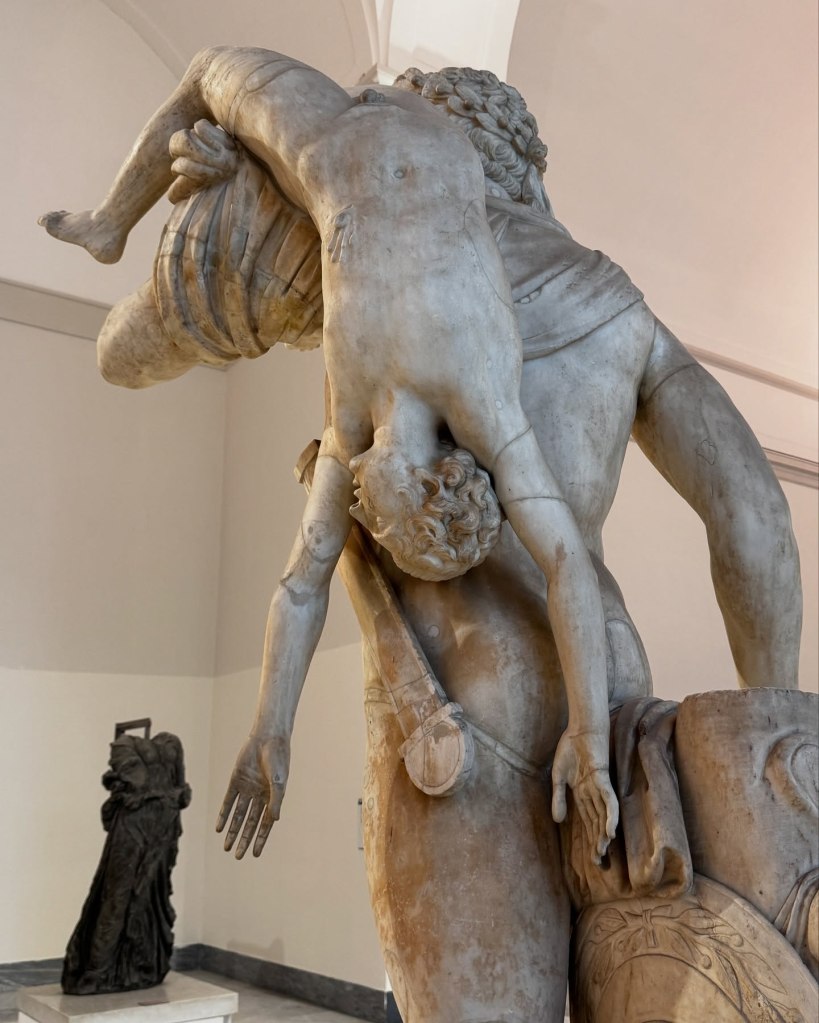
Roman School, 2nd or early 3rd century AD, The Neoptolemus and Astyanax (or Achilles and Troilus), Marble sculpture, Height 287 cm, Naples, Museo Archeologico Nazionale, Naples

The colossal statue vividly depicts a brutal episode from Greek mythology: Neoptolemus, the son of Achilles, hurling Astyanax, the infant son of Hector and Andromache, from the walls of Troy. According to Homer, Euripides, Seneca and Ovidius, Neoptolemus justified his actions by declaring, ‘Since my father killed his father, he might try to avenge the death. He could also become King of Troy, and we want no more kings of Troy!’
Astyanax’s tragic death during the fall of Troy is a recurring theme in classical literature. While Ovid’s ‘Metamorphoses’ explicitly recounts his fate, other authors mention him briefly or present alternative versions of the legend. A related iconographic theme, offering an alternative reading of the sculpture, is the story of Achilles ambushing and killing the Trojan prince Troilus. This scene is tied to a prophecy that foretold Troy’s inevitable destruction if Troilus were to reach adulthood.
The sculpture conveys the intensity of this moment through its dynamic composition. Neoptolemus is depicted with taut, muscular tension and an expression of ruthless determination, while the child’s helplessness heightens the horror of the act. The Roman adaptation of this myth likely draws from a now-lost Hellenistic prototype, reflecting that era’s dramatic storytelling and emotional realism.
Discovered in the mid-16th century at the Baths of Caracalla, the statue was found in fragments and underwent extensive restoration. A portrait head of Emperor Commodus was added to the central figure, recontextualising it to glorify imperial authority, while additional reconstructed limbs further altered its original narrative. Created to evoke both the grandeur of myth and the might of Rome, the statue later became a symbol of Renaissance fascination with antiquity when incorporated into the Farnese Collection. Its enduring legacy lies in its dramatic portrayal of mythological violence and its complex history of reinterpretation.