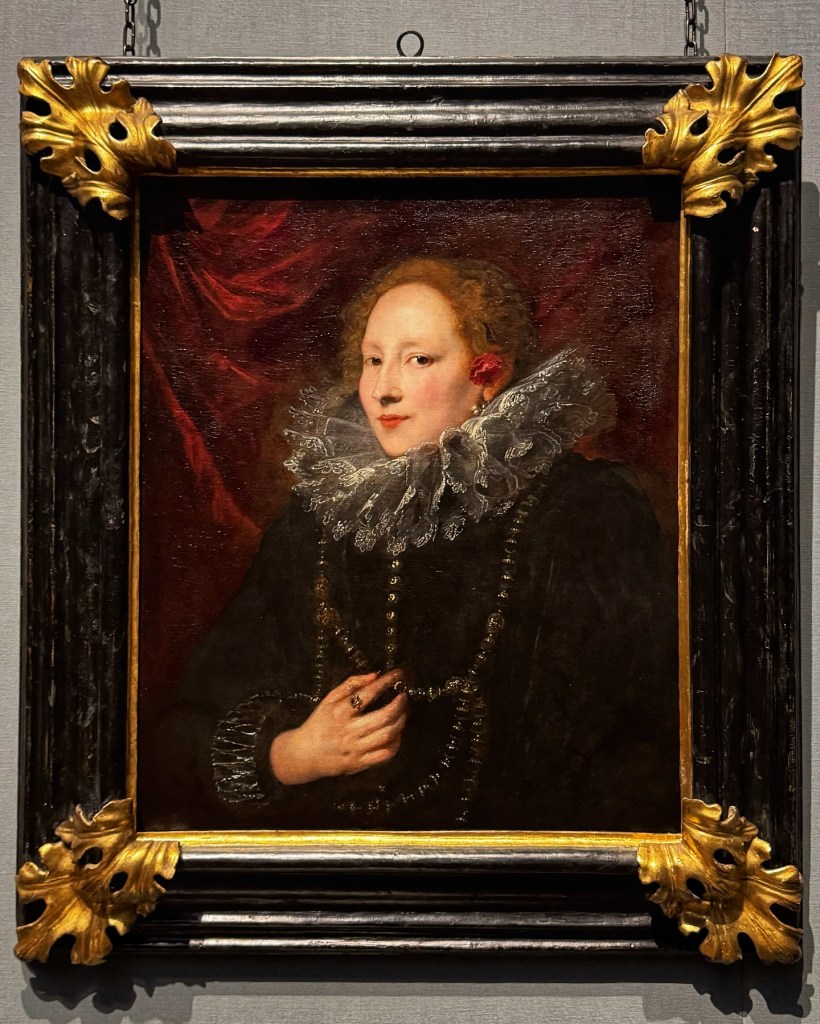
Antoon van Dyck (1599–1641), Portrait of a Woman, possibly Isabella Cattaneo Della Volta Imperiale, c. 1625–27, Oil on canvas, 74 × 60.4 cm, The National Gallery, London

Van Dyck arrived in Genoa in 1621, already highly regarded in Antwerp but still forging a personal style. While he had briefly worked in the studio of Peter Paul Rubens, Van Dyck was never his pupil in the traditional sense. Rather than continuing in Rubens’s monumental, Flemish Baroque mode, he absorbed the legacy of Titian and other Venetian Renaissance masters. In Genoa, he refined his style marked by luminous colour, elegant restraint, and psychological sensitivity. Genoa’s merchant aristocracy, with their taste for opulence tempered by self-discipline, responded to this approach with enthusiasm. Van Dyck’s portraits offered them not only likeness, but a sense of elevated timelessness, aligning them with romanticism of imperial Rome and the aristocratic refinement of Renaissance Venice.
The sitter has been identified as Isabella Cattaneo Della Volta Imperiale, who married Francesco Imperiale di Nicolò in 1619. The Cattaneo and Imperiale families were among Van Dyck’s most influential patrons. Their commissions placed him at the centre of Genoa’s sophisticated culture. Her depiction—youthful, assured, and adorned with understated elegance—is an emblem of the values that sustained Genoa’s elite: lineage, wealth, discretion, and taste.
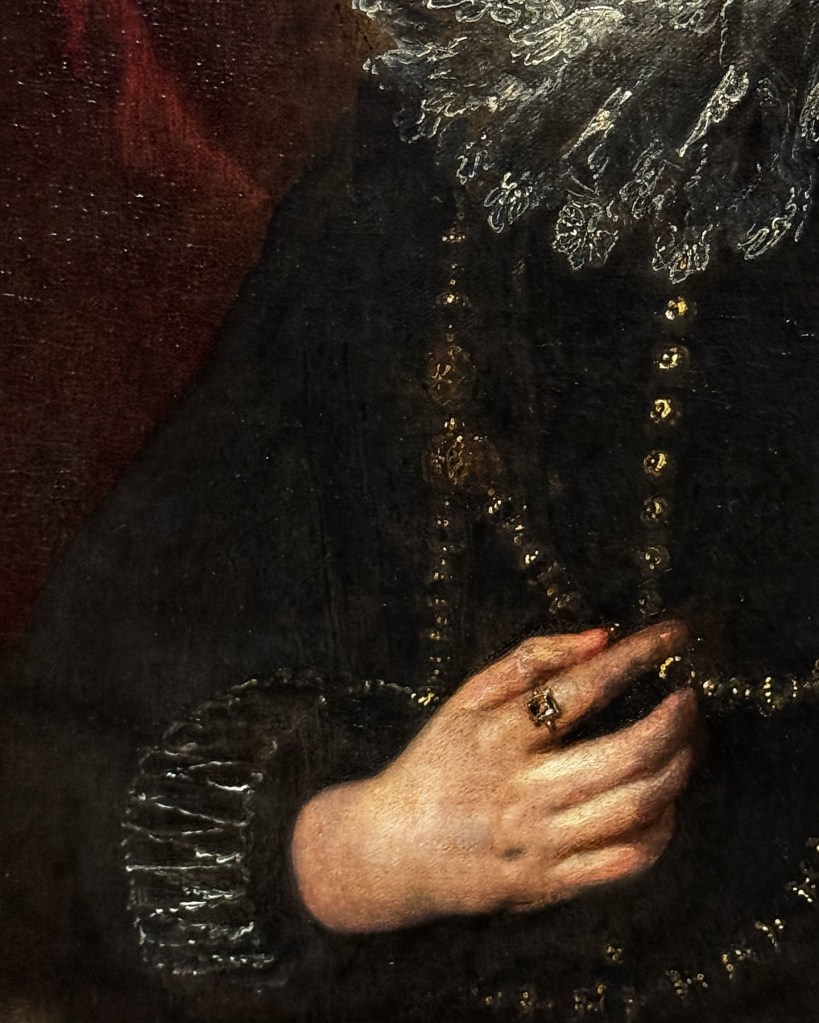
Framed by a deep red curtain, the figure is rendered with exquisite naturalism. Her auburn hair and soft gaze are warmed by the background, while her hand gestures towards a gold necklace-perhaps an allusion to her family name, Cattaneo, recalling ‘catena’, the Italian for chain. A rose behind her ear subtly suggests her married status. Although the condition of the painting has compromised the visibility of the original metallic embroidery, Van Dyck’s handling of flesh, light, and fabric still conveys the opulence that once defined
References
Barnes, S.J., De Poorter, N., Millar, O. and Vey, H., 2004. Van Dyck: A Complete Catalogue of the Paintings. New Haven and London: Yale University Press.
The National Gallery, London (n.d.) Portrait of a Woman, possibly Isabella Cattaneo Della Volta Imperiale, c. 1625–27. NG2144. Available at: https://www.nationalgallery.org.uk/paintings/anthony-van-dyck-portrait-of-a-woman (Accessed: 18 May 2025).