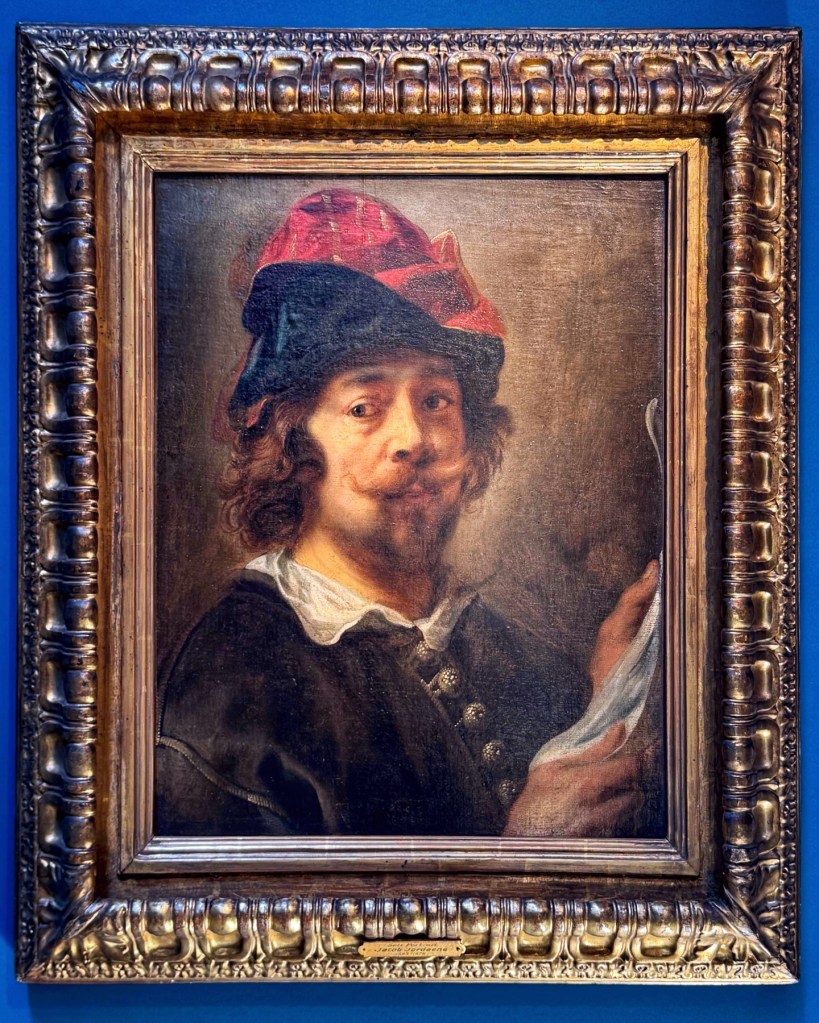
Jacob Jordaens (1593–1678), Portrait of the Artist, Bust-Length, in a Cap, 1640s?, Oil on canvas, 56.2 x 46.7 cm, Christie’s, Old Masters Evening Sale, London, 1 July 2025
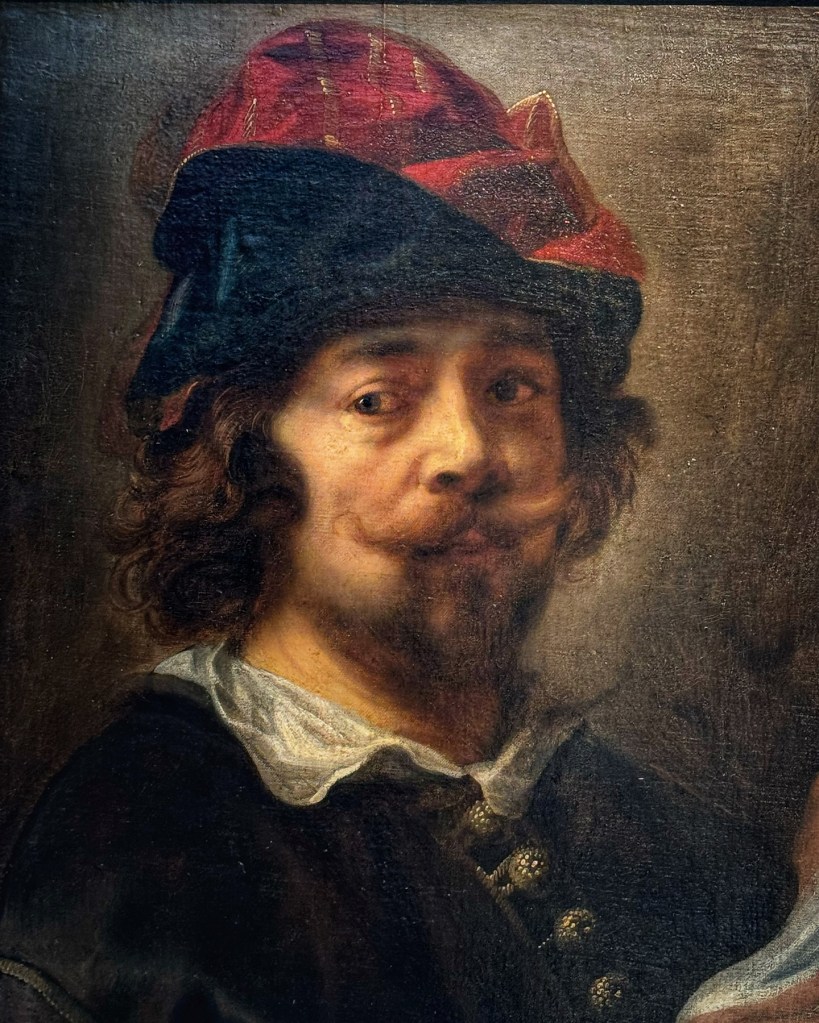
Jacob Jordaens (1593–1678), long overshadowed by Peter Paul Rubens (1577–1640) and Antoon van Dyck (1599–1641), came to occupy an unsual position in seventeenth-century Antwerp. Born in 1593, he trained under the painter Adam van Noort from around 1607, later marrying van Noort’s daughter Catharina in 1616, and registered with the Antwerp Guild of St Luke as a waterschilder in 1615 before eventually rising to become one of its deans . His career unfolded, in other words, within the deeply civic and guild-bound structures of Antwerp’s artistic life, a trajectory quite different from the courtly and internationally mobile careers of his better-known contemporaries. Unlike Rubens, whose self-portraits present a courtly image of diplomatic elegance, or van Dyck, who idealised himself in the manner of the aristocracy he served, Jordaens’s approach to self-portraiture was strikingly grounded.
This self-portrait, most probably painted around 1640, coincides with a crucial moment in his life. Rubens died on 30 May 1640, and van Dyck followed on 9 December 1641, leaving Jordaens to emerge as the most prominent painter in Antwerp and, indeed, in the southern Netherlands more broadly . The commissions that followed confirmed the scale of this inheritance: he was engaged to paint the ceiling decorations of the Huis ten Bosch near The Hague for Amalia van Solms, Princess of Orange, a project carried out between 1648 and 1652 and representing one of the grandest decorative undertakings in the northern Netherlands during the period. Against this backdrop, the self-portrait of around 1640 reveals not the hauteur of a court painter, but a quietly self-assured artist at the height of his powers, prosperous yet dignified and humble.
What sets Jordaens apart is the naturalism of his likeness and the way he rejected the overtly romanticised formulas favoured by his contemporaries. Van Dyck, for instance, consciously modelled his image on aristocratic ideals, projecting the painter as a gentleman of refinement, a strategy analysed at length in relation to broader patterns of early modern self-fashioning . Rembrandt (1606–1669), by contrast, engaged in a deeply introspective and often theatrical exploration of the self, filled with pathos and psychological drama, producing over forty self-portraits across his career in what has been described as an unparalleled visual autobiography. Jordaens does neither. His self-image lacks the affectation of status or existential drama. Instead, it presents a man rooted in his family, his workshop, and Antwerp’s bustling civic life, a quality that surfaces with particular clarity in works such as the Self-Portrait with Family of around 1621–22 (Museo del Prado, Madrid), where the domestic and the professional are rendered inseparable.
The image of the artist that emerges is closer to that of a learned artisan than a courtly visionary, a figure shaped by the guild tradition and by the prosperous, mercantile culture of the early modern Low Countries. It is worth noting that Jordaens’s eventual conversion to Calvinism, probably around 1655, adds a further dimension to this self-presentation: his affiliation with a faith that emphasised sobriety and communal life over aristocratic display sits, perhaps, not uncomfortably alongside the unaffected directness of his self-portraits. Perhaps this very realism, this refusal to inflate the myth of the self, has long made Jordaens more difficult to mythologise than Rubens or van Dyck. This is also why his portraits offer a singular counterpoint within the visual tradition of seventeenth-century self-fashioning.
References
d’Hulst, R.-A. (1982) Jacob Jordaens. London: Sotheby Publications
Vlieghe, H. (1998) Flemish Art and Architecture, 1585–1700. New Haven and London: Yale University Press.