
King’s College Chapel, Cambridge, begun under Henry VI (1421–1471) in 1446 and completed in 1547 under Henry VIII (1491–1547), is both a masterpiece of late Perpendicular Gothic and one of the most eloquent monuments of dynastic propaganda in England. Rising during the turbulence of the Wars of the Roses, halted and resumed under successive monarchs, and finally finished by the Tudors, the chapel embodies the intersection of religion, politics, and art in fifteenth- and sixteenth-century England.
Its fabric proclaims continuity across disruption. Henry VI conceived the chapel as the centrepiece of his new foundation, but after his deposition the works stalled. Only with Henry VII (1457–1509) did construction recover momentum, for the Tudor monarch recognised in this vast, unfinished structure a ready-made canvas upon which to project legitimacy. Through financial endowment and a carefully directed decorative programme, Henry VII and Henry VIII transformed the chapel into a dynastic monument. The architecture itself, with its immense proportions and the world’s largest fan vault, was a statement of authority, while its iconography embedded the Tudor myth of providential rule.
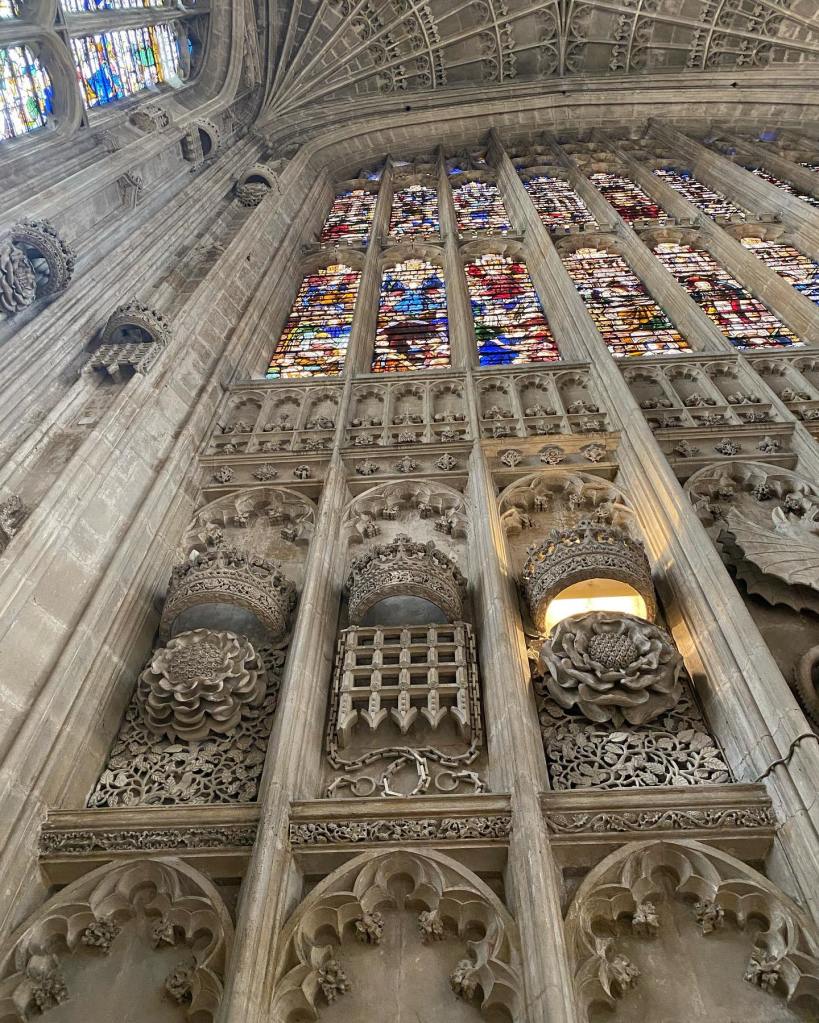
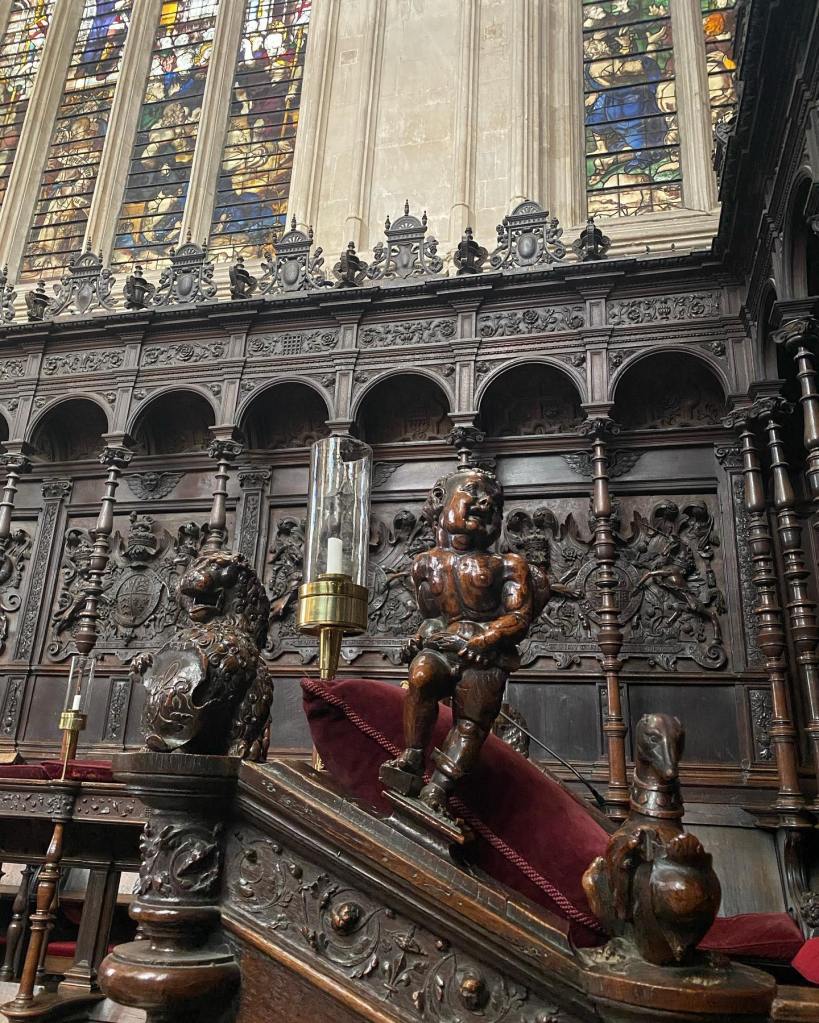
The heraldic scheme remains omnipresent: the crowned Tudor rose, the Beaufort portcullis, the Richmond greyhound, and the Tudor dragon are repeated with almost obsessive regularity. These devices proclaimed the dynasty’s roots in both Yorkist and Lancastrian lines, asserted its descent through Margaret Beaufort, and advertised the stability restored after decades of civil war. Yet heraldry was only one register of meaning.
The chapel’s stained glass, executed between 1515 and 1531, constitutes one of the most ambitious cycles of its age. Each window is organised around paired typologies: Old Testament scenes are juxtaposed with New Testament fulfilments. This exegetical method—reading Hebrew scripture as foreshadowing Christian truth—was conventional in late medieval theology but here acquires a new political charge. Scenes from Genesis, Exodus, and the Prophets are paired with episodes from the life of Christ, presenting salvation history as a continuous, divinely ordered plan.
Within this framework, royal heraldry is interwoven. Margins and tracery lights carry Tudor roses, portcullises, and royal arms, binding the dynasty into the same providential scheme. In effect, just as the Old Testament was fulfilled in the New, so the turmoil of the Wars of the Roses found resolution in the Tudor settlement. The dynasty presented itself as the vessel chosen to bring divine order to a fractured kingdom.
This fusion of scripture and politics is sharpened by the historical context of their completion. The glass was installed under Henry VIII, during the years in which the king’s marital and dynastic anxieties intensified. It is not accidental that windows emphasise genealogies and divine sanction, reinforcing the message that Tudor succession was inscribed into sacred history itself. The visual pairing of prophecy and fulfilment thus doubled as a legitimising allegory for the monarchy.
By the time of its consecration, King’s College Chapel had become something more than the original pious foundation of Henry VI. It was a dynastic theatre in glass and stone, its fan vault and stained cycles announcing both the magnificence of the English monarchy and the providential inevitability of Tudor rule. It remains, even now, one of the most potent survivals of how late medieval and Renaissance art could bind together religion, politics, and propaganda in a single architectural vision.