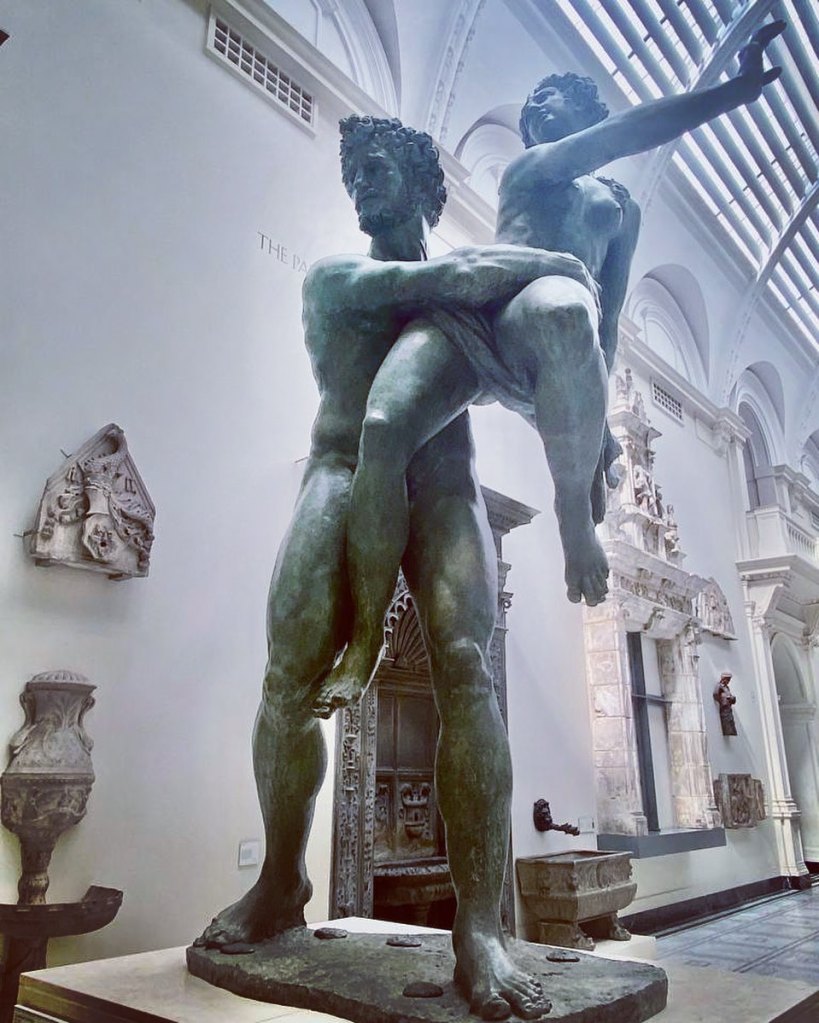
Designed by Vincenzo de’ Rossi (1525–1587) and cast by Raffaello Peri (active 1560s–1570s), Pluto and Proserpina, c.1565, Bronze sculpture, 225.5 × 160.3 × 120.2 cm. The Victoria and Albert Museum, London, on loan from The National Trust, Cliveden House, Buckinghamshire
First owned by Giovan Vittorio Soderini (1527–1597), a leading figure in Florentine garden culture, the bronze illustrates the Renaissance practice of binding mythological statuary to architecture and waterworks. Soderini’s garden projects, often inspired by Roman ruins and classical texts, made him a key intermediary in shaping Florentine taste. In 1594 the bronze was acquired by Antonio Salviati, whose family’s fortunes in banking and politics were closely tied to Medici interests. Installed in the nymphaeum of Villa Salviati, it contributed to a theatrical garden environment where sculpture, water, and grotto architecture created an atmosphere of dynastic magnificence. Such gardens, articulated by terraces, cascades, and statuary, conveyed confidence, wealth, and erudition, and marked a shift towards open display that reflected the relative political stability of late sixteenth-century Florence.
The subject comes from Ovid’s Metamorphoses, showing the abduction of Proserpina after Pluto has been pierced by Cupid’s arrow. The sculptural drama hinges on contrast: Pluto, heavily muscled, thrusts forward with relentless force, while Proserpina twists against him, her arms registering panic and resistance. The imagery captured both the cyclical rhythms of nature—Proserpina’s descent and return marking the seasons—and more immediate themes of passion, violence, and the imbalance of power.
For much of its history the bronze was attributed to Giambologna (1529–1608), whose style of spiralling figures and polished surfaces defined Florentine Mannerist sculpture. Recent scholarship, however, identifies the invention as Vincenzo de’ Rossi’s, with casting by the technically accomplished but little-known Raffaello Peri. De’ Rossi, trained in Florence and connected with Michelangelo’s circle, was active in the Medici court, producing the celebrated cycle of Labours of Hercules for the Palazzo Vecchio. His work, often marked by a robust, even muscular approach to form, stood in deliberate tension with Giambologna’s smoother and more elegant manner. The two sculptors competed directly for Medici patronage in the 1560s and 1570s, their contrasting treatments of myth shaping the visual identity of Florence.
Seen against this background, Pluto and Proserpina is not only an expressive narrative group but also a statement of artistic rivalry. Where Giambologna’s compositions often glide into elegant helices, de’ Rossi’s work confronts the viewer with mass and muscularity. The placement of such a bronze in a garden setting intensified its rhetorical power: visitors encountered not just a mythological story in metal, but a sculptural claim for artistic authority within a culture that measured itself against both antiquity and contemporary competition. The circulation of works like this through Florentine and later European collections made them touchstones in the evolving dialogue between art, mythology, and landscape.