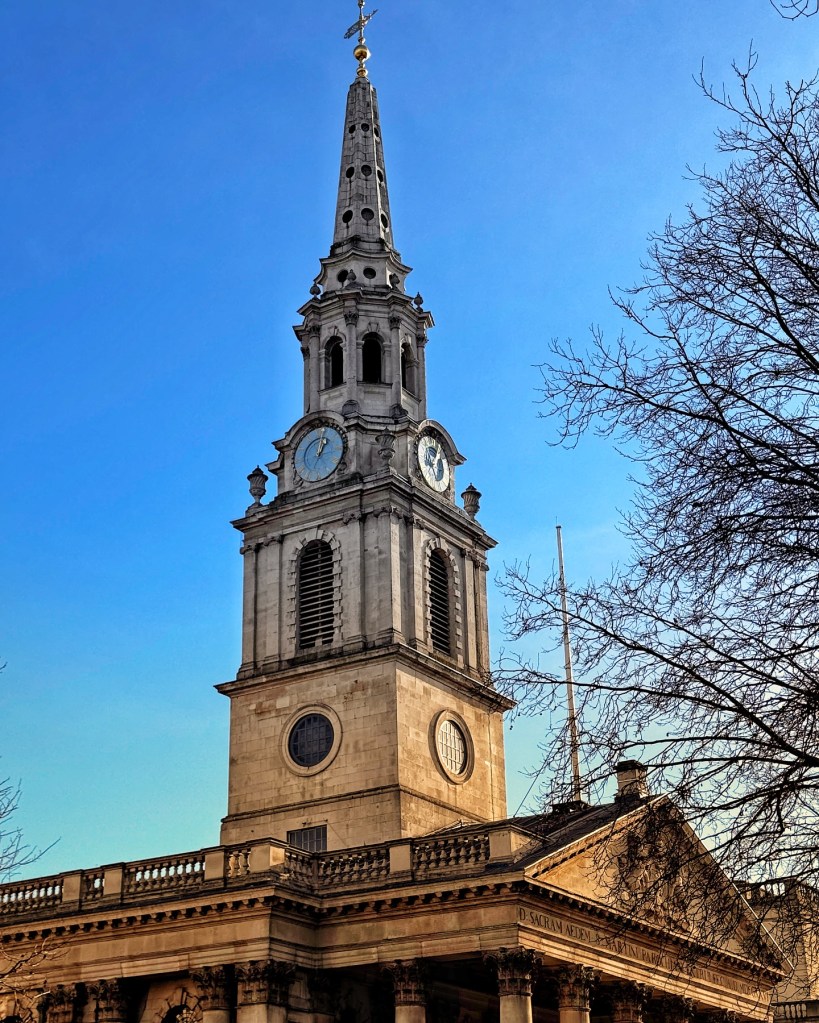
St Martin-in-the-Fields, completed in 1726, exemplifies the fusion of Anglo-Italian architectural traditions that shaped 18th-century ecclesiastical architecture in London and beyond.

The Scottish architect James Gibbs (1682–1754) was trained in Rome under Carlo Fontana (1634–1714), the last great exponent of the Roman High Baroque and a follower of Gian Lorenzo Bernini (1598-1680) and Francesco Borromini (1599-1667). Here, he successfully merged Roman Baroque with Wren’s Baroque legacy, as well as the rational classicism of his contemporaries, Colen Campbell (1676–1729) and William Kent (1685–1748), who gave new life to the Renaissance ideals of Andrea Palladio (1508–1580).
Gibbs fused Roman Baroque with the English church-building tradition at St Martin-in-the-Fields, bridging Wren’s restrained Baroque with monumental Roman architecture. Its most innovative feature is the integration of a giant Corinthian portico, reminiscent of the Pantheon, with a tall, tiered spire rising behind it. The unified classical order of exterior and interior reflects Gibbs’s mastery of proportion and his deep understanding of Vitruvian principles, central to 18th-century architectural thought.
Inside, the flattened barrel vault is adorned with stucco work by Giuseppe Artari (1690-1745) and Giovanni Battista Bagutti (1681-1755), whose Rococo plasterwork contrasts with the otherwise monumental space. The rectangular nave, divided into five bays by Corinthian columns, follows the traditional basilica form (modelled on the Basilica of Maxentius and Constantine, completed in 312 AD). At the same time, galleries above the aisles reflect the Protestant emphasis on clear sightlines for preaching. The acoustics, enhanced by the vault and stucco work, helped establish the church as a premier concert venue, a tradition that continues today.