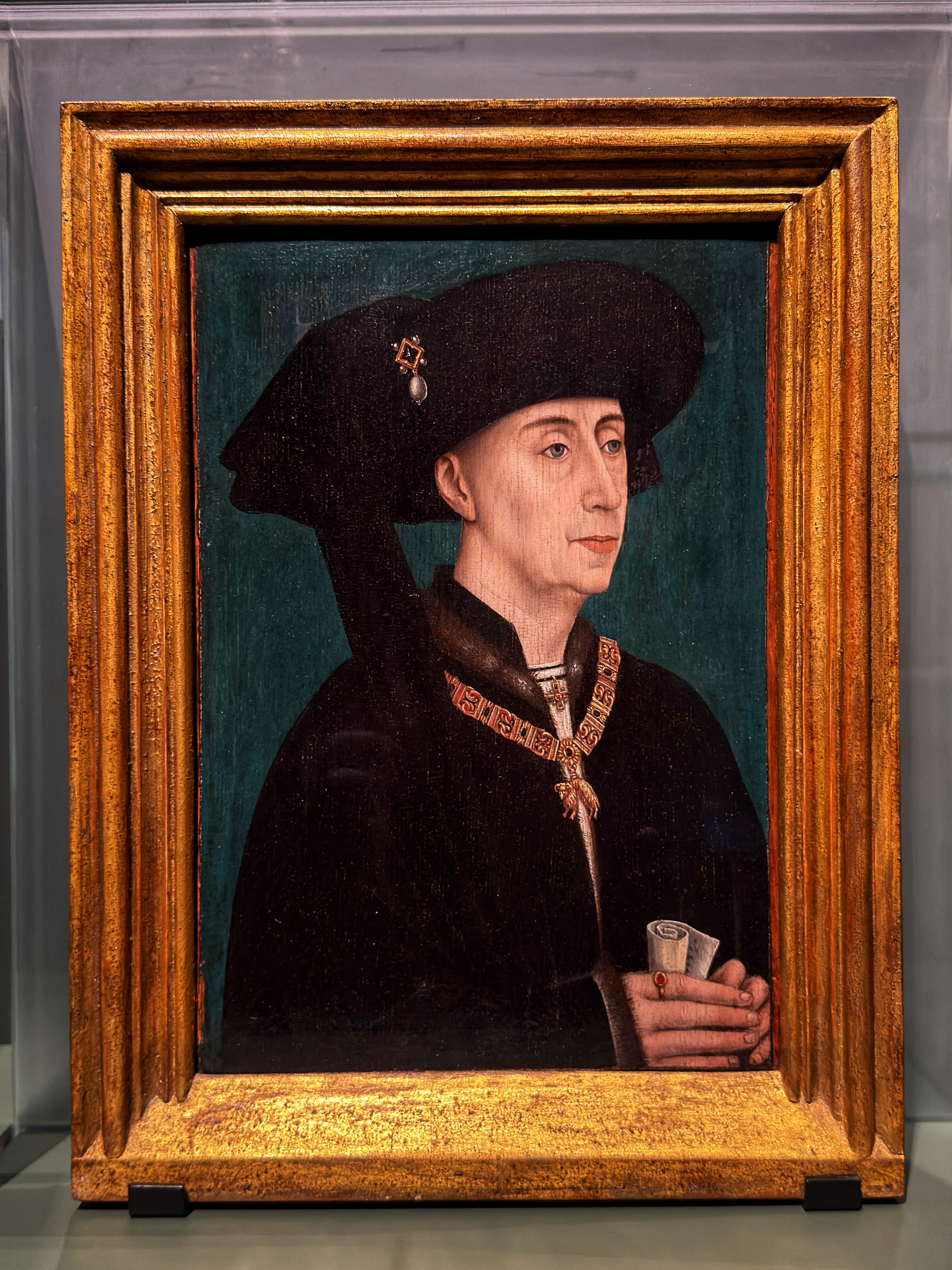
Anonymous Master after Rogier van der Weyden (c. 1399/1400–1464), Portrait of Philip the Good (1396–1467), second half of the 15th century, Oil on oak panel, 32.6 × 22.4 cm, Groeningemuseum, Bruges

An iconic representation of the Burgundian duke at a moment when his authority extended over one of the richest and most urbanised regions in Europe. Within the shifting balance of the Hundred Years’ War, he stood as a prince formally subject to the French crown yet operating with near-sovereign autonomy, at times aligned with England against France.
Enclosed within the dark folds of the Burgundian chaperon, Philip appears with austere restraint. Around his neck hangs the collar of the Order of the Golden Fleece, founded in Bruges in 1430, binding leading nobles of his territories to the ducal court.
Philip governed territories that extended beyond the core Burgundian lands, reaching across the Low Countries into a wider network of lordships. Powerful cities retained their own laws and privileges, requiring authority to move through negotiation rather than direct control. This structure coincided with extraordinary prosperity. Urban wealth sustained one of the most brilliant courts of the fifteenth century, in which painters such as Jan van Eyck (c. 1390–1441) and Rogier van der Weyden (c. 1399/1400–1464), worked in close proximity to ducal power.
Later historians would describe this period as a Burgundian golden age. The calm authority of the portrait reads differently in light of what followed. Philip’s son, Charles the Bold (1433–1477), attempted to consolidate these territories into a territorial kingdom. His ambitions ended at Nancy in 1477. The Burgundian structure fractured, and the northern Netherlandish lands passed, through Mary of Burgundy (1457–1482), into the Habsburg orbit.
The image proposes a ruler of political stability. The world he governed remained a fragile assemblage of cities, privileges, and negotiated power. How stable could such a structure ever be?
References
RKD – Netherlands Institute for Art History (n.d.) Anonymous Master after Rogier van der Weyden (c.1399/1400–1464), Portrait of Philip the Good (1396–1467), Musée des Beaux-Arts de Dijon Version ( the best known version) , second half of the 15th century. RKDimages, image no. 254421. Available at: https://rkd.nl/images/254421 (Accessed: 11 March 2026).
RKD – Netherlands Institute for Art History (n.d.) Anonymous Master after Rogier van der Weyden (c.1399/1400–1464), Portrait of Philip the Good (1396–1467), The Louvre version, second half of the 15th century. RKDimages, image no. 295307. Available at: https://rkd.nl/images/295307 (Accessed: 11 March 2026).
Van Loo, B. (2021) The Burgundians: A Vanished Empire: A History of 1111 Years and One Day. Translated by N. Forest-Flier. London: Head of Zeus