Antoon van Dyck (1599–1641), The Shepherd Paris as Personification of Artistic Judgment, c.1628. Oil on canvas, 96 × 84 cm. The Wallace Collection, London
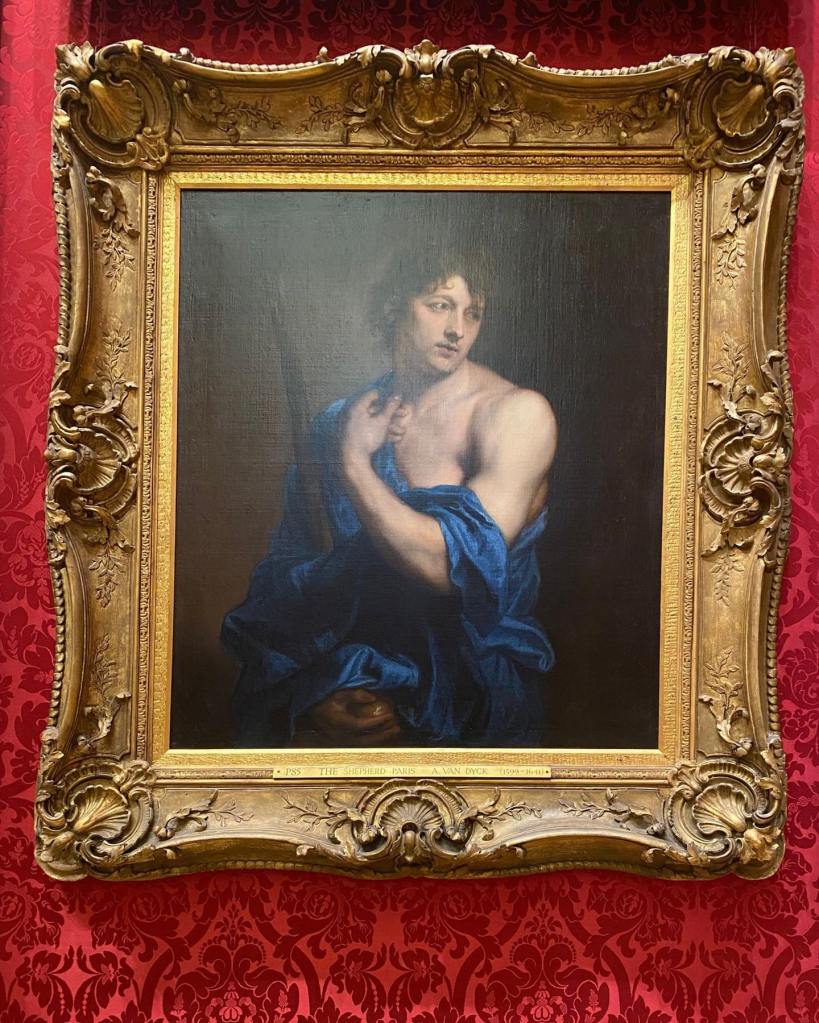
In the summer of 1816, at Christie’s auction rooms in London, a canvas from the collection of the Amsterdam banker Henry Hope (1735–1811) was sold as a self-portrait of Antoon van Dyck in the guise of the Trojan shepherd Paris. The buyer was Francis Charles Seymour-Conway, 3rd Marquess of Hertford (1777–1842), who intended to present it to George IV (1762–1830). The gift was never made, and the painting passed instead through the Hertford family’s hands until it entered the Wallace Collection, where it remains. The self-portrait identification was eventually abandoned, but it clung to the picture for decades, and its persistence is telling. Something about the figure, about the way this young man holds the golden apple and turns his gaze sideways with an expression that is neither heroic nor quite passive, invited viewers to see the painter in the myth. If it is not Van Dyck’s face, whose is it? And does it matter, given that the painting seems less interested in portraiture than in the idea of judgement itself?
The earliest traceable owner is Marc-René de Voyer de Paulmy, marquis d’Argenson (1722–1782), in whose collection the picture was recorded in 1754 (Barnes et al., 2004). Before that, provenance is uncertain. The painting dates from around 1628, shortly after Van Dyck’s return to Antwerp from a prolonged stay in Italy that had lasted from the autumn of 1621 to the summer of 1627. Those six years reshaped him. He had arrived in Italy as Peter Paul Rubens’s (1577–1640) most gifted former assistant, already an independent master in the Antwerp Guild of Saint Luke since 1618, and he left as a painter whose ambitions had moved decisively away from Rubens’ orbit. His Italian Sketchbook (British Museum, London), a working notebook of some 122 leaves filled largely during a visit to Venice in 1622, records the depth of his absorption in the Venetian masters. The overwhelming majority of the drawings are after Titian (c. 1488–1576), copied freely and rapidly, sometimes annotated with colour notes, as aides-mémoire for future compositions rather than finished studies (Jaffé, 1966). There are copies after Giorgione (c. 1477–1510), Paolo Veronese (1528–1588), and Tintoretto (1518–1594), and a smaller number after Raphael (1483–1520) and the antique, but it is Titian who dominates page after page. Giovanni Pietro Bellori (1613–1696), in his Le vite de’ pittori, scultori e architetti moderni [The Lives of the Modern Painters, Sculptors, and Architects] (1672), noted that Van Dyck adopted in Italy an increasingly flamboyant personal style, dressing in silks and gold chains, travelling with servants, and cultivating the manners of an aristocrat rather than an artisan (Bellori, 1672, cited in Wohl and Wohl, 2005). The observation is usually read as social ambition, and it was, but it also speaks to a painter who was working out a new relationship between artist and sitter, one in which the painter’s own judgement and sensibility were as much the subject as the person depicted.
The Shepherd Paris belongs to this moment of recalibration. The subject is drawn from one of antiquity’s most consequential myths. Paris, son of King Priam of Troy, raised as a shepherd on Mount Ida, is asked by Jupiter to judge which of three goddesses, Juno, Minerva, or Venus, is the most beautiful. Each offers a bribe: Juno promises power, Minerva wisdom, Venus the most beautiful woman in the world. Paris chooses Venus, and by doing so sets in motion the chain of abductions, betrayals, and alliances that leads to the Trojan War and the destruction of his own city. The story was treated by painters across every period, almost always as a group scene: Rubens alone returned to the subject at least half a dozen times, populating the canvas with fleshy goddesses, attendant putti, and agitated landscapes. Lucas Cranach the Elder (c. 1472–1553) painted it more than twenty times. The convention was spectacle, display, and the competitive exhibition of the female body.
Van Dyck does something altogether different. He eliminates the goddesses entirely. Paris sits alone, a three-quarter-length figure set against a shallow, darkened background, wearing a blue mantle draped loosely over bare shoulders. He holds the golden apple in his right hand, but the gesture is tentative, as though weighing it rather than preparing to award it. There is no Mount Ida, and no flock of sheep,as well as no divine entourage. The composition recalls Venetian half-length figures of the 1510s and 1520s, the kind of poetic, ambiguous single-figure painting that Titian and Giorgione had pioneered and that Van Dyck had studied so intensely in his sketchbook. The blue drapery, the warm flesh tones, the soft modelling of the shoulder and arm all carry Venetian colour into a Flemish hand. But where Titian’s pastoral figures tend towards dreamy self-containment, Van Dyck’s Paris is alert to something outside the frame: his gaze slips sideways, and his expression is harder to read than it first appears. Is he weighing his options, or has he already decided and is contemplating what the decision will cost?
The painting has circulated under several titles. In early collections it was listed simply as Paris, and later as Self-Portrait as Paris. The Wallace Collection now catalogues it as The Shepherd Paris, though the RKD (Netherlands Institute for Art History) and other sources list it under the more interpretive title De herder Paris als personificatie van het Artistieke Oordeel [The Shepherd Paris as Personification of Artistic Judgement] (RKD, n.d., image no. 37072). The self-portrait theory, though discarded on physiognomic grounds, left a residue in the allegorical reading. If Paris is not Van Dyck, he may nonetheless stand for the painter’s predicament: the artist as someone who must choose between competing ideals of beauty, truth, and invention, and who knows that every choice forecloses others. Judgement, in this reading, is the painter’s daily burden, and Paris becomes a figure for the act of discrimination that lies at the heart of artistic practice.
Whether Van Dyck intended anything so programmatic is an open question. He was not, on the whole, a painter of elaborate allegorical conceits in the manner of Rubens’s late mythologies. His mythological works are few, and they tend towards lyrical, intimate formats rather than rhetorical display. The Rinaldo and Armida (c. 1629, Baltimore Museum of Art), painted around the same time, similarly reduces a multi-figure narrative to an encounter between two bodies, and favours mood over action. What both paintings share is a Venetian inheritance filtered through a temperament more restrained, more inward, and more attentive to psychological nuance than Rubens’s. Rubens, confronted with the Judgement of Paris, gave us the spectacle of choice. Van Dyck gave us its weight.
The painting sits well among the collection’s other Van Dycks, including the portraits of Philippe le Roy and Marie de Raet, but it is the odd one out in that it is not a portrait at all. Or perhaps it is a portrait of a state of mind: the moment before a decision that cannot be taken back, painted by a man who had just made a consequential choice of his own, turning away from Rubens and towards Titian, away from Antwerp and towards the courts of Europe.
References
Barnes, S.J., De Poorter, N., Millar, O. and Vey, H. (2004) Van Dyck: A Complete Catalogue of the Paintings. New Haven and London: Yale University Press
Bellori, G.P. (1672) Le vite de’ pittori, scultori e architetti moderni [The Lives of the Modern Painters, Sculptors, and Architects]. Rome. Translated by Wohl, A.S. and Wohl, H. (2005) Cambridge: Cambridge University Press
Hedley, J. (1999) Van Dyck at the Wallace Collection [Exhibition catalogue]. London: The Wallace Collection
Jaffé, M. (1966) Van Dyck’s Antwerp Sketchbook. 2 vols. London: Macdonald
RKD – Netherlands Institute for Art History (n.d.) Anthony van Dyck, De herder Paris als personificatie van het Artistieke Oordeel [The Shepherd Paris as Personification of Artistic Judgement], c. 1628. RKDimages, image no. 37072. Available at: https://rkd.nl/en/explore/images/37072 (Accessed: 3 August 2023).
Wallace Collection (n.d.) Paris. Available at: https://wallacelive.wallacecollection.org/eMP/eMuseumPlus?service=ExternalInterface&module=collection&objectId=64960&viewType=detailView (Accessed: 3 August 2023).