
The Jesuits of Malá Strana acquired the Gothic parish church of St Nicholas after 1620, when Protestant properties across Bohemia passed rapidly into Catholic hands following the Battle of White Mountain. They spent the next fifty years buying up adjoining plots — gardens, schools, twelve houses — before laying the foundation stone for a new church in 1673, and another thirty years after that before construction actually began. The Church of St Nicholas (Kostel sv. Mikuláše), completed in 1755, absorbed half a century of building, two generations of a single architectural family, and spatial ideas drawn from Bavaria, Austria, Rome, and Venice — producing the largest Baroque church in Prague, with the tallest interior the city has.
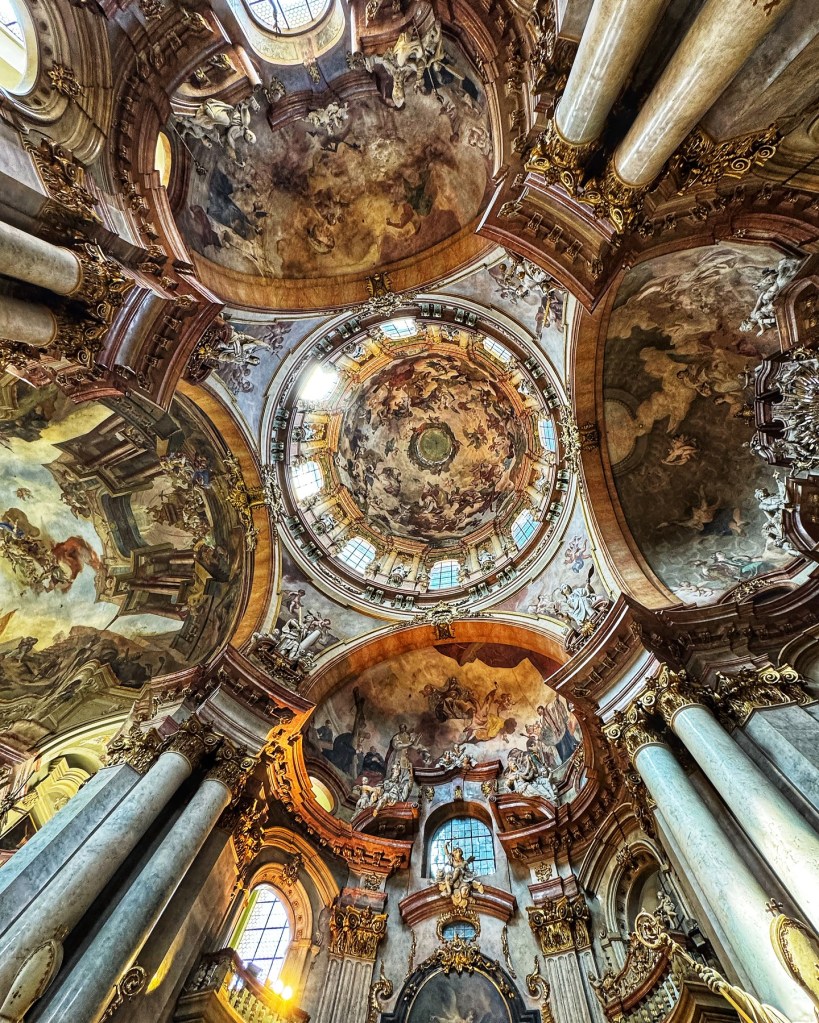
The Jesuits had first approached Giovanni Domenico Orsi (1634–1679), an Italian-Bohemian architect active on early Baroque commissions in Prague, but Orsi died before anything was built. When the order finally appointed Christoph Dientzenhofer (1655–1722), a Bavarian master builder from St Margarethen near Brannenburg who had settled in Prague and built up a considerable practice designing churches for the religious orders of Bohemia, they were choosing someone whose interests were unusually well matched to what they wanted. Dientzenhofer was preoccupied with a problem that had exercised architects since Guarino Guarini (1624–1683): how to build a longitudinal church that also felt centrally organised, enveloping the visitor rather than simply directing them forward. His solution at St Nicholas — a nave built on interlocking ellipsoidal geometries, with monumental piers set so that the interior seems to open and close as you move through it — abandoned axial planning for something more restless and, frankly, more disorienting. Architectural historians have since grouped St Nicholas with five other Bohemian churches of the same years under the label ‘radical’ or ‘Guarinesque,’ recognising in them a distinct and technically ambitious stream within Central European Baroque. The debt to Guarini’s geometrical thinking is clear, as is the influence of Borromini’s Roman work, though whether Christoph ever travelled to Italy remains unconfirmed. His other major Prague commission of these years, the Benedictine abbey church at Břevnov (1708–21), shows the same spatial logic at work. He completed the nave and facades of St Nicholas by around 1711 and died in 1722 without seeing the project finished.
Kilian Ignaz Dientzenhofer (1689–1751), Christoph’s son, returned to the building in 1731, completing the vaults and dome drum, and designed the western façade between 1737 and 1741. Kilian Ignaz had trained under Johann Lukas von Hildebrandt (1668–1745) in Vienna and had travelled through Germany, France, and Italy — and it shows. Where his father’s contribution is felt most in the interior, Kilian Ignaz’s façade, with its twin columns, deep niches, and layered planes, shows close study of both Borromini and Johann Bernhard Fischer von Erlach (1656–1723). The ideas worked out across this building, by father and son together, fed directly into the German Baroque: Balthasar Neumann (1687–1753), whose Würzburg Residenz and pilgrimage churches represent the fullest development of the fluid, interpenetrating spatial thinking that the Dientzenhofers had pioneered, acknowledged the Bohemian precedents. The final phases, including the 79-metre bell tower completed in 1755, were overseen by Anselmo Lurago (1701–1765), who had trained under Kilian Ignaz — completing a building that none of the three principal architects had lived to see finished.
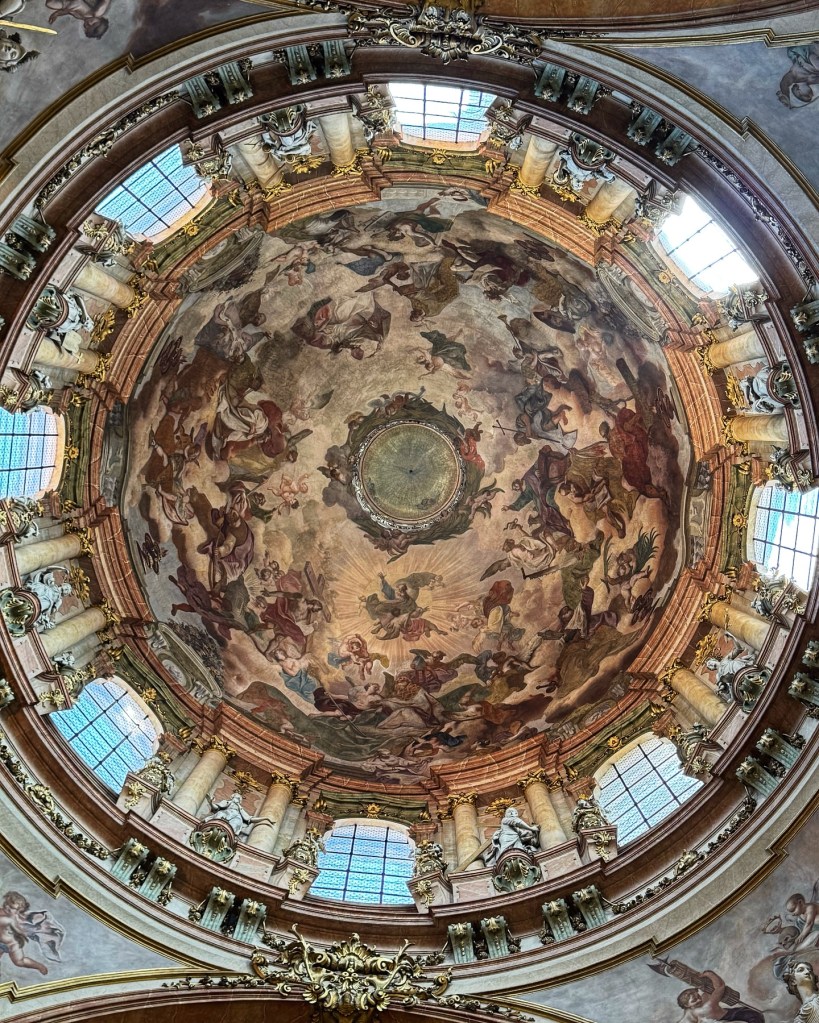
The dome was frescoed in 1753 by Franz Palko (1717–1766) with the Apotheosis of St Nicholas, the saint ascending among angels, papal insignia, and personifications of virtue. Palko used illusionistic architectural painting and a warm Venetian palette to open the dome’s surface upward, working in a tradition that runs back through Andrea Pozzo (1642–1709) and Giovanni Battista Tiepolo (1696–1770). Whether the result quite matches those models is a question the dome invites, though the ambition is not in doubt.
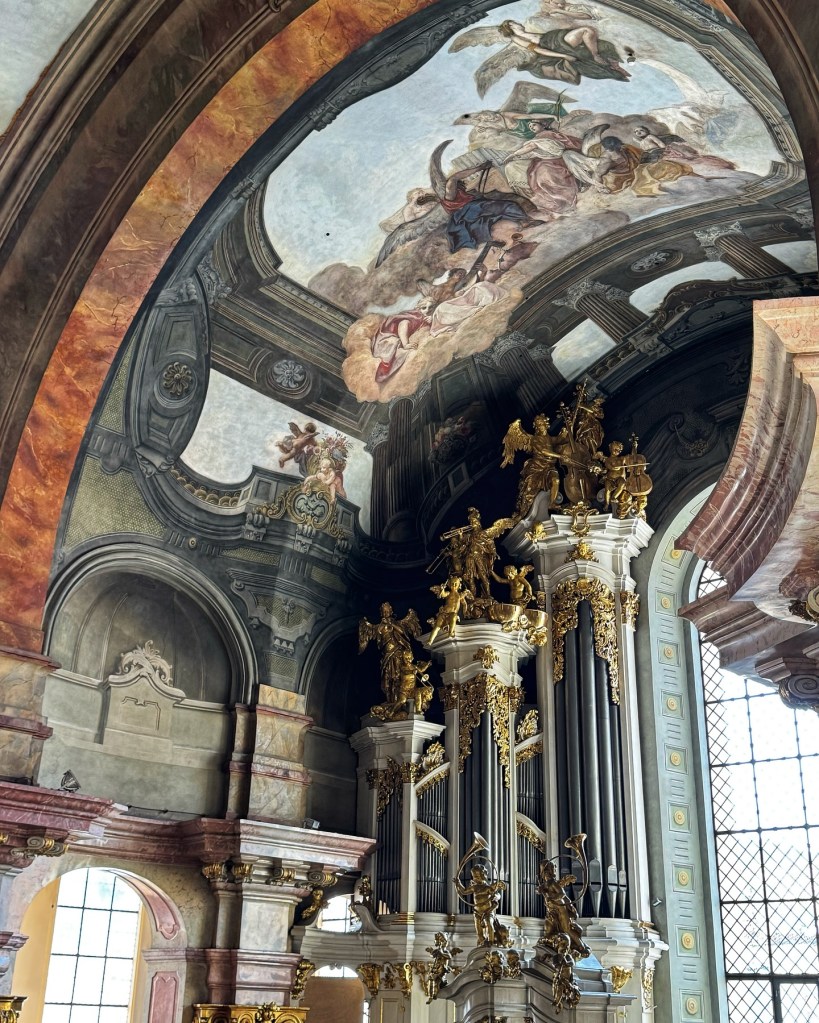
Between 1760 and 1761, Jan Lukas Kracker (1717–1779) painted the nave and sanctuary vaults with episodes from the life of St Nicholas: the rescue of the condemned, the gift of dowries to the three sisters, and the calming of the storm at sea. Painted mouldings and perspectival framing bind the scenes to the surrounding architecture, so that Dientzenhofer’s vaults and Kracker’s figures operate as a single surface rather than structure and ornament laid one on top of the other.
The sculptural programme by Ignaz Franz Platzer (1717–1787), carried out during the 1760s, includes colossal figures of the Evangelists, Doctors of the Church, and Jesuit saints. His six-metre-high St Nicholas commands the sanctuary through gesture and deeply cut drapery. The Jesuit Order was suppressed by Pope Clement XIV (1705–1774) in 1773, and the church passed to the secular parish of Malá Strana two years later — a quietly anticlimactic end to a building that had taken the better part of a century to complete and had, in the process, changed the course of religious architecture across Central Europe.





References
Kaufmann, T.D.C. (1995) Court, Cloister, and City: The Art and Culture of Central Europe, 1450–1800. Chicago: University of Chicago Press.
Louthan, H. (2009) Converting Bohemia: Force and Persuasion in the Catholic Reformation. Cambridge: Cambridge University Press
O’Malley, J.W. and Bailey, G.A. (eds) (2005) The Jesuits and the Arts, 1540–1773. Philadelphia: Saint Joseph’s University Press.