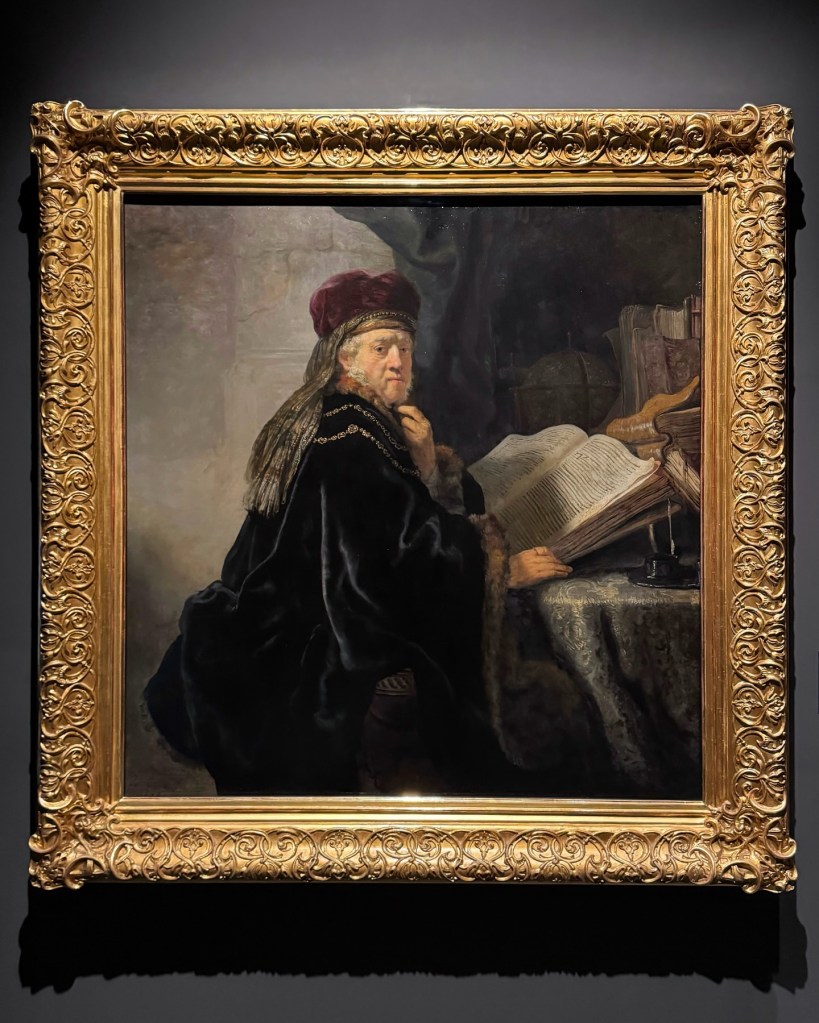
Rembrandt Harmensz. van Rijn (1606–1669), ‘A Scholar in His Study’, 1634, Oil on canvas, 141 × 135 cm Sternberg Palace, Prague
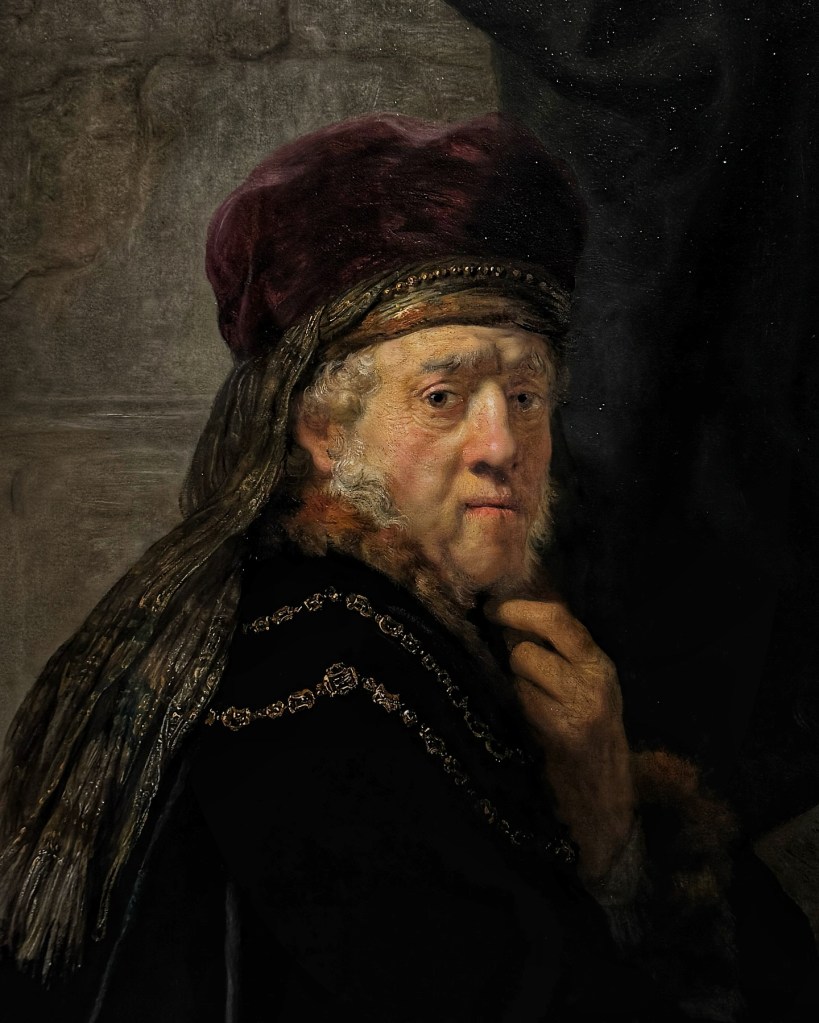
Three times in the mid-1630s, Rembrandt painted the same elderly head, and each time he dressed him differently. The sitter remained anonymous throughout, present in the picture as a tronie study rather than as a person. The most ambitious of the three is this Prague panel, signed and dated 1634. It was painted in the year of Rembrandt’s marriage to Saskia van Uylenburgh (1612–1642) and of his consolidation in Amsterdam as the most sought-after portraitist of the city. In the two related paintings, the same model reappears already robed and turbaned in the oriental manner.
Seen against Rembrandt’s working method in these years, the ambition of the panel becomes clearer. He is lifting an anonymous elderly head to the standing of a full historical subject, the kind of weighty narrative composition otherwise reserved for biblical or classical scenes. By the mid-1630s he was building his pictures from a deliberately assembled stock of costume, props, and staged interior. The scale of that stock only became fully visible some twenty years later, when bankruptcy proceedings (cessio bonorum) forced an official inventory of his Amsterdam house in 1656. Among the goods recorded that year were weapons, plaster casts after the antique, sculpted busts, ethnographic curiosities, lengths of fabric and historical garments, the working contents of a history painter’s studio rather than ordinary domestic furnishings. A studio accumulates and discards; what survived into the bankruptcy year is not necessarily what was present in 1634, and to read the inventory backwards across twenty years of acquisition and loss is to assume a stability of working resources that Rembrandt’s restless habits however may not support.
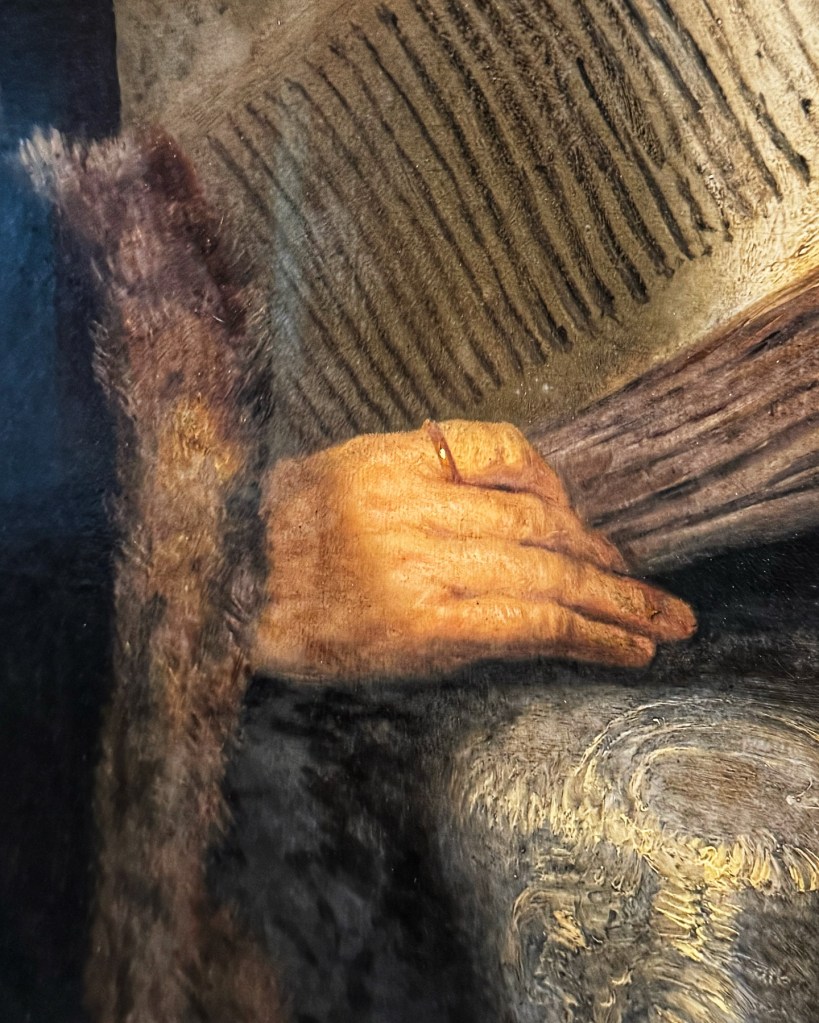
Inside the panel itself, that working method is visible at one remove. The learning of the sitter is evoked rather than documented. A heavy folio lies open beneath his hand. Bound books rest at the edge of the desk. A globe stands on its mount, and a quill waits beside the inkwell. These carefully chosen objects belong to an iconographic tradition Rembrandt had helped to shape during his early years in Leiden, that of the contemplative scholar at his desk, developed between roughly 1625 and 1635 in dialogue with Jan Lievens (1607–1674) and the young Gerrit Dou (1613–1675), when proximity to the university gave the type a ready local market. The Prague picture carries that Leiden formula into Amsterdam and inflates it. Where Dou’s scholars are intimate and small, painted in cabinet format for private collectors, Rembrandt’s is amplified, pressed close to the picture plane and lent the gravity of a figure from history painting. The nearly square format of the canvas is itself unusual for a scholar type, which more typically occupied an upright field; whether this signals a broader narrative ambition or simply a commission to a specific size is impossible to determine.
Within that staging, the clothing carries much of the argument. The sitter wears a heavy velvet coat embroidered with gold thread and trimmed with fur, a thick gold chain laid across his shoulders, and a soft fanciful cap of the kind Rembrandt reserved for figures of biblical or historical erudition. The ensemble is deliberately theatrical, drawing on graphic sources, on items from the studio’s working stock and on a broader iconography of the wise elder, rather than reconstructing any specific historical or geographical dress. It is at once historical and oriental, a doubled appeal aimed at a 1630s Amsterdam audience attuned both to pictorial fictions of antiquity and to the cosmopolitan reach of the city’s trading networks. But how knowingly were those audiences playing along? Did a buyer in 1634 see a wise man from the past, or a Rembrandt, or both at once, and does the question even separate cleanly?
What the picture asks, in the end, is how learning is allowed to look in paint. The sitter does not lecture, perform or display. He is caught mid-thought, his face poised somewhere between question and fatigue, and the room around him is shaped by light rather than by architecture. The chiaroscuro draws the eye towards the lit page and the lit hand and lets the rest of the chamber subside into shadow, the legacy of Rembrandt’s early absorption of Caravaggesque models through the Utrecht painters and through Lievens. Rembrandt is competing on a register his Amsterdam rivals could not easily occupy, lifting a single anonymous head into a figure of contemplative authority on the scale of historical narrative.
References
de Winkel, M. (2006) Fashion and Fancy: Dress and Meaning in Rembrandt’s Paintings. Amsterdam: Amsterdam University Press
Sevcik, A.K. (ed.) (2019) Inside Rembrandt 1606–1669. Petersberg: Michael Imhof Verlag
Sluijter, E.J. (2015) Rembrandt’s Rivals: History Painting in Amsterdam, 1630–1650. Oculi: Studies in the Art of the Low Countries 14. Amsterdam and Philadelphia: John Benjamins
Strauss, W.L. and van der Meulen, M. (1979) The Rembrandt Documents. New York: Abaris Books
Surh, D. (2017) ‘Scholar Interrupted at His Writing’, in Wheelock, A.K. Jr (ed.) The Leiden Collection Catalogue. New York. Available at: https://www.theleidencollection.com/artwork/a-scholar-interrupted-at-his-writing/ (Accessed:24 June 2025 )
RKD – Netherlands Institute for Art History (n.d.) Rembrandt Harmensz. van Rijn, A scholar, seated at a table with books, 1634. RKDimages, image no. 233140. Available at: https://rkd.nl/en/explore/images/233140 (Accessed: 23 June 2025)
van de Wetering, E. (2015) A Corpus of Rembrandt Paintings VI: Rembrandt’s Paintings Revisited – A Complete Survey. Dordrecht: Springer