Andrea Vaccaro (1604–1670) was among the most prolific and commercially successful painters in seventeenth-century Naples. A second-generation follower of Caravaggio, he absorbed the Caravaggesque vocabulary of tenebrism and naturalistic figuration not directly but through the strong local tradition that had taken root in the city after Caravaggio’s two Neapolitan periods (1606–1607, 1609–1610), with Battistello Caracciolo (1578–1635) and Jusepe de Ribera (1591–1652) among the most significant intermediaries. From the mid-1630s onwards, Vaccaro established himself as a leading figure in Neapolitan religious painting, and he remained active and in demand until his death, receiving commissions for both private collectors and churches including, late in his career, his only fresco cycle at San Paolo Maggiore.
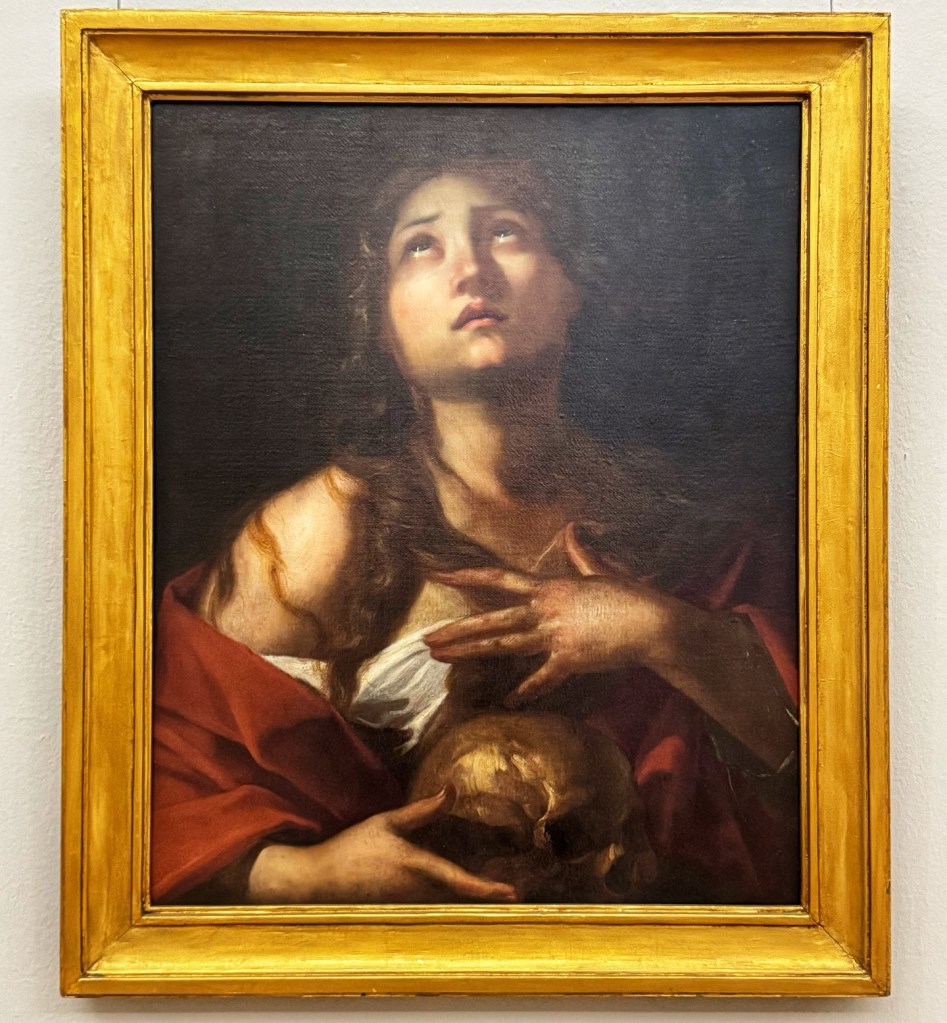
The Penitent Magdalene was among Vaccaro’s most frequently repeated subjects. His earliest documented painting, a Penitent Mary Magdalen of 1636, already treats the subject that would come to define his output: over fifty versions of the theme have been attributed to him and his workshop, though not all with equal confidence. This extraordinary volume of production, much of it destined for private devotion rather than public altarpieces, makes individual attributions difficult: signed examples are rare, workshop variants numerous, and quality uneven across the surviving corpus. The painting in Prague displays a level of painterly control and psychological attention that suggests either Vaccaro’s own hand or close supervision, though in the absence of a signature or documented provenance, certainty on this point is elusive.
The reasons for the multiplication of Magdalene images are rooted in both the devotional culture and the commercial realities of Counter-Reformation Naples. The Penitent Magdalene had become an enormously popular subject during this period, promoted by theologians and religious orders as a model of contrition and divine mercy. Vaccaro’s treatment of the theme, typically showing the saint half-length with uplifted or closed eyes, bare shoulders, and flowing hair, belongs recognisably to the Caravaggesque tradition but softens it considerably. Where Caravaggio’s own Penitent Magdalene (c. 1594–1596, Galleria Doria Pamphilj, Rome), though painted in Rome rather than Naples, established an influential type marked by raw naturalism and austere restraint, Vaccaro’s versions introduce a lyrical, more overtly sensual register. This shift owed much to the influence of Guido Reni and Domenichino, whose classicising manner Vaccaro absorbed from around 1630 onwards, blending it with the tenebrism of his Neapolitan formation. The result is a figure poised between piety and visual pleasure, devotional in function but appealing to a clientele that valued both.
From 1635, Vaccaro was exporting religious canvases to Spain for religious orders and noble patrons, and a significant portion of his surviving work is now in Spanish collections, including the Museo del Prado. The half-length devotional format, efficiently produced and well suited to serial repetition, was a natural vehicle for this expanding market.
References
Willette, T.C. (2003) The Documented Paintings and Life of Andrea Vaccaro (1604–1670). PhD dissertation. The Pennsylvania State University. Available at, https://etda.libraries.psu.edu/files/final_submissions/197?remediate_token=eyJfcmFpbHMiOnsibWVzc2FnZSI6IkJBaHBBY1U9IiwiZXhwIjoiMjAyNi0wNS0wNVQxNDo0MzoxMi4xNzlaIiwicHVyIjoicmVtZWRpYXRlX3JlcXVlc3QifX0%3D–776c0637bf9cd569030f2b274249e3f0f170a704&remediated=false (Accessed 25 June 2025)