Antoon van Dyck (1599-1641), Portrait of Sofonisba Anguissola, 1624, Oil on a canvas, 42 x 33, 5 cm (fragment), Knol Castle, Sevenoaks, Kent

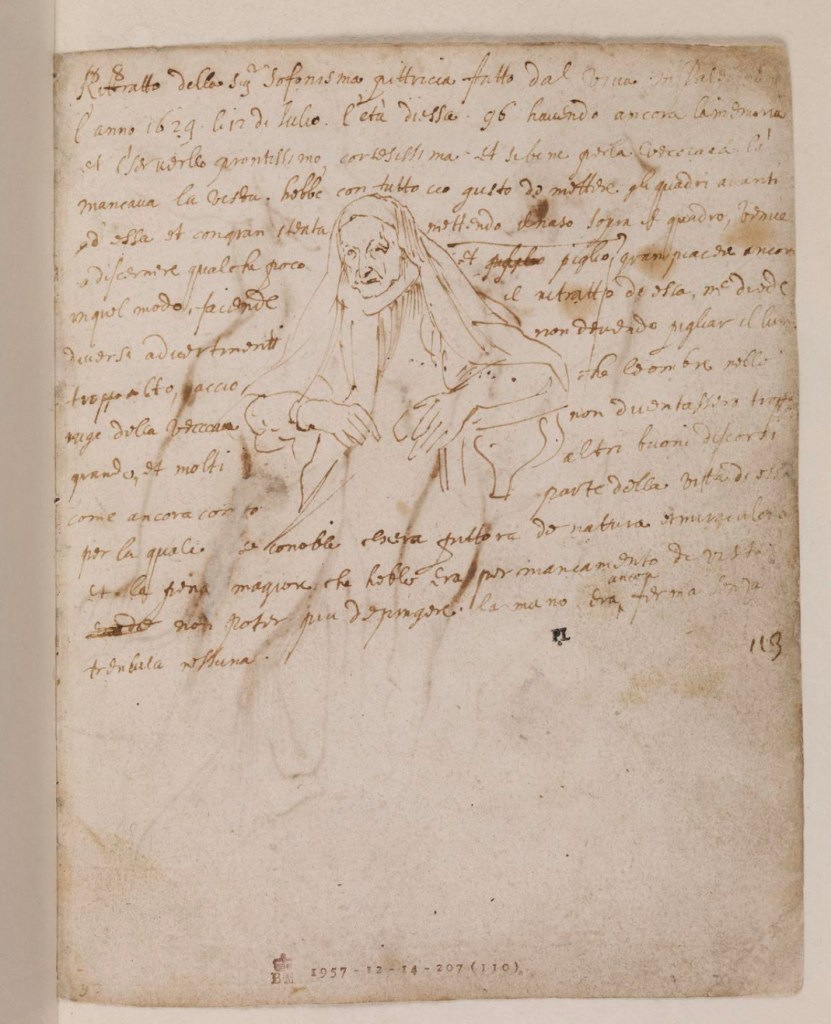
On 12 July 1624, Antoon van Dyck (1599–1641) visited Sofonisba Anguissola (c. 1532–1625) at her home in Palermo. She was, by that point, a living legend of Renaissance Italy: a woman who had exchanged drawings with Michelangelo Buonarroti (1475–1564), served at the court of Philip II of Spain (1527–1598), and outlived nearly every artist of her generation. Van Dyck recorded her age as ninety-six, sketched her in pen and brown ink, and wrote several lines of notes alongside the drawing in his Italian Sketchbook (British Museum), more than he gave to most sitters (Cust, 1902, pp. 51–52). The entry has since been conscripted into a familiar kind of art-historical romance: the young genius meets the aged master, the Baroque pays its respects to the Renaissance, the torch is passed. The reality, as usual, is less tidy.
Van Dyck was in Palermo to paint the viceroy Emanuele Filiberto of Savoy (1588–1624), a lucrative commission that placed him at the centre of the island’s political court. He was twenty-five, ambitious, and deep into the study of Titian (c. 1488–1576) and the Venetian colourists whose work he had been copying compulsively since arriving in Italy in 1621. Anguissola, who had worked at the Spanish court alongside artists shaped by the same Venetian tradition, represented a living point of contact with that world. Whether the visit was arranged through viceregal circles or through the network of Genoese merchants connected to her husband, Orazio Lomellini (d. after 1630), is unclear. What is clear is that Van Dyck came with professional purpose, not pilgrimage.
He recorded her age as ninety-six. If the conventional birth date of around 1532 is accepted, she was closer to ninety-two (Tramelli, 2016, p. 55). A recent palaeographic re-reading of the sketchbook has argued that the date should in fact be read as 1629, not 1624, which would confirm Van Dyck’s stated age and place the visit five years later than traditionally held (Rossi, 2026). Whether or not that revision survives scrutiny, the details Van Dyck recorded are vivid enough to stand on their own terms. She was very old, nearly blind, and, he noted, still sharp enough to lecture him on technique. She warned him against placing the light source too high above a sitter’s face, since the shadows would cut too harshly into aged skin. It is a specific, practical remark, and it reads like the advice of someone who had spent decades painting her own face with an attention that few of her contemporaries matched. Anguissola produced more self-portraits than any other European artist in the period between Albrecht Dürer (1471–1528) and Rembrandt van Rijn (1606–1669), though how many of the surviving attributions are secure remains a live question .
Her career had been remarkable and, in its institutional outlines, deeply strange. As a young woman in Cremona, she had come to Michelangelo’s attention through her father Amilcare (1494–1573), who sent her drawings to the master and arranged for Sofonisba to receive sketches from Michelangelo’s own notebooks to study and copy in her own style, a correspondence that continued for at least two years (Cole, 2019, pp. 33–36; Perlingieri, 1992, pp. 67–72). Giorgio Vasari (1511–1574), who visited the Anguissola household in 1566, praised her in the second edition of his Vite (Lives of the Most Eminent Painters, Sculptors, and Architects, 1568) for her ability to produce beautiful works ‘by herself alone.’ Around 1559 she entered the court of Philip II in Madrid, where she served as lady-in-waiting and painting tutor to Queen Isabel de Valois (1546–1568). She was paid a salary, received a pension, and was eventually given a dowry, yet she does not appear in the court records under any formal designation as a painter (Cole, 2019, pp. 92–98; Gamberini, 2016, pp. 29–42). The administrative silence is difficult to read. It may reflect the conventions of the Spanish court, where artistic labour performed by a noblewoman occupied a different bureaucratic category from that of a contracted artist. Or it may reflect something blunter: that the work was acknowledged privately and erased publicly, which is a pattern that held for a long time after her death. The truth is probably tangled between the two, and the surviving documentation does not allow us to separate them cleanly.
After the queen died in 1568, Philip arranged Anguissola’s marriage, around 1571–1573, to the Sicilian nobleman Don Fabrizio de Moncada (d. 1578), providing a generous dowry from the royal purse. The match placed her among the prominent families of the island, though Moncada died within a decade, reportedly killed by pirates off the Sicilian coast. Her second marriage, around 1579–1580, was to Orazio Lomellini, a Genoese nobleman with commercial interests in Palermo, said to have been some fifteen years her junior. The circumstances of the match are unusual: by most accounts they met aboard the ship carrying Anguissola from Sicily towards Genoa, and married shortly after, against the wishes of her brother and without seeking permission from the Spanish court. The couple lived for a long period in Genoa before settling permanently in Palermo around 1615, where Anguissola continued to paint and, by most accounts, to receive visitors interested in her work (Perlingieri, 1992, pp. 155–167).
The portrait at Knole House, part of the Sackville Collection, is a small panel: head and upper body, nothing more. At 42 × 33.5 cm, it preserves the face and the dress but no compositional setting beyond a dark ground. What remains shows Anguissola in a black dress and white veil, consistent with the sketch in the Italian Sketchbook. The handling is direct, even tender. Van Dyck gives her a steady gaze, slightly averted, and does not dramatise the wrinkles she had specifically asked him to light with care. How much of this restraint is Van Dyck’s own sensitivity and how much is Sofonisba’s instruction is, of course, impossible to separate.
The painting was for years misidentified as a likeness of Catherine Fitzgerald, Countess of Desmond (d. 1604), an Irishwoman famous in English folklore for supposedly having lived to the age of one hundred and forty. The confusion is instructive. Both women had been flattened into curiosities of longevity, and for the cataloguers who maintained the Sackville collection, one very old woman was apparently as good as another. The correct identification, when it came, restored a name but did not necessarily restore a person. How the painting entered the collection remains uncertain: the National Trust records suggest it was possibly brought to Knole by Arabella Diana Cope (1767–1825), Duchess of Dorset, though the trail is thin (National Trust Collections, n.d.).
The visit of 12 July took place in a city already gripped by plague. The epidemic had broken out in Palermo in May 1624, and by the time Van Dyck sat with Anguissola, the death toll was rising sharply. The viceroy was dead by 3 August. Van Dyck did not, as is sometimes implied, leave after this. He was quarantined in Palermo, unable to depart, and remained trapped on the island for over a year. During this enforced stay he painted his celebrated series of Saint Rosalie altarpieces, images of the city’s patron saint whose rediscovered relics were credited with halting the epidemic (Tramelli, 2016, pp. 60–63). He did not leave Palermo until September 1625. No further contact between the two artists is documented during those fifteen months, which is curious given that they were both in the same small, locked-down city. Whether Van Dyck visited again, or whether the old painter’s failing health made a second sitting impossible, the record does not say.
Anguissola died on 16 November 1625, roughly two months after Van Dyck finally departed. Her husband Lomellini, who survived her, commissioned a marble inscription for her tomb in the church of San Giorgio dei Genovesi in Palermo, placed in 1632. The Latin text praises her noble lineage, her beauty, her extraordinary natural gifts, and her distinction in portraying human images, in roughly that order, before concluding that no one of her age could be considered her equal (Lonza, Cossu and Scala, 1994, p. 370). Nobility first, beauty second, painting third. It is a conventional hierarchy for a funerary inscription honouring a noblewoman in seventeenth-century Sicily, and it tells us as much about the priorities of the genre as about Lomellini’s private estimation of his wife’s achievement. What Van Dyck thought, he wrote down in the Sketchbook: that she was pittora de natura et miraculosa, a painter from nature and miraculous (Cust, 1902, p. 52). He put the painting first.
References
Barnes, S.J., De Poorter, N., Millar, O. and Vey, H. (2004) Van Dyck: A Complete Catalogue of the Paintings. New Haven and London: Yale University Press
British Museum (n.d.) Anthony van Dyck, The Painter Sofonisba Anguissola, Seated in a Chair, leaf from Van Dyck’s Italian Sketchbook, folio 110. Pen and brown ink. Museum number: 1957,1214.207.110. Available at: https://www.britishmuseum.org/collection/object/P_1957-1214-207-110 (Accessed: 10 August 2024).
Brown, C. and Vlieghe, H. (eds.) (1999) Van Dyck 1599–1641. Exhibition catalogue. London: Royal Academy of Arts
Cole, M. W. (2019) Sofonisba’s Lesson: A Renaissance Artist and Her Work. Princeton: Princeton University Press
Cust, L. (1902) A Description of the Sketch-Book by Sir Anthony Van Dyck, Used by Him in Italy, 1621–1627, and Preserved in the Collection of the Duke of Devonshire, K.G. at Chatsworth. London: George Bell and Sons
Jaffé, D. (2001) ‘New Thoughts on Van Dyck’s Italian Sketchbook’, The Burlington Magazine, 143(1183), pp. 614–624. Available at: https://www.jstor.org/stable/i237010 (Accessed 10 August 2024)
Garrard, M.D. (1994) ‘Here’s Looking at Me: Sofonisba Anguissola and the Problem of the Woman Artist’, Renaissance Quarterly, 47(3), pp. 556–622.Available at :https://www.academia.edu/43811467/Heres_Looking_at_Me_Sofonisba_Anguissola_and_the_Problem_of_the_Woman_Artist (Accessed 9 August 2024)
Ferino-Pagden, S. and Kusche, M. (1995) Sofonisba Anguissola: A Renaissance Woman. Exhibition catalogue. Washington, DC: National Museum of Women in the Arts.
Gamberini, C. (2016) ‘Sofonisba Anguissola at the Court of Philip II’, in Barker, S. (ed.) Women Artists in Early Modern Italy: Careers, Fame, and Collectors. The Medici Archive Project Series. Turnhout: Harvey Miller, pp. 29–46. Available at: https://www.academia.edu/33365966 (Accessed 10 August 2024)
Higgie, J. (2021) The Mirror and the Palette: Rebellion, Revolution and Resilience: 500 Years of Women’s Self-Portraits. London: Weidenfeld & Nicolson
Lonza, G., Cossu, M. and Scala, D. (eds.) (1994) Sofonisba Anguissola e le sue sorelle. Exhibition catalogue. Rome: Leonardo Arte
National Trust Collections (n.d.) Sofonisba Anguissola (Cremona ?1530/6–1625), object no. 129883. Available at: https://www.nationaltrustcollections.org.uk/object/129883 (Accessed: 10 August 2024).
Perlingieri, I. S. (1992) Sofonisba Anguissola: The First Great Woman Artist of the Renaissance. New York: Rizzoli
Tramelli, B. (2016) ‘Sofonisba Anguissola, “Pittora de Natura”: A Page from Van Dyck’s Italian Sketchbook’, in Barker, S. (ed.) Women Artists in Early Modern Italy: Careers, Fame, and Collectors. The Medici Archive Project Series. Turnhout: Harvey Miller, pp. 47–71. Available at: https://www.academia.edu/29811820 (Accessed 10 Augsut 2024)
Vasari, G. (1568) Lives of the Most Eminent Painters, Sculptors and Architects. Translated by G. du C. de Vere. 10 vols. London: Macmillan and the Medici Society, 1912–14. Available at: https://www.gutenberg.org/ebooks/25326 (Accessed: 9 August 2024).
Recent corrections
Rossi, C. (2026) ‘1532–1629: le date di nascita e di morte di Sofonisba Anguissola, “pittora de natura et miraculata”, tra la peste di Palermo e il culto di Santa Rosalia’, Zenodo. Available at: https://doi.org/10.5281/zenodo.18471285 (Accessed 10 May 2026)