St Mary Abchurch, Abchurch Lane, City of London

St Mary Abchurch occupies a narrow plot close to Cannon Street, one of the many parish churches rebuilt after the Fire of 1666 under Sir Christopher Wren. The medieval parish, documented since at least the twelfth century, left little trace beyond the name, whose origin has been debated since the seventeenth century.
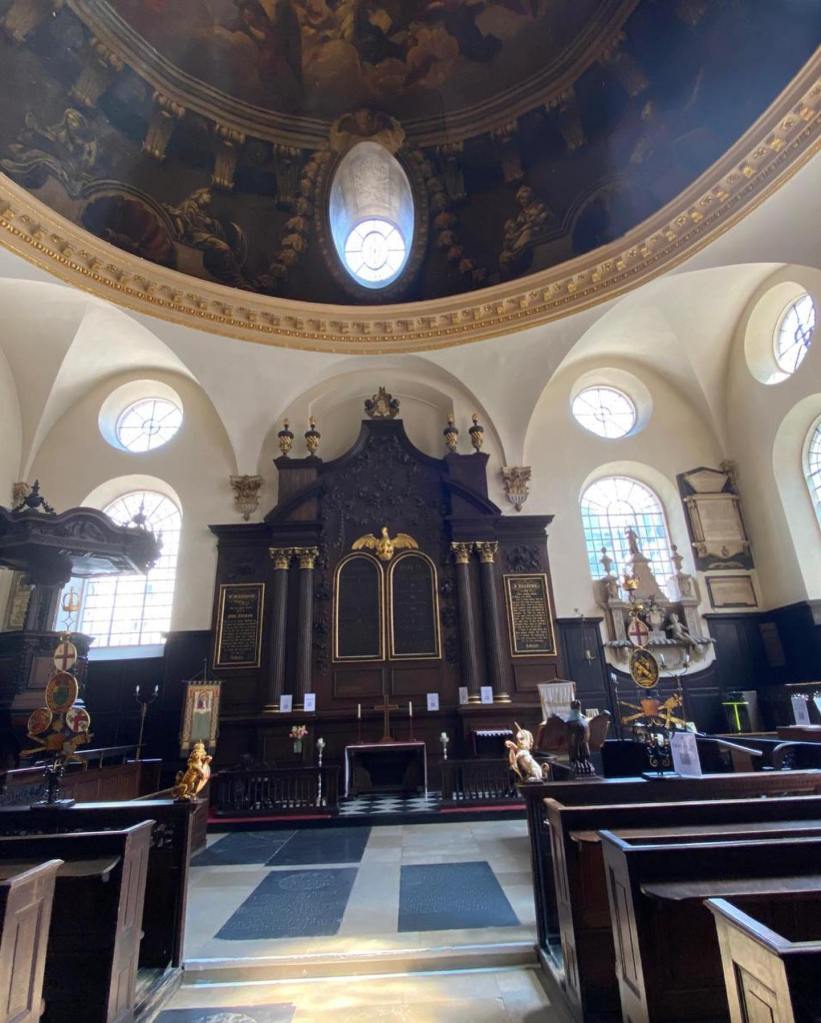
The new church, completed in 1686, exemplifies Wren’s ability to adapt a centralised plan to the City’s irregular topography. Its square volume is gathered beneath a shallow dome set on pendentives, an audacious solution for so confined a space and an early attempt in the domical forms that preoccupied Wren throughout his career. The design anticipates, in miniature, the spatial unity achieved on a grander scale at St Stephen Walbrook, while retaining the modest proportions of a parish interior.
The painted decoration of the dome, executed in 1708 by William Snow, places the ineffable Hebrew name of God — יהוה — at the centre, radiating light amid a host of angels and personifications of the Christian virtues. This use of the Tetragrammaton is rare in Anglican iconography and testifies to the interest in Hebraic sources within late Stuart theology. The scheme aligns with broader Baroque tendencies to fuse painted illusionism with architectural form, enveloping the viewer in a theatre of divine revelation.
Equally distinguished are the furnishings, which survive with unusual completeness. The reredos, pulpit, organ case, font cover and doorcases are enriched with carving attributed to Grinling Gibbons and William Emmett. Their luxuriant foliage and crisp detail belong among the finest examples of Baroque wood sculpture in England. Removed to safety during the Second World War, these fittings returned intact, preserving the unity of Wren’s interior.
The two poor boxes at the west end, painted with the inscription ‘Remember the Poor’, form part of the original ensemble. Together with the lavish dome and carving, they signal the dual obligations of post-Fire Anglicanism: the glorification of God and the charitable duties of the parish. St Mary Abchurch, discreet behind its brick walls, thus embodies both the inventiveness of Wren’s architectural imagination and the richness of the visual culture that accompanied London’s reconstruction.