Category: Northern Renaissance

  • Pinxi, Pinxit, Pingebat: The Signatures of Catharina van Hemessen

    Pinxi, Pinxit, Pingebat: The Signatures of Catharina van Hemessen

    Catharina van Hemessen (1527/8–after 1566), Portrait of a Woman, 1551, Oil on oak, 22.8 × 17.6 cm, National Gallery, London
    Catharina van Hemessen (1527/8–after 1566), Portrait of a Woman, 1551, Oil on oak, 22.8 × 17.6 cm, National Gallery, London

    At the time this portrait was made, van Hemessen was twenty-three years old and a registered master of the Antwerp Guild of Saint Luke. Across the top right corner she inscribed in pale yellow letters: CATHARINA DE / HEMESSEN / PINGEBAT / 1551, Catharina de Hemessen was painting this, 1551. In Latin, pingebat is the imperfect tense, used for an action still in progress, while pinxit is the perfect, denoting a completed act: she painted this, it is done.

    Three years earlier, on her self-portrait now in the Kunstmuseum Basel, she had signed differently: EGO CATERINA DE HEMESSEN ME PINXI 1548 ETATIS SVAE 20, I, Catharina van Hemessen, painted myself, 1548, at age twenty. That formula is first person, reflexive, and records her age. A second portrait from the same year, now in the Rijksmuseum, Amsterdam, already drops all three, reading simply Catherina de Hemessen pinxit 1548: third person, perfect, no ego, no me, no age. Within a single year, the assertive personal declaration of the self-portrait had given way to the more impersonal professional formula of the commissioned work.

    By 1551 the perfect has become the imperfect, and pingebat has replaced pinxit. The imperfect in artist signatures carried a specific resonance. In Book XXXV of his Natural History, Pliny the Elder (23–79 AD) praised the Greek painter Apelles of Kos (fl. 4th century BCE) for signing his works ‘Apelles faciebat’ — Apelles was making this — rather than the completed ‘fecit,’ a habit Pliny interpreted as a gesture of modesty, implying the work remained open to criticism and revision, the artist declining to declare it finished. The painter’s equivalent, pingebat over pinxit, drew on the same construction. Michelangelo (1475–1564) signed the Pietà in St Peter’s Basilica, Rome, MICHAEL ANGELUS BONAROTUS FLORENTINUS FACIEBAT, adapting the sculptor’s form of the same imperfect, and Albrecht Dürer (1471–1528) used effingebam in his 1500 Self-Portrait, signing Albertus Durerus Noricus ipsum me proprijs sic effingebam coloribus aetatis anno XXVIII, I, Albrecht Dürer of Nuremberg, was depicting myself in these my own colours, at age twenty-eight (Boffa 2013).

    Whether van Hemessen was conscious of that lineage when she moved from ego me pinxi to pingebat cannot be established. Antwerp in the mid-sixteenth century was sufficiently steeped in humanist scholarship (Pliny circulated in print editions from 1469 and was widely read in learned circles) for the resonance to have been available to a painter working within a cultivated workshop tradition, even if it cannot be proven to have been sought. That painters of the period moved between the two forms without apparent consistency makes it difficult to read intention into either choice, though for a woman operating professionally in a field with almost no precedent for her presence, the act of signing in full, on every securely attributed work, was already not a neutral gesture.

    The sitter, for all her evident wealth, has not survived the centuries with a name; the painter has.

    Catharina van Hemessen (1527/8–after 1566), Portrait of a Woman, 1551, Oil on oak, 22.8 × 17.6 cm, National Gallery, London
    Catharina van Hemessen (1527/8–after 1566), Portrait of a Woman, 1551, Oil on oak, 22.8 × 17.6 cm, National Gallery, London
    Catharina van Hemessen (1527/8–after 1566), Portrait of a Woman, 1551, Oil on oak, 22.8 × 17.6 cm, National Gallery, London
    Catharina van Hemessen (1527/8–after 1566), Portrait of a Woman, 1551, Oil on oak, 22.8 × 17.6 cm, National Gallery, London

    References

    De Clippel, K. (2004) Catharina van Hemessen (1528–na 1567). Een monografische studie [Catharina van Hemessen (1528–after 1567). A monographic study]. Brussels: Koninklijke Vlaamse Academie van België voor Wetenschappen en Kunsten

    Droz-Emmert, M. (2004) Catharina van Hemessen. Malerin der Renaissance [Catharina van Hemessen. Painter of the Renaissance]. Basel: Schwabe Verlag

    Boffa, D. (2013) ‘Sculptors’ signatures and the construction of identity in the Italian Renaissance’, in A Scarlet Renaissance: Essays in Honor of Sarah Blake McHam, pp. 35–56. Available at: https://www.academia.edu/2011416/Sculptors_Signatures_and_the_Construction_of_Identity_in_the_Italian_Renaissance (Accessed: 24 May 2026).

    National Gallery, London (n.d.) Portrait of a Woman, NG 4732. Available at: https://www.nationalgallery.org.uk/paintings/catharina-van-hemessen-portrait-of-a-woman (Accessed: 24 May 2026).

    National Gallery, London (n.d.) Portrait of a Man, NG 1042. Available at: https://www.nationalgallery.org.uk/paintings/catharina-van-hemessen-portrait-of-a-man (Accessed: 24 May 2026).

    Pliny the Elder (c. AD 77) Naturalis Historia [Natural History], Praefatio, 26. Translated by H. Rackham. Loeb Classical Library 330. Cambridge, MA: Harvard University Press, 1938

    RKD – Netherlands Institute for Art History (n.d.) Catharina van Hemessen, artist entry no. 37344. RKDartists. Available at: https://rkd.nl/en/explore/artists/37344 (Accessed: 24 May 2026).

    RKD – Netherlands Institute for Art History (n.d.) Catharina van Hemessen, Self-Portrait, 1548. RKDimages, image no. 41167. Available at: https://rkd.nl/en/explore/images/41167 (Accessed: 24 May 2026).

    Rijksmuseum, Amsterdam (n.d.) Catharina van Hemessen, Portrait of a Woman, 1548, SK-A-4256. Available at: https://www.rijksmuseum.nl/en/collection/SK-A-4256 (Accessed: 24 May 2026).

    Sutton, E. (ed.) (2019) Women Artists and Patrons in the Netherlands, 1500-1700. Amsterdam University Press

  • Michiel Coxie (1499–1592?) in Rome (c. 1532–c. 1539): Designs for the Loves of Jupiter

    Michiel Coxie (1499–1592?) in Rome (c. 1532–c. 1539): Designs for the Loves of Jupiter

    Michiel Coxie I (1499–1592?), The Abduction of Ganymede, early 1530s, Pen and brown ink on paper, 176 × 136 mm, the British Museum

    Michiel Coxie I (1499–1592?), Jupiter and Leda, early 1530s, Pen and brown ink on paper, 172 × 134 mm, the British Museum

    Michiel Coxie I (1499–1592?), The Abduction of Ganymede, early 1530s, Pen and brown ink on paper, 176 × 136 mm, the British Museum
    Michiel Coxie I (1499–1592?), Jupiter and Leda, early 1530s, Pen and brown ink on paper, 172 × 134 mm, the British Museum

    Michiel Coxie I (1499–1592?), The Abduction of Ganymede, early 1530s, Pen and brown ink on paper, 176 × 136 mm, the British Museum
    Michiel Coxie I (1499–1592?), The Abduction of Ganymede, early 1530s, Pen and brown ink on paper, 176 × 136 mm, the British Museum

    Coxie arrived in Rome around 1532, in his early thirties, at a moment when the city was still absorbing the shock of the Sack of 1527. He stayed seven years, long enough to take in what the Renaissance had accumulated, the principles of classical antiquity, Raphael’s compositional clarity, and direct access to Michelangelo’s drawings, from which he borrowed the figure of Ganymede here almost without disguise.

    These two sheets belong to a series of ten print designs on the loves of Jupiter, drawn from Ovid’s Metamorphoses. They were made to be transferred, as the indented lines confirm. Coxie used small cross-hatchings to build volume on the torsos and parallel strokes to indicate space. The method is Italian. So is the confidence with the nude, a fluency with the naked body that the northern tradition had not yet made its own, and that Coxie had acquired through direct study of classical sculpture and the work around him in Rome.

    It was those Roman years that earned him the nickname the Flemish Raphael, a measure of how highly his contemporaries rated him, and of how completely he had made the Italian Renaissance tradition his own.​​​​​​​​​​​​​​​​

    References

    The British Museum (n.d.) Michiel Coxie I (1499–1592), The Abduction of Ganymede by Jupiter, early 1530s, museum no. 1861,0112.1. Available at: https://www.britishmuseum.org/collection/object/P_1861-0112-1 (Accessed: 16 April 2026).

    The British Museum (n.d.) Michiel Coxie I (1499–1592), Jupiter, in the form of a swan, making love to Leda, early 1530s, museum no. 1861,0112.8. Available at: https://www.britishmuseum.org/collection/object/P_1861-0112-8 (Accessed: 16 April 2026).

    The British Museum (n.d.) Virgil Solis, after Michiel Coxie I (1499–1592), Leda and the swan, from ‘The Loves of Jupiter’, 1530–1562, museum no. 1837,0616.28. Available at: https://www.britishmuseum.org/collection/object/P_1837-0616-28 (Accessed: 16 April 2026).

    Jonckheere, K. (ed.) (2013) Michiel Coxcie (1499–1592) and the giants of his age. Turnhout: Harvey Miller.

    Jonckheere, K. (ed.) (2013) Michiel Coxcie and the giants of his age. Available at: https://www.academia.edu/12896271/Michiel_Coxcie_and_the_Giants_of_his_Age_Selection (Accessed: 17 April 2026).

  • A Silverpoint in Question: Rogier van der Weyden and Jan van Eyck

    A Silverpoint in Question: Rogier van der Weyden and Jan van Eyck

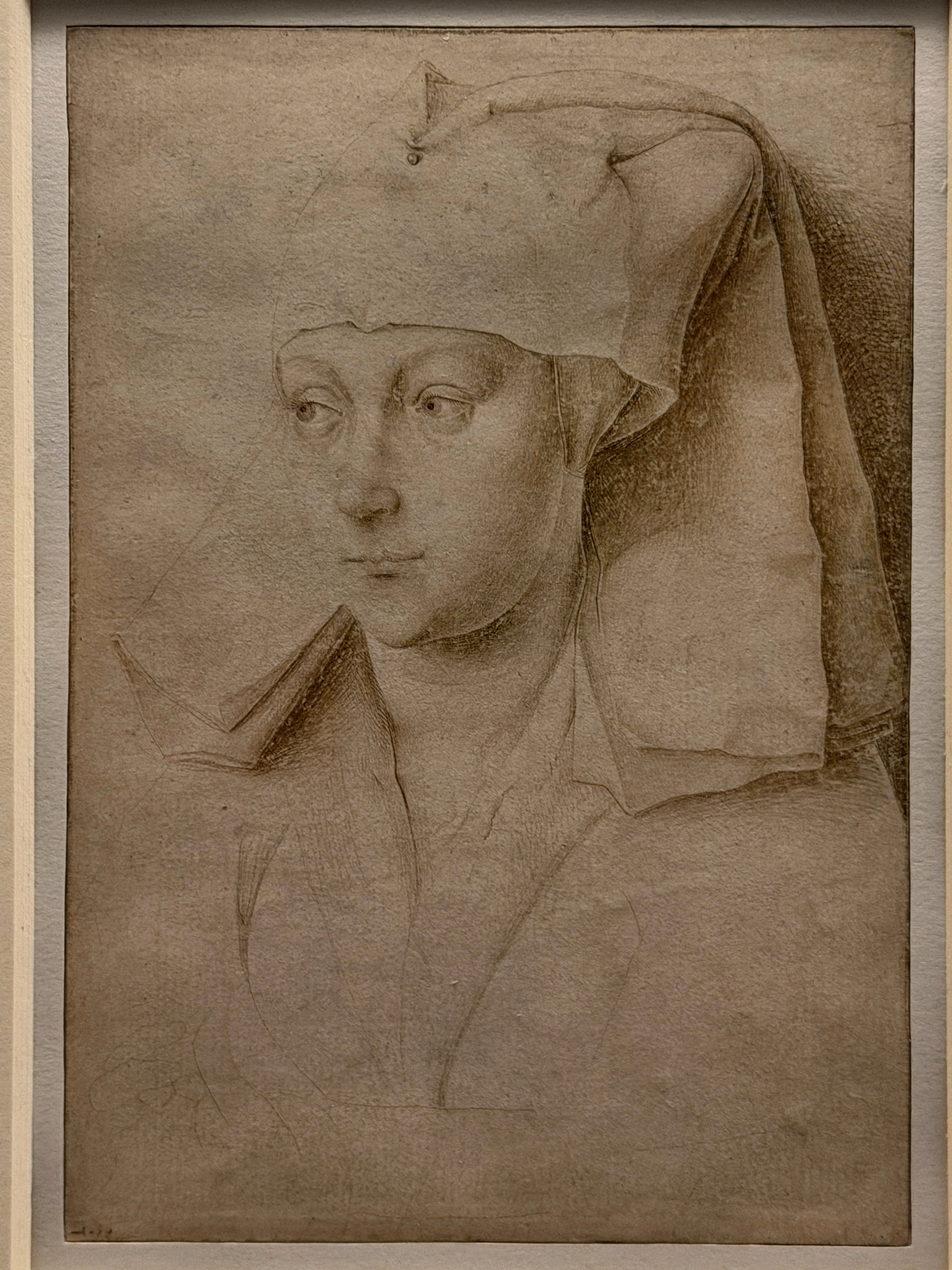
    Rogier van der Weyden (c. 1399–1464), Portrait of a Young Woman, c. 1435–40, Silverpoint on paper,166 × 116 mm, the British Museum, London
    Rogier van der Weyden (c. 1399–1464), Portrait of a Young Woman, c. 1435–40, Silverpoint on paper,166 × 116 mm, the British Museum, London


    This drawing is among the most discussed in the history of early Netherlandish art on account of its association with the two painters who, according to modern scholarship, played the most significant role in the development of northern European painting in the fifteenth century.​​​​​​​​​​​​​​​​

    The attribution to Rogier van der Weyden is accepted by the majority of modern scholarship, though not universally, and no related painting based on this design is known. The British Museum notes its stylistic proximity to Jan van Eyck (c. 1390–1441), visible in the handling of line and form as seen in the underdrawing technique of the Arnolfini Portrait, now in the National Gallery, London, and scholars have raised the possibility that the drawing engages directly with a lost Van Eyck prototype. If that reading holds, it is the only surviving proof  in which the working methods of both great artists meet on a single sheet, one thinking through the visual language of the other.

    The subject is an unknown young woman in three-quarter view wearing a linen headdress. The linen veil (doek) is recorded with particular care: the pull of cloth across the crown, the turns at the temple, the small pins that secure the arrangement reflect the practical reality of how such veil was worn and assembled in the fifteenth century. The contour of the brow, the recession of the far side of the face, and the exact fall of linen were all fixed on first contact, since silverpoint  cannot be erased or altered. Every line is the line as it was first made.

    Modern scholarship treats Van Eyck and Van der Weyden as the two figures who together established the foundations of northern European painting in the fifteenth century. Van Eyck developed oil painting to a point where it could render the specific weight of cloth, the translucency of skin, and the behaviour of light across different surfaces. Van der Weyden took the same observational precision and directed it toward the emotional state of the figure — the tension around a mouth, the quality of attention in a pair of eyes. 

    The generation that followed — Petrus Christus (c. 1410–1475/76), Dieric Bouts (c. 1415–1475), Hugo van der Goes (c. 1440–1482), Hans Memling (c. 1430–1494) and others — absorbed both inheritances and could not be understood without either.​​​​​​​​​​​​​​​​

    Van der Weyden’s compositional formulations reached painters across Europe through workshop transmission and, from the 1470s onward, through the engravings of Martin Schongauer (1448-1491), whose prints carried Netherlandish figure types and compositional structures across Europe with a speed no painted original could match. Dürer, who travelled to the Netherlands in 1520 to study this tradition at its source, is perhaps the most telling measure of how seriously that legacy continued to be regarded.

    References

    Ainsworth, M.W. (2017) Early Netherlandish Painting at the Crossroads: A Critical Look at Current Methodologies. New York: Metropolitan Museum of Art. Available at: https://www.metmuseum.org/art/metpublications/Early_Netherlandish_Painting_at_the_Crossroads (Accessed: 17 April 2026)

    British Museum (n.d.) Portrait of an unknown young woman. Available at: https://www.britishmuseum.org/collection/object/P_1874-0808-2266 (Accessed: 16 April 2026)

    National Gallery (n.d.) Jan van Eyck, The Arnolfini Portrait. Available at: https://www.nationalgallery.org.uk/paintings/jan-van-eyck-the-arnolfini-portrait (Accessed: 16 April 2026)

    Panofsky, E. (1953) Early Netherlandish Painting: Its Origins and Character. 2 vols. Cambridge, MA: Harvard University Press

    Pächt, O. (1994) Van Eyck and the Founders of Early Netherlandish Painting. London: Harvey Miller

  • The Family before the Baptism in Gerard David’s Jan des Trompes Triptych

    Gerard David (c. 1460–1523), The Baptism of Christ (Jan des Trompes Triptych), c. 1502–1508, Oil on oak, 132.2 × 182.4 cm, Groeningemuseum, Bruges

    Gerard David (c. 1460–1523), The Baptism of Christ (Jan des Trompes Triptych), c. 1502–1508, Oil on oak, 132.2 × 182.4 cm, Groeningemuseum, Bruges

    This triptych belongs to the Netherlandish tradition in which sacred history unfolds within a continuous, naturalised world. In David’s handling, the tranquility of the scene keeps the baptism close—not as a remote episode, but as something sustained through the ritual practices that shaped its meaning.

    On one wing, Jan des Trompes and his son kneel, brought forward by Saint John the Evangelist; on the other, Elisabeth van der Meersch appears with their four daughters, under the care of Saint Elizabeth of Hungary. After his wife death, the exterior panel is reworked to include his new wife Magdalena Cordier, presented by Mary Magdalene.

    At the centre, John the Baptist marks the moment, his role continuing into the distance where his preaching and recognition of Christ are set into the landscape. The scene extends quietly into the landscape without losing its stillness.

    The family is placed beside the sacred scene rather than within it, their devotion turned toward the central mystery. The Baptism is treated as a revelation that remains present. The figures are oriented towards it, their prayer directed toward what does not depend on them. Within this order, prayer is not a plea that secures grace, but a response to what is already given.

    Gerard David (c. 1460–1523), The Baptism of Christ (Jan des Trompes Triptych), c. 1502–1508, Oil on oak, 132.2 × 182.4 cm, Groeningemuseum, Bruges
    Gerard David (c. 1460–1523), The Baptism of Christ (Jan des Trompes Triptych), c. 1502–1508, Oil on oak, 132.2 × 182.4 cm, Groeningemuseum, Bruges
    Gerard David (c. 1460–1523), The Baptism of Christ (Jan des Trompes Triptych), c. 1502–1508, Oil on oak, 132.2 × 182.4 cm, Groeningemuseum, Bruges
    Gerard David (c. 1460–1523), The Baptism of Christ (Jan des Trompes Triptych), c. 1502–1508, Oil on oak, 132.2 × 182.4 cm, Groeningemuseum, Bruges
    Gerard David (c. 1460–1523), The Baptism of Christ (Jan des Trompes Triptych), c. 1502–1508, Oil on oak, 132.2 × 182.4 cm, Groeningemuseum, Bruges
    Gerard David (c. 1460–1523), The Baptism of Christ (Jan des Trompes Triptych), c. 1502–1508, Oil on oak, 132.2 × 182.4 cm, Groeningemuseum, Bruges
    Gerard David (c. 1460–1523), The Baptism of Christ (Jan des Trompes Triptych), c. 1502–1508, Oil on oak, 132.2 × 182.4 cm, Groeningemuseum, Bruges

    References

    RKD – Netherlands Institute for Art History (n.d.), Gerard David (c. 1460–1523), The Baptism of Christ (Jan des Trompes Triptych), c. 1502–1508. RKDimages database entry no. 43964. Available at:https://rkd.nl/images/43964  (Accessed: 6 April 2026)

  • The Virgin No One Can Settle

    Jean Fouquet (1410 / 1430–1477 / 1481), Madonna Surrounded by Seraphim and Cherubim, c. 1450, Oil on panel, 92 × 83.5 cm, Koninklijk Museum voor Schone Kunsten, Antwerp

    Jean Fouquet (1410 / 1430–1477 / 1481), Madonna Surrounded by Seraphim and Cherubim, c. 1450, Oil on panel, 92 × 83.5 cm, Koninklijk Museum voor Schone Kunsten, Antwerp
    Jean Fouquet (1410/1430–1477/1481), Madonna Surrounded by Seraphim and Cherubim, c. 1450, Oil on panel, 92 × 83.5 cm, Koninklijk Museum voor Schone Kunsten, Antwerp

    Painted for the Collegiate Church of Notre-Dame in Melun,
    the diptych once stood above the tomb of Catherine Budé,
    wife of Étienne Chevalier (c. 1410–1474).

    That setting has fractured.
    The Virgin now in Antwerp,
    Chevalier with St Stephen in Berlin,
    a medallion from the frame in the Louvre.

    The Virgin sits before a compressed field of angels.
    Red and blue, arranged with near-heraldic clarity.

    Their bodies press forward.
    Space narrows, becomes controlled.

    One breast uncovered.
    Defined with precision rather than softness.

    The type recalls the Virgo lactans,
    yet devotional warmth does not fully settle here.

    The face withdraws.
    Pale. Self-contained. Resistant to easy engagement.

    Agnès Sorel (1422–1450) presses close to the image.
    At the court of Charles VII (1403–1461),
    her presence as the first officially recognised royal mistress took on formal visibility,
    unsettling established hierarchies.

    Proximity to the king strained relations with the Dauphin Louis,
    later Louis XI (1423–1483).
    Exile followed.

    That history does not unfold here.
    It lingers at the edge.

    The exposed breast offers nourishment,
    yet avoids tenderness.

    Its clarity draws attention
    without resolving its meaning.

    The figure does not settle.
    Neither fully maternal,
    nor reducible to portrait.

    The face holds both in suspension.

    Chevalier kneels in the companion panel,
    finance minister, executor of Sorel’s will.

    Patronage, memory, obligation—
    all remain close.

    The Virgin’s red, white, and blue
    align with the heraldic colours of Charles VII.

    Catherine Budé’s tomb anchors the work,
    yet her absence complicates it.

    The figure gathers these presences
    without fixing them—

    whose memory, whose presence, remains here?


    References


    RKD – Netherlands Institute for Art History (n.d.), Jean Fouquet (1410/1430–1477/1481), Madonna Surrounded by Seraphim and Cherubim, c. 1450, RKDimages database entry no. 247521 Available at: https://rkd.nl/images/247521 (Accessed 22 March 2025)

    Gemäldegalerie Berlin (Staatliche Museen zu Berlin) (n.d.) Étienne Chevalier mit dem heiligen Stephanus. Collection database record. Available at: https://recherche.smb.museum/detail/865553/%c3%a9tienne-chevalier-mit-dem-heiligen-stephanus (Accessed 22 March 2025).

    Musée du Louvre (n.d.) Autoportrait en médaillon, collection database (Département des Objets d’art du Moyen Âge, de la Renaissance et des temps modernes). Available at: https://collections.louvre.fr/ark:/53355/cl010115375 (Accessed 22 March 2025)

  • Pieter Pourbus, A Triptych Wing with Juan López Gallo and His Sons

    Pieter Pourbus (c. 1523–1584), Juan López Gallo, President of the Spanish Nation, and His Sons, 1568, Oil on oak panel, 98 × 51.7 cm, Groeningemuseum, Bruges

    Pieter Pourbus (c. 1523–1584), Juan López Gallo, President of the Spanish Nation, and His Sons, 1568, Oil on oak panel, 98 × 51.7 cm, Groeningemuseum, Bruges

    When López Gallo knelt before his prie-dieu to be painted, he did so alongside his wife Catharina Pardo and their nine children, the entire household gathered in devotion across the three panels of a triptych. That unity has not survived. The central panel has never been recovered, and the right wing depicting Catharina with her six daughters has been missing since 1882. What remains is the left wing alone: López Gallo kneeling in prayer, his three sons standing behind him, their identities marked by the heraldry on the prie-dieu and echoed on his surcoat. He was originally accompanied by his patron saint, John the Baptist, later removed from the surface. In works of this kind, the saint typically mediates the act of prayer, bridging the donor and the sacred figure. His removal leaves the devotional gesture intact but less grounded, subtly shifting the panel’s internal balance.

    López Gallo appears here as the head of the Spanish Nation in Bruges, one of several merchant corporations that structured Iberian trade in the city. Even as Bruges’ economic success waned, these institutions stayed, and the painting is a proof of their continued presence.

    The Bruges context sharpens this fragment further. Retable panels for foreign patrons formed a notable strand of local art production in the mid-sixteenth century, even as Antwerp already dominated international art markets. Pourbus was one of the principal painters within this milieu. Arriving in Bruges in 1543 in the orbit of Lancelot Blondeel (c. 1498–1561), he rose to prominence through major commissions. His approach—ordering figures with clarity and suppressing anecdotal detail—proved influential among Bruges painters well into the later sixteenth century.

    Pieter Pourbus (c. 1523–1584), Juan López Gallo, President of the Spanish Nation, and His Sons, 1568, Oil on oak panel, 98 × 51.7 cm, Groeningemuseum, Bruges
    Pieter Pourbus (c. 1523–1584), Juan López Gallo, President of the Spanish Nation, and His Sons, 1568, Oil on oak panel, 98 × 51.7 cm, Groeningemuseum, Bruges

    References

    Van Oosterwijk, A. (ed.) (2017) The Forgotten Masters: Pieter Pourbus and Bruges Painting from 1525 to 1625. Ghent: Snoeck

  • Mary of Burgundy (1457–1482), last Valois Duchess of Burgundy and heir to the Burgundian Netherlands

    Mary of Burgundy (1457–1482), last Valois Duchess of Burgundy and heir to the Burgundian Netherlands

    Renier van Thienen (active c.1470–1495), Jan Borman II (c.1460–1520), Pieter de Backere (active late fifteenth century) and Jehan Hervy (active late fifteenth century), Tomb of Mary of Burgundy, c.1488–1502, Brass, copper, bronze and enamel effigy on black stone sarcophagus, 260 × 135 × 135 cm, Church of Our Lady, Bruges

    Renier van Thienen (active c.1470–1495), Jan Borman II (c.1460–1520), Pieter de Backere (active late fifteenth century) and Jehan Hervy (active late fifteenth century), Tomb of Mary of Burgundy, c.1488–1502, Brass, copper, bronze and enamel effigy on black stone sarcophagus, 260 × 135 × 135 cm, Church of Our Lady, Bruges
    Renier van Thienen (active c.1470–1495), Jan Borman II (c.1460–1520), Pieter de Backere (active late fifteenth century) and Jehan Hervy (active late fifteenth century), Tomb of Mary of Burgundy, c.1488–1502, Brass, copper, bronze and enamel effigy on black stone sarcophagus, 260 × 135 × 135 cm, Church of Our Lady, Bruges

    Renier van Thienen (active c.1470–1495), Jan Borman II (c.1460–1520), Pieter de Backere (active late fifteenth century) and Jehan Hervy (active late fifteenth century), Tomb of Mary of Burgundy, c.1488–1502, Brass, copper, bronze and enamel effigy on black stone sarcophagus, 260 × 135 × 135 cm, Church of Our Lady, Bruges
    Renier van Thienen (active c.1470–1495), Jan Borman II (c.1460–1520), Pieter de Backere (active late fifteenth century) and Jehan Hervy (active late fifteenth century), Tomb of Mary of Burgundy, c.1488–1502, Brass, copper, bronze and enamel effigy on black stone sarcophagus, 260 × 135 × 135 cm, Church of Our Lady, Bruges

    A young ruler lies in still metal, surrounded by the heraldry of a vanished political world.

    The tomb erected in Bruges some years after Mary of Burgundy’s death gathers into sculptural form the inheritance that had briefly converged in her person. The gilded effigy shows the duchess resting in composed stillness, crowned and wrapped in the mantle of Burgundian sovereignty. Along the sides of the sarcophagus a dense sequence of heraldic shields borne by lions unfolds in measured succession.

    These arms evoke dynastic lineage and the territories of the Burgundian house, so that the monument begins to resemble a visual genealogy as much as a funerary image, metal and stone quietly assembling the web of lands and claims once held together under Burgundian rule.

    That political configuration had taken shape during the long reign of Philip the Good (1396–1467), whose government consolidated the territories of the Low Countries into one of the most powerful princely formations of late medieval Europe. When his son Charles the Bold (1433–1477) was killed at Nancy in 1477, the inheritance passed to his only child, Mary of Burgundy.

    Her short rule unfolded at a fragile historical threshold between the Burgundian structure fashioned under Philip and the Habsburg order that would soon emerge. After 1477 the French king Louis XI (1423–1483) sought to dismantle Burgundian power, while the cities of the Low Countries compelled the young ruler to confirm their liberties in the Great Privilege of 1477.

    Her marriage that same year to Maximilian I (1459–1519) brought military support but also drew the Burgundian inheritance into the orbit of the Habsburg dynasty. Through their son Philip the Handsome (1478–1506) and grandson Charles V (1500–1558), these territories would become the political core of the Habsburg Netherlands.

    Renier van Thienen (active c.1470–1495), Jan Borman II (c.1460–1520), Pieter de Backere (active late fifteenth century) and Jehan Hervy (active late fifteenth century), Tomb of Mary of Burgundy, c.1488–1502, Brass, copper, bronze and enamel effigy on black stone sarcophagus, 260 × 135 × 135 cm, Church of Our Lady, Bruges
    Renier van Thienen (active c.1470–1495), Jan Borman II (c.1460–1520), Pieter de Backere (active late fifteenth century) and Jehan Hervy (active late fifteenth century), Tomb of Mary of Burgundy, c.1488–1502, Brass, copper, bronze and enamel effigy on black stone sarcophagus, 260 × 135 × 135 cm, Church of Our Lady, Bruges
    Renier van Thienen (active c.1470–1495), Jan Borman II (c.1460–1520), Pieter de Backere (active late fifteenth century) and Jehan Hervy (active late fifteenth century), Tomb of Mary of Burgundy, c.1488–1502, Brass, copper, bronze and enamel effigy on black stone sarcophagus, 260 × 135 × 135 cm, Church of Our Lady, Bruges
    Renier van Thienen (active c.1470–1495), Jan Borman II (c.1460–1520), Pieter de Backere (active late fifteenth century) and Jehan Hervy (active late fifteenth century), Tomb of Mary of Burgundy, c.1488–1502, Brass, copper, bronze and enamel effigy on black stone sarcophagus, 260 × 135 × 135 cm, Church of Our Lady, Bruges
    Renier van Thienen (active c.1470–1495), Jan Borman II (c.1460–1520), Pieter de Backere (active late fifteenth century) and Jehan Hervy (active late fifteenth century), Tomb of Mary of Burgundy, c.1488–1502, Brass, copper, bronze and enamel effigy on black stone sarcophagus, 260 × 135 × 135 cm, Church of Our Lady, Bruges
    Renier van Thienen (active c.1470–1495), Jan Borman II (c.1460–1520), Pieter de Backere (active late fifteenth century) and Jehan Hervy (active late fifteenth century), Tomb of Mary of Burgundy, c.1488–1502, Brass, copper, bronze and enamel effigy on black stone sarcophagus, 260 × 135 × 135 cm, Church of Our Lady, Bruges
    Renier van Thienen (active c.1470–1495), Jan Borman II (c.1460–1520), Pieter de Backere (active late fifteenth century) and Jehan Hervy (active late fifteenth century), Tomb of Mary of Burgundy, c.1488–1502, Brass, copper, bronze and enamel effigy on black stone sarcophagus, 260 × 135 × 135 cm, Church of Our Lady, Bruges
    Renier van Thienen (active c.1470–1495), Jan Borman II (c.1460–1520), Pieter de Backere (active late fifteenth century) and Jehan Hervy (active late fifteenth century), Tomb of Mary of Burgundy, c.1488–1502, Brass, copper, bronze and enamel effigy on black stone sarcophagus, 260 × 135 × 135 cm, Church of Our Lady, Bruges
    Renier van Thienen (active c.1470–1495), Jan Borman II (c.1460–1520), Pieter de Backere (active late fifteenth century) and Jehan Hervy (active late fifteenth century), Tomb of Mary of Burgundy, c.1488–1502, Brass, copper, bronze and enamel effigy on black stone sarcophagus, 260 × 135 × 135 cm, Church of Our Lady, Bruges
    Renier van Thienen (active c.1470–1495), Jan Borman II (c.1460–1520), Pieter de Backere (active late fifteenth century) and Jehan Hervy (active late fifteenth century), Tomb of Mary of Burgundy, c.1488–1502, Brass, copper, bronze and enamel effigy on black stone sarcophagus, 260 × 135 × 135 cm, Church of Our Lady, Bruges

    References

    Van Loo, B. (2021) The Burgundians: A Vanished Empire: A History of 1111 Years and One Day. Translated by N. Forest-Flier. London: Head of Zeus.


  • The Braunschweiger Monogrammist’s The Loose Society and the Regulation of Brothel Life in Sixteenth-Century Antwerp

    Braunschweiger Monogrammist (fl. in Antwerp c. 1525–1545), The Loose Society, c. 1535–1540, Oil on oak, 30,1 x 46,5 cm, Gemäldegalerie

    Braunschweiger Monogrammist (fl. in Antwerp c. 1525–1545), The Loose Society, c. 1535–1540, Oil on oak, 30,1 x 46,5 cm, Gemäldegalerie


    Elusive in identity and known from only a small number of surviving works, the Braunschweiger Monogrammist produced several carefully staged interior scenes. Within this corpus, the Berlin painting is the most complex in its organisation of space and action.

    On the left, a long table anchors a compact group of figures: women sit on men’s knees, couples lean into tactile negotiation, glasses are raised, and bodies press together. The barred openings and markings on the wall suggest a commercial rather than a domestic environment.

    The right side shifts the tone dramatically. On the floor, two women fight, one forcing the other down. A man bends forward to pour water over them in an attempt to break up the fight, while nearby a woman extends her arm to restrain another man from intervening. Numerous smaller details, charged with coded meaning, are embedded in the setting, so that the brothel interior emerges as a closely observed theatre in which seduction, calculation, possession, and disorder unfold within a single continuous space.

    Such ambivalence reflects historical reality. In sixteenth-century Netherlandish cities brothels were condemned in principle yet regulated in practice. Commercial centres such as Antwerp drew merchants, labourers, sailors, and foreign mercenaries. From the time of the Burgundian dukes, and later under the Habsburg crown, pragmatic containment frequently prevailed over prohibition. Brothels functioned as managed outlets within a volatile urban environment.

    The painting captures precisely this fragile equilibrium. It moralises, yet it also observes; it entertains, yet it dissects. In doing so, it occupies an interesting position between didactic imagery and the emerging Netherlandish genre painting — a compact genre scene in which moral framing and social observation operate in deliberate tension.


    References

    RKD – Netherlands Institute for Art History (n.d.), Braunschweiger Monogrammist (fl. in Antwerp c. 1525–1545), The Loose Society, c. 1535–1540, RKDimages database entry no. 51439 , Available at: https://rkd.nl/images/51439 (February 16 2026)

    Other versions

    RKD – Netherlands Institute for Art History (n.d.), after Master of Brunswick (fl. in Antwerp c. 1525–1545), Brothel Scene with Card Players, c. 1540, RKDimages database entry no. 56035, Available at: https://rkd.nl/images/56035(February 16 2026)

    RKD – Netherlands Institute for Art History (n.d.), Braunschweiger Monogrammist (fl. in Antwerp c. 1525–1545), The Loose Society, c. 1535–1540, RKDimages database entry no. 213411 Available at: https://rkd.nl/images/213411 ( February 16 2026)

  • Petrus Christus’ Portrait of a Young Girl: Between Burgundian Code and Individual Presence

    Petrus Christus (active c. 1444–1476), Portrait of a Young Woman, c.1470, Oil on oak panel, 29 x 22.5 cm, Gemäldegalerie, Berlin
    Petrus Christus (active c. 1444–1476), Portrait of a Young Woman, c.1470, Oil on oak panel, 29 x 22.5 cm, Gemäldegalerie, Berlin

    The sitter appears composed within the frame, her presence stabilised through dress, posture, and the tight limits of the composition. Everything required for recognition is present — and yet we know neither who she is nor why the portrait was made.

    That sense of completion sits oddly beside a long history of misattribution. For centuries the portrait was attributed to Jan van Eyck(1390-1441). Petrus Christus was recovered as an independent Bruges master only in the nineteenth century through the work of Gustav Friedrich Waagen (1794-1868) and later Max J. Friedländer (1867-1958), who reconstructed a small, unusually coherent oeuvre. That the painting sat so long under Van Eyck’s name is itself a measure of its quality: precise and authoritative enough to bear the greater reputation.

    The sitter’s appearance conforms to the most exacting Burgundian ideals of beauty in the later fifteenth century, particularly the preference for a conspicuously high forehead. This effect was carefully produced. Hair is tightly bound and drawn back to heighten the forehead; the neck is lengthened through posture and dress; the body is compressed into a narrow vertical silhouette. The tall black headdress is a variant of the truncated, or bee-hive, hennin fashionable at the Burgundian court, reinforcing height and linearity.

    Johan Huizinga (1872–1945), in The Autumn of the Middle Ages, described a Burgundian court culture in which ceremony had become increasingly rigid and elaborate — a response, he argued, to the violence and instability of the wider world. The fixed forms of dress, precedence, and display that governed courtly life were, in his account, compensatory rather than confident: the more brittle the social order, the more exacting the performance required to sustain it. Christus’ portrait belongs to that moment. The high forehead, the stiff verticality of the hennin, the compression of the body into a narrow silhouette — all conform to a code of appearance that left little room for accident or individuality. And yet the sitter’s gaze complicates the reading. She looks out at the viewer directly, with an alertness that many art historians have found unsettling. Something personal — watchful, self-possessed, faintly resistant — survives within the form.

    References

    Dyballa, K. and Kemperdick, S. (eds.) (2024) Netherlandish and French Paintings 1400–1480: Critical Catalogue for the Gemäldegalerie – Petersberg: Michael Imhof Verlag

    Huizinga, J. (1996) The Autumn of the Middle Ages. Chicago: University of Chicago Press

  • Bathsheba Observed by King David: Jan Matsys and the Language of Antwerp Mannerism

    Jan Matsys (c. 1509–1575), Bathsheba Observed by King David, c. 1560s–early 1570s, Oil on  panel, 110 x 76 cm, Hatfield House, Hertfordshire

    Jan Matsys (c. 1509–1575), Bathsheba Observed by King David, c. 1560s–early 1570s, Oil on  panel, 110 x 76 cm, Hatfield House, Hertfordshire
    Jan Matsys (c. 1509–1575), Bathsheba Observed by King David, c,1560s–early 1570s, Oil on  panel, 110 x 76 cm, Hatfield House, Hertfordshire

    Jan Massys (c.1509–1575), son of the more renowned Quinten Massys (c.1466–1530), turned decisively from his father’s pious and civic-minded subjects. Where Quinten treated religious themes with Gothic-inflected realism and dense devotional symbolism, Jan addressed a secular, courtly audience drawn to allegory, artifice, and eroticism.

    His Bathsheba, drawn from 2 Samuel 11, exemplifies this shift. The biblical episode—David observing from a rooftop before inquiring about the woman—is reimagined in a polished, Italianate idiom. Bathsheba appears in the foreground, pale and statuesque, her skin rendered with porcelain smoothness, her hair coiled in gold netting and set with jewels. She gazes into a mirror, serene and self-contained. Her elongated, serpentine form reflects both Italian and Flemish Mannerist ideals: elegant, weightless, consciously artificial.

    Behind her stand carved male statues, possibly personifications of Law and Wisdom. Their stony immobility heightens the contrast with Bathsheba’s living softness and underscores the moral tension—virtue observing as temptation unfolds. In the biblical account, David, from the loggia of an opposite building, asks a servant who she is; on learning that she is Bathsheba, wife of Uriah, he sets in motion a chain of lust, deceit, and murder.

    The architecture conflates an imagined Jerusalem with elements familiar from sixteenth-century Antwerp: domes, loggias, arcades, and a bell tower create a civic backdrop for sacred history, situating the episode within a moralised contemporary framework. The mirror at the composition’s centre engages with vanitas traditions, carrying both flattering and admonitory associations—eroticising the figure while signalling moral peril.

    Painted in the decades leading to the iconoclasm and religious upheavals of the Low Countries, the work balances on the edge between beauty and sin. Jan replaces the devotional gravity of his father’s altarpieces with the courtly language of Mannerism—stylised nudity, sculptural poise, moral allegory, and calculated artifice. This Bathsheba is not intended for public devotion but as moral theatre for the private eye, reflecting on the fragility of virtue, the seductions of power, and the unstable border between sacred text and worldly desire.

    Jan Matsys (c. 1509–1575), Bathsheba Observed by King David, c. 1560s–early 1570s, Oil on  panel, 110 x 76 cm, Hatfield House, Hertfordshire
    Jan Matsys (c. 1509–1575), Bathsheba Observed by King David, c. 1560s–early 1570s, Oil on  panel, 110 x 76 cm, Hatfield House, Hertfordshire
    Jan Matsys (c. 1509–1575), Bathsheba Observed by King David, c. 1560s–early 1570s, Oil on  panel, 110 x 76 cm, Hatfield House, Hertfordshire
    Jan Matsys (c. 1509–1575), Bathsheba Observed by King David, c. 1560s–early 1570s, Oil on  panel, 110 x 76 cm, Hatfield House, Hertfordshire

    References

    Galassi, M.C. (2024) Jan Massys (c.1510–1573): Renaissance Painter of Flemish Female Beauty. Turnhout: Brepols Publishers