Category: Limoges Enamel

  • Attributed to François I Limousin (active before 1582-after 1615), ‘Portrait of  Diane de Poitiers (1500 –  1566)’, c.1600

    Attributed to François I Limousin (active before 1582-after 1615), Portrait of  Diane de Poitiers (1500 –  1566), c.1600, Limoges enamel on copper, 28.8 x 21.7 cm, The British Museum, London, The Waddesdon (Rothschild) Bequest, Room 3
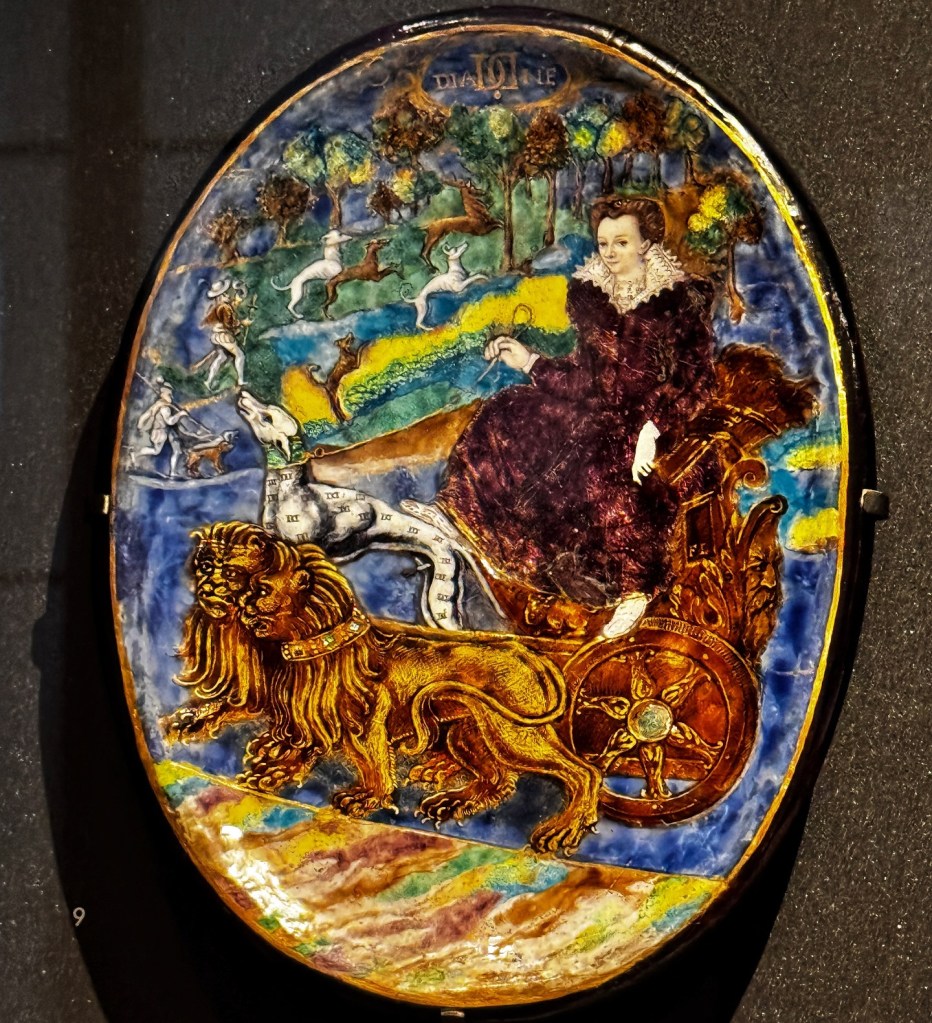
    Attributed to François I Limousin (active before 1582-after 1615), Portrait of  Diane de Poitiers (1500 –  1566), c.1600, Limoges enamel on copper, 28.8 x 21.7 cm, The British Museum, London, The Waddesdon (Rothschild) Bequest, Room 3

    This 16th-century Limoges plaque, part of the Waddesdon Bequest assembled by Baron Anselm von Rothschild (1803–1874) and his son Baron Ferdinand de Rothschild (1839–1898), reflects their fascination with Renaissance drama and historical narratives that have inspired artists and collectors for centuries. Created decades after Diane de Poitiers’ death, it portrays her, the favourite mistress of King Henri II of France (1519–1559), as Diana, goddess of hunting.

    Over twenty years older than Henri, she was far more than a mistress—she acted as his confidante, advisor, and maternal guide through his formative years and reign. Her power extended into governance, where she managed finances and appointments and co-signed royal decrees. The king’s gift of the Château de Chenonceau symbolised her position, and Diane de Poitiers turned it into an architectural masterpiece. Renaissance artists frequently portrayed her as a mythological goddess, aligning her with chastity, grace, and authority.

    This plaque captures the mythologised image of Diane that persisted long after her death. She is depicted in a lion-drawn chariot, symbolising regal power, surrounded by hunting dogs and a woodland setting that emphasises her role as goddess of the hunt. Her interlaced ‘DD’ monogram appears on a white hound beneath her foot, subtly tying her identity to Diana. The translucent enamels and gilding elevate the scene, presenting her as a timeless symbol of strength, elegance, and Renaissance ideals.

  • Attributed to Jean de Court (fl. 1550–1583),‘ Jacob’s vision of Heaven, c. 1560

    Attributed to Jean de Court (fl. 1550–1583), Jacob’s vision of Heaven, c. 1560, Limoges Enamel Tazza, Copper, enamel, gold, 25.2 cm wide, 10.3 cm high, 25.2 cm, The British Museum, London, The Waddesdon (Rothschild) Bequest, Room 3

    Attributed to Jean de Court (fl. 1550–1583), Jacob’s vision of Heaven, c. 1560, Limoges Enamel Tazza, Copper, enamel, gold, 25.2 cm wide, 10.3 cm high, 25.2 cm, The British Museum, London, The Waddesdon (Rothschild) Bequest, Room 3

    Crafted from copper and decorated with painted enamel and gilding, the piece demonstrates the mastery of Limoges artisans in the 16th century, who were renowned for their ability to create durable, vibrant surfaces. The grisaille technique—a monochromatic palette of grey tones accented with subtle salmon pink for flesh—gives the composition a sculptural depth. The enlevage method, involving the scraping away layers of enamel to reveal contrasting colours beneath, adds intricate detailing. Gilded highlights further enhance the brilliance of the design, making this tazza both visually striking and technically advanced.

    The interior of the tazza is adorned with a biblical scene depicting Jacob’s Ladder, drawn from the Book of Genesis. The central image shows Jacob asleep beneath a tree, dreaming of a ladder from earth to heaven. Angels ascend and descend the ladder. This iconography symbolises the connection between humanity and the divine, a theme central to the Renaissance worldview. The ladder represents the bridge between earthly existence and spiritual enlightenment, with the ascending and descending angels serving as metaphors for prayers rising to heaven and divine blessings returning to earth.

  • Attributed to Jean de Court (Fl. 1550–1583), ‘Mucius Scaevola before Lars Porsenna’, c. 1580

    Attributed to Jean de Court (Fl. 1550–1583), Mucius Scaevola before Lars Porsenna, c. 1580, Limoges enamel tazza, copper, enamel, gold; 19 cm wide, 6.5 cm high, 19 cm deep. The British Museum, London, The Waddesdon (Rothschild) Bequest, Room 3

    Attributed to Jean de Court (Fl. 1550–1583), Mucius Scaevola before Lars Porsenna, c. 1580, Limoges enamel tazza, copper, enamel, gold; 19 cm wide, 6.5 cm high, 19 cm deep. The British Museum, London, The Waddesdon (Rothschild) Bequest, Room 3

    The narrative portrayed on the tazza recounts the heroic act of Mucius Scaevola, a young Roman who infiltrated the camp of the Etruscan king Lars Porsenna during Rome’s early struggle for survival. When captured, Mucius demonstrated his unwavering courage and loyalty to Rome by placing his hand into the flames, showing no sign of pain or fear to prove his dedication to Rome and intimidate the king. This act of self-sacrifice not only spared his life but also convinced Porsenna to end his siege of the city. The legendary story of Mucius Scaevola and Lars Porsenna, derived from Livy’s ‘History of Rome’ (59 BCE–17 CE) and was celebrated throughout the Renaissance as an emblem of civic virtue, illustrating the triumph of personal honour, courage, and republican ideals over tyranny.

    In this work, Jean de Court, known as Master IC, employs the painted enamel techniques for which Limoges was famous. Vibrant enamel colours, detailed gilding, and a polished copper surface create a luminous effect, enhancing the scene’s dramatic tension. This technical mastery reflects the Renaissance fascination with classical antiquity and its ideals and the desire to translate complex narratives into intellectually engaging artworks

  • Leonard Limosin (c.1505–c.1577), ‘Portrait of Anne d’Este (1531–1607)’, c.1563–66

    Leonard Limosin (c.1505–c.1577), Portrait of Anne d’Este (1531–1607), c.1563–66. Painted and enamelled on copper, Limoges, 30 × 47 cm. Rothschild’s Waddesdon Bequest, Collection of The British Museum, London

    Leonard Limosin (c.1505–c.1577), Portrait of Anne d’Este (1531–1607), c.1563–66. Painted and enamelled on copper, Limoges, 30 × 47 cm. Rothschild’s Waddesdon Bequest, Collection of The British Museum, London

    Long identified as Catherine Mary of Lorraine, Duchess of Montpensier (1551–1596), the sitter is now recognised as her mother, Anne d’Este, Duchess of Guise (1531–1607).

    Anne, the daughter of Ercole II, Duke of Ferrara — himself the son of Lucrezia Borgia and grandson of Pope Alexander VI — and Renée of France, daughter of King Louis XII of France, occupied a singular position within the shifting political landscape of the French Wars of Religion. Her marriage in 1548 to Francis, Duke of Guise, tied her to one of the most powerful Catholic families in France and bound her closely to Catherine de’ Medici. The assassination of Francis in 1563 shaped the next phase of her life, as she pursued vengeance against his killer, the Huguenot leader Gaspard de Coligny.

    Her second marriage in 1566 to Jacques of Savoy, Duke of Nemours and Genevois, reinforced her status, but his death in 1585 left her once again a widow at the centre of factional struggles. The Catholic League, sustained in part by her sons, increased her political significance, yet also brought her into direct conflict with King Henry III, who in 1588 had her two eldest sons murdered and placed her under arrest. Though implicated by some in Henry’s own assassination, she later rallied to Henry IV, acknowledging his legitimacy and working to stabilise the realm. In her final years she served Queen Marie de’ Medici as superintendante de la maison, her position confirming the enduring prestige of her house.

    The enamel portrait by Limosin, produced in Limoges around 1563–66, belongs to the moment of her widowhood, when Anne’s authority was consolidated yet fragile. Painted and enamelled on copper, it combines the luminosity and permanence of Limoges technique with the formal rigour of court portraiture. Limosin, celebrated across Europe for his mastery of enamel painting, deploys his precise line and deep, translucent colour to create a likeness that is both durable and ceremonial. The format served not only as a commemoration of her status, but also as a portable emblem of dynastic presence at a time when images carried weight in negotiation and alliance.

    At her death in 1607, an inventory of her belongings recorded an exceptional assemblage: finely crafted clocks and a library rich in texts in Italian, French, Spanish, German, Greek, and Latin, spanning ancient authorities and modern writers alike. The portrait, with its technical brilliance and courtly gravity, mirrors that cultivated environment and speaks to Anne d’Este’s place at the centre of European politics and culture.