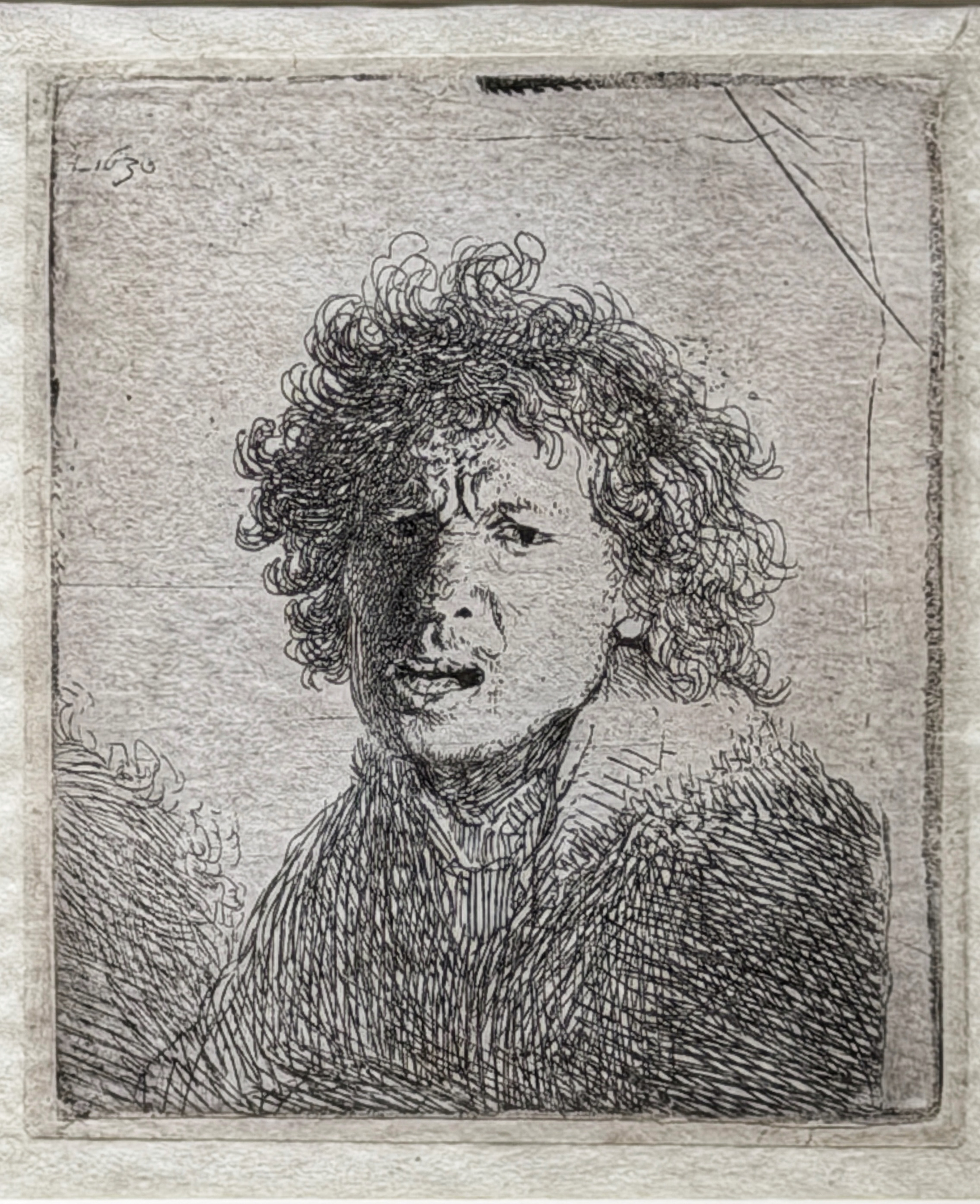
Rembrandt Harmenszoon van Rijn (1606-1669), Self-Portrait open mouthed, as if shouting: bust, Etching on laid paper: 7,0 × 5,9 cm, Signed in monogram and dated upper left: RHL 1630, Catalogued in Bartsch 13; The New Holstein 67, Second state (of III) , Douwes Fine Art, Amsterdam, Treasure House Fair , London
The tronie was an established genre long before Rembrandt, a head study built around a single emotional state or character type rather than the identity of any particular sitter. In Leiden, working alongside Jan Lievens (1607–1674), Rembrandt drew on the faces around him, family members, friends, neighbours, people from the street, as well as his own face studies, building a repertoire of human types across a range of emotional registers: surprise, grief, rage, laughter, suspicion, or, as in this sheet where the mouth falls open mid-shout and the features tighten around it, raw vocal urgency.
When Rembrandt used his own face within this practice the function was no different from any other available model, one more emotional state captured and held in reserve. Each sheet added another solved problem that could be recalled and repositioned when a history painting required a prophet crying out, a figure recoiling in fear, a crowd caught in the instant before it turns, an apostle overcome with grief, or a face registering the precise moment that doubt becomes certainty.
References
Dickey, S.S. (2019) ‘Printmaking in Leiden c. 1630: Rembrandt, Lievens, and Van Vliet’, in Coutré, J.N. (ed.) Leiden circa 1630: Rembrandt Emerges [Exhibition catalogue]. Kingston: Agnes Etherington Art Centre, Queen’s University
Gottwald, F. (2011) Das Tronie. Muster – Studie – Meisterwerk. Die Genese einer Gattung der Malerei vom 15. Jahrhundert bis zu Rembrandt [The tronie. Pattern, study and masterwork. The genesis of a genre of painting from the fifteenth century to Rembrandt]. Munich/Berlin: Deutscher Kunstverlag
Hirschfelder, D. (2008) Tronie und Porträt in der niederländischen Malerei des 17. Jahrhunderts [Tronie and portrait in seventeenth-century Netherlandish painting]. Berlin: Gebr. Mann Verlag
Van de Wetering, E. (2005a) A Corpus of Rembrandt Paintings, Volume IV: The Self-Portraits. Dordrecht: Springer
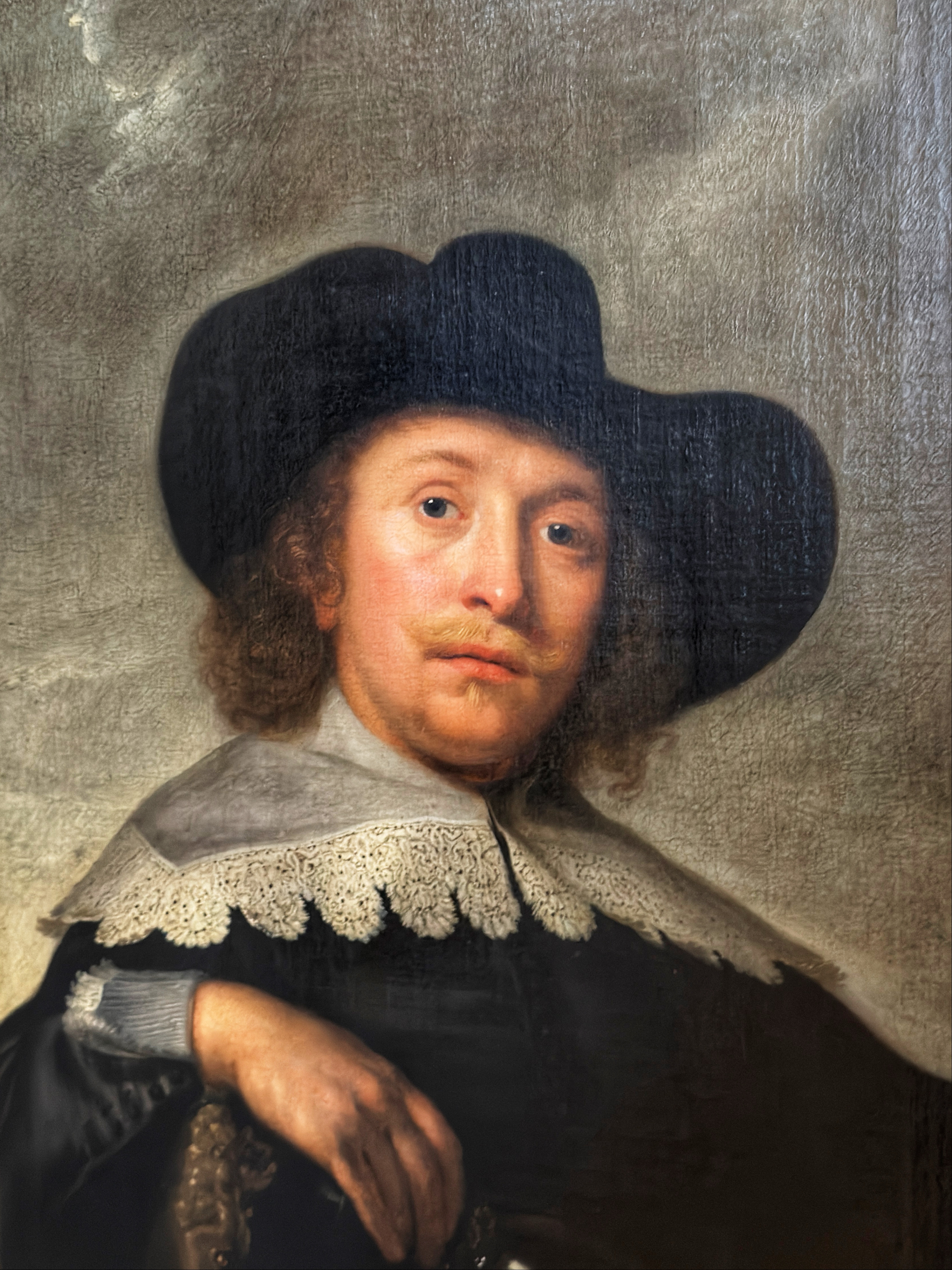
Bartholomeus van der Helst (Dutch, 1613–1670), Portrait of a Man with an Empty Wineglass, 1649, oil on canvas, 99 × 82 cm, Schwarzenberg Palace, Národní galerie Praha, Prague
It is easy to imagine the Amsterdam art market of the late 1640s as a ladder with Rembrandt at the top, but that is not quite how it worked. He had been one of the city’s most sought-after portraitists in the 1630s, so the impression of his pre-eminence rests on something real; it is only that the market was wider and more divided than any single reputation suggests. The historians who have studied Amsterdam’s surviving inventories describe a large and specialised trade in which painters tended to settle into a particular niche, and build a clientele within it (Bok, 1994). Competition at the upper end, where the larger commissions and the portraits of well-to-do sitters were decided, was real but involved a relatively small group of well established names. Van der Helst belonged to that group, and his work of these years is best understood in relation to it rather than against Rembrandt alone. Part of what set him apart was a kind of elegance that did not originate in Amsterdam at all.
By 1649 Rembrandt (1606-1669) was in any case taking on little portrait work. That October he appeared before the Amsterdam Commissioners of Marital Affairs to answer a breach-of-promise claim from Geertje Dircx (c. 1610-1656), who had nursed his son and shared his household after after his wife Saskia’s death. The case has sometimes been read as the scandal that drove away his clients, but there is little to support that. Patrons continued to commission him in the following years, among them Jan Six and the city government, which is hard to reconcile with a damaged reputation (Crenshaw, 2006). The more likely explanation is simply that his interests had shifted. He had painted few commissioned single or group portraits since the militia piece now known as the Night Watch of 1642, and the prevailing view, which ranked history painting above portraiture, fitted his own preference for the former (Turner, 2000). The opening this left in the portrait market was genuine, but it owed more to his choices than to any loss of standing.
Into it stepped a younger man who wanted precisely the work Rembrandt was setting aside. Bartholomeus van der Helst (1613-1670) had reached the front rank of Amsterdam portraiture by the late 1640s, a position put beyond doubt when the crossbowmen’s civic guard chose him to record their banquet for the Peace of Münster, held on 18 June 1648 (van Gent, 2011). The treaty that ended eighty years of war for independence had been signed that January, and the large group portrait van der Helst made from the banquet, now in the Rijksmuseum, remains the image through which that civic moment is usually remembered. This Prague portrait followed in 1649.
Taste in these years was moving away from Rembrandt’s manner, and several painters were moving with it. Jacob Backer (1608-1651) had trained alongside Govert Flinck (1615-1660) under Lambert Jacobsz in Leeuwarden before both men, together with Ferdinand Bol (1616-1680), worked in Rembrandt’s circle at Hendrick van Uylenburgh’s studio. By the later 1640s all three were lightening their palettes and clarifying their surfaces, winning commissions that an earlier decade might have sent to their teacher Rembrandt. Van der Helst’s response to the same competition was a manner contemporaries and later cataloguers found more elegant and more immediately flattering than its Amsterdam rivals, and its source was most probably Flemish. The example was Antoon van Dyck (1599- 1641), whose way of arranging a sitter had become, in the years after his death in 1641, something close to a common European language for portraying the wealthy (van Gent, 2011). The manner was Flemish in origin, but its appeal travelled well beyond Flanders. Van Dyck spent his last decade at the court of Charles I, and the easy aristocratic grace of his English portraits shaped how the wealthy expected to be painted for a generation afterwards, in England most of all (Hearn, 2009). The interesting part is the clientele to which van der Helst applied it: merchants, guardsmen and regents with no claim to old aristocratic rank, who wished all the same to be seen with the ease van Dyck had devised for those who had it.
The debt to van Dyck shows in the pose. The sitter leans on the gilt arm of a chair, his body turned three-quarters towards us, the wide black hat and loose shoulder-length curls framing a face that meets the viewer directly. The bearing is relaxed in a way the stiffer Amsterdam portrait of the 1630s rarely permitted, and instead of placing the figure against a wall, van der Helst sets him before a clouded sky broken by a single shaft of pale light at the upper left, an unusually informal setting for a sober Amsterdam likeness of these years (Ekkart and Buvelot, 2007). The dress is austere, unrelieved black relieved only by a broad linen collar edged in deep scalloped lace and a soft pleated cuff at the wrist. One hand rests on the chair. The other, lower in the canvas, curls loosely around a pale glass. The grace of the arrangement has a clear hint of van Dyck’s legacy; the gravity of the dress is Amsterdam’s own, and the meeting of the two is what this portrait formula is really about.
The glass invites reading, and there is a settled tradition for it. A held or emptied drinking glass in seventeenth-century Dutch painting carried associations of sociability and good company, and in still life and merry-company scenes an empty or overturned roemer could also strike a quieter note about how briefly such pleasures last. Van der Helst knew that language from the inside, having spent a decade composing the collective drinking of civic guard banquets, and the single glass in a single portrait brings a trace of that companionable warmth into a format that allows the sitter no company. Is the emptiness meant to carry the fuller weight of transience, or does it simply mark a pause in good company? It would probably be a mistake to force too much of a vanitas reading.
For all the borrowed Flemish polish of the pose, those heavy, striking eyes do something the elegant formula never asks for. They are the one part of the picture that seems to belong to the man rather than to the manner, the place where the practised arrangement of hat, collar and easy turn gives way to something the painter found rather than composed. Rembrandt would have gone looking for whatever sat behind them, pressing the face until it yielded a thought or a mood. Van der Helst plainly did not, and that is the curious thing, because the weight is there even so, surfacing without being sought. It is not melancholy; it is closer to the ordinary heaviness that settles into a face when the sitting runs long and the man stops performing for the painter. In a portrait built to flatter, it arrives almost by accident. Whatever it is, the sitter keeps it to himself, and stays just out of reach.
Bartholomeus van der Helst (Dutch, 1613–1670), Portrait of a Man with an Empty Wineglass, 1649, oil on canvas, 99 × 82 cm, Schwarzenberg Palace, Národní galerie Praha, PragueBartholomeus van der Helst (Dutch, 1613–1670), Portrait of a Man with an Empty Wineglass, 1649, oil on canvas, 99 × 82 cm, Schwarzenberg Palace, Národní galerie Praha, Prague
Crenshaw, P. (2006) Rembrandt’s Bankruptcy: The Artist, His Patrons, and the Art Market in Seventeenth-Century Netherlands. Cambridge: Cambridge University Press
Ekkart, R. and Buvelot, Q. (eds.) (2007) Dutch Portraits: The Age of Rembrandt and Frans Hals. The Hague: Royal Picture Gallery Mauritshuis / London: National Gallery
Hearn, K. (2009) Van Dyck and Britain. London: Tate Publishing
Middelkoop, N. (2019) Bartholomeus van der Helst (1613–1670): Portrait of the Golden Age. Rotterdam: Museum Boijmans Van Beuningen / Zwolle: WBOOKS
Montias, J.M. (2002) Art at Auction in 17th Century Amsterdam. Amsterdam: Amsterdam University Press
Ševčík, A.K. (ed.), Bartilla, S. and Seifertová, H. (2012) National Gallery in Prague: Dutch Paintings of the 17th and 18th Centuries. Prague: National Gallery in Prague
Sluijter, E.J. (2015) Rembrandt’s Rivals: History Painting in Amsterdam, 1630–1650. Amsterdam and Philadelphia: John Benjamins
Turner, J. (ed.) (2000) From Rembrandt to Vermeer: 17th-Century Dutch Artists. New York: St Martin’s Press
van Gent, J. (2011) Bartholomeus van der Helst (ca. 1613–1670): een studie naar zijn leven en werk [Bartholomeus van der Helst (ca. 1613–1670): A Study of His Life and Work]. Zwolle: Waanders
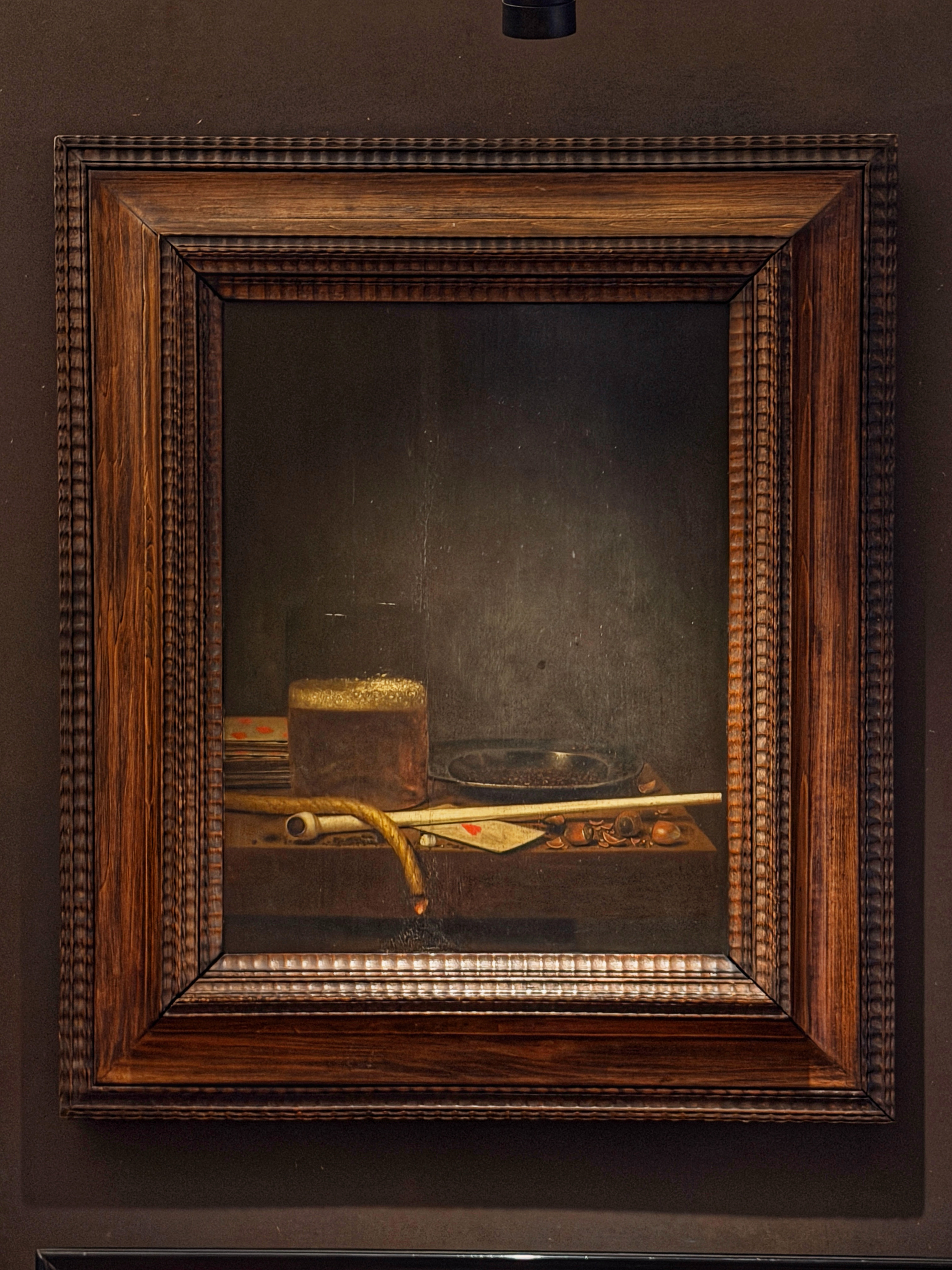
Jan Jansz van de Velde III (c.1620 – 1662), Still Life with a Beer Glass, Pipe, Playing Card, Chestnuts and Smoker’s Requisites, c.1647, Oil on oak panel, 40 × 31 cm, Národní galerie, Sternberg Palace, Prague
A herbarium published in Antwerp in 1576 recorded that seamen returning from the Americas were already smoking tobacco to satisfy their hunger, renew their strength and lighten their mood. It came in through the ports and the inns where sailors and soldiers gathered, spreading through the commercial networks of Europe. By 1630 the habit had reached all levels of Dutch society. Within another generation a painter in Haarlem or Amsterdam could build an entire career around depicting its equipment. Van de Velde III is today almost entirely forgotten, with only around 35 signed and dated works so far identified, despite coming from one of Haarlem’s most prominent artistic dynasties.
On this small panel he arranged a foaming pasglas — a ringed beer glass passed from hand to hand in drinking games, each player required to drink exactly to the next mark, not a drop more — alongside a clay pipe with a slow match draped across it, a pewter plate, a playing card showing a heart, and chestnuts, some split open and scattered on the table, a cheap autumn street food, warming and seasonal. The slow match — a length of treated hemp cord that soldiers carried to ignite their weapons on the battlefield — is here reduced to lighting a pipe on a tavern table, though it has not entirely lost where it came from. The pipe was smoked for company and for solitude alike, a remedy against melancholy as much as an invitation to it.
Jan Jansz van de Velde III (c.1620 – 1662), Still Life with a Beer Glass, Pipe, Playing Card, Chestnuts and Smoker’s Requisites, c.1647, Oil on oak panel, 40 × 31 cm, Národní galerie, Sternberg Palace, PragueJan Jansz van de Velde III (c.1620 – 1662), Still Life with a Beer Glass, Pipe, Playing Card, Chestnuts and Smoker’s Requisites, c.1647, Oil on oak panel, 40 × 31 cm, Národní galerie, Sternberg Palace, Prague
References
Seifertová-Korecká, H. (1966) ‘Jan Jansz. van de Velde’s Stilleben in der Kreisgalerie in Liberec’ [Jan Jansz. van de Velde’s still lifes in the Regional Gallery in Liberec], Oud Holland, 81, pp. 51–54. Available at, https://rkddb.rkd.nl/rkddb/digital_book/18750176_081_01_s008_text.pdf (Accessed 12 jUNE 2026)
RKD – Netherlands Institute for Art History (n.d.) Jan Jansz van de Velde III, RKDartists no. 79780. The Hague: RKD – Netherlands Institute for Art History. Available at: https://rkd.nl/en/explore/artists/79780 (Accessed: 12 June 2026).
de l’Obel, M. (1576) Plantarum seu stirpium historia [History of plants]. Antwerp: Christophe Plantin. Available at: https://archive.org/details/gri_33125009313699 (Accessed: 20 June 2026).
Chong, A. and Kloek, W.Th. (eds) (1999) Still-Life Paintings from the Netherlands, 1550–1720. Amsterdam: Rijksmuseum / Cleveland: Cleveland Museum of Art
Hendrick Goltzius (1558–1617), Self-Portrait, c. 1588–1590, Black chalk on vellum, 146 × 104 mm, The British Museum
Hendrick Goltzius (1558–1617), Self-Portrait, c. 1588–1590, Black chalk on vellum, 146 × 104 mm, The British Museum
Around 1588 to 1590, when this self-portrait was made, Goltzius was approximately thirty. He had run his own publishing workshop in Haarlem since 1582 — breaking the Antwerp monopoly on Northern European print publishing.
Painting entered his practice only in 1600, at the age of forty-two. In the late 1580s there was no need to look elsewhere: line carried, for Goltzius, the full expressive ambition that other artists distributed across multiple media.
Building on the innovations of the Netherlandish engraver Cornelis Cort (c. 1533–1578), who worked largely in Italy, Goltzius pushes the engraved stroke to an extreme: it thickens, narrows, shifts weight along its length, describing form without recourse to tonal modelling. Volume emerges from incision alone.
The physical condition of his right hand sits quietly behind all of this. Scarred in childhood and never fully mobile, it has often been treated as an explanation for the character of his line. More recent accounts are cautious on the point, yet the fact remains that this was his working hand, and that contemporaries regarded his command of the burin as exceptional.
Seen in these terms, the drawing becomes more precise in what it declares. He presents himself holding a copper-plate and, a burin — the tools of engraving — yet what he has made is a drawing in chalk. He did not reach for the instrument that defined his reputation. The line does not move onward into another process; it stops here.
Hendrick Goltzius (1558–1617), Self-Portrait, c. 1588–1590, Black chalk on vellum, 146 × 104 mm, The British MuseumHendrick Goltzius (1558–1617), Self-Portrait, c. 1588–1590, Black chalk on vellum, 146 × 104 mm, The British Museum
RKD – Netherlands Institute for Art History (n.d.), Hendrick Goltzius (1558–1617), Self-portrait, c. 1589. RKDimages database entry no. 141791. Available at: https://rkd.nl/images/141791 (Accessed: 17 April 2026).
RKD(n.d.), Hendrick Goltzius (1558–1617), Self-portrait, c. 1580–1585. RKDimages database entry no. 231405. Available at: https://rkd.nl/images/231405 (Accessed: 17 April 2026).
RKD (n.d.), Hendrick Goltzius (1558–1617), Self-portrait, c. 1589. RKDimages database entry no. 141791. Available at: https://rkd.nl/images/141791 (Accessed: 17 April 2026).
RKD (n.d.), Hendrick Goltzius (1558–1617), Right hand, 1588. RKDimages database entry no. 304736. Available at: https://rkd.nl/images/304736 (Accessed: 17 April 2026).
RKD(n.d.), Hendrick Goltzius (1558–1617), Self-portrait, c. 1600. RKDimages database entry no. 21528. Available at: https://rkd.nl/images/21528 (Accessed: 17 April 2026).
RKD (n.d.), Hendrick Goltzius (1558–1617), Self-portrait, c. 1600. RKDimages database entry no. 21528. Available at: https://rkd.nl/images/21528 (Accessed: 17 April 2026).
RKD(n.d.), Hendrick Goltzius (1558–1617), The artist’s right hand, c. 1588. RKDimages database entry no. 259907. Available at: https://rkd.nl/images/259907 (Accessed: 17 April 2026).
RKD (n.d.), Hendrick Goltzius (1558–1617), Self-portrait, c. 1605. RKDimages database entry no. 109424. Available at: https://rkd.nl/images/109424 (Accessed: 17 April 2026).
Carel Fabritius (1622–1654), A View of Delft, with a Musical Instrument Seller’s Stall, 1652, Oil on canvas, 15.5 × 31.7 cm, The National Gallery, LondonCarel Fabritius (1622–1654), A View of Delft, with a Musical Instrument Seller’s Stall, 1652, Oil on canvas, 15.5 × 31.7 cm, The National Gallery, LondonCarel Fabritius (1622–1654), A View of Delft, with a Musical Instrument Seller’s Stall, 1652, Oil on canvas, 15.5 × 31.7 cm, The National Gallery, London
This small painting raises difficult questions about how we assess quality in Old Master works. What does ‘quality’ mean when an artwork has passed through centuries, bearing abrasion, significant pigment loss, structural interventions and other changes? The condition in which a work survives is not separate from its history; it is part of it. Once an artwork leaves the artist’s studio, it begins another life in which it continues to change.
Only around twelve paintings are securely attributed to Carel Fabritius. When set against estimates that roughly 98–99 per cent of Dutch Golden Age paintings have been lost, that number alters the meaning of the period itself. ‘Golden Age’ describes prosperity and output; it does not describe survival. What remains is a narrow and uneven selection shaped by accident, taste and decay.
Conceived for a perspective box and activated from a fixed peephole, the painting was designed as a controlled optical installation. The extreme recession of the Nieuwe Kerk and the radical foreshortening of the viola da gamba cohere only when the viewer’s eye occupies a particular point; outside that position, the image becomes unstable, as it does now. The original perspective box has been lost. What remains is a small painted surface — fragile, yet ethically preserved in the condition in which it survives — a small window into Delft in the 1650s: a well-dressed merchant seated at the turn of the street, his viola da gamba and lute displayed at the stall, the Nieuwe Kerk beyond.
In its present state, it asks whether we are prepared to recognise the quality of the masterpiece within the limits that time and condition have imposed upon it.
Hendrick Avercamp (1585–1634), A Scene on the Ice near a Town, c.1615, Oil on oak panel, 58 × 89.8 cm, The National Gallery, London
Hendrick Avercamp (1585–1634), A Scene on the Ice near a Town, c.1615, Oil on oak panel, 58 × 89.8 cm. The National Gallery, London
Few painters faced a tougher challenge than Hendrick Avercamp. In the bustling art market of the Dutch Golden Age, originality was hard-won, yet Avercamp staked his career on a single subject: the frozen waterways of the Little Ice Age, where society turned public space into social theatre. From this narrow focus he carved out an entirely new pictorial type.
Hendrick Avercamp (1585–1634) was born in Amsterdam into a family of apothecaries but moved as a child with his family to Kampen, where he would spend most of his life. Contemporary sources describe him as mute, probably also deaf, which earned him the name de Stomme van Kampen (‘the mute of Kampen’). His training under Pieter Isaacsz (1569–1625), a painter active at both the Danish and Dutch courts and steeped in Haarlem Mannerism, gave him a solid basis in figure drawing and taste for decorative refinement. Scholars also suspect he absorbed lessons from Gillis van Coninxloo (1544–1607) and David Vinckboons (1576–1632), whose landscapes and figure types echo through his own compositions. Yet what Avercamp created with his winter scenes was something new: a formula in which he set out, very consciously as a young man, to prove himself against the most crowded and competitive art market in Europe.
The Dutch Golden Age was a harsh place to earn a living as a painter. The market overflowed not only with contemporary works but also with paintings from earlier generations, imported from different regions and traditions. Within this environment, originality had to be visible and immediate. Avercamp’s response was the panoramic winter scene, drawn directly from the frozen canals and rivers of the Little Ice Age. These works appear cheerful at first sight, animated with skating crowds, lovers, drinkers, and children tumbling on the ice. But the more one looks, the more the atmosphere darkens. A note of melancholy hangs behind the bustle, a quiet stillness that sets the tone as much as the humour. It may be linked to Avercamp’s disability, his position as an outsider who watched the social theatre but did not take part in it.
If Pieter Bruegel the Elder (c.1525–1569) provided a model for winter scenes, Avercamp stripped away allegory and moralising. His panels are bluntly descriptive yet never merely documentary. At the same time, skating was too charged an image for viewers not to read moral meaning into it—life as unstable ground, pleasure as a dangerous risk. The works hover between affectionate detail and emblematic possibility, which is part of their enduring power.
The problem is that his oeuvre is uneven. Some early paintings are astonishingly refined, the main figures finished with crisp precision. Others, from the same period, feel sketchy. It is not easy to separate intention from condition. Many panels seem to have been built in layers, refined details laid over looser underpainting. Four centuries on, it is often the fragile glazes that have disappeared with the varnish, leaving a rougher surface than Avercamp meant us to see. This unevenness also complicates attribution, especially since his success generated a wave of imitation.
His drawings offer a more reliable insight into his working method. A greater number of securely attributed sheets survive than paintings, and these reveal the process of developing ideas in sketch form — figures noted from life, later adapted and reiterated as stock motifs within panel compositions. Stories on the ice were not invented afresh each time but developed and re-used.This also links him to a wider Netherlandish tradition. Already in the sixteenth century, painters in the Low Countries specialised in crowd scenes that balanced dozens of figures in correct proportion, something that was never common in Italy, for example.
The fragments of his biography add to the sense of distance. He lived between Kampen and Amsterdam, probably travelling with his mother, on whom he depended not only as a child but also as an adult restricted by his disability. What we know comes in scraps, reconstructed by scholars who are still piecing together the roots of his peculiar formula.
His career ended abruptly in 1634, probably due to plague. Yet the formula outlived him. His nephew Barend Avercamp (1612–1679) possibly collaborated with him and then carried on the winter scene for decades, his paintings often difficult to distinguish from Hendrick’s own. Other artists joined in, repeating the formula to the point that the field of attribution has become murky. Still, Avercamp had set the type: the animated winter panorama, packed with anecdote yet carrying a peculiar emotional charge. His surviving oeuvre is small—barely thirty paintings can be securely given to him—but reinforced by drawings that show the careful eye and steady hand behind the apparent spontaneity. These works defined winter as a lasting theme in Dutch art and left behind images that are not only lively records of public life but also haunted by a quiet, unmistakable melancholy.
Hendrick Avercamp (1585–1634), A Scene on the Ice near a Town, c.1615, Oil on oak panel, 58 × 89.8 cm, The National Gallery, LondonHendrick Avercamp (1585–1634), A Scene on the Ice near a Town, c.1615, Oil on oak panel, 58 × 89.8 cm. The National Gallery, LondonHendrick Avercamp (1585–1634), A Scene on the Ice near a Town, c.1615, Oil on oak panel, 58 × 89.8 cm. The National Gallery, LondonHendrick Avercamp (1585–1634), A Scene on the Ice near a Town, c.1615, Oil on oak panel, 58 × 89.8 cm. The National Gallery, LondonHendrick Avercamp (1585–1634), A Scene on the Ice near a Town, c.1615, Oil on oak panel, 58 × 89.8 cm. The National Gallery, LondonHendrick Avercamp (1585–1634), A Scene on the Ice near a Town, c.1615, Oil on oak panel, 58 × 89.8 cm. The National Gallery, LondonHendrick Avercamp (1585–1634), A Scene on the Ice near a Town, c.1615, Oil on oak panel, 58 × 89.8 cm. The National Gallery, LondonHendrick Avercamp (1585–1634), A Scene on the Ice near a Town, c.1615, Oil on oak panel, 58 × 89.8 cm. The National Gallery, LondonHendrick Avercamp (1585–1634), A Scene on the Ice near a Town, c.1615, Oil on oak panel, 58 × 89.8 cm. The National Gallery, LondonHendrick Avercamp (1585–1634), A Scene on the Ice near a Town, c.1615, Oil on oak panel, 58 × 89.8 cm. The National Gallery, LondonHendrick Avercamp (1585–1634), A Scene on the Ice near a Town, c.1615, Oil on oak panel, 58 × 89.8 cm. The National Gallery, LondonHendrick Avercamp (1585–1634), A Scene on the Ice near a Town, c.1615, Oil on oak panel, 58 × 89.8 cm. The National Gallery, LondonHendrick Avercamp (1585–1634), A Scene on the Ice near a Town, c.1615, Oil on oak panel, 58 × 89.8 cm. The National Gallery, LondonHendrick Avercamp (1585–1634), A Scene on the Ice near a Town, c.1615, Oil on oak panel, 58 × 89.8 cm. The National Gallery, LondonHendrick Avercamp (1585–1634), A Scene on the Ice near a Town, c.1615, Oil on oak panel, 58 × 89.8 cm. The National Gallery, LondonHendrick Avercamp (1585–1634), A Scene on the Ice near a Town, c.1615, Oil on oak panel, 58 × 89.8 cm. The National Gallery, LondonHendrick Avercamp (1585–1634), A Scene on the Ice near a Town, c.1615, Oil on oak panel, 58 × 89.8 cm. The National Gallery, LondonHendrick Avercamp (1585–1634), A Scene on the Ice near a Town, c.1615, Oil on oak panel, 58 × 89.8 cm. The National Gallery, LondonHendrick Avercamp (1585–1634), A Scene on the Ice near a Town, c.1615, Oil on oak panel, 58 × 89.8 cm. The National Gallery, LondonHendrick Avercamp (1585–1634), A Scene on the Ice near a Town, c.1615, Oil on oak panel, 58 × 89.8 cm. The National Gallery, LondonHendrick Avercamp (1585–1634), A Scene on the Ice near a Town, c.1615, Oil on oak panel, 58 × 89.8 cm. The National Gallery, LondonHendrick Avercamp (1585–1634), A Scene on the Ice near a Town, c.1615, Oil on oak panel, 58 × 89.8 cm. The National Gallery, LondonHendrick Avercamp (1585–1634), A Scene on the Ice near a Town, c.1615, Oil on oak panel, 58 × 89.8 cm. The National Gallery, London
References
Roelofs, P. (ed.) (2009) Hendrick Avercamp: Master of the Ice Scene. Amsterdam: Rijksmuseum / Nieuw Amsterdam Publishers.
Godfried Schalcken (1643–1706), Girl Threading a Needle by Candlelight, c.1670s, Oil on oak panel, 19.3 × 15.6 cm, Wallace Collection, London
Godfried Schalcken (1643–1706), Girl Threading a Needle by Candlelight, c.1670s, Oil on oak panel, 19.3 × 15.6 cm, Wallace Collection, London
The Girl Threading a Needle by Candlelight, painted in the 1670s, is more than a virtuoso miniature: it is a pointed reflection of the conditions of Dutch painting at the close of the Golden Age. The choice of format—a panel scarcely twenty centimetres high—shows Schalcken working within the Leiden fijnschilder tradition of jewel-like cabinet pictures, but the subject reveals how that tradition was adapting to a shrinking and more demanding market.
The 1670s were a decade of economic contraction and the collapse of the once-vast Dutch art market; painters could no longer rely on a broad middle-class clientele and instead tailored their works to connoisseurs who prized refinement, intimacy, and technical feats. Schalcken’s innovation was to make the candle itself the organising principle of the scene. Where his colleagues Dou or Van Mieris might present a young woman at her toilette or a scholar in his study, Schalcken reduces the pictorial world to a solitary figure performing an everyday act, transfigured by the glow of a single flame.
What the panel demonstrates, therefore, is a late-seventeenth-century solution to a double challenge: how to maintain invention within a genre threatened by repetition, and how to appeal to an elite market hungry for novelties that could also display the painter’s virtuosity. In this work the ordinary gesture of threading a needle becomes a spectacle of intimacy, its beauty residing in the controlled play of light on skin and fabric. The painting shows us how Schalcken turned the technical problem of representing artificial light into a signature style that could be endlessly repeated, satisfying both collectors and, after his death, a market sustained by studio replicas and reproductive prints. That it was this particular motif which became one of the most copied candlelight subjects of the eighteenth century is telling: it encapsulated in miniature the direction of Dutch genre painting after the Golden Age—small in scale, refined in finish, and focused on the transformation of the ordinary into a scene of quiet intensity.
Godfried Schalcken (1643–1706), Girl Threading a Needle by Candlelight, c.1670s, Oil on oak panel, 19.3 × 15.6 cm, Wallace Collection, London
Rembrandt Harmensz. van Rijn (1606–1669), ‘A Scholar in His Study’, 1634, Oil on canvas, 141 × 135 cm Sternberg Palace, Prague
Rembrandt Harmensz. van Rijn (1606–1669), ‘A Scholar in His Study’, 1634, Oil on panel, 105 × 76 cm, Sternberg Palace, Prague
Three times in the mid-1630s, Rembrandt painted the same elderly head, and each time he dressed him differently. The sitter remained anonymous throughout, present in the picture as a tronie study rather than as a person. The most ambitious of the three is this Prague panel, signed and dated 1634. It was painted in the year of Rembrandt’s marriage to Saskia van Uylenburgh (1612–1642) and of his consolidation in Amsterdam as the most sought-after portraitist of the city. In the two related paintings, the same model reappears already robed and turbaned in the oriental manner.
Seen against Rembrandt’s working method in these years, the ambition of the panel becomes clearer. He is lifting an anonymous elderly head to the standing of a full historical subject, the kind of weighty narrative composition otherwise reserved for biblical or classical scenes. By the mid-1630s he was building his pictures from a deliberately assembled stock of costume, props, and staged interior. The scale of that stock only became fully visible some twenty years later, when bankruptcy proceedings (cessio bonorum) forced an official inventory of his Amsterdam house in 1656. Among the goods recorded that year were weapons, plaster casts after the antique, sculpted busts, ethnographic curiosities, lengths of fabric and historical garments, the working contents of a history painter’s studio rather than ordinary domestic furnishings. A studio accumulates and discards; what survived into the bankruptcy year is not necessarily what was present in 1634, and to read the inventory backwards across twenty years of acquisition and loss is to assume a stability of working resources that Rembrandt’s restless habits however may not support.
Inside the panel itself, that working method is visible at one remove. The learning of the sitter is evoked rather than documented. A heavy folio lies open beneath his hand. Bound books rest at the edge of the desk. A globe stands on its mount, and a quill waits beside the inkwell. These carefully chosen objects belong to an iconographic tradition Rembrandt had helped to shape during his early years in Leiden, that of the contemplative scholar at his desk, developed between roughly 1625 and 1635 in dialogue with Jan Lievens (1607–1674) and the young Gerrit Dou (1613–1675), when proximity to the university gave the type a ready local market. The Prague picture carries that Leiden formula into Amsterdam and inflates it. Where Dou’s scholars are intimate and small, painted in cabinet format for private collectors, Rembrandt’s is amplified, pressed close to the picture plane and lent the gravity of a figure from history painting. The nearly square format of the canvas is itself unusual for a scholar type, which more typically occupied an upright field; whether this signals a broader narrative ambition or simply a commission to a specific size is impossible to determine.
Within that staging, the clothing carries much of the argument. The sitter wears a heavy velvet coat embroidered with gold thread and trimmed with fur, a thick gold chain laid across his shoulders, and a soft fanciful cap of the kind Rembrandt reserved for figures of biblical or historical erudition. The ensemble is deliberately theatrical, drawing on graphic sources, on items from the studio’s working stock and on a broader iconography of the wise elder, rather than reconstructing any specific historical or geographical dress. It is at once historical and oriental, a doubled appeal aimed at a 1630s Amsterdam audience attuned both to pictorial fictions of antiquity and to the cosmopolitan reach of the city’s trading networks. But how knowingly were those audiences playing along? Did a buyer in 1634 see a wise man from the past, or a Rembrandt, or both at once, and does the question even separate cleanly?
What the picture asks, in the end, is how learning is allowed to look in paint. The sitter does not lecture, perform or display. He is caught mid-thought, his face poised somewhere between question and fatigue, and the room around him is shaped by light rather than by architecture. The chiaroscuro draws the eye towards the lit page and the lit hand and lets the rest of the chamber subside into shadow, the legacy of Rembrandt’s early absorption of Caravaggesque models through the Utrecht painters and through Lievens. Rembrandt is competing on a register his Amsterdam rivals could not easily occupy, lifting a single anonymous head into a figure of contemplative authority on the scale of historical narrative.
Rembrandt Harmensz. van Rijn (1606–1669), ‘A Scholar in His Study’, 1634, Oil on panel, 105 × 76 cm, Sternberg Palace, PragueRembrandt Harmensz. van Rijn (1606–1669), ‘A Scholar in His Study’, 1634, Oil on panel, 105 × 76 cm, Sternberg Palace, Prague
References
de Winkel, M. (2006) Fashion and Fancy: Dress and Meaning in Rembrandt’s Paintings. Amsterdam: Amsterdam University Press
Sevcik, A.K. (ed.) (2019) Inside Rembrandt 1606–1669. Petersberg: Michael Imhof Verlag
Sluijter, E.J. (2015) Rembrandt’s Rivals: History Painting in Amsterdam, 1630–1650. Oculi: Studies in the Art of the Low Countries 14. Amsterdam and Philadelphia: John Benjamins
Strauss, W.L. and van der Meulen, M. (1979) The Rembrandt Documents. New York: Abaris Books
RKD – Netherlands Institute for Art History (n.d.) Rembrandt Harmensz. van Rijn, A scholar, seated at a table with books, 1634. RKDimages, image no. 233140. Available at: https://rkd.nl/en/explore/images/233140 (Accessed: 23 June 2025)
van de Wetering, E. (2015) A Corpus of Rembrandt Paintings VI: Rembrandt’s Paintings Revisited – A Complete Survey. Dordrecht: Springer
Attributed to Willem Drost (1633–1659), The Annunciation to the Virgin, 1650? , Schwarzenberg Palace, Prague
Attributed to Willem Drost (1633–1659), The Annunciation to the Virgin, 1650? , Schwarzenberg Palace, Prague
In the early 1920s, the newly formed Czechoslovak Republic was busy assembling its cultural inheritance. Vincenc Kramář (1877–1960), appointed director of the Picture Gallery of the Society of Patriotic Friends of the Arts in 1919, understood that a young nation’s public collection needed anchoring works: pictures that could hold their own against the old European galleries. Kramář, already celebrated as one of the most perceptive collectors of Cubist painting north of Paris, turned his eye to the Dutch Golden Age and began pursuing Rembrandt attributions with a determination bordering on hunger. His ‘discovery’ of potential Rembrandts in Czech private hands drew a stream of offers, not all of them convincing. Among the paintings he secured for the gallery was a canvas bearing the signature ‘Rembrandt f.’, depicting the Virgin Mary at the moment of the Annunciation. The angel Gabriel was absent, the composition visibly cut down on at least one side, and the provenance was uncertain. None of this deterred Kramář. He believed the fragment was genuine, and he believed it mattered.
For the better part of two centuries, no one seriously questioned that judgement. The signature seemed legible enough, and the painting’s qualities, its dense chiaroscuro, the uncanny treatment of light on fabric, the inward intensity of Mary’s expression, were broadly consistent with what collectors expected from Rembrandt’s hand. Abraham Bredius (1855–1946) included the painting under Rembrandt’s name in his 1935 catalogue raisonné, the standard reference of its day, and there it sat, untroubled, until the broader convulsions of Rembrandt scholarship in the second half of the twentieth century forced a reconsideration. The quiet revision of this painting’s authorship is itself a minor chapter in one of art history’s longest-running dramas: the steady contraction of Rembrandt’s oeuvre from over seven hundred paintings to something closer to three hundred, a process that has redrawn the boundaries between master and workshop, original and imitation, collaboration and copy, with consequences that are still being debated.
The first doubts about the Prague Annunciation surfaced in the 1950s and 1960s, when several scholars began to propose alternative names from Rembrandt’s circle. Constantijn van Renesse (1626–1680), Arent de Gelder (1645–1727), Nicolaes Maes (1634–1693), and Karel van der Savoy (active mid-seventeenth century) were all suggested as possible authors, each proposal resting on perceived stylistic affinities and each encountering its own difficulties. The breakthrough came in 1967, when Kurt Bauch (1897–1975), in his Studien zur Kunstgeschichte, became the first scholar to connect the painting with the then little-known Willem Drost. Bauch pointed to similarities between the figure of Mary and the female types found in other paintings attributed to Drost, and his proposal gradually gathered support. Werner Sumowski (1931–2015), in his monumental Gemälde der Rembrandt-Schüler (1983–1994), accepted the Drost attribution and catalogued the painting accordingly, lending it the weight of systematic comparative study. Jonathan Bikker, in his 2005 monograph on Drost, the first devoted to the artist, placed the painting within Drost’s Amsterdam period and dated it to around 1654–1655, rather than the earlier date of 1645–1646 that had previously been assumed. Hana Seifertová confirmed the attribution in the 2012 illustrated summary catalogue of Dutch paintings at the National Gallery Prague.
This redating matters enormously. Under the old chronology of circa 1645–1646, Drost would have been only twelve or thirteen when he painted the canvas, an age at which such psychological depth and technical command would strain credulity to breaking point. Even allowing for prodigious talent, the claim is difficult to sustain. If, however, the painting belongs to the mid-1650s, as Bikker and others now suggest, then Drost would have been around twenty-one, a young man who had spent several years in Rembrandt’s workshop (probably entering around 1648, which was the customary age for a Dutch apprentice) and had reached the period of his most assured production. This is the same phase that produced his Bathsheba with King David’s Letter (Musée du Louvre, Paris, c. 1654) and the so-called Sibyl or Young Woman in a Brocade Gown (Metropolitan Museum of Art, New York, c. 1654), both of which share with the Prague painting a distinctive treatment of drapery, an oblique facial type, and a quality of absorbed inwardness that sets Drost apart from his fellow pupils.
Yet the attribution remains just that: an attribution, hedged with qualifications. The Národní galerie Praha catalogues the painting as “attributed to Willem Drost,” a label that acknowledges probability rather than certainty. The Rembrandt Research Project, which spent four decades systematically reassessing the master’s oeuvre, rejected the Rembrandt attribution, but the painting fell outside the scope of the project’s published volumes and was not subjected to the kind of full technical examination (dendrochronology, canvas-thread analysis, infrared reflectography) that has settled other disputed cases. Is it possible that the painting was begun by Rembrandt and completed by a pupil? Or that it represents a particularly accomplished studio work, produced under supervision but essentially by Drost’s hand? These questions remain open, and may never be fully resolved. What can be said is that the current scholarly consensus, shaped principally by Bauch, Sumowski, and Bikker, favours Drost more strongly than any alternative.
The painting itself is a fragment, and this is worth dwelling on. At some unknown point in its history, the canvas was cut down, removing the figure of the angel Gabriel who would have occupied the left side of the composition. What survives is Mary alone, her body twisting slightly as if in the aftermath of shock, one hand raised as though to ward off the messenger, the other pressed to her chest. A book appears to be falling or to have slipped from her grasp, a conventional detail in Annunciation iconography that here takes on physical immediacy: the news has literally knocked the text from her hands. The figure is lit by a powerful, directional light that isolates her against the dark interior, catching the white of her headdress and the pale fabric of her robe while leaving the surrounding space indistinct. The bed visible in the upper right corner, picked out by the same strong light, may function as an allusion to the Incarnation, to the bodily reality of what has been announced. Yannis Hadjinicolaou, in his 2016 study Denkende Körper, formende Hände, drew attention to the physicality of Mary’s response, her recoiling posture and the emphatic gesture of her hands, reading it as characteristic of what the Rembrandtists understood as handeling: the use of the body as a vehicle for inner states, a pictorial language in which emotion is not simply expressed on the face but distributed across the entire figure.
This is not the Virgin of high Marian theology, enthroned and expectant. She is a young woman, startled and uncertain, her humility rendered as a form of physical vulnerability. The treatment has a distinctly Protestant inflection, or at least a humanising one: Gabriel’s message arrives not in a palatial chamber but in a modest domestic space, and the recipient is not the Queen of Heaven but a girl from Nazareth who does not yet know what the angel’s words will mean for her. The Rembrandtesque tradition to which Drost belonged had a particular gift for this kind of sacred intimacy, for locating the divine within the ordinary and allowing the viewer to feel the strangeness of the encounter rather than its doctrinal certainty.
What remains tantalising is how much has been lost. The original composition, with the angel present, may have been an ambitious two-figure scene, perhaps closer in format to Rembrandt’s own treatments of moments of divine encounter, such as the Angel Leaving the Family of Tobias (Musée du Louvre, 1637) or the Supper at Emmaus (Musée Jacquemart-André, Paris, 1629). Without the angel, we cannot judge the painting’s spatial logic, its compositional rhythm, or the relationship between the two figures that would have given the scene its dramatic structure. What survives is a magnificent half of something that may once have been extraordinary.
Drost himself disappeared not long after the painting was made. He left the Netherlands, probably around 1654 or 1655, and travelled south, eventually settling in Venice, where he adapted his Rembrandtesque chiaroscuro to the warmer, more defined tenebrist manner associated with the young Luca Giordano (1634–1705). He never returned to Amsterdam. Bikker’s archival discoveries established that Drost died and was buried in Venice on 25 February 1659, at the age of only twenty-five. His entire working life, from apprentice to his last Venetian canvases, spanned barely a decade, and his secure oeuvre amounts to no more than a few dozen paintings. Arnold Houbraken (1660–1718), the great chronicler of Dutch artists’ lives, gave Drost only a glancing mention, recording that he had been a pupil of Rembrandt and had spent time in Rome (Houbraken may have confused Rome with Venice, or Drost may have visited both). The brevity of the life and the scarcity of the documentation have left much in shadow. What survives, including this damaged, reattributed fragment in Prague, suggests a painter of rare sensitivity who absorbed the lessons of Rembrandt’s workshop more completely than almost anyone else, and who was just beginning to find his own voice when he died.
References
Bauch, K. (1967) Studien zur Kunstgeschichte. Berlin: Walter de Gruyter, pp. 133–134.
Bikker, J. (2005) Willem Drost (1633–1659): A Rembrandt Pupil in Amsterdam and Venice. New Haven and London: Yale University Press
Bredius, A. (1935) Rembrandt: Schilderijen. Vienna: Phaidon
Bredius, A. (1969) Rembrandt: The Complete Edition of the Paintings. Revised by H. Gerson. London: Phaidon
Hadjinicolaou, Y. (2016) Denkende Körper, formende Hände: Handeling in Kunst und Kunsttheorie der Rembrandtisten. Berlin: De Gruyter, p. 271.
Seifertová, H. (2012) ‘Willem Drost, The Annunciation to the Virgin‘, in Seifertová, H., Ševčík, A.K. (eds.) and Bartilla, S. National Gallery in Prague: Dutch Paintings of the 17th and 18th Centuries. Illustrated Summary Catalogue. Prague: Národní galerie v Praze, p. 129, cat. no. 107
Slavíček, L. (2006–2007) ‘Vincenc Kramář and a fragment of Rembrandt’s Annunciation of the Virgin: On the history and reception of an acquisition’, Bulletin of the National Gallery in Prague, XVI–XVII, pp. 21–39
Sumowski, W. (1983–1994) Gemälde der Rembrandt-Schüler [Paintings of the Rembrandt Pupils]. 6 vols. Landau/Pfalz: Edition PVA
RKD – Netherlands Institute for Art History (n.d.) Willem Drost. RKDartists, artist no. 24317. Available at: https://rkd.nl/en/explore/artists/24317 (Accessed: 23 June 2025).
RKD – Netherlands Institute for Art History (n.d.) Willem Drost. The Annunciation. RKDImage no. 233149. Available at: https://rkd.nl/images/233149 ( Accessed: 23 June 2025)
Frans Hals (1582-1666), Portrait of a Woman with a Fan, c.1640, Oil on canvas, 59 x 80 cm, The National Gallery, London
Frans Hals (1582-1666), Portrait of a Woman with a Fan, c.1640, Oil on canvas, 59 x 80 cm, The National Gallery, London
Frans Hals infused portraiture with a vivid immediacy that redefined its possibilities within Haarlem’s artistic tradition.His broad, visible brushwork conveyed the illusion of life in motion, setting him apart from his many contemporaries. In this portrait, that vitality appears not just in fabric handling but in the woman’s facial expression and pose immediacy. Hals didn’t freeze his subjects in rigid symbolism; he captured them as if mid-thought, mid-presence. The freedom of his technique was deliberate—expressive of status, character, and lived reality. His portraits broke from emblematic formality and introduced profound psychological immediacy into the genre.
The woman in ‘Portrait of a Woman with a Fan’ is depicted with a subtle complexity that resists fixed interpretation. Her costume—dark silk, crisp lace, and a feathered fan with a gold mount—places her firmly within Haarlem’s elite, yet Hals doesn’t reduce her to a display of wealth. Her expression is composed but not cold, her eyes meeting the viewers with guarded curiosity. There is a tension between formality and individuality: the stiff structure of her dress contrasts with the softness in her features and the slight parting of her lips. Hals offers no overt narrative or symbolism—just a fleeting presence, attentive and dignified, suspended in time
The artist did not simply document Haarlem’s elite but gave them a kind of immortal charm. In works like this portrait, where the woman is not known by name, Hals still conveys her historical presence with compelling human dignity. She represents a type—married, wealthy, self-possessed—but also utterly singular. Scholars find this duality central to Hals’s contribution: He honours the Haarlem portraiture tradition while redefining it, introducing a more intimate, vibrant, and less didactic approach.
Frans Hals (1582-1666), Portrait of a Woman with a Fan, c.1640, Oil on canvas, 59 x 80 cm, The National Gallery, LondonFrans Hals (1582-1666), Portrait of a Woman with a Fan, c.1640, Oil on canvas, 59 x 80 cm, The National Gallery, LondonFrans Hals (1582-1666), Portrait of a Woman with a Fan, c.1640, Oil on canvas, 59 x 80 cm, The National Gallery, London