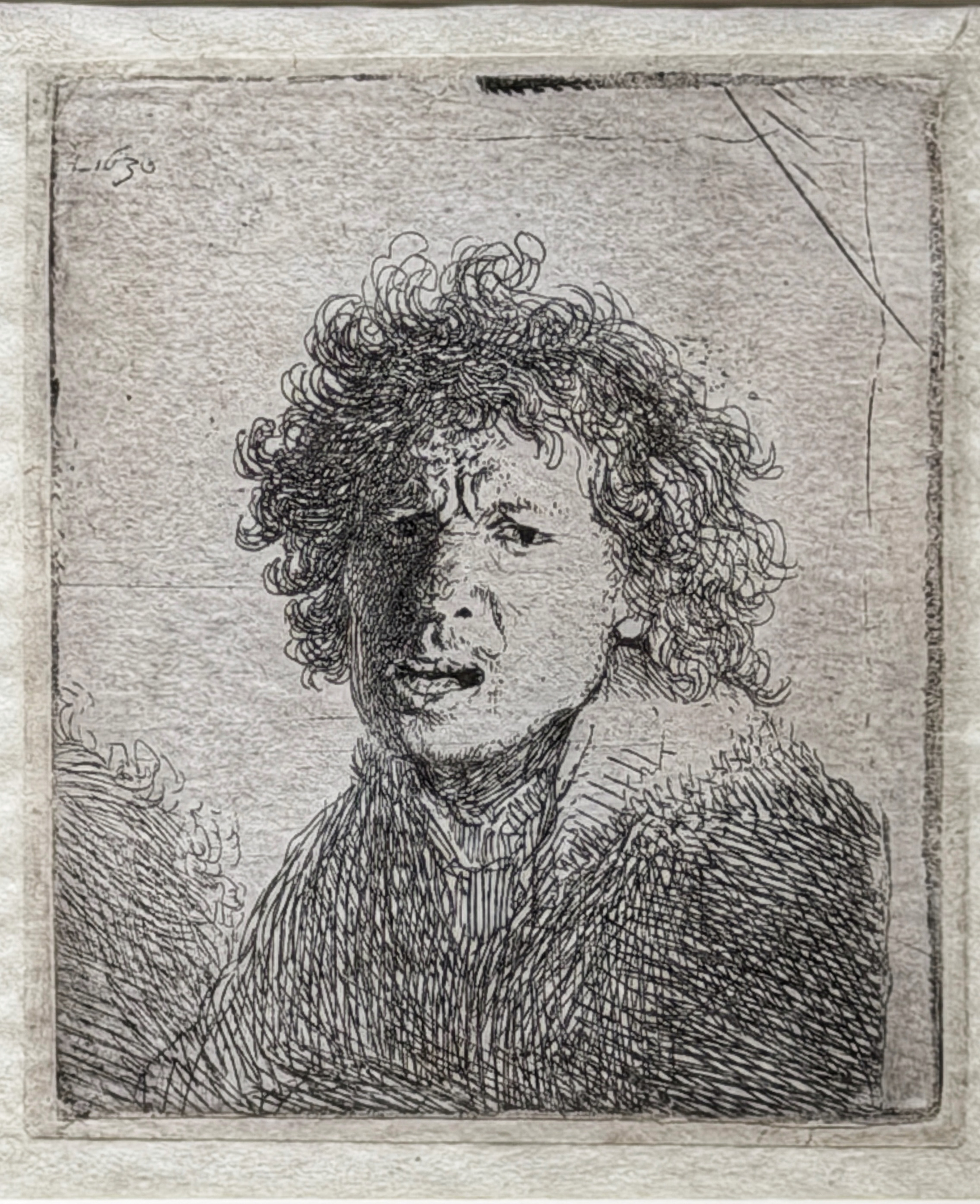
Rembrandt Harmenszoon van Rijn (1606-1669), Self-Portrait open mouthed, as if shouting: bust, Etching on laid paper: 7,0 × 5,9 cm, Signed in monogram and dated upper left: RHL 1630, Catalogued in Bartsch 13; The New Holstein 67, Second state (of III) , Douwes Fine Art, Amsterdam, Treasure House Fair , London
The tronie was an established genre long before Rembrandt, a head study built around a single emotional state or character type rather than the identity of any particular sitter. In Leiden, working alongside Jan Lievens (1607–1674), Rembrandt drew on the faces around him, family members, friends, neighbours, people from the street, as well as his own face studies, building a repertoire of human types across a range of emotional registers: surprise, grief, rage, laughter, suspicion, or, as in this sheet where the mouth falls open mid-shout and the features tighten around it, raw vocal urgency.
When Rembrandt used his own face within this practice the function was no different from any other available model, one more emotional state captured and held in reserve. Each sheet added another solved problem that could be recalled and repositioned when a history painting required a prophet crying out, a figure recoiling in fear, a crowd caught in the instant before it turns, an apostle overcome with grief, or a face registering the precise moment that doubt becomes certainty.
References
Dickey, S.S. (2019) ‘Printmaking in Leiden c. 1630: Rembrandt, Lievens, and Van Vliet’, in Coutré, J.N. (ed.) Leiden circa 1630: Rembrandt Emerges [Exhibition catalogue]. Kingston: Agnes Etherington Art Centre, Queen’s University
Gottwald, F. (2011) Das Tronie. Muster – Studie – Meisterwerk. Die Genese einer Gattung der Malerei vom 15. Jahrhundert bis zu Rembrandt [The tronie. Pattern, study and masterwork. The genesis of a genre of painting from the fifteenth century to Rembrandt]. Munich/Berlin: Deutscher Kunstverlag
Hirschfelder, D. (2008) Tronie und Porträt in der niederländischen Malerei des 17. Jahrhunderts [Tronie and portrait in seventeenth-century Netherlandish painting]. Berlin: Gebr. Mann Verlag
Van de Wetering, E. (2005a) A Corpus of Rembrandt Paintings, Volume IV: The Self-Portraits. Dordrecht: Springer
Probably by Rembrandt van Rijn (1606–1669),? An Old Man in an Armchair, c. 1652, oil on canvas, 111 × 88 cm, The National Gallery, London (NG6274)Probably by Rembrandt van Rijn (1606–1669)?, An Old Man in an Armchair, c. 1652, oil on canvas, 111 × 88 cm, The National Gallery, London (NG6274)Probably by Rembrandt van Rijn (1606–1669) ?, An Old Man in an Armchair, c. 1652, oil on canvas, 111 × 88 cm, The National Gallery, London (NG6274)
By the early twentieth century, more than six hundred paintings bore Rembrandt’s name. By the end of it, that number had been cut by nearly half, and some of the most admired works in major collections had been reassigned to pupils, followers, and anonymous imitators. The Rembrandt Research Project, founded in 1968 by a team of Dutch art historians led by Josua Bruyn (1923–2011), set out to discipline a corpus that had swollen over three centuries of enthusiastic, and often careless, attribution. The results were severe. In the first three volumes of A Corpus of Rembrandt Paintings (1982, 1986, 1989), covering the period up to 1642, the RRP catalogued 286 paintings from the roughly 330 accepted by Abraham Bredius (1855–1946) in his 1935 catalogue raisonné. Of these, 146 were accepted, 122 rejected outright, and just twelve left in a category of acknowledged doubt. Horst Gerson (1907–1978), revising Bredius in 1969, had already reduced the total oeuvre to approximately 420 paintings; the RRP drove it below 250. The number of signed self-portraits alone was halved. Museums across Europe and America found themselves staring at paintings whose labels had become, almost overnight, institutional embarrassments.
The problem, though, was structural, and it did not begin with modern scholarship. Rembrandt ran a large and commercially productive workshop in Amsterdam from the mid-1630s onward, training pupils who were themselves already competent painters. Some fifty artists are now associated with his studio, of whom about twenty can be documented by name. Joachim von Sandrart (1606–1688), a near contemporary, recorded that Rembrandt earned between 2,000 and 2,500 guilders annually from tuition fees and the sale of student work alone, on top of income from his own paintings and prints. Pupils paid him one hundred guilders a year for instruction and were set to work copying the master’s compositions, painting from the same models, and working through shared pictorial problems, often in partitioned spaces separated by paper or linen walls. This was not a factory in the Rubens mould, where assistants executed sections of the master’s compositions under direct supervision. It was something harder to categorise: a teaching environment in which the boundaries between master and pupil were porous by design, where pupils absorbed the master’s idiom so thoroughly that their independent productions could, and did, pass for his work, sometimes within his own lifetime.
The RRP’s original methodology rested on an assumption that Rembrandt executed his paintings without workshop assistance, treating collaboration as the exception rather than the rule. Its classificatory system, dividing works into A (accepted), B (uncertain), and C (rejected), had no framework for collaborative production. That assumption, as Ernst van de Wetering (1938–2021) later acknowledged, did not accord with what documentary evidence actually suggested about workshop practice in the seventeenth century. Van de Wetering, who had joined the RRP in 1968 as a junior assistant and became its chairman in 1993 after a deep ideological dispute led to the withdrawal of the three other surviving members, quietly abandoned the A/B/C system from volume four onward. His approach was processual rather than stylistic: where Bruyn and his colleagues had described images and compared surfaces, Van de Wetering described processes, asking whether a painting’s genesis indicated that the maker was also the person who had conceived the composition. The question sounds simple. In practice, it proved enormously difficult to answer, and it led Van de Wetering in a direction his former colleagues would not have taken.
In A Corpus of Rembrandt Paintings VI: Rembrandt’s Paintings Revisited (2014), the final and most controversial volume of the project, Van de Wetering reinstated forty-four paintings rejected in the first three volumes and added approximately twenty more that had not previously been catalogued, arriving at a total oeuvre of some 336 works. This was a staggering reversal. It was also the work of a single scholar, carried out after the collective authority of the original team had collapsed. What does it mean when one person’s eye undoes the considered judgement of four?
An Old Man in an Armchair belongs squarely to this contested territory. The painting was almost certainly among the pictures at Chiswick House collected by the 3rd Earl of Burlington (d. 1753), passing by inheritance to the Dukes of Devonshire. The National Gallery acquired it in August 1957 from the 11th Duke under the Finance Act of 1956, and it was praised on arrival as a powerful example of Rembrandt’s work of the 1650s. Kenneth Clark (1903–1983), in Rembrandt and the Italian Renaissance (1966), remarked on its pronounced Venetian quality, citing the saturated colours and the use of glazes to create depth of tone, and compared it to Tintoretto, though whether Rembrandt would have known the Venetian master’s work at first hand remains uncertain. Gregory Martin, writing in Apollo in 1969 under the pointed title ‘The Death of a Myth’, was among the first to question the attribution, and by the late 1960s a more systematic comparison with securely attributed works, combined with technical analysis of materials, led scholars to recatalogue the painting as the work of a contemporary follower.
The technical evidence assembled in subsequent decades appeared to support this conclusion. The National Gallery’s own research, presented in the 2010 exhibition Close Examination: Fakes, Mistakes and Discoveries, drew attention to the painter’s use of comparatively pure pigments: the bright red on the sitter’s left cuff consists of pure vermilion, the orange-yellow streaks in his robe are natural earth pigment laid unmixed, and the deep purplish glazes on the gown and hand are composed solely of red lake pigments. This handling of red lake glazes would be unusual in securely attributed Rembrandts of this period. Neil MacLaren’s National Gallery catalogue, revised and expanded by Christopher Brown in 1991, listed the painting as ‘follower of Rembrandt’, and the technical study by David Bomford, Jo Kirby, Ashok Roy, Axel Rüger, and Raymond White (2006) maintained this position. Christian Tümpel (1937–2009), in Rembrandt: All Paintings in Colour (1993), offered a slightly different formulation, cataloguing it as the work of an unknown collaborator in Rembrandt’s studio. For the better part of three decades, the painting hung under a label that politely withdrew a claim the Gallery had paid for.
Then came Corpus VI. Van de Wetering, cataloguing the painting as no. 221 and dating it to c. 1652, argued that its bold and innovative brushwork was too experimental, too searching, to be the product of a follower imitating a known style. A follower, by definition, follows: he works from an established model and adapts it to his own, usually lesser, capacities. But the handling of An Old Man in an Armchair does not follow. It anticipates. The loose, suggestive treatment of the left sleeve, achieved with half a dozen very broad strokes, and the way light is used to dissolve form rather than to define it, represent, in Van de Wetering’s reading, an early and significant step in Rembrandt’s development toward the rough manner of his later works. The question Van de Wetering posed is a fair one: is it really plausible that a pupil or follower, working within the orbit of the studio, would have pushed the painterly idiom in a direction the master himself had not yet fully explored?
The National Gallery’s response was measured. A spokesperson, quoted at the time of the Corpus VI publication, noted that ‘An Old Man in an Armchair is a picture that has generated much debate over the years, as many Rembrandts do, and we look forward to further discussions concerning its attribution.’ The Gallery has since amended its label to ‘Probably by Rembrandt’, a formulation that holds the question open without committing the institution to a definitive answer. It is worth pausing on that word, ‘probably’. It is not ‘yes’ and it is not ‘no’. It is a label designed to manage institutional uncertainty in public, and it says more about the limits of connoisseurship than it does about the painting.
Nor was the reception of Corpus VI uniformly approving. The art historian Michael Savage, reviewing the volume in detail, noted that while lengthy argument was presented for the reattribution, he remained unconvinced. The Burlington Magazine, in an editorial assessing the project’s final phase, observed that Van de Wetering was ‘never more impressive than when using every weapon in his armoury’ to rescue rejected paintings, but also noted that the volume, unlike its predecessors, almost entirely ignored rejected works, offering no consistent assessment of condition or provenance for many of the most contentious entries. The implied certainty of a catalogue that gives precisely 336 paintings to Rembrandt’s own hand sat uneasily with a methodology that claimed to embrace probability and acknowledge doubt. And there was a more uncomfortable observation: Van de Wetering had invoked Bayesian reasoning as the theoretical underpinning of his approach, but the catalogue itself was, as Savage noted, profoundly frequentist in its conclusions. Paintings either were or were not by Rembrandt. No probabilities were assigned, no grey areas acknowledged.
The broader problem remains unsettled. Signing practices in the seventeenth century offer no secure ground. Rembrandt signed his paintings far more frequently than Rubens (1577–1640), who signed only about five works in his entire career, but this frequency has not made authentication easier. Contemporary sources cannot confirm whether pupil works sold from the studio also carried the master’s signature. Bruyn himself conceded, in volume three of the Corpus, that while it was ‘conceivable that Rembrandt signatures were appended in the workshop by his studio assistants, as a kind of trademark’, there was no direct evidence for the reverse situation either: the master putting his own name on a pupil’s work. The theory of studio signing was, in effect, developed to explain away paintings that bore signatures but failed stylistic tests. Once those stylistic tests themselves were called into question, the theory lost its anchor.
Paintings dismissed as workshop productions for decades have, in several recent cases, been confirmed as autograph after renewed examination, sometimes overturning judgements that had relied largely on photographic reproductions rather than direct study of the work itself. The pattern has repeated often enough to constitute its own kind of evidence: the same apparatus that once expelled paintings from Rembrandt’s oeuvre is now being used to readmit them. On what, then, does authority finally rest? On the eye, which the RRP was founded to discipline? On scientific analysis, which can identify materials but cannot say who held the brush? On the institutional weight of whoever speaks last?
An Old Man in an Armchair sits at the centre of these questions, and it is unlikely to leave them any time soon. The painting’s ambition is visible in its handling: the rough, suggestive strokes of the left sleeve, the dissolved contours where the figure meets the chair, the saturated warmth of the red lake glazes. These are the marks of a painter testing the limits of an idiom, pressing paint toward something it has not yet been asked to do. Whether that painter was Rembrandt, working his way toward a new pictorial language, or someone close enough to him to anticipate where that language might go, is a question the evidence cannot conclusively settle. Perhaps the more useful question is what it tells us about the nature of the line itself: the line between master and pupil, between invention and imitation, between the hand that conceives and the hand that executes. The Rembrandt Research Project spent nearly half a century trying to draw that line with precision, and the result, as often as not, was to demonstrate that precision is the one thing the evidence will not support.
References
Bomford, D., Kirby, J., Roy, A., Rüger, A. and White, R. (2006) Rembrandt. London: National Gallery Company
Clark, K. (1966) Rembrandt and the Italian Renaissance. London: John Murray
MacLaren, N., revised by Brown, C. (1991) National Gallery Catalogues: The Dutch School, 1600–1900. 2nd edn. 2 vols. London: National Gallery Publications
Martin, G. (1969) ‘The Death of a Myth’, Apollo, XC, pp. 266–267
RKD – Netherlands Institute for Art History (n.d.), Follower of Rembrandt van Rijn (1606–1669) ?, An Old Man in an Armchair, m RKDimages database entry no. 286285 . Available at: https://rkd.nl/images/286285 (Accessed 28 December 2025)
Schwartz, G. (1985) Rembrandt: His Life, His Paintings. Harmondsworth: Penguin
Tümpel, C. (1993) Rembrandt: All Paintings in Colour. Antwerp: Fonds Mercator
Van de Wetering, E. (2014) A Corpus of Rembrandt Paintings VI: Rembrandt’s Paintings Revisited, A Complete Survey. Dordrecht: Springer
Van de Wetering, E. (2016) Rembrandt: The Painter Thinking. Amsterdam: Amsterdam University Press
Van de Wetering, E. (2014) ‘A reattribution to Rembrandt of Old man in an armchair (1652) in the National Gallery, London’, The Burlington Magazine, 156, no. 1335 (June 2024), pp. 394–404.Available at:https://www.burlington.org.uk/archive/back-issues/201406 (Accessed 26 December 2025)
Rembrandt Harmensz. van Rijn (1606–1669), Woman Sitting Half Dressed beside a Stove, 1658, Etching, engraving and drypoint on laid paper, 6 state of 7, Plate 228 × 186 mm; Sheet 243 × 198 mm, Christie’s, The Sam Josefowitz Collection: Graphic Masterpieces by Rembrandt van Rijn – Part III, London, 3 December 2025
Rembrandt Harmensz. van Rijn (1606–1669), Woman Sitting Half Dressed beside a Stove, 1658, Etching, engraving and drypoint on laid paper, 6 state of 7, Plate 228 × 186 mm; Sheet 243 × 198 mm, Christie’s, The Sam Josefowitz Collection: Graphic Masterpieces by Rembrandt van Rijn – Part III, London, 3 December 2025
Rembrandt Harmensz. van Rijn (1606–1669), Self-Portrait with Cap Pulled Forward, c. 1630, Etching with touches of drypoint on laid paper, Plate 50 × 43 mm; Sheet 52 × 44 mm, Sixth state of ten, Christie’s, The Sam Josefowitz Collection: Graphic Masterpieces by Rembrandt van Rijn – Part III, London, 3 December 2025, lot 2
References
Christie’s (2025) Self-Portrait with Cap Pulled Forward, Rembrandt Harmensz. van Rijn (1606–1669). The Sam Josefowitz Collection: Graphic Masterpieces by Rembrandt van Rijn – Part III, Live Auction 23941. London: Christie’s, 3 December 2025. Available at: https://www.christies.com/en/lot/lot-6564142 (Accessed: 30 November 2025).
Rembrandt Harmensz. van Rijn (1606–1669), The Entombment, c. 1654, Etching and Drypoint on Vellum, Plate 206 × 157 mm; Sheet 218 × 161 mm, Third state of Four, The Sam Josefowitz Collection: Graphic Masterpieces by Rembrandt van Rijn – Part III, London, 3 December 2025Rembrandt Harmensz. van Rijn (1606–1669), The Entombment, c. 1654, Etching and Drypoint on Vellum, Plate 206 × 157 mm; Sheet 218 × 161 mm, Third state of Four, The Sam Josefowitz Collection: Graphic Masterpieces by Rembrandt van Rijn – Part III, London, 3 December 2025
This rare impression is almost entirely black, the plate wiped so heavily that only the thinnest traces of light survive. The mourners’ faces, the curve of Christ’s body and face, and the gestures that support him register only as slight, wavering outlines against the dark. The brightness that grazes the figures is produced solely by the ink thinning enough for the vellum to breathe through. In Rembrandt’s late etchings such near-erasure often carries a devotional charge: the scene is not offered in clarity but allowed to emerge gradually, as if the viewer must enter the darkness before any meaning can take shape. In seventeenth-century Amsterdam, impressions like this could invite a meditative way of seeing, where the Passion is approached through shadow, and the remaining light becomes the point at which grief, faith and reflection meet.
Rembrandt Harmensz. van Rijn (1606–1669), ‘A Scholar in His Study’, 1634, Oil on canvas, 141 × 135 cm Sternberg Palace, Prague
Rembrandt Harmensz. van Rijn (1606–1669), ‘A Scholar in His Study’, 1634, Oil on panel, 105 × 76 cm, Sternberg Palace, Prague
Three times in the mid-1630s, Rembrandt painted the same elderly head, and each time he dressed him differently. The sitter remained anonymous throughout, present in the picture as a tronie study rather than as a person. The most ambitious of the three is this Prague panel, signed and dated 1634. It was painted in the year of Rembrandt’s marriage to Saskia van Uylenburgh (1612–1642) and of his consolidation in Amsterdam as the most sought-after portraitist of the city. In the two related paintings, the same model reappears already robed and turbaned in the oriental manner.
Seen against Rembrandt’s working method in these years, the ambition of the panel becomes clearer. He is lifting an anonymous elderly head to the standing of a full historical subject, the kind of weighty narrative composition otherwise reserved for biblical or classical scenes. By the mid-1630s he was building his pictures from a deliberately assembled stock of costume, props, and staged interior. The scale of that stock only became fully visible some twenty years later, when bankruptcy proceedings (cessio bonorum) forced an official inventory of his Amsterdam house in 1656. Among the goods recorded that year were weapons, plaster casts after the antique, sculpted busts, ethnographic curiosities, lengths of fabric and historical garments, the working contents of a history painter’s studio rather than ordinary domestic furnishings. A studio accumulates and discards; what survived into the bankruptcy year is not necessarily what was present in 1634, and to read the inventory backwards across twenty years of acquisition and loss is to assume a stability of working resources that Rembrandt’s restless habits however may not support.
Inside the panel itself, that working method is visible at one remove. The learning of the sitter is evoked rather than documented. A heavy folio lies open beneath his hand. Bound books rest at the edge of the desk. A globe stands on its mount, and a quill waits beside the inkwell. These carefully chosen objects belong to an iconographic tradition Rembrandt had helped to shape during his early years in Leiden, that of the contemplative scholar at his desk, developed between roughly 1625 and 1635 in dialogue with Jan Lievens (1607–1674) and the young Gerrit Dou (1613–1675), when proximity to the university gave the type a ready local market. The Prague picture carries that Leiden formula into Amsterdam and inflates it. Where Dou’s scholars are intimate and small, painted in cabinet format for private collectors, Rembrandt’s is amplified, pressed close to the picture plane and lent the gravity of a figure from history painting. The nearly square format of the canvas is itself unusual for a scholar type, which more typically occupied an upright field; whether this signals a broader narrative ambition or simply a commission to a specific size is impossible to determine.
Within that staging, the clothing carries much of the argument. The sitter wears a heavy velvet coat embroidered with gold thread and trimmed with fur, a thick gold chain laid across his shoulders, and a soft fanciful cap of the kind Rembrandt reserved for figures of biblical or historical erudition. The ensemble is deliberately theatrical, drawing on graphic sources, on items from the studio’s working stock and on a broader iconography of the wise elder, rather than reconstructing any specific historical or geographical dress. It is at once historical and oriental, a doubled appeal aimed at a 1630s Amsterdam audience attuned both to pictorial fictions of antiquity and to the cosmopolitan reach of the city’s trading networks. But how knowingly were those audiences playing along? Did a buyer in 1634 see a wise man from the past, or a Rembrandt, or both at once, and does the question even separate cleanly?
What the picture asks, in the end, is how learning is allowed to look in paint. The sitter does not lecture, perform or display. He is caught mid-thought, his face poised somewhere between question and fatigue, and the room around him is shaped by light rather than by architecture. The chiaroscuro draws the eye towards the lit page and the lit hand and lets the rest of the chamber subside into shadow, the legacy of Rembrandt’s early absorption of Caravaggesque models through the Utrecht painters and through Lievens. Rembrandt is competing on a register his Amsterdam rivals could not easily occupy, lifting a single anonymous head into a figure of contemplative authority on the scale of historical narrative.
Rembrandt Harmensz. van Rijn (1606–1669), ‘A Scholar in His Study’, 1634, Oil on panel, 105 × 76 cm, Sternberg Palace, PragueRembrandt Harmensz. van Rijn (1606–1669), ‘A Scholar in His Study’, 1634, Oil on panel, 105 × 76 cm, Sternberg Palace, Prague
References
de Winkel, M. (2006) Fashion and Fancy: Dress and Meaning in Rembrandt’s Paintings. Amsterdam: Amsterdam University Press
Sevcik, A.K. (ed.) (2019) Inside Rembrandt 1606–1669. Petersberg: Michael Imhof Verlag
Sluijter, E.J. (2015) Rembrandt’s Rivals: History Painting in Amsterdam, 1630–1650. Oculi: Studies in the Art of the Low Countries 14. Amsterdam and Philadelphia: John Benjamins
Strauss, W.L. and van der Meulen, M. (1979) The Rembrandt Documents. New York: Abaris Books
RKD – Netherlands Institute for Art History (n.d.) Rembrandt Harmensz. van Rijn, A scholar, seated at a table with books, 1634. RKDimages, image no. 233140. Available at: https://rkd.nl/en/explore/images/233140 (Accessed: 23 June 2025)
van de Wetering, E. (2015) A Corpus of Rembrandt Paintings VI: Rembrandt’s Paintings Revisited – A Complete Survey. Dordrecht: Springer
Attributed to Willem Drost (1633–1659), The Annunciation to the Virgin, 1650? , Schwarzenberg Palace, Prague
Attributed to Willem Drost (1633–1659), The Annunciation to the Virgin, 1650? , Schwarzenberg Palace, Prague
In the early 1920s, the newly formed Czechoslovak Republic was busy assembling its cultural inheritance. Vincenc Kramář (1877–1960), appointed director of the Picture Gallery of the Society of Patriotic Friends of the Arts in 1919, understood that a young nation’s public collection needed anchoring works: pictures that could hold their own against the old European galleries. Kramář, already celebrated as one of the most perceptive collectors of Cubist painting north of Paris, turned his eye to the Dutch Golden Age and began pursuing Rembrandt attributions with a determination bordering on hunger. His ‘discovery’ of potential Rembrandts in Czech private hands drew a stream of offers, not all of them convincing. Among the paintings he secured for the gallery was a canvas bearing the signature ‘Rembrandt f.’, depicting the Virgin Mary at the moment of the Annunciation. The angel Gabriel was absent, the composition visibly cut down on at least one side, and the provenance was uncertain. None of this deterred Kramář. He believed the fragment was genuine, and he believed it mattered.
For the better part of two centuries, no one seriously questioned that judgement. The signature seemed legible enough, and the painting’s qualities, its dense chiaroscuro, the uncanny treatment of light on fabric, the inward intensity of Mary’s expression, were broadly consistent with what collectors expected from Rembrandt’s hand. Abraham Bredius (1855–1946) included the painting under Rembrandt’s name in his 1935 catalogue raisonné, the standard reference of its day, and there it sat, untroubled, until the broader convulsions of Rembrandt scholarship in the second half of the twentieth century forced a reconsideration. The quiet revision of this painting’s authorship is itself a minor chapter in one of art history’s longest-running dramas: the steady contraction of Rembrandt’s oeuvre from over seven hundred paintings to something closer to three hundred, a process that has redrawn the boundaries between master and workshop, original and imitation, collaboration and copy, with consequences that are still being debated.
The first doubts about the Prague Annunciation surfaced in the 1950s and 1960s, when several scholars began to propose alternative names from Rembrandt’s circle. Constantijn van Renesse (1626–1680), Arent de Gelder (1645–1727), Nicolaes Maes (1634–1693), and Karel van der Savoy (active mid-seventeenth century) were all suggested as possible authors, each proposal resting on perceived stylistic affinities and each encountering its own difficulties. The breakthrough came in 1967, when Kurt Bauch (1897–1975), in his Studien zur Kunstgeschichte, became the first scholar to connect the painting with the then little-known Willem Drost. Bauch pointed to similarities between the figure of Mary and the female types found in other paintings attributed to Drost, and his proposal gradually gathered support. Werner Sumowski (1931–2015), in his monumental Gemälde der Rembrandt-Schüler (1983–1994), accepted the Drost attribution and catalogued the painting accordingly, lending it the weight of systematic comparative study. Jonathan Bikker, in his 2005 monograph on Drost, the first devoted to the artist, placed the painting within Drost’s Amsterdam period and dated it to around 1654–1655, rather than the earlier date of 1645–1646 that had previously been assumed. Hana Seifertová confirmed the attribution in the 2012 illustrated summary catalogue of Dutch paintings at the National Gallery Prague.
This redating matters enormously. Under the old chronology of circa 1645–1646, Drost would have been only twelve or thirteen when he painted the canvas, an age at which such psychological depth and technical command would strain credulity to breaking point. Even allowing for prodigious talent, the claim is difficult to sustain. If, however, the painting belongs to the mid-1650s, as Bikker and others now suggest, then Drost would have been around twenty-one, a young man who had spent several years in Rembrandt’s workshop (probably entering around 1648, which was the customary age for a Dutch apprentice) and had reached the period of his most assured production. This is the same phase that produced his Bathsheba with King David’s Letter (Musée du Louvre, Paris, c. 1654) and the so-called Sibyl or Young Woman in a Brocade Gown (Metropolitan Museum of Art, New York, c. 1654), both of which share with the Prague painting a distinctive treatment of drapery, an oblique facial type, and a quality of absorbed inwardness that sets Drost apart from his fellow pupils.
Yet the attribution remains just that: an attribution, hedged with qualifications. The Národní galerie Praha catalogues the painting as “attributed to Willem Drost,” a label that acknowledges probability rather than certainty. The Rembrandt Research Project, which spent four decades systematically reassessing the master’s oeuvre, rejected the Rembrandt attribution, but the painting fell outside the scope of the project’s published volumes and was not subjected to the kind of full technical examination (dendrochronology, canvas-thread analysis, infrared reflectography) that has settled other disputed cases. Is it possible that the painting was begun by Rembrandt and completed by a pupil? Or that it represents a particularly accomplished studio work, produced under supervision but essentially by Drost’s hand? These questions remain open, and may never be fully resolved. What can be said is that the current scholarly consensus, shaped principally by Bauch, Sumowski, and Bikker, favours Drost more strongly than any alternative.
The painting itself is a fragment, and this is worth dwelling on. At some unknown point in its history, the canvas was cut down, removing the figure of the angel Gabriel who would have occupied the left side of the composition. What survives is Mary alone, her body twisting slightly as if in the aftermath of shock, one hand raised as though to ward off the messenger, the other pressed to her chest. A book appears to be falling or to have slipped from her grasp, a conventional detail in Annunciation iconography that here takes on physical immediacy: the news has literally knocked the text from her hands. The figure is lit by a powerful, directional light that isolates her against the dark interior, catching the white of her headdress and the pale fabric of her robe while leaving the surrounding space indistinct. The bed visible in the upper right corner, picked out by the same strong light, may function as an allusion to the Incarnation, to the bodily reality of what has been announced. Yannis Hadjinicolaou, in his 2016 study Denkende Körper, formende Hände, drew attention to the physicality of Mary’s response, her recoiling posture and the emphatic gesture of her hands, reading it as characteristic of what the Rembrandtists understood as handeling: the use of the body as a vehicle for inner states, a pictorial language in which emotion is not simply expressed on the face but distributed across the entire figure.
This is not the Virgin of high Marian theology, enthroned and expectant. She is a young woman, startled and uncertain, her humility rendered as a form of physical vulnerability. The treatment has a distinctly Protestant inflection, or at least a humanising one: Gabriel’s message arrives not in a palatial chamber but in a modest domestic space, and the recipient is not the Queen of Heaven but a girl from Nazareth who does not yet know what the angel’s words will mean for her. The Rembrandtesque tradition to which Drost belonged had a particular gift for this kind of sacred intimacy, for locating the divine within the ordinary and allowing the viewer to feel the strangeness of the encounter rather than its doctrinal certainty.
What remains tantalising is how much has been lost. The original composition, with the angel present, may have been an ambitious two-figure scene, perhaps closer in format to Rembrandt’s own treatments of moments of divine encounter, such as the Angel Leaving the Family of Tobias (Musée du Louvre, 1637) or the Supper at Emmaus (Musée Jacquemart-André, Paris, 1629). Without the angel, we cannot judge the painting’s spatial logic, its compositional rhythm, or the relationship between the two figures that would have given the scene its dramatic structure. What survives is a magnificent half of something that may once have been extraordinary.
Drost himself disappeared not long after the painting was made. He left the Netherlands, probably around 1654 or 1655, and travelled south, eventually settling in Venice, where he adapted his Rembrandtesque chiaroscuro to the warmer, more defined tenebrist manner associated with the young Luca Giordano (1634–1705). He never returned to Amsterdam. Bikker’s archival discoveries established that Drost died and was buried in Venice on 25 February 1659, at the age of only twenty-five. His entire working life, from apprentice to his last Venetian canvases, spanned barely a decade, and his secure oeuvre amounts to no more than a few dozen paintings. Arnold Houbraken (1660–1718), the great chronicler of Dutch artists’ lives, gave Drost only a glancing mention, recording that he had been a pupil of Rembrandt and had spent time in Rome (Houbraken may have confused Rome with Venice, or Drost may have visited both). The brevity of the life and the scarcity of the documentation have left much in shadow. What survives, including this damaged, reattributed fragment in Prague, suggests a painter of rare sensitivity who absorbed the lessons of Rembrandt’s workshop more completely than almost anyone else, and who was just beginning to find his own voice when he died.
References
Bauch, K. (1967) Studien zur Kunstgeschichte. Berlin: Walter de Gruyter, pp. 133–134.
Bikker, J. (2005) Willem Drost (1633–1659): A Rembrandt Pupil in Amsterdam and Venice. New Haven and London: Yale University Press
Bredius, A. (1935) Rembrandt: Schilderijen. Vienna: Phaidon
Bredius, A. (1969) Rembrandt: The Complete Edition of the Paintings. Revised by H. Gerson. London: Phaidon
Hadjinicolaou, Y. (2016) Denkende Körper, formende Hände: Handeling in Kunst und Kunsttheorie der Rembrandtisten. Berlin: De Gruyter, p. 271.
Seifertová, H. (2012) ‘Willem Drost, The Annunciation to the Virgin‘, in Seifertová, H., Ševčík, A.K. (eds.) and Bartilla, S. National Gallery in Prague: Dutch Paintings of the 17th and 18th Centuries. Illustrated Summary Catalogue. Prague: Národní galerie v Praze, p. 129, cat. no. 107
Slavíček, L. (2006–2007) ‘Vincenc Kramář and a fragment of Rembrandt’s Annunciation of the Virgin: On the history and reception of an acquisition’, Bulletin of the National Gallery in Prague, XVI–XVII, pp. 21–39
Sumowski, W. (1983–1994) Gemälde der Rembrandt-Schüler [Paintings of the Rembrandt Pupils]. 6 vols. Landau/Pfalz: Edition PVA
RKD – Netherlands Institute for Art History (n.d.) Willem Drost. RKDartists, artist no. 24317. Available at: https://rkd.nl/en/explore/artists/24317 (Accessed: 23 June 2025).
RKD – Netherlands Institute for Art History (n.d.) Willem Drost. The Annunciation. RKDImage no. 233149. Available at: https://rkd.nl/images/233149 ( Accessed: 23 June 2025)
Rembrandt Harmenszoon van Rijn (1606-1669), Belshazzar’s Feast, c.1637, Oil on canvas, 167.6 × 209.2 cm, The National Gallery, London
Rembrandt Harmenszoon van Rijn (1606-1669), Belshazzar’s Feast, c.1637, Oil on canvas, 167.6 × 209.2 cm, The National Gallery, London
Painted when Rembrandt was just thirty, ‘Belshazzar’s Feast’ marked his ambitious entry into grand history painting. He chose the biblical episode from the Book of Daniel’, chapter 5, where mysterious writing appears on the wall during a Babylonian banquet, foretelling King Belshazzar’s downfall. The words written are: Mene, Mene, Tekel, Upharsin (מנא מנא תקל ופרסין). These Aramaic words are units of currency, but, as Daniel interprets them, they carry metaphorical meanings: ‘Mene’ (God has numbered the days of your kingdom and brought it to an end), ‘Tekel’ (you have been weighed and found wanting), and ‘Peres’ (your kingdom is divided and given to the Medes and Persians). The writing is understood as a divine verdict, signalling Belshazzar’s imminent death and the end of his reign. The painting displays Rembrandt’s mastery in depicting intricate Asian textiles using a complex mix of pigments—gold leaf, vermilion, and ultramarine—matching the depth of the biblical scene, rich in layered theological meanings.
Rembrandt, then living in Amsterdam’s Jewish quarter, was likely influenced by his neighbour, the rabbi and scholar Manasseh ben Israel (1604–1657), though no direct link is recorded. Scholars have suggested that the wrong vertical layout and cryptic spacing of the letters were not a mistake but a well-planned visual metaphor—echoing rabbinic traditions where this writing was meant to be obscure, a divine riddle seen by all but understood only by Daniel.
The hand of God (yad El) is also a biblical motif, especially in Exodus, where God’s hand leads Israel out of Egypt—reinforcing the idea that no empire can stand against divine will.
The exaggerated hands in the painting are Rembrandt’s idiom for monumentality and his vehicle for expressive form. Their scale is intentional, not a flaw in anatomy. In Rembrandt’s visual language, the hands become a key site for registering psychological tension—conveying fear, disbelief, and confrontation with the divine.
Rembrandt Harmenszoon van Rijn (1606-1669), Belshazzar’s Feast, c.1637, Oil on canvas, 167.6 × 209.2 cm, The National Gallery, London Rembrandt Harmenszoon van Rijn (1606-1669), Belshazzar’s Feast, c.1637, Oil on canvas, 167.6 × 209.2 cm, The National Gallery, London Rembrandt Harmenszoon van Rijn (1606-1669), Belshazzar’s Feast, c.1637, Oil on canvas, 167.6 × 209.2 cm, The National Gallery, London Rembrandt Harmenszoon van Rijn (1606-1669), Belshazzar’s Feast, c.1637, Oil on canvas, 167.6 × 209.2 cm, The National Gallery, London Rembrandt Harmenszoon van Rijn (1606-1669), Belshazzar’s Feast, c.1637, Oil on canvas, 167.6 × 209.2 cm, The National Gallery, London
Rembrandt Harmensz. Van Rijn (1606-1669), Abraham Entertaining the Angels,1656, Etching and drypoint on laid paper, the only state, 16 x 13.2 cm, Sotheby’s, London, Old Master & 19th Century Paintings Auction. 2-9 April 2025
Rembrandt Harmensz. Van Rijn (1606-1669), Abraham Entertaining the Angels,1656, Etching and drypoint on laid paper, the only state, 16 x 13.2 cm, Sotheby’s, London, Old Master & 19th Century Paintings Auction. 2-9 April 2025
This etching is not a literal depiction of Genesis 18 but a visual metaphor crafted for viewers familiar with theological discourse. It powerfully illustrates the doctrine of sola gratia—the belief that salvation and divine blessing come by God’s grace alone. Rembrandt, deeply influenced by this idea, often depicted aged, modest figures to express how divine grace works through human frailty—when God chooses the weak, often the old and outwardly incapable, to fulfil His will.
Here, Abraham, who was already ninety-nine years old, bows low before three visitors—strangers who reveal themselves as two angels and the Lord Himself. Sarah, aged eighty-nine, listens just behind the tent door and quietly smiles in disbelief at the news that she will bear a child within a year after a lifetime of waiting and loss. Their extreme age is not incidental—it is the visual and theological centre of the image. The impossibility of childbirth at this stage of life gives the promise its force, making the moment one of the most spiritually charged in the entire biblical narrative.
For interpreters of Rembrandt’s time, the scene affirmed the central truth of divine sovereignty: God fulfils His promises not through human capacity but by acting freely and decisively where nature has no power. Abraham and Sarah are not chosen for their strength but for their complete dependence on God’s will.
The composition construction itself departs from European conventions. The three seated figures form a semicircle around a platter of food—an arrangement derived from a Mughal miniature in Rembrandt’s vast art collection, which he had copied in a drawing. His engagement with Islamic and Indian art was made possible through Amsterdam’s global trade connections, which allowed him to reimagine sacred scenes beyond Western iconographic traditions.
Rembrandt ( 1606-1669), ‘An Elderly Man as Saint Paul’, 1659? , Oil on canvas, 102 × 85.5 cm, The National Gallery, London
Rembrandt ( 1606-1669), ‘An Elderly Man as Saint Paul’, 1659? , Oil on canvas, 102 × 85.5 cm, The National Gallery, London
In 1656, three years before this painting was made, Rembrandt applied for the form of insolvency protection known in Amsterdam as cessie bonorum. The contents of his house on the Sint Anthonisbreestraat were catalogued and auctioned: antique busts, Flemish paintings, Japanese armour, an album of Michelangelo drawings, Indian fans, a plaster cast of the Emperor Augustus. The list runs to over three hundred items and reads less like an inventory than a portrait of a restless collecting mind. By 1659 he had moved to a rented house in the Jordaan and was painting with undiminished urgency, producing some of the most searching works of his career from rooms that were no longer his own. The figure sits with a book and a sword, the traditional attributes of Paul the Apostle, though both are pushed to the margins and barely legible in shadow. What holds the eye instead are the hands, softly lit, and the face: an old man’s face, heavy-lidded and creased, caught in that particular stillness belonging to thought that has no immediate destination. Neither transported by vision nor bowed by grief, the figure simply sits, somewhere between one thing and another. The features are consistent with his self-portraits of these years, and several scholars have proposed as much, though the National Gallery’s title is carefully non-committal. What seems clear is that the painter and the penitent apostle are not so easily separated: both men had held something, and lost it. Paul was an unlikely model for contemplative portraiture. Before his conversion on the road to Damascus he had been a persecutor; afterwards, he was shipwrecked, imprisoned, beaten, and eventually beheaded under Nero. His epistles, many of them written from captivity, move between self-accusation and a dogged insistence on grace that can seem almost wilful. The sword here refers to his martyrdom, the book to the scriptures he spent his later years interpreting. But Rembrandt places these objects almost as afterthoughts. The painting’s real subject lies elsewhere: in what a face looks like when it has worked something through. The light falls from a source not visible in the picture, settling unevenly across the figure, thickening in places into impasto that has a near-sculptural quality. In the robe and the shadowed passages behind the figure, paint is applied in broad, open strokes that resolve into coherent form only from a distance. It is a technique that invites the eye to participate in the construction of the image rather than simply receive it, and it has drawn sustained scholarly attention since at least the eighteenth century. Two bas-relief roundels are just visible in the background. The left has been identified as depicting the Sacrifice of Isaac, a scene with particular resonance for a painting that circles around Pauline theology: in the Epistle to the Hebrews, Abraham’s willingness to sacrifice his son is given as the exemplary act of faith, the moment when obedience and trust hold without the support of reason (Heb. 11:17–20). Whether Rembrandt intended a precise theological programme here, or whether these scenes function as something more atmospheric and associative, is harder to say. The right roundel is too damaged to read with confidence. That the wall carries these barely legible images at all suggests a reluctance to make the meanings too available. Things are present, but not insisted upon.
Rembrandt ( 1606-1669), ‘An Elderly Man as Saint Paul’, 1659? , Oil on canvas, 102 × 85.5 cm, The National Gallery, London
References
Alpers, S. (1988) Rembrandt’s Enterprise: The Studio and the Market. Chicago: University of Chicago Press
Brown, C., Kelch, J. and Van Thiel, P. (1991) Rembrandt: The Master and His Workshop. New Haven and London: Yale University Press
Chapman, H.P. (1990) Rembrandt’s Self-Portraits: A Study in Seventeenth-Century Identity. Princeton: Princeton University Press