Gerard David (c. 1460–1523), The Baptism of Christ (Jan des Trompes Triptych), c. 1502–1508, Oil on oak, 132.2 × 182.4 cm, Groeningemuseum, Bruges
Gerard David (c. 1460–1523), The Baptism of Christ (Jan des Trompes Triptych), c. 1502–1508, Oil on oak, 132.2 × 182.4 cm, Groeningemuseum, Bruges
This triptych belongs to the Netherlandish tradition in which sacred history unfolds within a continuous, naturalised world. In David’s handling, the tranquility of the scene keeps the baptism close—not as a remote episode, but as something sustained through the ritual practices that shaped its meaning.
On one wing, Jan des Trompes and his son kneel, brought forward by Saint John the Evangelist; on the other, Elisabeth van der Meersch appears with their four daughters, under the care of Saint Elizabeth of Hungary. After his wife death, the exterior panel is reworked to include his new wife Magdalena Cordier, presented by Mary Magdalene.
At the centre, John the Baptist marks the moment, his role continuing into the distance where his preaching and recognition of Christ are set into the landscape. The scene extends quietly into the landscape without losing its stillness.
The family is placed beside the sacred scene rather than within it, their devotion turned toward the central mystery. The Baptism is treated as a revelation that remains present. The figures are oriented towards it, their prayer directed toward what does not depend on them. Within this order, prayer is not a plea that secures grace, but a response to what is already given.
Gerard David (c. 1460–1523), The Baptism of Christ (Jan des Trompes Triptych), c. 1502–1508, Oil on oak, 132.2 × 182.4 cm, Groeningemuseum, BrugesGerard David (c. 1460–1523), The Baptism of Christ (Jan des Trompes Triptych), c. 1502–1508, Oil on oak, 132.2 × 182.4 cm, Groeningemuseum, BrugesGerard David (c. 1460–1523), The Baptism of Christ (Jan des Trompes Triptych), c. 1502–1508, Oil on oak, 132.2 × 182.4 cm, Groeningemuseum, BrugesGerard David (c. 1460–1523), The Baptism of Christ (Jan des Trompes Triptych), c. 1502–1508, Oil on oak, 132.2 × 182.4 cm, Groeningemuseum, BrugesGerard David (c. 1460–1523), The Baptism of Christ (Jan des Trompes Triptych), c. 1502–1508, Oil on oak, 132.2 × 182.4 cm, Groeningemuseum, BrugesGerard David (c. 1460–1523), The Baptism of Christ (Jan des Trompes Triptych), c. 1502–1508, Oil on oak, 132.2 × 182.4 cm, Groeningemuseum, BrugesGerard David (c. 1460–1523), The Baptism of Christ (Jan des Trompes Triptych), c. 1502–1508, Oil on oak, 132.2 × 182.4 cm, Groeningemuseum, Bruges
References
RKD – Netherlands Institute for Art History (n.d.), Gerard David (c. 1460–1523), The Baptism of Christ (Jan des Trompes Triptych), c. 1502–1508. RKDimages database entry no. 43964. Available at:https://rkd.nl/images/43964 (Accessed: 6 April 2026)
In 15th-century Europe Bruges was one of the continent’s greatest markets, where merchants, luxury goods, credit, and brokerage were drawn together through the Zwin waterway and its outport at Sluis. Its vast mass and tower of about 115 metres belong less to the Bruges of today than to the Bruges that once rivalled Ghent, Venice, and London. Yet the building is more interesting than a monument to prosperity, as its architecture never settles into one defined language.
The nave, begun in the second quarter of the 13th century, introduces that condition. It stands close to Scheldt Gothic, with dark Tournai limestone in the lower structural elements and continuing in the upper articulation—triforium, window frames, and colonnettes—set against increasingly dominant brick. The elevation is clearly organised, yet materially divided: brick carries the wall, while stone defines its structure.
That condition becomes clearer when the choir was rebuilt around 1270–1280. The plan grows more ambitious, with an ambulatory and radiating chapels comparable in conception to Tournai Cathedral. The spatial system expands, yet the construction does not follow it. Brick forms much of the fabric, while Tournai stone remains selective, marking structure rather than determining it.
The tower, begun before 1287 and largely completed in the 14th century, makes this visible at the scale of the city. Larger openings in the upper stages were later partially filled after deformation, leaving a denser mass than intended.
At the level of the choir, private devotion takes architectural form: the Gruuthuse family’s oratory (c. 1470–1472), set within the adjoining palace, opens through elevated windows directly into the church, its carved wooden interior and gilded medieval bosses framing the liturgy from a separate, privileged space.
The aisles were extended in the 14th and 15th centuries, the Paradise Portal added around 1465, and in 1762 the interior was reworked with new vaults, simplified triforia, and plastered surfaces. The building, however, holds these changes without merging them—and that tension seems to define its unique character.
The Church of Our Lady, BrugeesThe Church of Our Lady, BrugeesThe Church of Our Lady, BrugeesThe Church of Our Lady, BrugeesThe Church of Our Lady, BrugeesThe Gruuthuse family’s oratory (c. 1470–1472),BrugesThe Gruuthuse family’s oratory (c. 1470–1472),BrugesThe Gruuthuse family’s oratory (c. 1470–1472),BrugesThe Gruuthuse family’s oratory (c. 1470–1472),BrugesThe Gruuthuse family’s oratory (c. 1470–1472),Bruges
References
Buyle, M., Coomans, T., Esther, J. and Genicot, L.-F. (1997) Architecture gothique en Belgique. Brussels: Éditions Racine
Pieter Pourbus (c. 1523–1584), Juan López Gallo, President of the Spanish Nation, and His Sons, 1568, Oil on oak panel, 98 × 51.7 cm, Groeningemuseum, Bruges
Pieter Pourbus (c. 1523–1584), Juan López Gallo, President of the Spanish Nation, and His Sons, 1568, Oil on oak panel, 98 × 51.7 cm, Groeningemuseum, Bruges
When López Gallo knelt before his prie-dieu to be painted, he did so alongside his wife Catharina Pardo and their nine children, the entire household gathered in devotion across the three panels of a triptych. That unity has not survived. The central panel has never been recovered, and the right wing depicting Catharina with her six daughters has been missing since 1882. What remains is the left wing alone: López Gallo kneeling in prayer, his three sons standing behind him, their identities marked by the heraldry on the prie-dieu and echoed on his surcoat. He was originally accompanied by his patron saint, John the Baptist, later removed from the surface. In works of this kind, the saint typically mediates the act of prayer, bridging the donor and the sacred figure. His removal leaves the devotional gesture intact but less grounded, subtly shifting the panel’s internal balance.
López Gallo appears here as the head of the Spanish Nation in Bruges, one of several merchant corporations that structured Iberian trade in the city. Even as Bruges’ economic success waned, these institutions stayed, and the painting is a proof of their continued presence.
The Bruges context sharpens this fragment further. Retable panels for foreign patrons formed a notable strand of local art production in the mid-sixteenth century, even as Antwerp already dominated international art markets. Pourbus was one of the principal painters within this milieu. Arriving in Bruges in 1543 in the orbit of Lancelot Blondeel (c. 1498–1561), he rose to prominence through major commissions. His approach—ordering figures with clarity and suppressing anecdotal detail—proved influential among Bruges painters well into the later sixteenth century.
Pieter Pourbus (c. 1523–1584), Juan López Gallo, President of the Spanish Nation, and His Sons, 1568, Oil on oak panel, 98 × 51.7 cm, Groeningemuseum, BrugesPieter Pourbus (c. 1523–1584), Juan López Gallo, President of the Spanish Nation, and His Sons, 1568, Oil on oak panel, 98 × 51.7 cm, Groeningemuseum, Bruges
References
Van Oosterwijk, A. (ed.) (2017) The Forgotten Masters: Pieter Pourbus and Bruges Painting from 1525 to 1625. Ghent: Snoeck
St Salvator’s Cathedral in Bruges is one of those Gothic buildings whose architecture resists tidy stylistic placement. The fabric accumulated gradually between the 13th and the 15th centuries, with later additions extending into the early 16th, so the building preserves several overlapping stages in the development of Gothic architecture in the Low Countries rather than presenting any single coherent campaign. That accumulated quality is not incidental: it is how the building argues with itself, and reading it requires some patience with contradiction.
The site has been in use far longer than the Gothic structure suggests. A Romanesque church had stood here since 1127, built after a fire destroyed its predecessor in 1116, and the base of the tower preserves masonry from the 12th century beneath everything that came later. The Gothic construction began around 1250 and continued for roughly a century, absorbing and displacing the Romanesque fabric as it rose. What survives in the lower nave — the broad, weighty piers, the conservative management of wall surface — owes something to the Romanesque tradition it replaced, and something to the specific logic of Gothic architecture in the Scheldt river basin, whose churches tended toward substantial masonry surfaces and comparatively limited windows rather than the dissolving stonework of the French ambition.
The Scheldt tradition worked primarily in the blue-grey limestone quarried near Tournai, transported by river to building sites across the old County of Flanders. Bruges, however, built mainly in brick, reserving imported stone for structural elements and decorative articulation — a local material condition that shaped how the Gothic vocabulary was applied. At St. Salvator the three-storey elevation of the nave, with its arcade, triforium, and clerestory, articulates the Gothic structural system through clustered piers and rib vaults, but the interior is organised by substantial wall surfaces rather than by extensive glazing. The rib vault performs its structural function without the French ambition of dissolving the wall into light. Clerestory windows register against masonry rather than overcoming it, and the effect is sober and self-contained. Whether this reads as constraint or as a distinctly Flemish form of architectural intelligence is a question the building declines to resolve.
The comparison with the Brabantine Gothic churches that developed during the 15th century in Mechelen, Brussels, Leuven, and Antwerp makes the difference precise. Brabantine Gothic worked in pale Gobertange freestone from Brabant, with slender supports, enlarged traceried windows, and a horizontal emphasis that distributes attention rationally across the elevation. These churches do not strain for height; they pursue consistency and precision, and light enters them in a very different register from the compressed clerestory illumination of St. Salvator. The two traditions are not in opposition — both are Gothic, both are Flemish in the broad sense — but they represent different answers to the question of what the masonry envelope is for. St. Salvator retains the older answer: the wall is structure, and light works within it rather than through it.
The building’s status as a cathedral is relatively recent and arrived through loss rather than ambition. Bruges had possessed a proper cathedral since 1562, when the Diocese of Bruges was established under Philip II of Spain and St. Donatian’s Church on the Burg — built by Arnulf I, Count of Flanders (c. 890–965) around 950 to house the relics of Saint Donatian, and the largest church in the city — was elevated to cathedral status with the installation of the first bishop. Jan van Eyck (c. 1390–1441), who lived and died in Bruges and was buried there, painted the church into the background of The Virgin and Child with Canon van der Paele (1436, Groeningemuseum, Bruges). The French forces occupied the city in 1794. By 1799 St. Donatian’s had been demolished by the occupying French Republic, its diocese dissolved and eventually merged into the Diocese of Ghent under the Napoleonic Concordat of 1801. The foundations were not excavated until 1955 and are now visible in the cellars of the hotel that occupies the site.
When Belgium became independent in 1830 and the Diocese of Bruges was restored in 1834, St. Salvator’s was the obvious candidate for the cathedral role, being the city’s oldest and most substantial surviving parish church. It was not, however, an entirely adequate substitute: St. Donatian’s had stood at the civic heart of Bruges on the Burg, and St. Salvator’s was already dwarfed by the nearby Church of Our Lady, whose brick tower at 115.6 metres remained the tallest structure in the city. The desire to produce something more imposing was understandable. A fire in 1839 collapsed the roof and presented the opportunity. The English architect Robert Dennis Chantrell (1793–1872), known principally for his Gothic Revival restorations of English churches, was commissioned both to restore the building and to design a taller tower. His decision to work in a Neo-Romanesque rather than Neo-Gothic manner produced the fortress-like 99-metre structure now dominating the exterior. The choice did not go unchallenged: the Royal Commission for Monuments added a small peak to the top without Chantrell’s authorisation, judging his original design insufficiently vertical. The result sits on a 12th-century base with an authority that is partly borrowed and partly invented, and it shapes the first impression of a building whose medieval fabric tells a considerably more complicated story. Chantrell’s decision to rebuild the tower in a Neo-Romanesque rather than Neo-Gothic manner produced the fortress-like 99-metre structure that now defines the exterior, and his choice was not universally welcomed: the Royal Commission for Monuments added a small peak to the top without his authorisation, judging the original design too flat. The result is a tower whose style belongs to neither the medieval fabric of the nave nor the Brabantine Gothic tradition the city might otherwise have pursued, and it sits on the 12th-century base with a confidence that is either pragmatic or obtuse.
St Salvator’s Cathedral, Bruges, c. 1250–1500St Salvator’s Cathedral, niche in the north aisle. Wall painting depicting two angels holding a ceremonial cloth, third quarter of the 15th centurySt Salvator’s Cathedral, Bruges, c. 1250–1500St Salvator’s Cathedral, Bruges, c. 1250–1500St Salvator’s Cathedral, Bruges, c. 1250–1500St Salvator’s Cathedral, Bruges, c. 1250–1500 Pieter Claeissens the Elder (c. 1500–1576), Resurrection of Christ, 1573, Oil on panel, 269 × 240 cm, Sint-Salvatorskathedraal, Bruges Pieter Claeissens the Elder (c. 1500–1576), Resurrection of Christ, 1573, Oil on panel, 269 × 240 cm, Sint-Salvatorskathedraal, Bruges Jacob van Oost (1603–1671), Christ Vanquishing Satan? , c. 1650–1670?, Oil on canvas?, Saint Salvator’s Cathedral, Bruges
References
Buyle, M., Coomans, T., Esther, J. and Genicot, L.-F. (1997) Architecture gothique en Belgique. Brussels: Éditions Racine
Coomans, T. et al. (2008) Medieval Brick Architecture in Flanders and Northern Europe: The Question of the Cistercian Origin. Novi Monasterii, vol. 7. 329 pp. ISBN 978-90-382-1293-7. Available at: https://www.researchgate.net/publication/327346486 (Accessed: 12 March 2026).
Coomans, T. (2020) ‘Gothic Architecture on the Western Fringe of the Empire: The Church of Our Lady in Tongeren (Belgium)’, Bulletin van de Koninklijke Musea voor Kunst en Geschiedenis, 89, pp. 5–42. Available at: https://www.academia.edu/44652704 (Accessed: 12 March 2026)
Webster, C. (2010) R.D. Chantrell (1793–1872) and the Architecture of a Lost Generation. Reading: Spire Boo
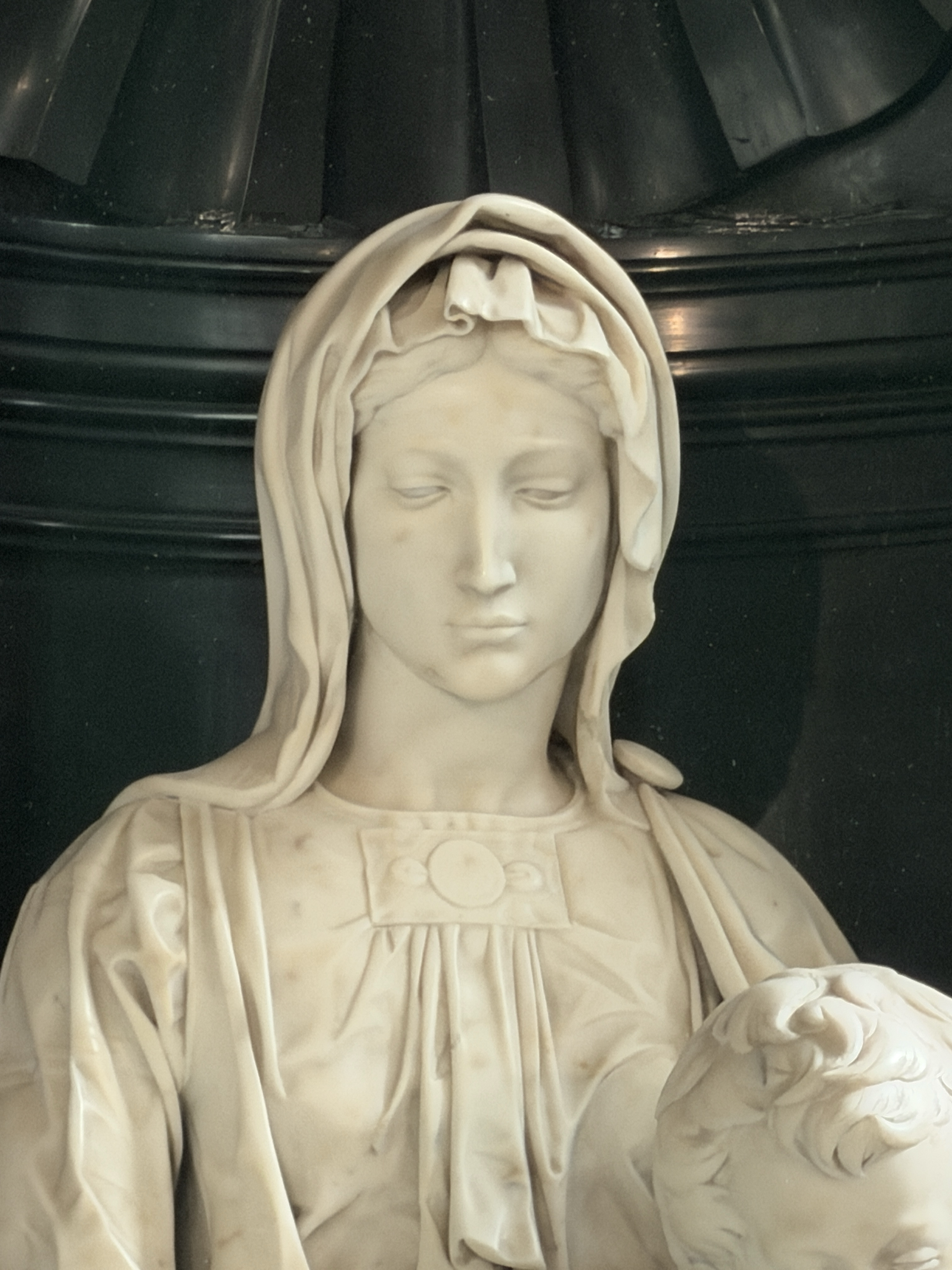
Michelangelo Buonarroti (1475–1564), Madonna and Child (known as the Bruges Madonna), c. 1503–1505, Marble, 128 cm, Church of Our Lady, Bruges
Michelangelo Buonarroti (1475–1564), Madonna and Child (known as the Bruges Madonna), c. 1503–1505, Marble, 128 cm, Church of Our Lady, Bruges
Marian devotion shaped the religious life of Bruges at the beginning of the sixteenth century. The city moved under the presence of the Virgin: chapels dedicated to her, confraternities, processions through the streets, and small painted panels used in private prayer.
In the painting of the Low Countries—particularly in works by Jan van Eyck (c. 1390–1441), Rogier van der Weyden (c. 1399–1464), and Hans Memling (c. 1430–1494)—the Virgin often bends toward the child with quiet intimacy. Hands meet, veils are touched, bodies lean toward one another. A language of tenderness slowly formed across generations of devotional images.
Into this environment arrived Michelangelo’s sculpture.
Carved in Florence around 1503–1505, it belongs to the early years of the artist’s career. The Roman Pietà had already revealed his command of marble, while the colossal David was being carved almost simultaneously. Michelangelo was still in his twenties, still testing what a figure in stone might contain: calm surfaces, compact strength, bodies poised between stillness and movement.
The Bruges Madonna carries that early gravity. The Virgin sits upright, composed, her gaze lowered into a quiet interior space. The child stands between her knees rather than clinging to her arms, though her hand still lightly holds his.
The marble was purchased in Florence by the Bruges merchants Jan and Alexander Mouscron and brought north by 1506, later installed in their chapel in the Church of Our Lady in 1514. It is often described as the only finished sculpture by Michelangelo to reach the Low Countries during his lifetime.
In a city steeped in Marian devotion, the Virgin does not gather the child fully toward her. A small bond remains in the hand she holds, yet a subtle distance persists. The child steadies himself on the ground, as if already aware of the world beyond the mother’s lap.
How might such calm Italian reserve have been received in Bruges—strange, dignified, or another way of imagining the quiet emotional weight carried by motherhood?
The sculpture was twice removed from Bruges by occupying forces. In 1794, French Revolutionary troops seized it along with other works and sent it to Paris, where it remained until its return after Napoleon’s defeat in 1815. A century and a half later, in 1944, retreating German soldiers smuggled it out of the city wrapped in mattresses inside a Red Cross truck. It was discovered the following year in the Altaussee salt mine in Austria and recovered by the Allied ‘Monuments Men’ team charged with retrieving looted art across Europe. That a marble carved quietly in Florence for a merchant family’s chapel should have attracted the attention of two successive waves of military plunder says something about the weight it had acquired, well beyond the devotional purpose for which it was made.
Michelangelo Buonarroti (1475–1564), Madonna and Child (known as the Bruges Madonna), c. 1503–1505, Marble, 128 cm, Church of Our Lady, BrugesMichelangelo Buonarroti (1475–1564), Madonna and Child (known as the Bruges Madonna), c. 1503–1505, Marble, 128 cm, Church of Our Lady, Bruges
References
Edsel, R.M. and Witter, B. (2009) The Monuments Men: Allied Heroes, Nazi Thieves, and the Greatest Treasure Hunt in History. New York: Center Street
Hirst, M. (2012) Michelangelo, Volume I: The Achievement of Fame, 1475–1534. New Haven and London: Yale University Press.
Wallace, W.E. (2010) Michelangelo: The Artist, the Man, and His Times. Cambridge: Cambridge University Press.
Ridderbos, B., Van Buren, A. and Van Veen, H. (eds.) (2005) Early Netherlandish Paintings: Rediscovery, Reception and Research. Amsterdam: Amsterdam University Press
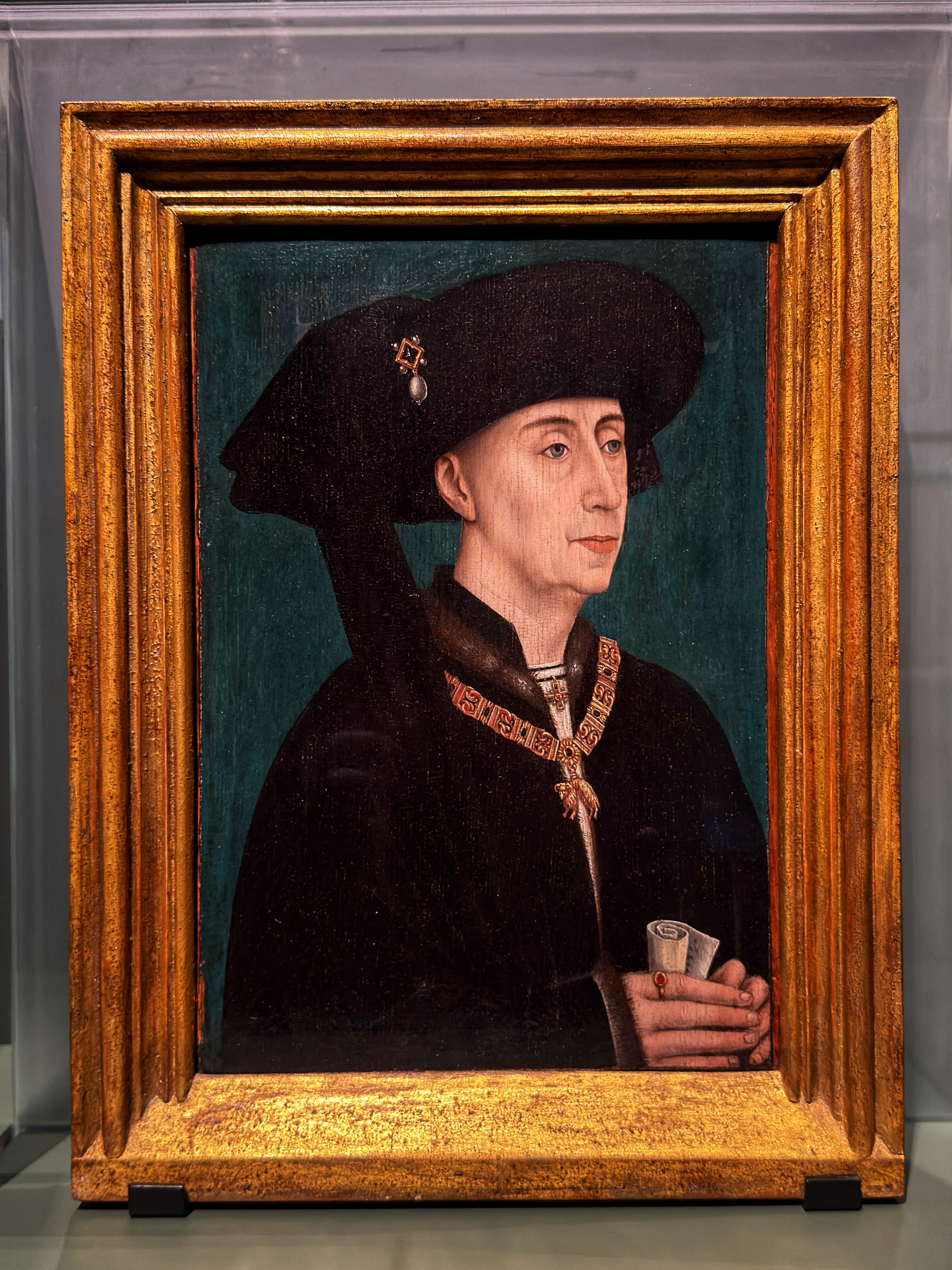
Anonymous Master after Rogier van der Weyden (c. 1399/1400–1464), Portrait of Philip the Good (1396–1467), second half of the 15th century, Oil on oak panel, 32.6 × 22.4 cm, Groeningemuseum, Bruges
Anonymous Master after Rogier van der Weyden (c. 1399/1400–1464), Portrait of Philip the Good (1396–1467), second half of the 15th century, Oil on oak panel, 32.6 × 22.4 cm, Groeningemuseum, Bruges
An iconic representation of the Burgundian duke at a moment when his authority extended over one of the richest and most urbanised regions in Europe. Within the shifting balance of the Hundred Years’ War, he stood as a prince formally subject to the French crown yet operating with near-sovereign autonomy, at times aligned with England against France.
Enclosed within the dark folds of the Burgundian chaperon, Philip appears with austere restraint. Around his neck hangs the collar of the Order of the Golden Fleece, founded in Bruges in 1430, binding leading nobles of his territories to the ducal court.
Philip governed territories that extended beyond the core Burgundian lands, reaching across the Low Countries into a wider network of lordships. Powerful cities retained their own laws and privileges, requiring authority to move through negotiation rather than direct control. This structure coincided with extraordinary prosperity. Urban wealth sustained one of the most brilliant courts of the fifteenth century, in which painters such as Jan van Eyck (c. 1390–1441) and Rogier van der Weyden (c. 1399/1400–1464), worked in close proximity to ducal power.
Later historians would describe this period as a Burgundian golden age. The calm authority of the portrait reads differently in light of what followed. Philip’s son, Charles the Bold (1433–1477), attempted to consolidate these territories into a territorial kingdom. His ambitions ended at Nancy in 1477. The Burgundian structure fractured, and the northern Netherlandish lands passed, through Mary of Burgundy (1457–1482), into the Habsburg orbit.
The image proposes a ruler of political stability. The world he governed remained a fragile assemblage of cities, privileges, and negotiated power. How stable could such a structure ever be?
References
RKD – Netherlands Institute for Art History (n.d.) Anonymous Master after Rogier van der Weyden (c.1399/1400–1464), Portrait of Philip the Good (1396–1467), Musée des Beaux-Arts de Dijon Version ( the best known version) , second half of the 15th century. RKDimages, image no. 254421. Available at: https://rkd.nl/images/254421 (Accessed: 11 March 2026).
RKD – Netherlands Institute for Art History (n.d.) Anonymous Master after Rogier van der Weyden (c.1399/1400–1464), Portrait of Philip the Good (1396–1467), The Louvre version, second half of the 15th century. RKDimages, image no. 295307. Available at: https://rkd.nl/images/295307 (Accessed: 11 March 2026).
Van Loo, B. (2021) The Burgundians: A Vanished Empire: A History of 1111 Years and One Day. Translated by N. Forest-Flier. London: Head of Zeus
Renier van Thienen (active c.1470–1495), Jan Borman II (c.1460–1520), Pieter de Backere (active late fifteenth century) and Jehan Hervy (active late fifteenth century), Tomb of Mary of Burgundy, c.1488–1502, Brass, copper, bronze and enamel effigy on black stone sarcophagus, 260 × 135 × 135 cm, Church of Our Lady, Bruges
Renier van Thienen (active c.1470–1495), Jan Borman II (c.1460–1520), Pieter de Backere (active late fifteenth century) and Jehan Hervy (active late fifteenth century), Tomb of Mary of Burgundy, c.1488–1502, Brass, copper, bronze and enamel effigy on black stone sarcophagus, 260 × 135 × 135 cm, Church of Our Lady, BrugesRenier van Thienen (active c.1470–1495), Jan Borman II (c.1460–1520), Pieter de Backere (active late fifteenth century) and Jehan Hervy (active late fifteenth century), Tomb of Mary of Burgundy, c.1488–1502, Brass, copper, bronze and enamel effigy on black stone sarcophagus, 260 × 135 × 135 cm, Church of Our Lady, Bruges
A young ruler lies in still metal, surrounded by the heraldry of a vanished political world.
The tomb erected in Bruges some years after Mary of Burgundy’s death gathers into sculptural form the inheritance that had briefly converged in her person. The gilded effigy shows the duchess resting in composed stillness, crowned and wrapped in the mantle of Burgundian sovereignty. Along the sides of the sarcophagus a dense sequence of heraldic shields borne by lions unfolds in measured succession.
These arms evoke dynastic lineage and the territories of the Burgundian house, so that the monument begins to resemble a visual genealogy as much as a funerary image, metal and stone quietly assembling the web of lands and claims once held together under Burgundian rule.
That political configuration had taken shape during the long reign of Philip the Good (1396–1467), whose government consolidated the territories of the Low Countries into one of the most powerful princely formations of late medieval Europe. When his son Charles the Bold (1433–1477) was killed at Nancy in 1477, the inheritance passed to his only child, Mary of Burgundy.
Her short rule unfolded at a fragile historical threshold between the Burgundian structure fashioned under Philip and the Habsburg order that would soon emerge. After 1477 the French king Louis XI (1423–1483) sought to dismantle Burgundian power, while the cities of the Low Countries compelled the young ruler to confirm their liberties in the Great Privilege of 1477.
Her marriage that same year to Maximilian I (1459–1519) brought military support but also drew the Burgundian inheritance into the orbit of the Habsburg dynasty. Through their son Philip the Handsome (1478–1506) and grandson Charles V (1500–1558), these territories would become the political core of the Habsburg Netherlands.
Renier van Thienen (active c.1470–1495), Jan Borman II (c.1460–1520), Pieter de Backere (active late fifteenth century) and Jehan Hervy (active late fifteenth century), Tomb of Mary of Burgundy, c.1488–1502, Brass, copper, bronze and enamel effigy on black stone sarcophagus, 260 × 135 × 135 cm, Church of Our Lady, BrugesRenier van Thienen (active c.1470–1495), Jan Borman II (c.1460–1520), Pieter de Backere (active late fifteenth century) and Jehan Hervy (active late fifteenth century), Tomb of Mary of Burgundy, c.1488–1502, Brass, copper, bronze and enamel effigy on black stone sarcophagus, 260 × 135 × 135 cm, Church of Our Lady, BrugesRenier van Thienen (active c.1470–1495), Jan Borman II (c.1460–1520), Pieter de Backere (active late fifteenth century) and Jehan Hervy (active late fifteenth century), Tomb of Mary of Burgundy, c.1488–1502, Brass, copper, bronze and enamel effigy on black stone sarcophagus, 260 × 135 × 135 cm, Church of Our Lady, BrugesRenier van Thienen (active c.1470–1495), Jan Borman II (c.1460–1520), Pieter de Backere (active late fifteenth century) and Jehan Hervy (active late fifteenth century), Tomb of Mary of Burgundy, c.1488–1502, Brass, copper, bronze and enamel effigy on black stone sarcophagus, 260 × 135 × 135 cm, Church of Our Lady, BrugesRenier van Thienen (active c.1470–1495), Jan Borman II (c.1460–1520), Pieter de Backere (active late fifteenth century) and Jehan Hervy (active late fifteenth century), Tomb of Mary of Burgundy, c.1488–1502, Brass, copper, bronze and enamel effigy on black stone sarcophagus, 260 × 135 × 135 cm, Church of Our Lady, Bruges
References
Van Loo, B. (2021) The Burgundians: A Vanished Empire: A History of 1111 Years and One Day. Translated by N. Forest-Flier. London: Head of Zeus.
Petrus Christus (active c. 1444–1476), Portrait of a Young Woman, c.1470, Oil on oak panel, 29 x 22.5 cm, Gemäldegalerie, Berlin
The sitter appears composed within the frame, her presence stabilised through dress, posture, and the tight limits of the composition. Everything required for recognition is present — and yet we know neither who she is nor why the portrait was made.
That sense of completion sits oddly beside a long history of misattribution. For centuries the portrait was attributed to Jan van Eyck(1390-1441). Petrus Christus was recovered as an independent Bruges master only in the nineteenth century through the work of Gustav Friedrich Waagen (1794-1868) and later Max J. Friedländer (1867-1958), who reconstructed a small, unusually coherent oeuvre. That the painting sat so long under Van Eyck’s name is itself a measure of its quality: precise and authoritative enough to bear the greater reputation.
The sitter’s appearance conforms to the most exacting Burgundian ideals of beauty in the later fifteenth century, particularly the preference for a conspicuously high forehead. This effect was carefully produced. Hair is tightly bound and drawn back to heighten the forehead; the neck is lengthened through posture and dress; the body is compressed into a narrow vertical silhouette. The tall black headdress is a variant of the truncated, or bee-hive, hennin fashionable at the Burgundian court, reinforcing height and linearity.
Johan Huizinga (1872–1945), in The Autumn of the Middle Ages, described a Burgundian court culture in which ceremony had become increasingly rigid and elaborate — a response, he argued, to the violence and instability of the wider world. The fixed forms of dress, precedence, and display that governed courtly life were, in his account, compensatory rather than confident: the more brittle the social order, the more exacting the performance required to sustain it. Christus’ portrait belongs to that moment. The high forehead, the stiff verticality of the hennin, the compression of the body into a narrow silhouette — all conform to a code of appearance that left little room for accident or individuality. And yet the sitter’s gaze complicates the reading. She looks out at the viewer directly, with an alertness that many art historians have found unsettling. Something personal — watchful, self-possessed, faintly resistant — survives within the form.
References
Dyballa, K. and Kemperdick, S. (eds.) (2024) Netherlandish and French Paintings 1400–1480: Critical Catalogue for the Gemäldegalerie – Petersberg: Michael Imhof Verlag
Huizinga, J. (1996) The Autumn of the Middle Ages. Chicago: University of Chicago Press