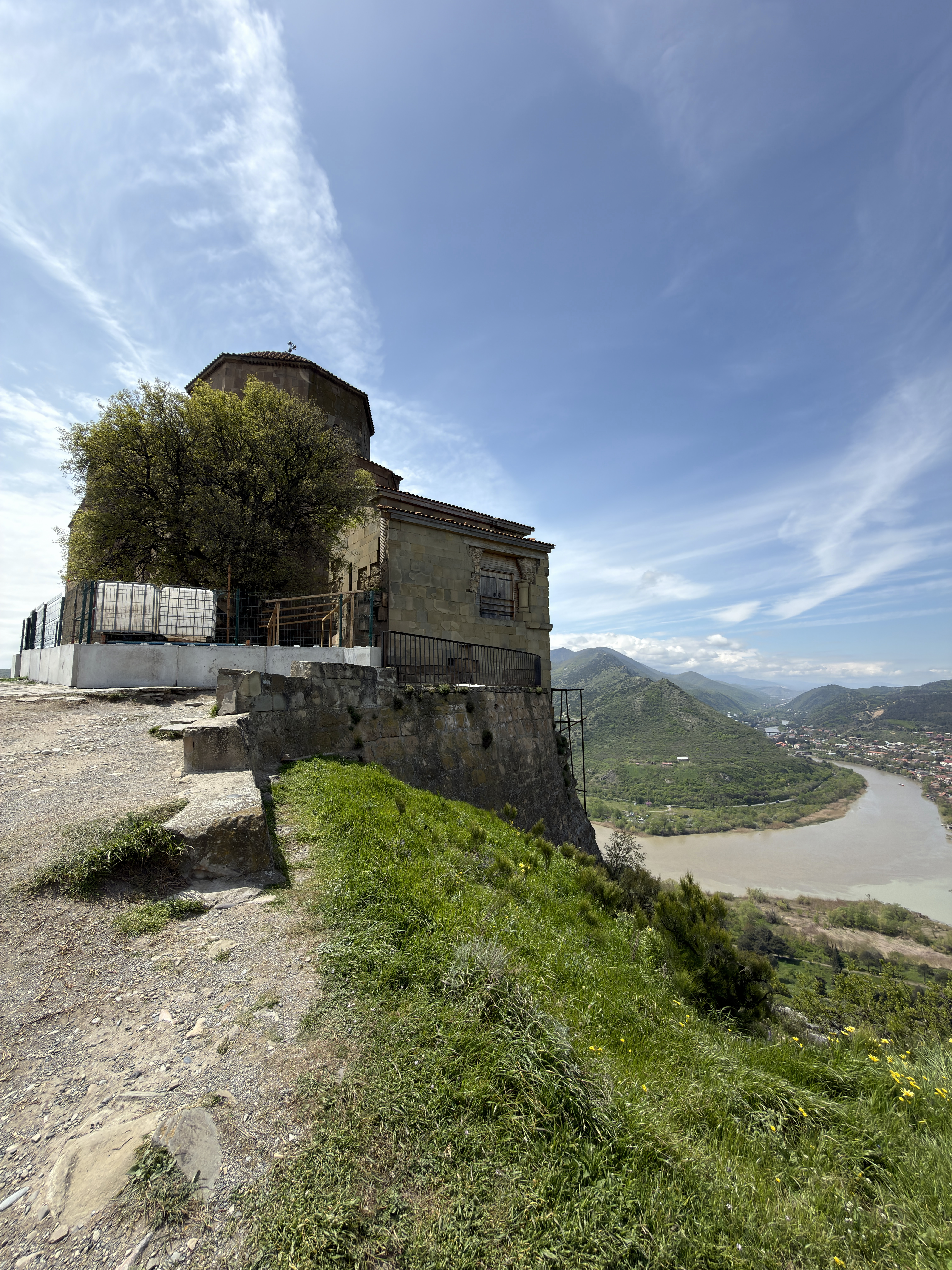

Mtskheta sits where two rivers meet, the Mtkvari and the Aragvi, and it was here, in the first royal capital of Kartli, which the Romans knew as Iberia, that a haunting legend of a particular kind took root, one that precedes the Christianisation of the kingdom by some three centuries and bypasses its logic entirely, with no apostle arriving with a mission. The story, preserved in the Kartlis Tskhovreba, the medieval Georgian chronicles, begins instead with a Jewish man from this city, present at the Crucifixion, who bought Christ’s seamless tunic, the Chiton, from a Roman soldier and carried it home. When his sister Sidonia took the garment in her arms she died, for no reason the chronicle troubles to explain, and was buried where she fell with the tunic still held to her body, and a cedar grew in time from the earth above her grave.
When St Nino brought Christianity to Kartli in the early fourth century and King Mirian commissioned a church on that ground, the cedar was felled for a pillar that nothing and no one could raise until Nino prayed through the night, an angel descended, and the column settled blazing into its place. The site, and eventually the present cathedral built under Catholicos-Patriarch Melkisedek between 1010 and 1029, took its name from this: Svetitskhoveli, the Life-Giving Pillar.


References
Eastmond, A. (1998) Royal Imagery in Medieval Georgia. University Park, PA: Penn State University Press
Foletti, I. and Thunø, E. (eds.) (2016) The Medieval South Caucasus: Artistic Cultures of Albania, Armenia and Georgia. Brno: Convivium Supplementum
Frankopan, P. (2018) The New Silk Roads: The Present and Future of the World. London: Bloomsbury Publishing
Khoshtaria, D. (2023) Medieval Georgian Churches: A Concise Overview of Architecture. Available at: https://www.academia.edu/103250488/Medieval_Georgian_Churches_A_Concise_Overview_of_Architecture (Accessed: 1 May 2026)
Khoshtaria, D. (2023) Medieval Georgian Churches: A Concise Overview of Architecture. Tbilisi: Artanuji Publishing
Mepisashvili, R. and Tsintsadze, V. (1979) The Arts of Ancient Georgia. London: Thames and Hudson
MacCulloch, D. (2009) A History of Christianity: The First Three Thousand Years. London: Allen Lane