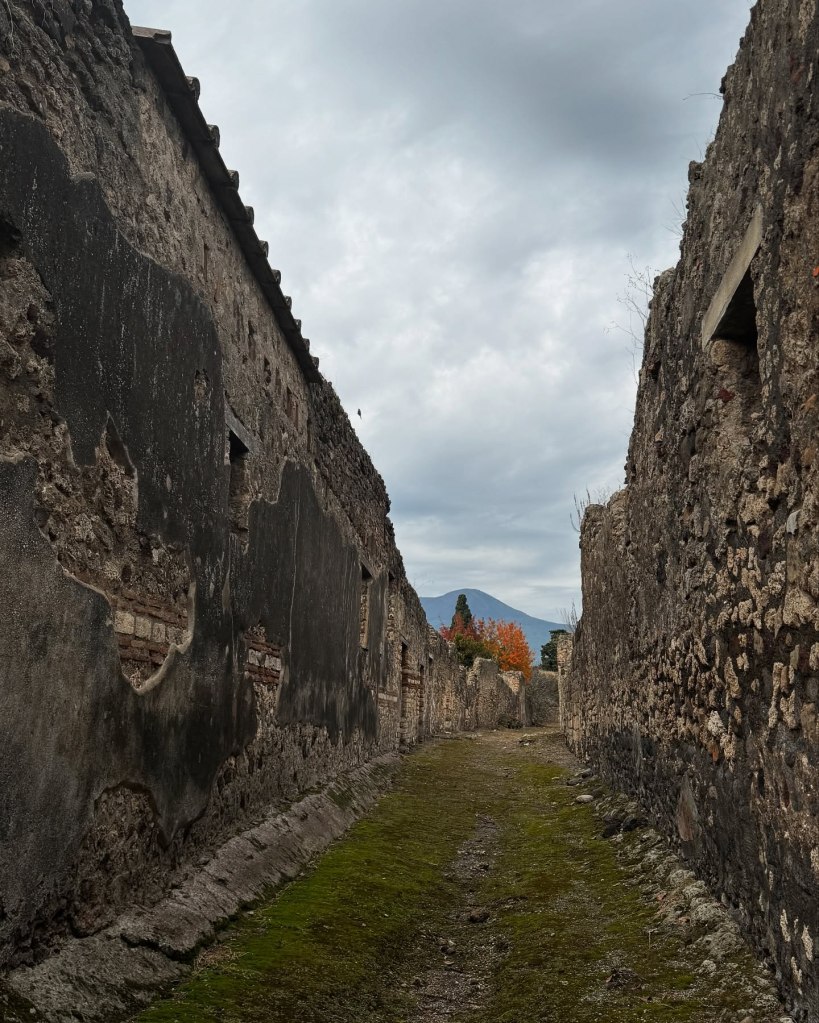




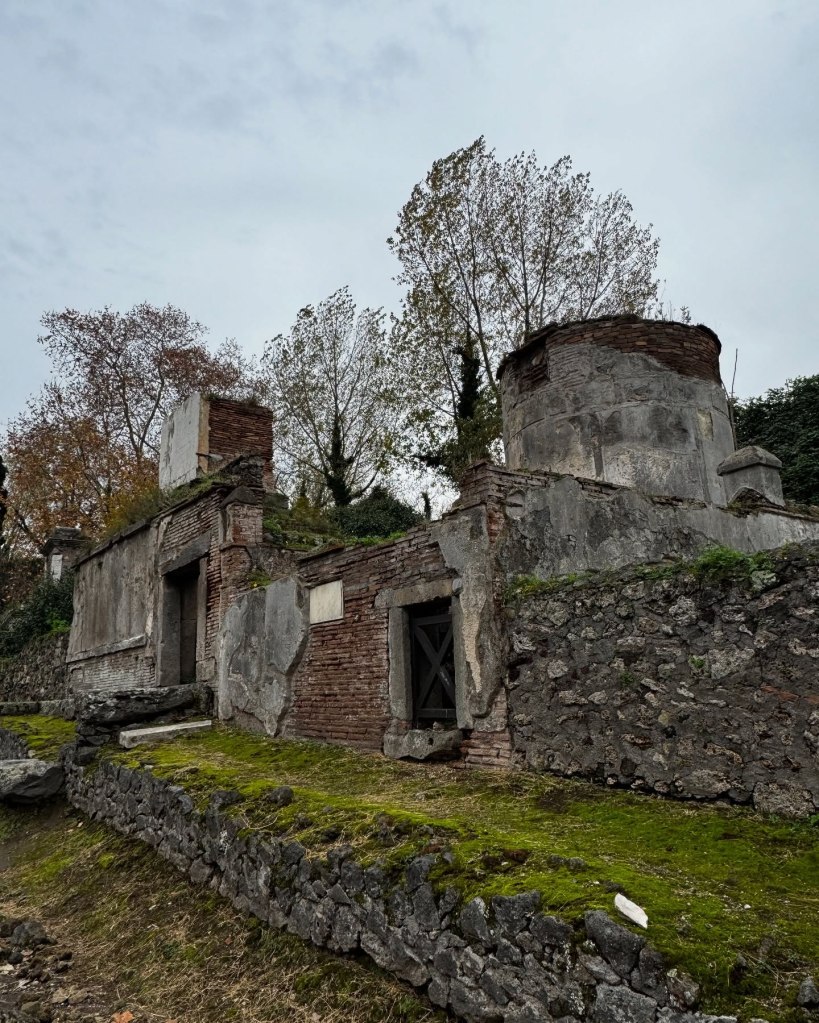
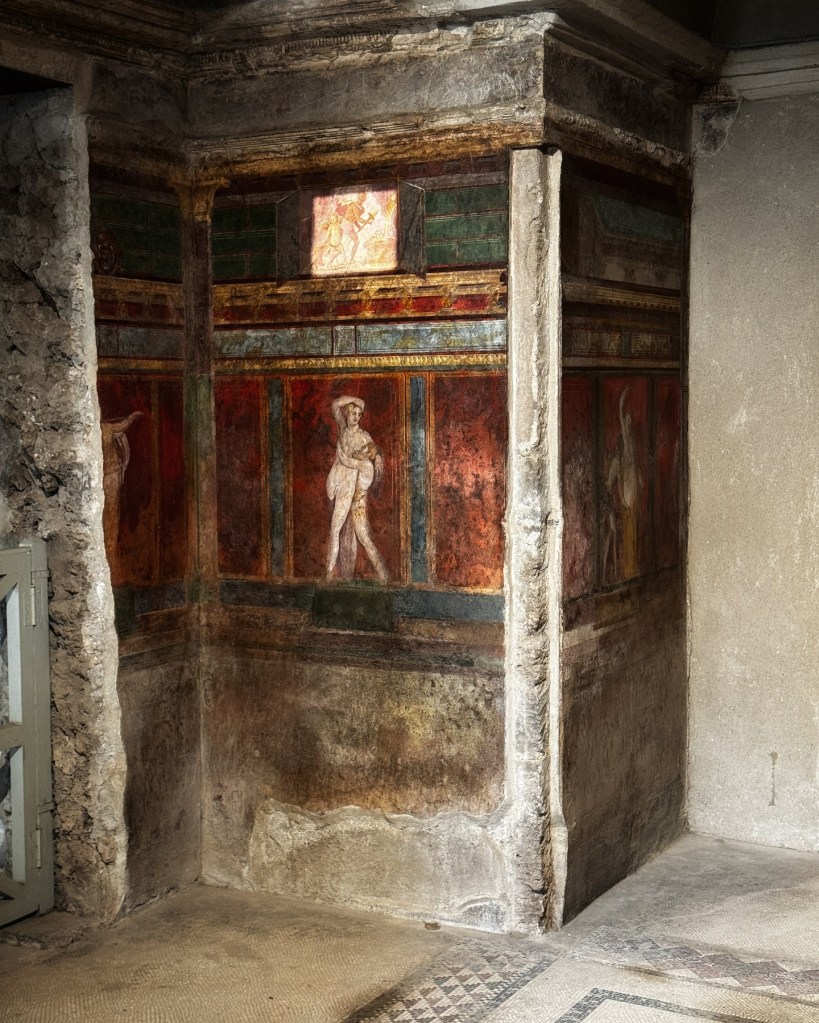
These remarkably well-preserved frescoes, dated to circa 60–50 BC, continue to line the walls of the Villa of the Mysteries near Pompeii, despite long-term conservation challenges. Their vivid palette, compositional complexity, and refined technique have made them a focal point of interdisciplinary study since their rediscovery in 1909, having remained sealed under volcanic ash for nearly two millennia. Art historians regard them as exemplary of late Republican Roman wall painting, while scientific analyses underscore the technological sophistication of ancient artisans.
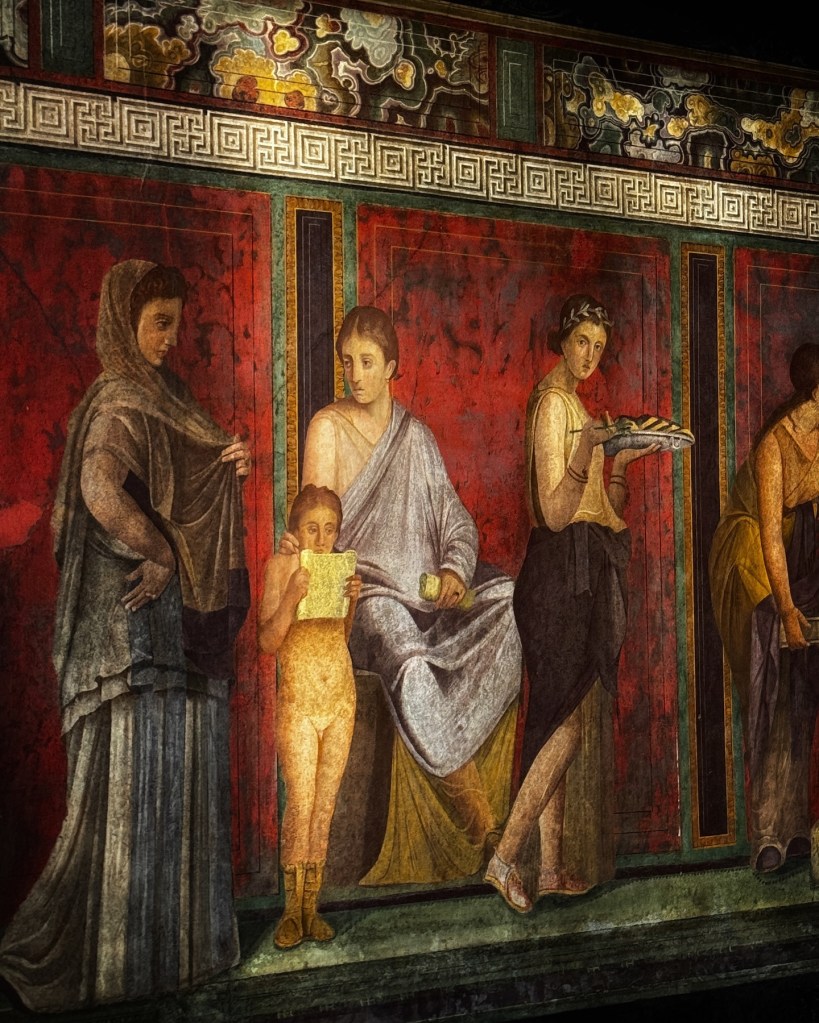
Material studies using techniques such as X-ray fluorescence (XRF) and Raman spectroscopy have confirmed the use of both natural and synthetic pigments. Red and yellow ochres, green earth, and carbon black—derived from organic sources like soot or charcoal—formed the basis of the colour palette. Notably, the presence of Egyptian blue, a synthetic pigment produced by heating quartz, copper compounds, and calcium-based fluxes, demonstrates the Romans’ command of early inorganic chemistry.
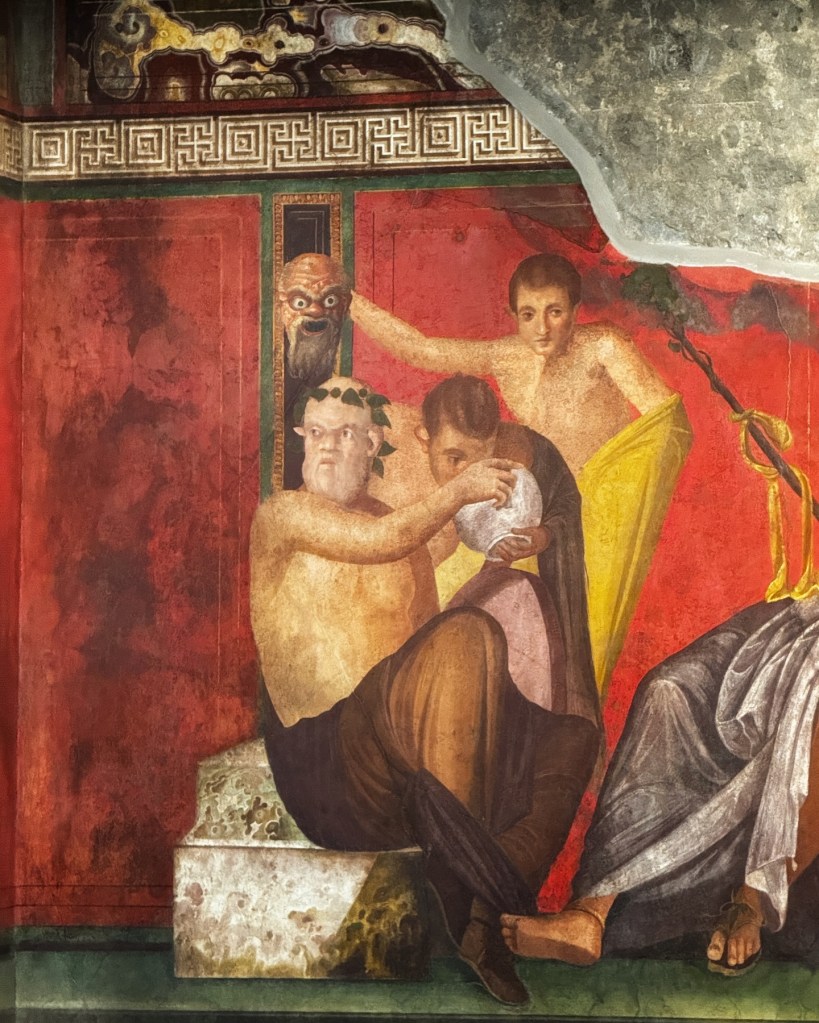
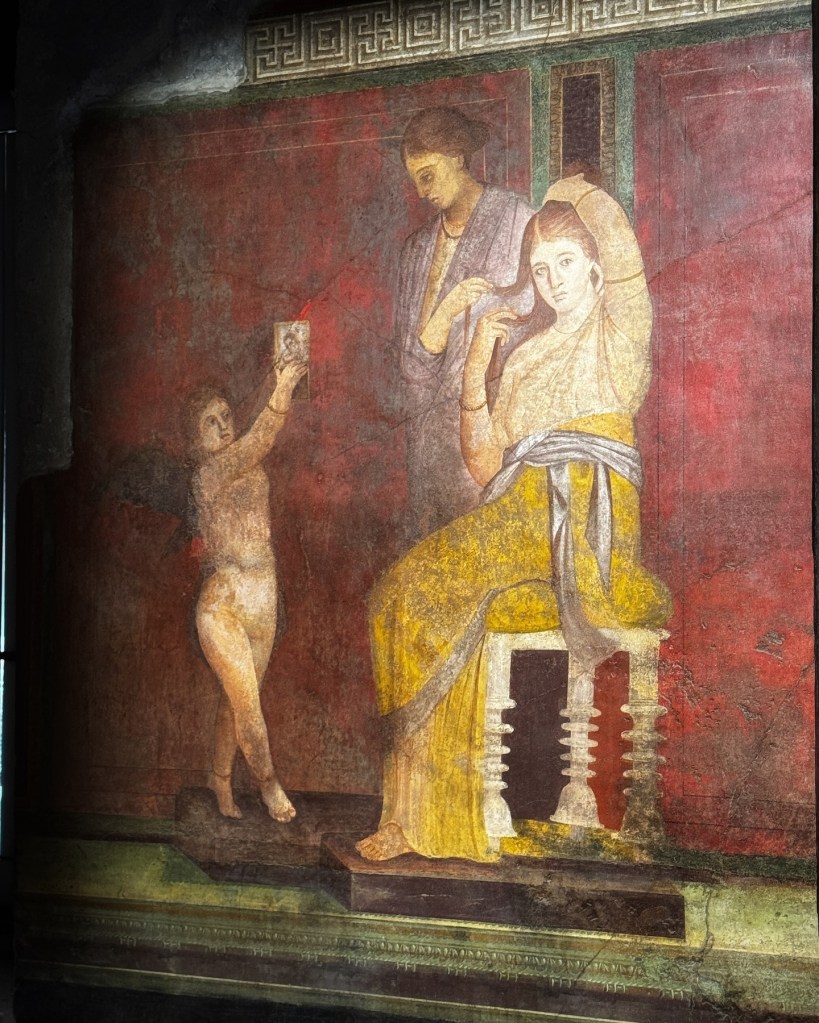
The central cycle in the so-called Initiation Chamber features near life-sized figures interpreted as participants in Dionysian rituals. These scenes are invaluable not only for their aesthetic and technical qualities but also for the light they shed on Roman religious iconography, social dynamics, and the interplay between ritual and representation in elite domestic settings.




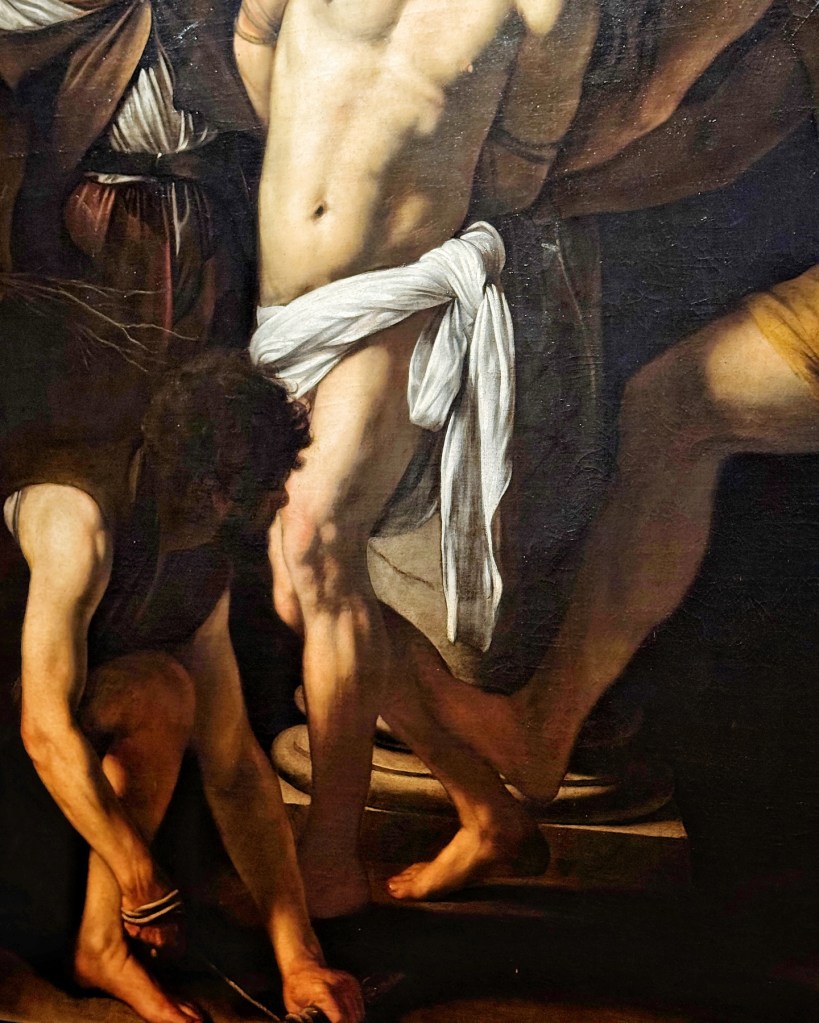
Michelangelo Merisi da Caravaggio (1571–1610) ( 1671-1610), The Flagellation of Christ, 1607-1608, Oil on canvas, 286×213 cm, Museo di Capodimonte, Naples
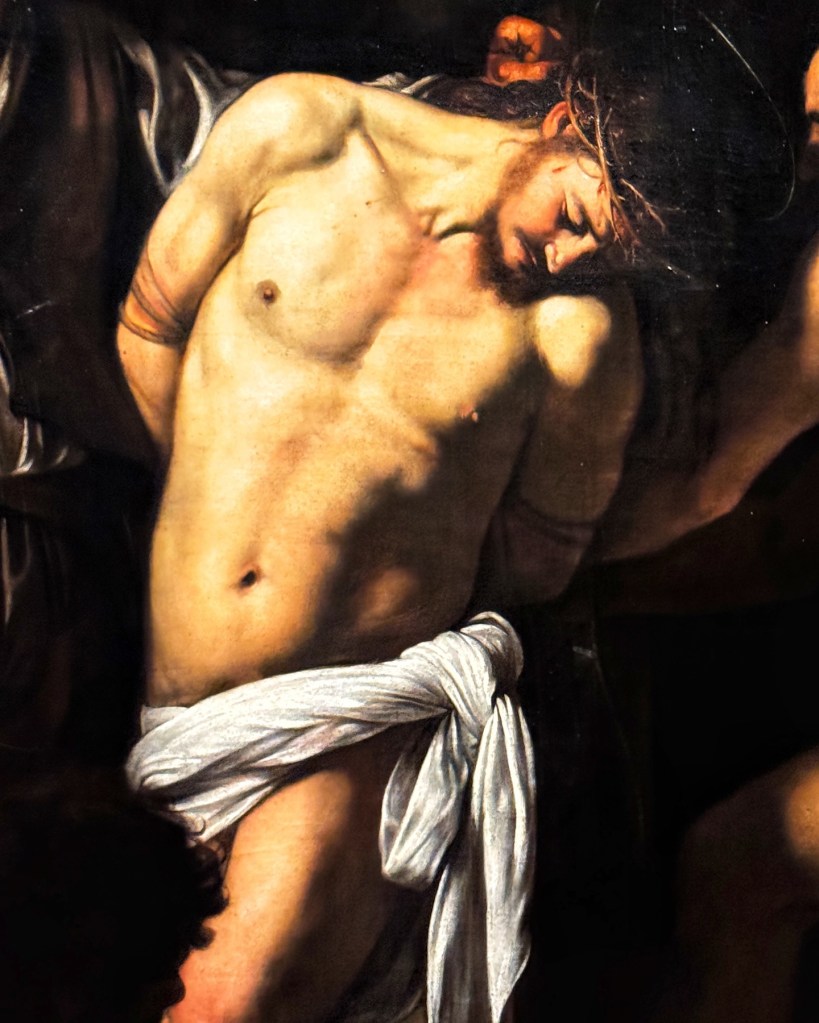
This masterpiece is one of the defining works of Caravaggio’s Neapolitan period, a phase of his career marked by profound personal and artistic transformation. The painting was commissioned by Tommaso de’ Franchis, a Genoese aristocrat residing in Naples, for his family chapel in the church of San Domenico Maggiore. It was likely created after ‘Seven Works of Mercy’ for the Pio Monte della Misericordia, another masterpiece completed shortly after he arrived in Naples. Both paintings remain in Naples to this day.
‘The Flagellation of Christ ‘ depicts the brutal moment when Christ is bound to a column and whipped by three tormentors. Caravaggio’s attention to the anatomy of the human form is extraordinary. Christ is shown with a muscular yet vulnerable physique; his torso is bathed in a harsh, focused light that highlights the violence of the scene. His twisted, bound pose conveys both physical agony and spiritual endurance.
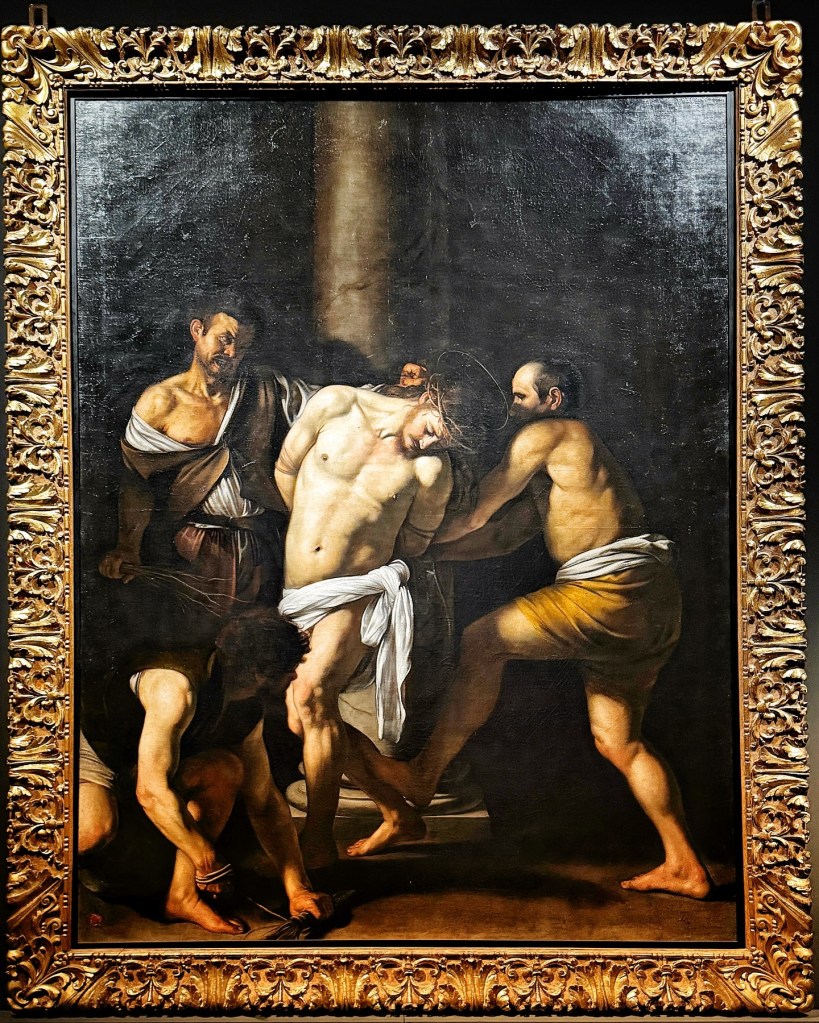
A particularly striking feature of the painting is the depiction of the figures’ legs. Caravaggio positions them at dynamic angles, creating a palpable sense of movement and interaction. The placement of Christ’s bare feet, planted humbly and submissively in contrast to the aggressive stances of the tormentors, symbolises the tension between divinity and human cruelty. The hands, especially Christ’s bound wrists, are rendered with meticulous realism, capturing the strain and suffering of the moment.
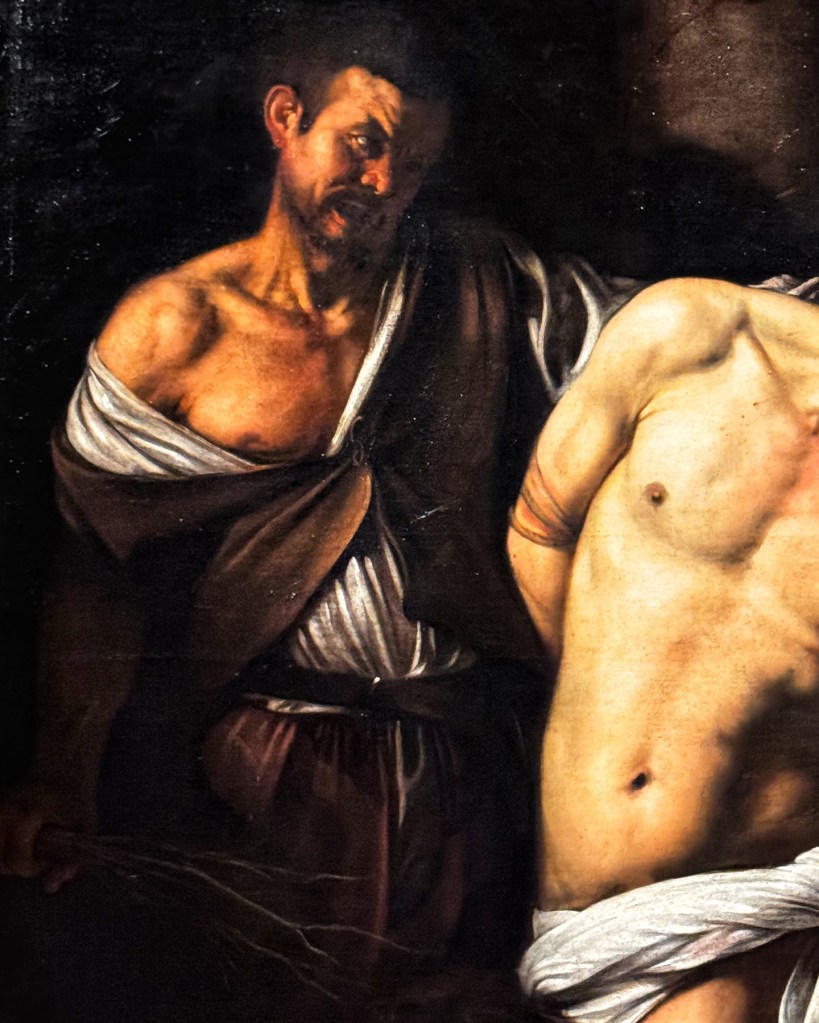
The tormentors are depicted with equal anatomical precision, their muscular arms and brutish expressions standing in stark contrast to Christ’s stillness. Caravaggio’s masterful use of tenebrism—where figures emerge dramatically from an almost void-like darkness—further isolates the scene, intensifying its emotional power and drawing the viewer’s focus to the interplay of light, shadow, and human form.

Architecture frequently functions as a medium for reimagining history, blending past ideals into fresh narratives to meet modern aspirations. In the 19th century, such adaptations became expressions of shifting political meanings. The Basilica of San Francesco di Paola, commissioned by King Ferdinand I of the Two Sicilies (1751–1825) in 1816, embodies this dynamic. Following his restoration to power after Napoleon Bonaparte’s defeat, Ferdinand framed his return as divinely ordained, crediting the intercession of San Francesco di Paola (1416–1507) with his luck.

The basilica’s design closely mirrors that of the Pantheon in Rome, an ancient structure constructed between 113 and 125 CE during the reign of Emperor Hadrian (76–138). Its immense dome, circular floor plan, and grand portico adorned with Corinthian columns were deliberately intended to evoke the authority of imperial Rome. The project was initially directed by Leopoldo Laperuta (1780–1858), a distinguished Neapolitan architect, and later completed by Pietro Bianchi (1787–1849), who refined this design to adhere to the neoclassical ideals of symmetry, order, and grandeur.
The sweeping semi-circular colonnades flanking the basilica were inspired by St. Peter’s Square in Vatican City (1656–1667), designed by the famous Gian Lorenzo Bernini (1598–1680). These colonnades unify the basilica with the broader context of Piazza del Plebiscito, seamlessly integrating the religious monument with its civic and political surroundings. The square has historical ties to the Royal Palace opposite the basilica, which was constructed in 1600 by Domenico Fontana (1543–1607) under the administration of the Spanish Viceroy Fernando Ruiz de Castro (1548–1601). Originally a parade ground, the square was later renamed in honour of the 1860 plebiscite, which marked Naples’ unification with the Kingdom of Italy.
Antoon van Dyck ( 1599-1641), Crucifixion, 1621-1625, Oil on canvas, 155 x 111 cm, Museo Nazionale di Capodimonte, Naples

This minimalist Crucifixion, one of the most repeated compositions in Van Dyck’s oeuvre, was created during his Italian period (1621–1627) and probably builds upon his earlier Genoese version.
The ‘Crucifixion’ portrays Christ moments before death, highlighting his isolation and humanity. The oblique positioning of the cross creates instability, leading the viewer’s gaze upward to Christ’s anguished face. His strained and contorted body conveys both physical pain and spiritual abandonment, echoing the words from the Gospel of Mark: ‘Eloi, Eloi, lama sabachthani?’ (Mark 15:34).
Van Dyck employs a deliberately restrained palette of earthy browns and pale flesh tones, which intensifies the scene’s drama. The stark illumination of Christ’s body contrasts sharply with the dark sky, employing tenebrism reminiscent of Caravaggio. The light symbolises divine grace and redemption, while the surrounding darkness evokes the weight of sin and the moment of divine judgment.
This composition also aligns with the Jesuit practice of meditatio imaginativa, inviting viewers to place themselves at the foot of the cross and deeply contemplate Christ’s suffering, a core element of Counter-Reformation devotional practices.
References
Martin, J.R. and Feigenbaum, G. (1979) Van Dyck as a Religious Artist. Princeton, NJ: The Art Museum, Princeton University; Princeton University Press

Charles III of Naples (1716–1788) was twenty-one when he ordered a new opera house to replace the Teatro San Bartolomeo, which had been the city’s main lyric venue since 1621. He had been king for two years. What he wanted from the commission, beyond the obvious fact of a grander building, is harder to say — but Giovanni Antonio Medrano (1703–1760) and Angelo Carasale (d. 1742) delivered it fast, and on 4 November 1737 the Teatro di San Carlo opened. It would be forty-one years before Milan built the Teatro alla Scala, fifty-five before Venice completed La Fenice. Those two houses now tend to define Italian opera in the European memory; San Carlo, curiously, comes third in a list of two.
The inaugural opera was Domenico Sarro’s (1679–1744) Achille in Sciro, to a libretto by Pietro Metastasio (1698–1782). Naples received it warmly and then largely forgot it, which is the usual fate of works chosen to open buildings rather than for any other reason.
The composers who followed filled in a picture that had no obvious precedent. Leonardo Leo (1694–1744), Niccolò Porpora (1686–1768), Leonardo Vinci (1690–1730), Johann Adolf Hasse (1699–1783), Gaetano Latilla (1711–1788), Niccolò Jommelli (1714–1774), Baldassarre Galuppi (1706–1785), Niccolò Piccinni (1728–1800), Antonio Sacchini (1730–1786), Tommaso Traetta (1727–1779), Giacomo Tritto (1733–1824), Giovanni Paisiello (1740–1816), and Domenico Cimarosa (1749–1801) all worked at San Carlo — a concentration of talent in a single house that tells where the centre of gravity in mid-eighteenth-century opera actually lay.
Composers came from further afield too. Christoph Willibald Gluck (1714–1787) premiered La clemenza di Tito there in 1752; Johann Christian Bach (1735–1782) brought Catone in Utica in 1761 and Alessandro nell’Indie the year after. Wolfgang Amadeus Mozart (1756–1791) was in Naples in 1770 and saw Jommelli’s L’Armida abbandonata, though what he thought of it he kept largely to himself.
References
Robinson, M.F. (1972) Naples and Neapolitan Opera. Oxford: Clarendon Press
Strohm, R. (1997) Dramma per Musica: Italian Opera Seria of the Eighteenth Century. New Haven and London: Yale University Press
The Duomo of Naples, officially known as the Cathedral of Santa Maria Assunta, is a grand landmark that blends Gothic, Renaissance, and Baroque styles. Its construction began in the late 13th century under the reign of Charles I of Anjou (1226–1285), with subsequent contributions spanning many centuries.

The Duomo features a three-aisled basilica plan, dominated by its Gothic nave and a richly decorated interior. The interior is monumental, with 12 side chapels on either side of the nave. The cathedral underwent significant renovations during the 15th century, incorporating Renaissance elements, and again in the 17th and 18th centuries, when Baroque influences transformed its chapels and altars. In the 19th century, a Neogothic façade was designed by Enrico Alvino (1809–1872), completing the cathedral’s eclectic appearance.
The cathedral’s dome, completed in the 16th century, dominates the central crossing of the nave and transept. It reflects a mix of Renaissance and Baroque influences, with frescoes added during later centuries. The dome’s frescoes, depicting The Assumption of the Virgin Mary, were executed in the 17th century by Paolo de Matteis (1662–1728), whose mastery of perspective and use of dramatic chiaroscuro imbues the space with a sense of divine elevation.
The crowning feature of the altar is the sculpture of The Assumption of the Virgin Mary, added during the Baroque period. Sculpted by Pietro Bracci (1700–1773), it depicts the Virgin being carried heavenward by angels, surrounded by swirling clouds and radiant light. Inspired by Gian Lorenzo Bernini’s (1598–1680) theatrical style, Bracci’s work combines dynamic movement with intricate detailing, achieving a sense of celestial transcendence.


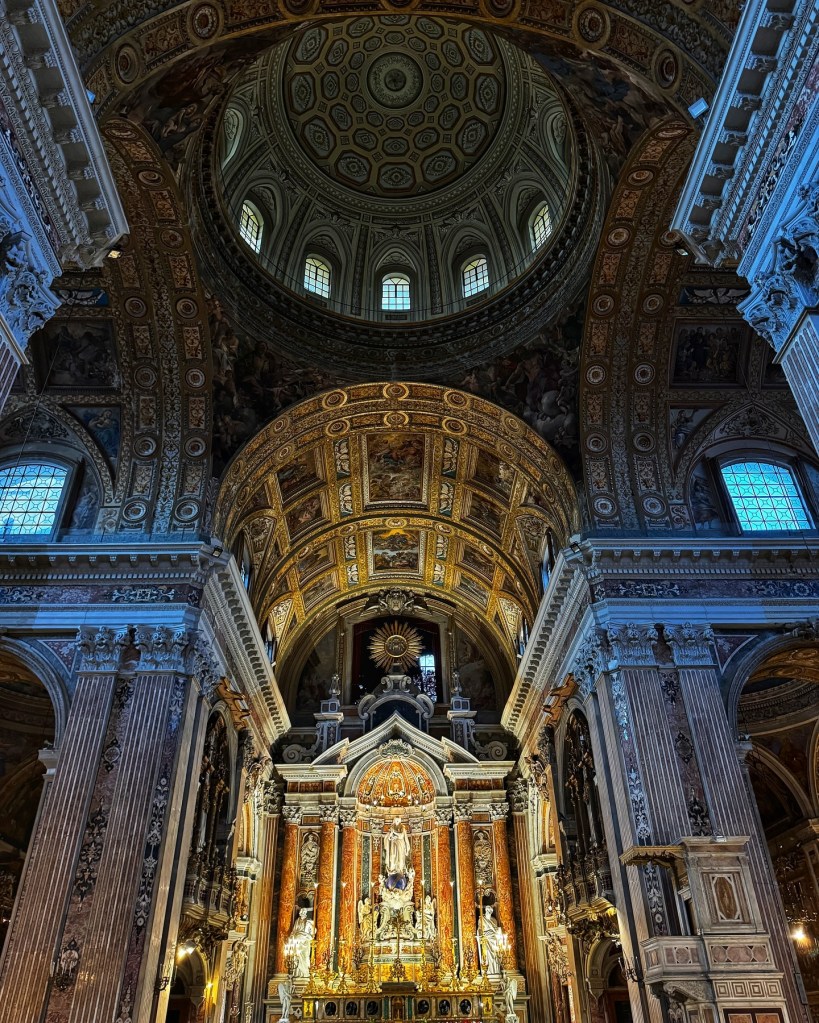
Chiesa del Gesù Nuovo in Naples is a landmark of Neapolitan Baroque, seamlessly blending architectural innovations of its era. Initially built in 1470 as the Palazzo Sanseverino, the Jesuits acquired the structure in 1584 and transformed it into a church under the direction of Giuseppe Valeriano (1542–1596), a Jesuit architect from Abruzzo. Valeriano reimagined the building while preserving its distinctive diamond-rusticated façade, which remains one of its most recognisable elements.

At the heart of the church is the grand altar, a masterpiece by Cosimo Fanzago (1591–1678), a sculptor and architect from Clusone who became the most prolific sculptor in Naples. The altar, a triumph of marble inlay and gilding, epitomises Baroque art’s emotional intensity. Its design naturally draws the viewer’s gaze toward the dome, fostering a sense of spiritual elevation. The original dome, painted by Giovanni Lanfranco (1582–1647), was destroyed in the 1688 earthquake and later repainted by Paolo de Matteis (1662–1728). De Matteis’s frescoes, depicting dynamic heavenly scenes, combine Baroque theatricality with lighter Rococo influences.
The interior is an extraordinary example of integrated Baroque design, featuring contributions from some of the era’s greatest artists. Belisario Corenzio (1558–1646), a Greek-born painter active in Naples, decorated the vault, while Massimo Stanzione (1585–1656) adorned the apse and upper vault, merging Caravaggist realism with vivid colouration. Giovanni Bernardino Azzolino (1572–1645) crafted the altarpiece in the Chapel of Saint Francis Xavier, and Luca Giordano (1634–1705), a Neapolitan artist celebrated for his speed and energy, painted frescoes in the same chapel. In the Chapel of St. Ignatius of Loyola, Jusepe de Ribera (1591–1652), a Spanish-born painter working in Naples, created intensely dramatic scenes from St. Ignatius’s life, employing chiaroscuro to heighten the emotional impact
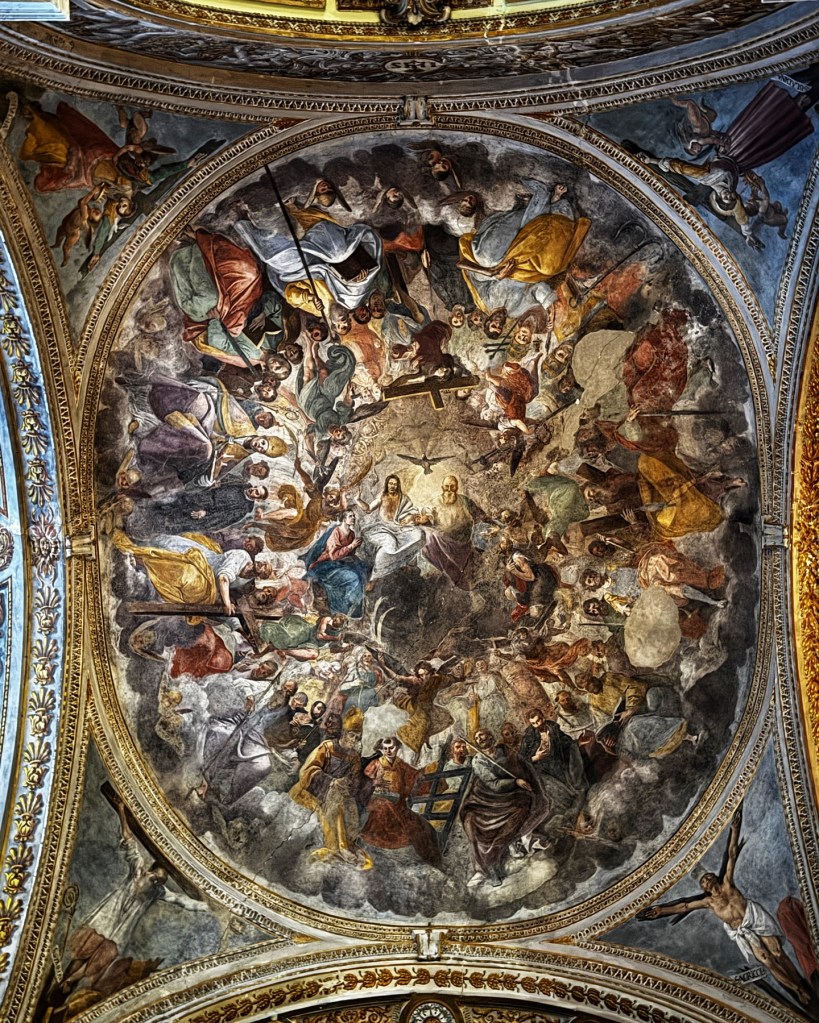

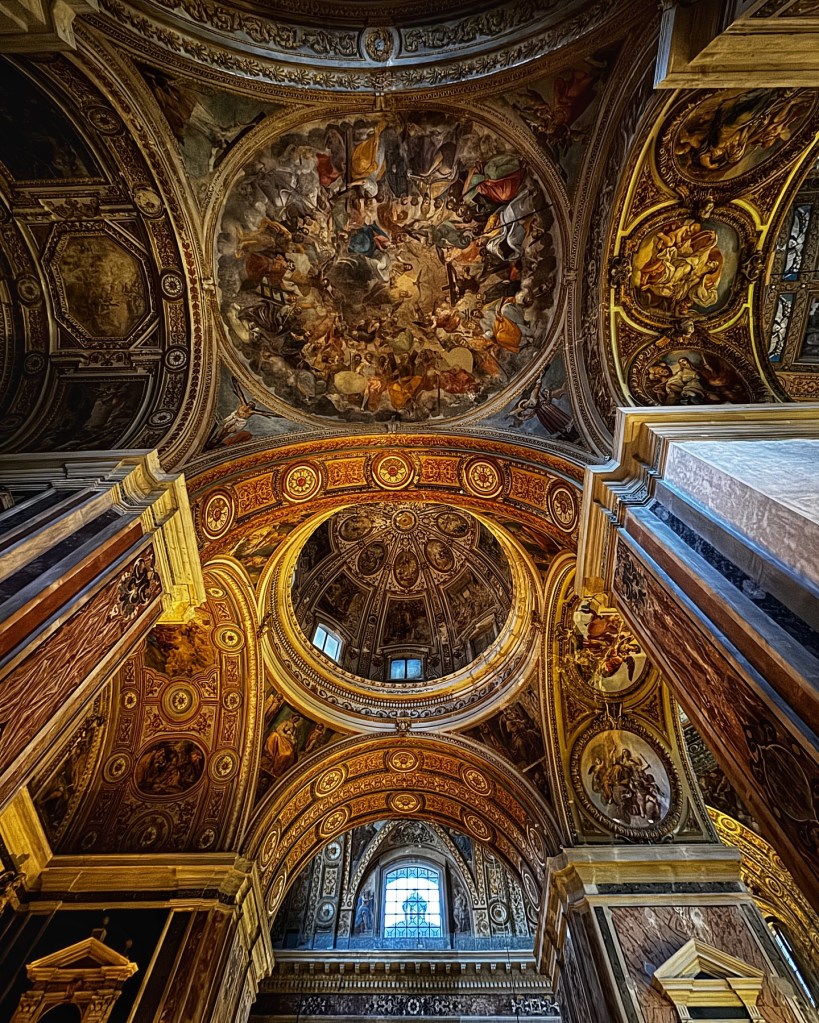


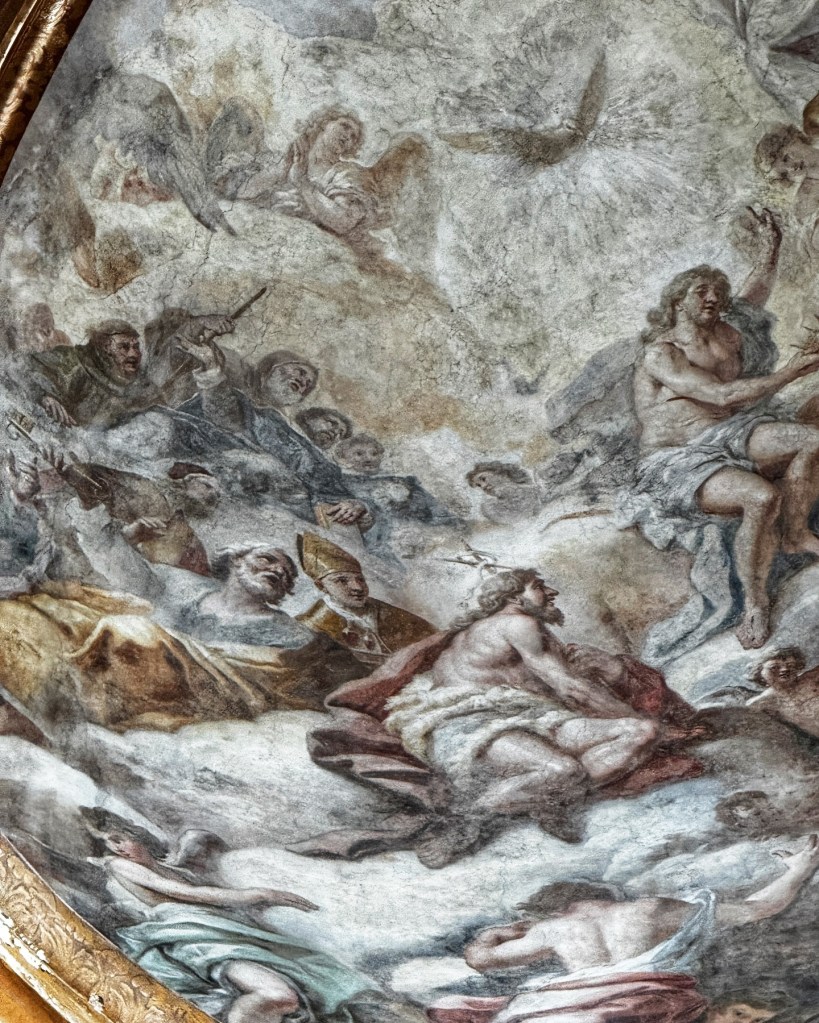
The ‘Paradise’ fresco in the Royal Chapel of the Treasure of San Gennaro in Naples Cathedral, painted by Giovanni Lanfranco (1582–1647), is a masterpiece of Baroque art. Completed in 1643, it presents a breathtaking vision of saints and angels ascending towards God. Yet, its creation was anything but serene, plagued by conflict, scandal, and fierce competition.

The chapel, commissioned in 1608, became a battleground for major artistic commissions. Domenico Zampieri, known as Domenichino (1581–1641), was invited from Rome in 1631 to undertake the project but encountered fierce opposition from the Cabal of Naples—a group of artists, including Jusepe de Ribera (1591–1652), Battistello Caracciolo (c. 1578–1635), and Belisario Corenzio (c. 1558–1646). These artists sought to dominate Naples’ art market through sabotage and intimidation. Domenichino faced the defacement of his work, harassment, and death threats. In 1641, he died under suspicious circumstances, with many suspecting poisoning at the hands of his rivals.
Lanfranco, Domenichino’s long-standing rival, managed to secure his safety and position in Naples, possibly through strategic negotiations or sharing parts of the work or profits. He took over the project, erasing Domenichino’s designs and asserting his own artistic vision. Completing the dome fresco cemented his reputation while rewriting the chapel’s artistic narrative.
This rivalry illustrates the darker side of Italy’s libertarian 17th-century art market. Unlike the highly regulated guild systems in the Netherlands, which imposed strict rules, taxes, and barriers to entry, Italy’s more open market allowed for artistic mobility and opportunities. Local and foreign artists could travel, settle, exchange ideas, and secure commissions from various patrons. However, this freedom also bred unchecked competition, sabotage, and exploitation, creating a volatile environment for ambitious artists.
Lanfranco’s ‘Paradise’ exemplifies this duality. While the lack of regulation encouraged bitter rivalries and conflicts, it also fostered creativity and collaboration that defined the Neapolitan Baroque.

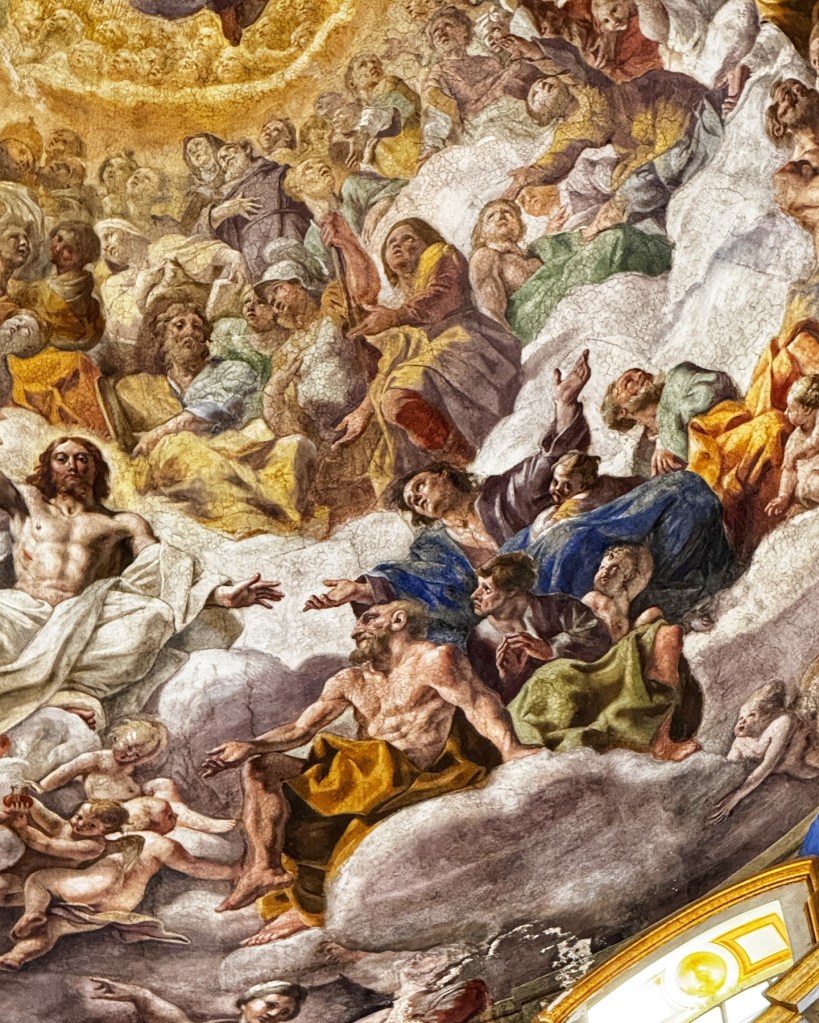


Chiesa di Santa Caterina a Formiello, situated beside Porta Capuana in Naples, reflects an architectural journey that began with the principles of the Florentine Renaissance school in the early 16th century and later embraced the opulence of 17th- and 18th-century Baroque transformations. Its evolution, shaped by contributions from notable architects and artists, exemplifies the fusion of Renaissance clarity with the theatrical and emotional intensity characteristic of Neapolitan Baroque.
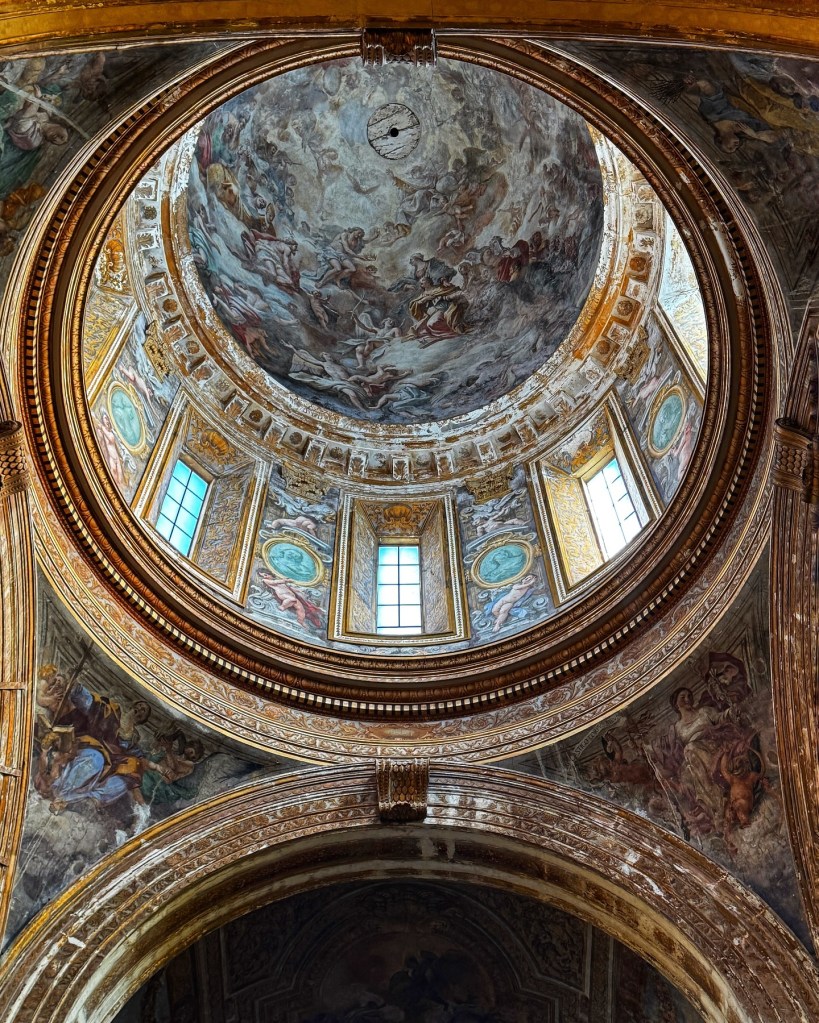
The present church was constructed between 1510 and 1593, adhering to the principles of Florentine Renaissance design. The architect Romolo Balsimelli is traditionally credited with its conception. His work drew inspiration from Filippo Brunelleschi (1377–1446) and other Florentine masters, employing a Latin cross layout with a single nave and a barrel-vaulted ceiling. The structure’s clear lines and harmonious proportions reflect the Renaissance ideals of balance and order.
The cloister, completed in 1514, was designed by Antonio Fiorentino della Cava. It features two tiers of arches supported by Ionic columns, combining Norman influences with Renaissance stylistic elements.
In subsequent centuries, the Renaissance church became a canvas for Baroque embellishments. A key feature of the church is its Renaissance dome, later transformed with Baroque decoration. In 1712, Paolo de Matteis (1662–1728) painted frescoes on the dome, infusing it with vibrant colours and dynamic compositions that epitomise Baroque theatricality. Between 1708 and 1709, Guglielmo Borremans (1672–1744) adorned the vault and lunettes of the transept with scenes depicting Saint Dominic and the Virgin pacifying Christ’s wrath. Swirling clouds, dramatic gestures, and a masterful interplay of light and shadow characterise these frescoes, hallmarks of Baroque artistry.
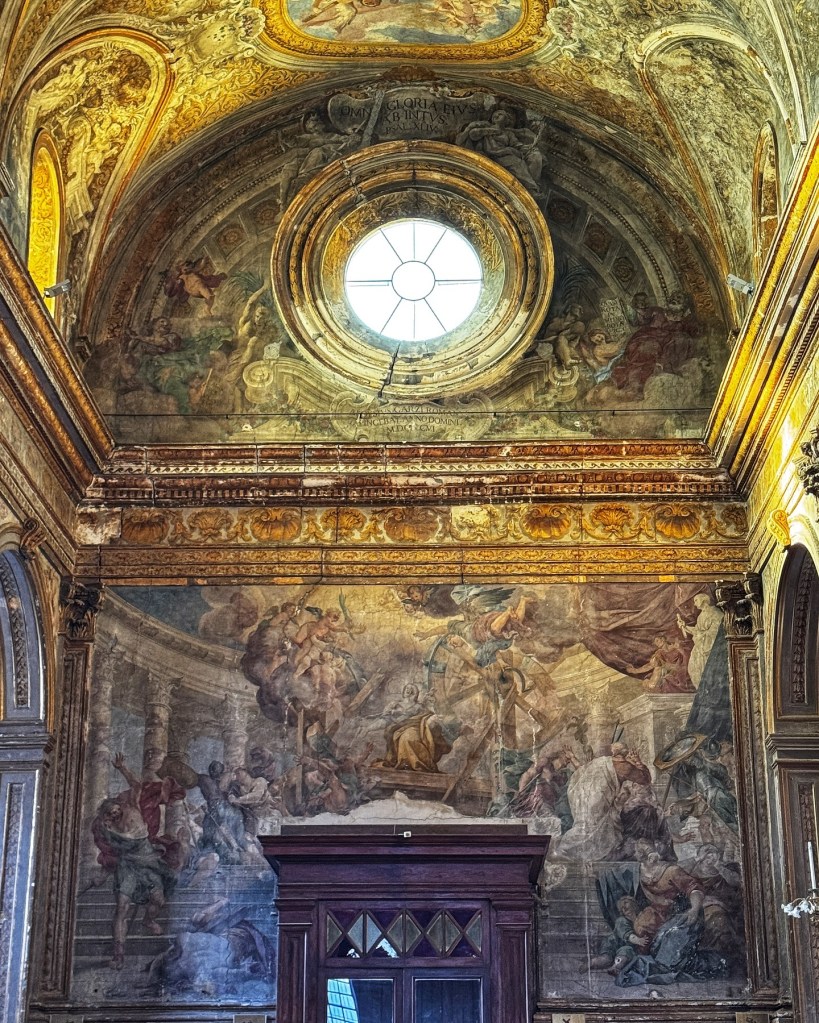
The counter-façade features frescoes by Luigi Garzi (1638–1721), painted between 1695 and 1697. His works, including The Martyrdom of Saint Catherine and The Marriage of Saint Catherine of Alexandria, emphasise movement, emotion, and intricate details, adding to the church’s profound sense of spiritual drama.