Catharina van Hemessen (1527/8–after 1566), Portrait of a Woman, 1551, Oil on oak, 22.8 × 17.6 cm, National Gallery, London
At the time this portrait was made, Catharina van Hemessen was twenty-three years old and a registered master of the Antwerp Guild of Saint Luke. Across the top right corner she inscribed in pale yellow letters: CATHARINA DE / HEMESSEN / PINGEBAT / 1551, Catharina de Hemessen was painting this, 1551. In Latin, pingebat is the imperfect tense, used for an action still in progress, while pinxit is the perfect, denoting a completed act: she painted this, it is done.
Three years earlier, on her self-portrait now in the Kunstmuseum Basel, she had signed differently: EGO CATERINA DE HEMESSEN ME PINXI 1548 ETATIS SVAE 20, I, Catharina van Hemessen, painted myself, 1548, at age twenty. That formula is first person, reflexive, and records her age. A second portrait from the same year, now in the Rijksmuseum, Amsterdam, already drops all three, reading simply Catherina de Hemessen pinxit 1548: third person, perfect, no ego, no me, no age. Within a single year, the assertive personal declaration of the self-portrait had given way to the more impersonal professional formula of the commissioned work.
By 1551 the perfect has become the imperfect, and pingebat has replaced pinxit. The imperfect in artist signatures carried a specific resonance. In Book XXXV of his Natural History, Pliny the Elder (23–79 AD) praised the Greek painter Apelles of Kos (fl. 4th century BCE) for signing his works ‘Apelles faciebat’ — Apelles was making this — rather than the completed ‘fecit,’ a habit Pliny interpreted as a gesture of modesty, implying the work remained open to criticism and revision, the artist declining to declare it finished. The painter’s equivalent, pingebat over pinxit, drew on the same construction. Michelangelo (1475–1564) signed the Pietà in St Peter’s Basilica, Rome, MICHAEL ANGELUS BONAROTUS FLORENTINUS FACIEBAT, adapting the sculptor’s form of the same imperfect, and Albrecht Dürer (1471–1528) used effingebam in his 1500 Self-Portrait, signing Albertus Durerus Noricus ipsum me proprijs sic effingebam coloribus aetatis anno XXVIII, I, Albrecht Dürer of Nuremberg, was depicting myself in these my own colours, at age twenty-eight (Boffa 2013).
Whether van Hemessen was conscious of that lineage when she moved from ego me pinxi to pingebat cannot be established. Antwerp in the mid-sixteenth century was sufficiently steeped in humanist scholarship (Pliny circulated in print editions from 1469 and was widely read in learned circles) for the resonance to have been available to a painter working within a cultivated workshop tradition, even if it cannot be proven to have been sought. That painters of the period moved between the two forms without apparent consistency makes it difficult to read intention into either choice, though for a woman operating professionally in a field with almost no precedent for her presence, the act of signing in full, on every securely attributed work, was already not a neutral gesture.
The sitter, for all her evident wealth, has not survived the centuries with a name; the painter has.
Catharina van Hemessen (1527/8–after 1566), Portrait of a Woman, 1551, Oil on oak, 22.8 × 17.6 cm, National Gallery, LondonCatharina van Hemessen (1527/8–after 1566), Portrait of a Woman, 1551, Oil on oak, 22.8 × 17.6 cm, National Gallery, LondonCatharina van Hemessen (1527/8–after 1566), Portrait of a Woman, 1551, Oil on oak, 22.8 × 17.6 cm, National Gallery, LondonCatharina van Hemessen (1527/8–after 1566), Portrait of a Woman, 1551, Oil on oak, 22.8 × 17.6 cm, National Gallery, London
References
De Clippel, K. (2004) Catharina van Hemessen (1528–na 1567). Een monografische studie [Catharina van Hemessen (1528–after 1567). A monographic study]. Brussels: Koninklijke Vlaamse Academie van België voor Wetenschappen en Kunsten
Droz-Emmert, M. (2004) Catharina van Hemessen. Malerin der Renaissance [Catharina van Hemessen. Painter of the Renaissance]. Basel: Schwabe Verlag
Pliny the Elder (c. AD 77) Naturalis Historia [Natural History], Praefatio, 26. Translated by H. Rackham. Loeb Classical Library 330. Cambridge, MA: Harvard University Press, 1938
RKD – Netherlands Institute for Art History (n.d.) Catharina van Hemessen, artist entry no. 37344. RKDartists. Available at: https://rkd.nl/en/explore/artists/37344 (Accessed: 24 May 2026).
RKD – Netherlands Institute for Art History (n.d.) Catharina van Hemessen, Self-Portrait, 1548. RKDimages, image no. 41167. Available at: https://rkd.nl/en/explore/images/41167 (Accessed: 24 May 2026).
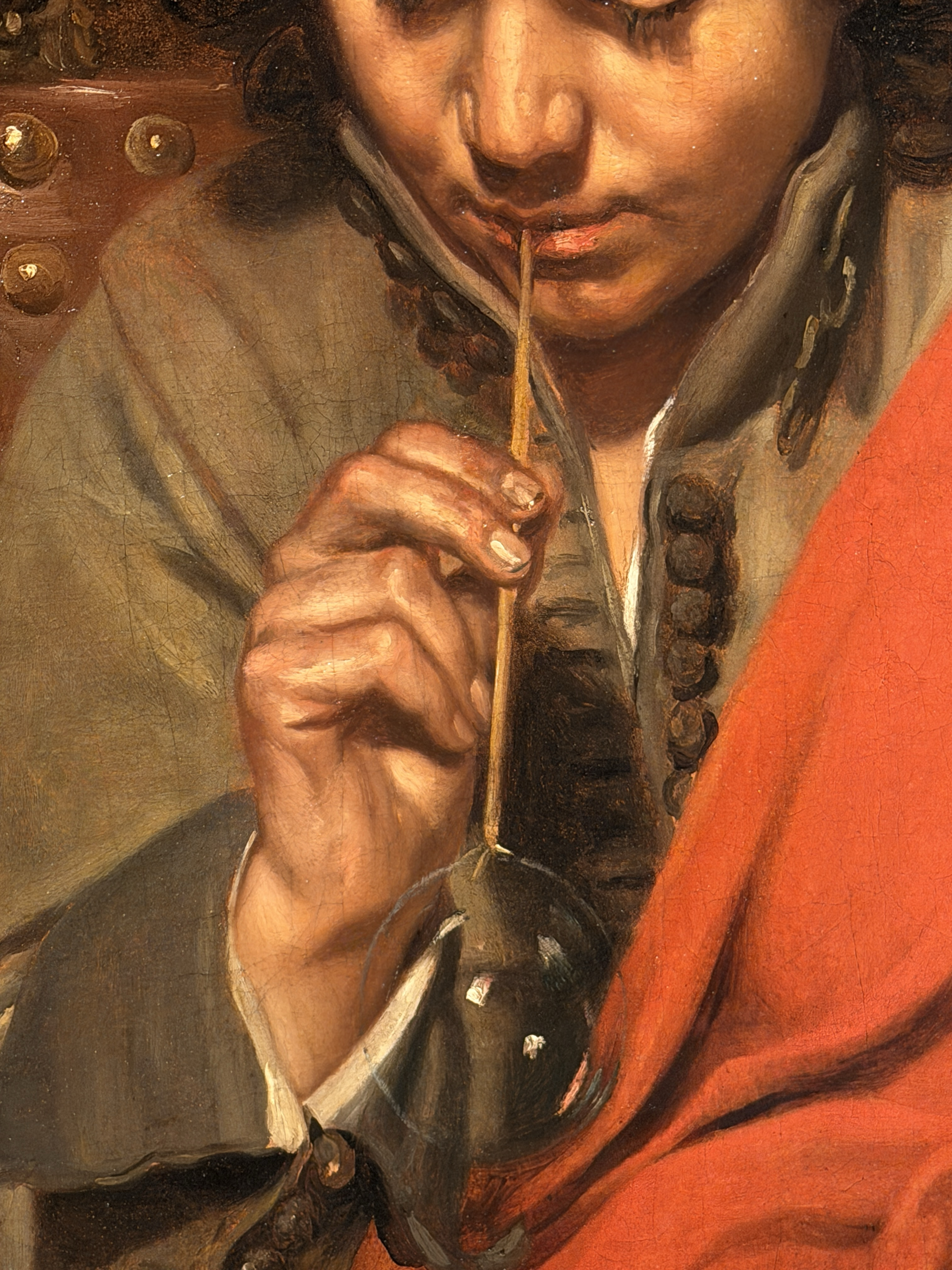
Michaelina Wautier (1604–1689), Boys Blowing Bubbles, c. 1650–55, Oil on canvas, 90.5 × 121.3 cm, Royal Academy of Arts, London, on a short-term loan from the Seattle Art Museum
Michaelina Wautier (1604–1689), Boys Blowing Bubbles, c. 1650–55, Oil on canvas, 90.5 × 121.3 cm, Royal Academy of Arts, London, on a short-term loan from the Seattle Art MuseumMichaelina Wautier (1604–1689), Boys Blowing Bubbles, c. 1650–55, Oil on canvas, 90.5 × 121.3 cm, Royal Academy of Arts, London, on a short-term loan from the Seattle Art Museum
By the mid-seventeenth century painters in the Southern Netherlands and the Dutch Republic worked within a culture saturated with so many models. Paintings, prints, studio practice and travel ensured that artists encountered established forms constantly, and invention became less a matter of new motifs than of what was done with familiar ones. Theory reinforced this by defining painting as a liberal art grounded in inventio, where the artist claimed authority over both execution and conception. Wautier’s use of the invenit et fecit signature on some of her paintings states that claim plainly.
Here she is not after novelty of motif. The vanitas elements are conventional and readable at a glance: the bubble, candle, hourglass, book and, as conservation has recently revealed, a skull beneath later overpaint. These signs bring their usual freight — youth, passing time, mortality — but they do not anchor the image to a single meaning. They are present without being directive.
The figures carry more weight. Their specificity suggests real sitters, a sense reinforced by their appearance in other works by Wautier. The children are not treated as types, yet they are not quite portraits either. The seated boy is absorbed in blowing, his attention turned inward; the second boy’s wandering gaze keeps the scene from settling into one action. There is no narrative arc and no declared moral.
Their concentration touches on contemporary preoccupations with depicting interior states through gesture and attention. The painting constructs a held moment, and the vanitas objects deepen a sense of time already present in the figures themselves. Genre, portraiture and allegory remain in play throughout. None takes over.
Michaelina Wautier (1604–1689), Boys Blowing Bubbles, c. 1650–55, Oil on canvas, 90.5 × 121.3 cm, Royal Academy of Arts, London, on a short-term loan from the Seattle Art MuseumMichaelina Wautier (1604–1689), Boys Blowing Bubbles, c. 1650–55, Oil on canvas, 90.5 × 121.3 cm, Royal Academy of Arts, London, on a short-term loan from the Seattle Art MuseumMichaelina Wautier (1604–1689), Boys Blowing Bubbles, c. 1650–55, Oil on canvas, 90.5 × 121.3 cm, Royal Academy of Arts, London, on a short-term loan from the Seattle Art MuseumMichaelina Wautier (1604–1689), Boys Blowing Bubbles, c. 1650–55, Oil on canvas, 90.5 × 121.3 cm, Royal Academy of Arts, London, on a short-term loan from the Seattle Art Museum
References
Gruber, G., Van der Stighelen, K. and Domercq, J. (eds.) (2025) Michaelina Wautier. Exhibition catalogue, Kunsthistorisches Museum, Vienna, and Royal Academy of Arts, London. Stuttgart: Belser.
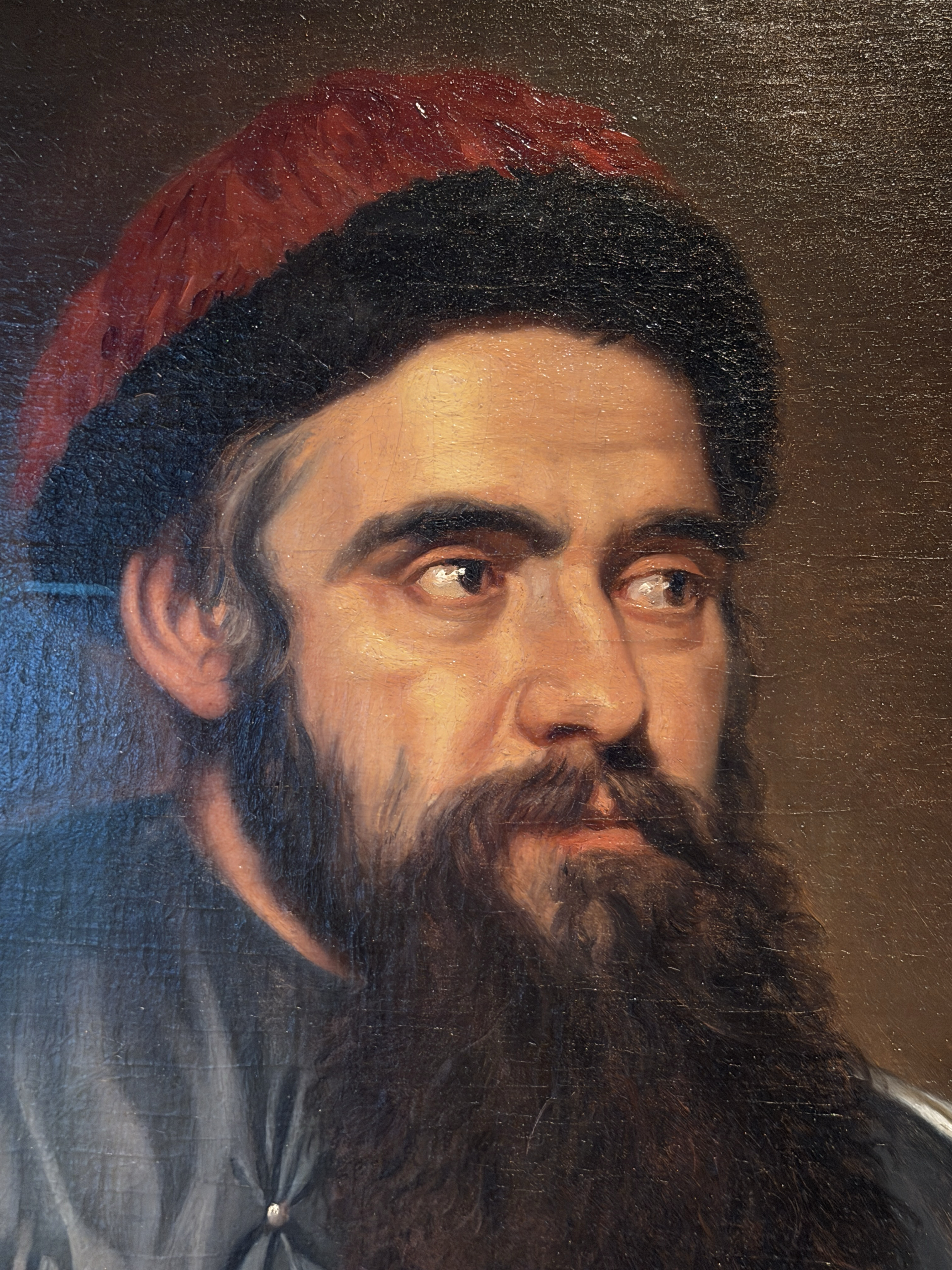
Michaelina Wautier (1604–1689), Portrait of Jesuit Martino Martini (1614–1661) in Chinese Scholar’s Dress, 1654, Oil on canvas, 69.5 × 59 cm, Royal Academy of Arts, London, on a short-term loan from the Klesch Collection, London
Michaelina Wautier (1604–1689), Portrait of Jesuit Martino Martini (1614–1661) in Chinese Scholar’s Dress, 1654, Oil on canvas, 69.5 × 59 cm, Royal Academy of Arts, London, on a short-term loan from the Klesch Collection, LondonMichaelina Wautier (1604–1689), Portrait of Jesuit Martino Martini (1614–1661) in Chinese Scholar’s Dress, 1654, Oil on canvas, 69.5 × 59 cm, Royal Academy of Arts, London, on a short-term loan from the Klesch Collection, London
In the seventeenth century, Jesuit missionaries, while serving Catholic ambitions, played a striking role in broadening Europe’s intellectual horizons. Through their missions they carried knowledge of ancient civilisations back to Europe. This portrait gives that movement of ideas a face.
Here Martino Martini (1614–1661), a Jesuit from Trento known in China as Wei Kangguo, appears in Chinese scholar’s robes. He was in Brussels in 1654, residing at the Jesuit College and likely connected to Archduke Leopold Wilhelm’s circle, Wautier’s principal patron.
Martini’s dress reflects the Jesuit policy of accommodation developed in late Ming and early Qing China. Pioneered by another Jesuit Matteo Ricci (1552–1610), this approach encouraged missionaries to master Classical Chinese, move within literati circles, and wear the robes of Confucian scholars rather than Buddhist monks.
Upon returning to Europe in 1653, he produced the Novus Atlas Sinensis’ (1655), incorporated into Joan Blaeu’s ‘Atlas Maior’ and largely based on Chinese cartographic sources. His Chinese name and attire show a scholar positioning himself at the crossroads of two worlds. Through figures like Martini, Jesuit networks expanded Europe’s awareness of China, Persia, Egypt, India, Ethiopia, and other ancient civilisations, reshaping the contours of early modern knowledge.
Michaelina Wautier (1604–1689), Portrait of Jesuit Martino Martini (1614–1661) in Chinese Scholar’s Dress, 1654, Oil on canvas, 69.5 × 59 cm, Royal Academy of Arts, London, on a short-term loan from the Klesch Collection, London
References
Gruber, G., Van der Stighelen, K. and Domercq, J. (eds.) (2025) Michaelina Wautier. Exhibition catalogue, Kunsthistorisches Museum, Vienna, and Royal Academy of Arts, London. Stuttgart: Belser
Diana de Rosa, called Annella di Massimo (1602-1643), Salome with the Head of Saint John the Baptist, Oil on canvas, 127.5 x 99.7 cm, Sotheby’s Old Master and 19th Century Paintings Evening Auction, London, 2 July 2025
Diana de Rosa, called Annella di Massimo (1602-1643), Salome with the Head of Saint John the Baptist, Oil on canvas, 127.5 x 99.7 cm, Sotheby’s Old Master and 19th Century Paintings Evening Auction, London, 2 July 2025
This Salome with the Head of Saint John the Baptist, previously unknown to scholars, belongs to a body of work that has spent most of the last four centuries in near-total obscurity. Its author, Diana De Rosa (1602–1643), was born in Naples to Caterina de Mauro and the painter Tommaso de Rosa. Her father died in 1610, and her mother remarried in 1612, to the Caravaggist painter Filippo Vitale (1585–1650), a figure whose dark, naturalistic manner owed a clear debt to Caravaggio’s Neapolitan period and whose household functioned as a working studio. The relationship between De Rosa and Pacecco de Rosa (1607–1656), properly Giovanni Francesco de Rosa, remains unresolved in the literature: some sources identify Pacecco as an uncle from whom she received early instruction in drawing, while others argue, more convincingly, that he was her brother, and that both siblings trained under Vitale’s direction. What is not disputed is that the De Rosa-Vitale household constituted one of the most productive artistic dynasties in viceregal Naples, a family in which paint was, quite literally, the family business.
By around 1621, De Rosa had entered the workshop of Gaspare del Popolo, where she met the painter Agostino Beltrano (c.1607–1656), whom she married in 1626. Her abilities, however, had already attracted the attention of Massimo Stanzione (1585–1656), the Cavaliere who ran the busiest and most prestigious studio in Naples at the time, rivalled in stature only by Jusepe de Ribera (1591–1652). Stanzione took her into his own workshop, where she produced paintings from his designs, which he then retouched before delivery to clients. It was this working arrangement, a recognised and contractual dependency rather than a casual association, that gave rise to her designation as ‘Annella di Massimo’ : Annella, the diminutive; di Massimo, possession. Her name, in other words, was absorbed into his.
The principal biographical source for De Rosa’s life is Bernardo de Dominici (1683–1759), the self-appointed Vasari of Naples, whose three-volume Vite de’ pittori, scultori ed architetti napoletani [Lives of the Neapolitan Painters, Sculptors and Architects], published between 1742 and 1745, remains the only extended contemporary account of her career. De Dominici claims she maintained an active professional practice while raising seven children, and that Stanzione kept her on the workshop payroll during periods of absence for childbearing. Archival evidence confirms at least part of the domestic picture: baptismal records from the parish of Santa Maria della Carità show that two of her children, Nicola Tomaso and Agnese Chiara, were baptised on 21 December 1638 and 19 July 1640 respectively. But the details of De Dominici’s broader narrative have not been independently verified, and his testimony elsewhere has been shown to be unreliable. A 2017 study by Andrea Zezza posed the question directly in its title: Geniale imbroglione o conoscitore rigoroso? [Ingenious fraud or rigorous connoisseur?]. The answer, as with most things concerning De Dominici, is probably both.
De Rosa is credited with ceiling paintings depicting scenes from the Life of the Virgin for the church of Santa Maria della Pietà dei Turchini in Naples, though these were destroyed when the roof collapsed in 1638. Three further scenes from the Life of the Virgin, executed for the church of San Giovanni Maggiore, survive in part: two are now held by the Museo Diocesano di Napoli. For the Royal Church of Monte Oliveto she painted a Madonna nursing the infant Christ; for the sacristy of Santa Maria degli Angeli at Pizzofalcone, a young Saint John the Baptist with a lamb. Neither work survives. A posthumous inventory records a bequest of twelve ducats from Diana di Rosa to the Theatine house of Santa Maria degli Angeli, suggesting she maintained ties with religious communities as patron as well as painter. What remains, in sum, is fragmentary: a few surviving canvases, a handful of attributions supported by stylistic comparison, and a documentary record that is rich in anecdote but thin on certainties.
The date of De Rosa’s death in 1643 is not in dispute. The manner of it is. De Dominici claimed she was murdered by her husband Beltrano, driven by jealousy after a servant girl falsely reported that she was conducting an affair with Stanzione. The story has an unmistakably literary shape to it (a virtuous wife, a jealous husband, a lying maid, a wrongful death) and it entered popular culture readily enough. By the late nineteenth century, the Neapolitan painter Giuseppe Tramontano (dates unknown) had produced a canvas depicting De Rosa and Stanzione being spied upon by the treacherous servant, a painting now in the Intesa Sanpaolo collection. Current scholarship regards the murder narrative as unfounded. De Dominici himself noted, somewhat undermining his own account, that the painter Paolo de Matteis (1662–1728) disputed the story. The more probable cause of death is illness. She died affluent, and she was forty-one.
The Salome appeared at Sotheby’s London on 2 July 2025 as property from an Italian private collection, estimated at £60,000–80,000. It sold for £317,500, more than quadrupling the high estimate. This is, at the very least, a market corrective. Until Giuseppe Porzio’s monograph of 2023, the first dedicated study of her work, De Rosa had no sustained modern treatment. Riccardo Lattuada has been instrumental in attributing several canvases to her over the last decade, working from direct examination and stylistic comparison to the core group of paintings assembled around her name. Her subjects, predominantly female (Lucretia, Sophonisba, Salome, various saints), share a physical type and a psychological register that are distinct from those of her master Stanzione, and that bear a meaningful relationship to the work of Artemisia Gentileschi (1593–c.1656), who was active in Naples during the same years.
The Gallerie d’Italia in Naples staged the first exhibition to address De Rosa’s context directly: Donne nella Napoli spagnola: Un altro Seicento [Women in Spanish Naples: Another Seventeenth Century], running from 20 November 2025 to 22 March 2026, co-curated by Porzio alongside Antonio Ernesto Denunzio, Raffaella Morselli and Eve Straussman-Pflanzer. The show brought together sixty-nine works and positioned De Rosa as the essential counterpart to Gentileschi within the Neapolitan milieu, a figure no less significant for having been, until very recently, all but invisible. How many more paintings are in private collections, unrecognised or misattributed, is a question that only further research can answer. The Salome, previously unknown to scholars, suggests the answer may be: rather more than we thought.
Postscript. In March 2026, following the Gallerie d’Italia exhibition, the Ordine degli Architetti di Napoli replaced a street plaque in the Vomero quarter that had read only ‘Annella di Massimo’. The new plaque gives her full name. Residents had petitioned to remove the original in the 1950s, on the grounds that the woman it honoured had probably never existed.
References
Dabbs, J.K. (2020) ‘Bernardo de Dominici (1683–1759 Naples) and the Vite de’ pittori, scultori ed architetti napoletani (1742–45)’, in Dabbs, J.K., Life Stories of Women Artists, 1550–1800. London: Routledge. Available at: https://www.taylorfrancis.com/chapters/mono/10.4324/9781315091815-21 (Accessed: 2 July 2022).
Denunzio, A.E., Morselli, R., Porzio, G. and Straussman-Pflanzer, E. (eds.) (2025) Donne nella Napoli spagnola: Un altro Seicento [Women in Spanish Naples: Another Seventeenth Century]. Exhibition catalogue, Gallerie d’Italia, Naples, 20 November 2025 – 22 March 2026. Naples: Gallerie d’Italia
Porzio, G. (2023) Diana Di Rosa: ‘Bellissima, onestissima, virtuosa dipintrice’ nella Napoli del Seicento [‘An Exceedingly Beautiful, Honest and Skilful Painter’ in Seventeenth-Century Naples]. Naples: Porcini
Artemisia Gentileschi ( 1593–1654), David with the head of Goliath, late 1630s, aoil on canvas, 202 x 137 cm, Sotheby’s Old Master and 19th Century Paintings Evening Auction 2 July 2025
Artemisia Gentileschi ( 1593–1654), David with the head of Goliath, late 1630s, aoil on canvas, 202 x 137 cm, Sotheby’s Old Master and 19th Century Paintings Evening Auction 2 July 2025
In the late 1630s, Artemisia Gentileschi was living and working in London, a move that placed her at the centre of one of the most ambitious courts in Europe. She had already built a substantial reputation in Italy, working across Florence, Rome, Venice, and Naples, and in 1638 she travelled to England, probably at the invitation of King Charles I, a collector whose holdings included major works by Titian, Raphael, and Mantegna acquired partly through the dissolution of the Gonzaga collection in 1627–28. Her father, Orazio Gentileschi (1563–1639), had been at the Stuart court since the mid-1620s, completing the celebrated ceiling paintings at the Queen’s House in Greenwich (an Allegory of Peace and the Arts) for Henrietta Maria, a commission that shows the seriousness with which the Stuarts pursued Continental talent. Artemisia’s arrival therefore placed her within a court already attuned to Caravaggesque naturalism through her father’s presence, though she brought to it an independent reputation earned across two decades of Italian practice. She was among the very few women of her age admitted to the Accademia delle Arti del Disegno in Florence, elected in 1616 under Medici patronage, a distinction carrying considerable institutional weight.
Here, she engages directly with the Old Testament episode from 1 Samuel 17, in which David defeats the giant Goliath with a sling and severs his head with Goliath’s own sword. The subject was not unfamiliar territory for her. Her multiple treatments of Judith Slaying Holofernes (the versions in the Uffizi and the Museo di Capodimonte among the most viscerally charged) had already established her command of scenes in which violent liberation is rendered in intimate, psychologically loaded terms. The David and Goliath subject offered a related but distinct set of possibilities: where Judith acts with fierce agency in mid-stroke, David is shown in the aftermath, the violence completed, the moral weight of what has occurred settling across the composition.
Recent conservation work revealed her signature and part of the date inscribed on the sword, confirming her authorship. The sword thus becomes a marker of both identity and agency, as Artemisia inscribes herself into the very instrument of decapitation, collapsing the distinction between maker and subject. This is consistent with her broader habit of self-inscription: in the Self-Portrait as the Allegory of Painting (c.1638–39, Royal Collection), also produced during the London years and almost certainly for Charles I, she fuses the identity of the painter with painting itself in an equally calculated act of self-definition. That both works appear to date from roughly the same moment gives the signature on the sword an additional biographical charge.
The position of Goliath’s severed head, lying slack-jawed at David’s feet rather than held aloft, departs sharply from the conventional treatment of the subject. In Donatello’s bronze David (c.1440–60, Bargello), the giant’s head lies beneath the victor’s foot as a trophy; in Caravaggio’s David with the Head of Goliath (c.1609–10, Galleria Borghese), the severed head is raised into the picture space and identified, controversially, with Caravaggio’s own features. Artemisia rejects the expected show of triumph and turns instead towards the post-battle quiet, the psychological stillness that follows. The act of killing is over; what remains is something closer to reckoning. This refusal of spectacle in favour of interiority is among the qualities that modern scholars (particularly following Mary D. Garrard’s foundational 1989 monograph) have identified as characteristic of Artemisia’s reworking of inherited biblical subjects: a consistent displacement of heroic gesture towards contemplative, even ambivalent, stillness.
Light falls starkly across David’s lap and limbs, the white folds of his sleeves, and the intricately wrought hilt, producing an interplay of illumination and shadow that sharpens the sense of drama. The technique owes a clear debt to Caravaggio, under whose indirect influence Artemisia had formed as an artist in Rome. She was active there in the years immediately following his death in 1610, and her early work absorbed his tenebrism with a directness suggesting close study of his canvases rather than secondhand transmission. Yet her handling of light here is less theatrical, the transitions between illuminated and shadowed passages smoother and less abrupt, inclined towards psychological complexity over dramatic shock. The warm tonality of the flesh, the studied specificity of the textile rendering, and the careful attention to the material reality of the sword hilt are consistent with the broader direction of her mature style as traced in recent technical scholarship by Judith Mann and others working on the conservation and technical analysis of her surviving canvases.
Artemisia Gentileschi ( 1593–1654), David with the head of Goliath, late 1630s, aoil on canvas, 202 x 137 cm, Sotheby’s Old Master and 19th Century Paintings Evening Auction 2 July 2025
Sofonisba Anguissola (1532–1625), Self-Portrait at the Easel, c.1556, Oil on canvas, 66 × 57 cm, The National Gallery, Prague (Waldstein Riding School), on short-term loan from Łańcut Castle, Poland
Sofonisba Anguissola (1532–1625), Self-Portrait at the Easel, c.1556, Oil on canvas, 66 × 57 cm, The National Gallery, Prague (Waldstein Riding School), on short-term loan from Łańcut Castle, PolandSofonisba Anguissola (1532–1625), Self-Portrait at the Easel, c.1556, Oil on canvas, 66 × 57 cm, The National Gallery, Prague (Waldstein Riding School), on short-term loan from Łańcut Castle, Poland
Amilcare Anguissola (1494–1573), a minor nobleman in Cremona, named his children after the heroes and heroines of Carthage. His eldest daughter, born around 1532, received the name of Sophonisba, a queen who had chosen poison over Roman captivity during the Second Punic War. The name was a statement of will, and perhaps of ambition. Amilcare had been reading Baldassare Castiglione’s (1478–1529) Il Libro del Cortegiano (The Book of the Courtier, 1528), a widely circulated manual on how men and women of noble birth ought to conduct themselves at court (Cole, 2019, pp. 14–18). Among its prescriptions was the idea that painting could be a proper accomplishment for the well-born, provided it was pursued with what Castiglione called sprezzatura, an appearance of ease and grace, as though the effort behind it cost nothing at all. Amilcare took this seriously. He arranged for Sofonisba and her sister Elena to board in the household of the Cremonese painter Bernardino Campi (c. 1522–1591) around 1546, an unusual step at a time when women could not enter the guild apprenticeships through which male painters were trained (Perlingieri, 1992, pp. 47–53). Campi was himself an admirer of Correggio (c. 1489–1534), and it was likely through him that Sofonisba first encountered the softer, more luminous handling of paint associated with the Parma school (Maye, 2013). When Campi left Cremona, Sofonisba continued her studies with Bernardino Gatti (c. 1495–1576), a former pupil of Correggio whose manner deepened this connection further. Parmigianino (1503–1540), that other great presence in north Italian painting of the previous generation, she probably came to know through the wide circulation of his prints rather than through either teacher directly (Ferino-Pagden and Kusche, 1995, p. 11).
By her early twenties, Anguissola’s ability had attracted attention well beyond Cremona. In 1554 she travelled to Rome, where she showed a drawing, traditionally described as a smiling girl teaching an elderly woman to read, to Michelangelo Buonarroti (1475–1564). He set her a challenge: send me a weeping boy, he told her, since tears are harder to capture than laughter. She responded with Asdrubale Bitten by a Crayfish (c. 1554, Museo di Capodimonte, Naples), a drawing of her infant brother shrieking as a crustacean nipped his finger, while their younger sister looked on, amused. Tommaso de’ Cavalieri (c. 1509–1587), who later forwarded the drawing to Cosimo I de’ Medici alongside a Cleopatra that Michelangelo had given him some twenty years earlier, praised it for its “considerable invention” (Cole, 2019, pp. 33–36). In sixteenth-century critical vocabulary, invenzione, the capacity to conceive original compositions from the imagination rather than merely copying from life or from another artist, was the highest faculty a painter could demonstrate (Jacobs, 1994, pp. 80–82). That Cavalieri used the term about a young woman’s drawing was a recognition of real substance. And the pairing itself says something: a drawing by a twenty-two-year-old from Cremona placed alongside a Michelangelo and judged fit company for it.
This Self-Portrait at the Easel Painting a Devotional Panel, c. 1556, was painted in the years immediately following that exchange, and it reads as a considered response to the reputation she was building. Anguissola shows herself seated before her easel, brush and maulstick (a padded stick used by painters to steady the hand while working on fine details) in hand, dressed in a plain brownish-red habit beneath a black waistcoat, with a white blouse closed high around the neck. The modesty is deliberate. She presents herself as a woman of rank who also happens to paint, and who does so with the studied ease her father’s Castiglione would have approved of .
What she places on the easel, however, carries a more pointed argument than her clothing. The Madonna and Child visible on her canvas is rendered in a softer, more rounded manner than the self-portrait itself, drawing on the idiom of Correggio and Parmigianino that she had absorbed through her Cremonese training. The shift between the two registers is purposeful. It demonstrates that Anguissola could adapt her hand to devotional painting as fluently as to portraiture, a capacity that has been argued was essential to her ambitions as a prospective court painter, since the Spanish court expected continuity and stylistic assimilation from the artists it employed (Cole, 2019, pp. 72–78; Maye, 2013, p. 27). By choosing a sacred subject rather than a copy or a likeness from life, she returns to the very quality Michelangelo had recognised in her two years earlier: invenzione. A Madonna cannot be drawn from a model sitting in the room. It must be imagined, composed, constructed from within. The painting on the easel is proof that she can do this.
The composition itself was not without precedent. Eight years earlier, Catharina van Hemessen (c. 1528–after 1560) had painted herself at an easel in Antwerp: seated, holding brush and maulstick, sketching a head onto a small oak panel. That painting (Self-Portrait at the Easel, 1548, Kunstmuseum Basel) is now widely accepted as the earliest surviving oil painting to depict any artist, male or female, at work (Droz-Emmert, 2004). Anguissola’s arrangement is strikingly similar. Whether she had seen Van Hemessen’s self-portrait, or whether both painters arrived independently at the same solution, remains an open question, though it is worth noting that both women would eventually find their way to the Spanish court. Where Anguissola departs from the older picture is in the choice of subject on the easel: Van Hemessen paints what appears to be a head, possibly her own; Anguissola paints the Virgin. That substitution is worth pausing over. A woman painting her own likeness asserts her technical skill. A woman painting the Virgin asserts something further: her intellectual authority, her right to sacred themes traditionally governed by male painters and the guild structures from which women were barred. In Boccaccio’s (1313–1375) De mulieribus claris (On Famous Women, 1374), the ancient painter Thamyris earns her fame by painting the goddess Diana. By placing the Virgin on her easel, Sofonisba places herself in something like the same lineage, claiming not merely competence but the authority to compose sacred narrative (Garrard, 1994, pp. 574–577).
Giorgio Vasari (1511–1574), who visited the Anguissola household in Cremona in 1566, praised Sofonisba in the second edition of his Vite (Lives of the Most Eminent Painters, Sculptors, and Architects, 1568) for having laboured at the difficulties of design with greater study and grace than any woman of his time, and for her ability to produce beautiful works ‘by herself alone’ (Vasari, 1568/1906, vol. 5). He singled out her capacity for independent creation, and it is exactly that independence which the Łańcut self-portrait advertises. Yet it does so without any hint of protest or defiance. This is a composed, deliberate image: a young noblewoman at work, looking out towards us as if we had entered her studio during a sitting, the brush poised but still. She is already inside the profession, and the painting lets us know it as a fact rather than as a claim that needs arguing.
The painting also functioned practically. Anguissola circulated self-portraits as calling cards to prospective patrons, since she could not compete openly for commissions in the way male painters could. Letters from her father to the Duke of Ferrara in 1556, and to the Duchess of Mantua in 1557, record the dispatch of self-portraits as diplomatic gifts (Lonza, Cossu and Scala, 1994, pp. 364–365; Maye, 2013, pp. 26–27). At least sixteen self-portraits by her survive or are recorded, a number that exceeds those by any other artist in the period between Albrecht Dürer (1471–1528) and Rembrandt van Rijn (1606–1669) (Ferino-Pagden and Kusche, 1995, p. 22). Each one was a portable demonstration of her ability, and this, among the most carefully staged, would have spoken directly to the values of any educated viewer who knew their Castiglione. It worked. By 1559, Philip II of Spain (1527–1598) had invited her to Madrid as painting tutor and lady-in-waiting to his young bride, Elisabeth of Valois (1546–1568). She remained at the Spanish court for over a decade. After the queen’s death in 1568, Sofonisba stayed on to educate the young infantas, and around 1571–1573 Philip arranged a marriage for her, with a generous dowry, to the Sicilian nobleman Don Fabrizio de Moncada (d. 1578).
Nearly seventy years after this self-portrait was painted, the young Antoon van Dyck (1599–1641) sought Sofonisba out in Palermo. He had arrived in Sicily in the spring of 1624, commissioned to paint the Spanish viceroy Emanuele Filiberto of Savoy (1588–1624). Within weeks, the city was struck by plague, and Van Dyck found himself quarantined, unable to leave. On 12 July 1624 he visited Sofonisba and sketched her in his Italian Sketchbook (now in the British Museum). He noted, in a long inscription beside the drawing, that her eyesight had failed but her mind remained sharp (‘havendo ancora la memoria et il cervello prontissimo‘), and that she had advised him not to set the light too high when painting her, lest the shadows in the wrinkles of old age grow too large (Cust, 1902, pp. 51–52). Van Dyck believed her to be ninety-six; if she was born around 1532, she was closer to ninety-two. He described her as pittora de natura et miraculosa, a painter from nature and miraculous, a phrase whose devotional overtones have themselves become the subject of scholarly discussion (Tramelli, 2016, pp. 55–60). He is said to have claimed afterwards that their conversation taught him more about the true principles of painting than anything else in his life, though this remark is recorded not in the sketchbook itself but in the later accounts of Raffaele Soprani (1612–1672) and Filippo Baldinucci (1624–1697) (Tramelli, 2016, p. 62). How much of that is legend polished by admiration, and how much reflects a genuine debt, is difficult to say.
Van Dyck remained trapped in Palermo through the worst of the plague, painting his celebrated series of Saint Rosalie pictures before finally leaving in the autumn of 1625. Sofonisba died in Palermo in November of that same year. A recent research by Dr. Crla Rossi has proposed that the date inscribed in the sketchbook should be re-read as 1629 rather than 1624, which would place the visit, and her death, several years later (Rossi, 2026). Whether or not that revision holds, the encounter itself, and its place in the biographical record, tells us something about what this self-portrait set in motion.
Sofonisba Anguissola (1532–1625), Self-Portrait at the Easel, c.1556, Oil on canvas, 66 × 57 cm, The National Gallery, Prague (Waldstein Riding School), on short-term loan from Łańcut Castle, PolandSofonisba Anguissola (1532–1625), Self-Portrait at the Easel, c.1556, Oil on canvas, 66 × 57 cm, The National Gallery, Prague (Waldstein Riding School), on short-term loan from Łańcut Castle, Poland
References
Cole, M. W. (2019) Sofonisba’s Lesson: A Renaissance Artist and Her Work. Princeton: Princeton University Press
Cust, L. (1902) A Description of the Sketch-book by Sir Anthony Van Dyck Used by Him in Italy 1621–1627. London: George Bell and Sons.]
Droz-Emmert, M. (2004) Catharina van Hemessen: Malerin der Renaissance. Basel: Schwabe
Ferino-Pagden, S. and Kusche, M. (1995) Sofonisba Anguissola: A Renaissance Woman. Exhibition catalogue. Washington, DC: National Museum of Women in the Arts
Garrard, M. D. (1994) ‘Here’s Looking at Me: Sofonisba Anguissola and the Problem of the Woman Artist’, Renaissance Quarterly, 47(3), pp. 556–622. Available at: https://doi.org/10.2307/2863021 (Accessed 13 June 2025)
Higgie, J. (2021) The Mirror and the Palette: Rebellion, Revolution and Resilience: 500 Years of Women’s Self-Portraits. London: Weidenfeld & Nicolson
Jacobs, F. H. (1994) ‘Woman’s Capacity to Create: The Unusual Case of Sofonisba Anguissola’, Renaissance Quarterly, 47(1), pp. 74–101. Available at: https://doi.org/10.2307/2863112 (Accessed 12 June 2025)
Lonza, G., Cossu, M. and Scala, D. (eds.) (1994) Sofonisba Anguissola e le sue sorelle. Exhibition catalogue. Rome: Leonardo Arte
Maye, K. (2013) ‘Performing for the Court: Sofonisba Anguissola’s Self-Portraits at the Easel as Court Gifts’, Athanor, 31, pp. 25–31. Available at: https://journals.flvc.org/athanor/article/view/126724 (Accessed 12 June 2025)
Perlingieri, I. S. (1992) Sofonisba Anguissola: The First Great Woman Artist of the Renaissance. New York: Rizzoli
Tramelli, B. (2016) ‘Sofonisba Anguissola, “Pittora de Natura”: A Page from Van Dyck’s Italian Sketchbook’, in Barker, S. (ed.) Women Artists in Early Modern Italy: Careers, Fame, and Collectors. The Medici Archive Project Series. Turnhout: Harvey Miller, pp. 47–71. Available at: https://www.academia.edu/29811820 (Accessed 14 June 2025)
Vasari, G. (1568/1906) Le vite de’ più eccellenti pittori, scultori ed architettori. Edited by G. Milanesi. Florence: G. C. Sansoni.
Woods-Marsden, J. (1998) Renaissance Self-Portraiture: The Visual Construction of Identity and the Social Status of the Artist. New Haven: Yale University Press.
Additional corrections
Rossi, C. (2026) ‘1532–1629: le date di nascita e di morte di Sofonisba Anguissola, “pittora de natura et miraculata”, tra la peste di Palermo e il culto di Santa Rosalia’, Zenodo. Available at: https://doi.org/10.5281/zenodo.18471285 (Accessed 15 May 2026)
Artemisia Gentileschi (1593 – 1654/1656), Judith Beheading Holofernes, 1612–1613, Oil on canvas, 158.8 × 125.5 cm, Museo di Capodimonte, Naples
Artemisia Gentileschi (1593 – 1654/1656), Judith Beheading Holofernes, 1612–1613, Oil on canvas, 158.8 × 125.5 cm, Museo di Capodimonte, Naples
The story of Judith and Holofernes originates in the Biblical account of a young widow, Judith, from the besieged city of Bethulia. To save her people from destruction at the hands of the Assyrian general Holofernes, Judith uses her wit and courage, pretending to seduce him before assassinating him in his drunken stupor. This narrative became a popular subject in art for its symbolic themes of virtue triumphing over vice, divine justice, and the power of faith.
The story was often seen as an allegory for the underdog’s triumph or a divine endorsement of righteous rebellion, resonating with audiences during political upheaval and religious reformations. For Artemisia, however, the subject also offered a chance to explore themes of female strength and agency, reflecting both the broader cultural moment and her own perspective as a woman artist.
This version captures the climactic moment of the story with brutal realism. With the sleeves rolled up in preparation, Judith seizes Holofernes by the hair with one hand while wielding a sword with the other. Her expression is calm and determined, in sharp contrast to Holofernes’ anguished struggle. The vivid depiction of blood spurting across the pristine white sheet beneath him heightens the visceral drama, while the meticulous detailing of Judith’s clothing and the interplay of light and shadow add complexity to the composition. Artemisia’s use of chiaroscuro, influenced by Caravaggio’s tenebrism, enhances the theatricality of the scene, yet her treatment of Judith as an active and powerful agent is distinctly her own.
This portrayal of Judith stands apart from many male artists, who often presented her as an idealised figure. Artemisia’s Judith is a protagonist of strength and action, embodying justice and resilience. The physicality of the composition—from Judith’s firm grip to the dynamic positioning of the figures—underscores the narrative’s moral gravity and shifts the focus from aestheticised beauty to raw, unflinching heroism.
Antoon van Dyck (1599-1641), Portrait of Sofonisba Anguissola, 1624, Oil on a canvas, 42 x 33, 5 cm (fragment), Knol Castle, Sevenoaks, Kent
Antoon van Dyck (1599-1641), Portrait of Sofonisba Anguissola, 1624, Oil on a canvas, 42 x 33, 5 cm (fragment), Knol Castle, Sevenoaks, Kent British Museum (n.d.) Anthony van Dyck, The Painter Sofonisba Anguissola, Seated in a Chair, leaf from Van Dyck’s Italian Sketchbook, folio 110. Pen and brown ink. Museum number: 1957,1214.207.110. Available at: https://www.britishmuseum.org/collection/object/P_1957-1214-207-110 (Accessed: 10 August 20242026).
On 12 July 1624, Antoon van Dyck (1599–1641) visited Sofonisba Anguissola (c. 1532–1625) at her home in Palermo. She was, by that point, a living legend of Renaissance Italy: a woman who had exchanged drawings with Michelangelo Buonarroti (1475–1564), served at the court of Philip II of Spain (1527–1598), and outlived nearly every artist of her generation. Van Dyck recorded her age as ninety-six, sketched her in pen and brown ink, and wrote several lines of notes alongside the drawing in his Italian Sketchbook (British Museum), more than he gave to most sitters (Cust, 1902, pp. 51–52). The entry has since been conscripted into a familiar kind of art-historical romance: the young genius meets the aged master, the Baroque pays its respects to the Renaissance, the torch is passed. The reality, as usual, is less tidy.
Van Dyck was in Palermo to paint the viceroy Emanuele Filiberto of Savoy (1588–1624), a lucrative commission that placed him at the centre of the island’s political court. He was twenty-five, ambitious, and deep into the study of Titian (c. 1488–1576) and the Venetian colourists whose work he had been copying compulsively since arriving in Italy in 1621. Anguissola, who had worked at the Spanish court alongside artists shaped by the same Venetian tradition, represented a living point of contact with that world. Whether the visit was arranged through viceregal circles or through the network of Genoese merchants connected to her husband, Orazio Lomellini (d. after 1630), is unclear. What is clear is that Van Dyck came with professional purpose, not pilgrimage.
He recorded her age as ninety-six. If the conventional birth date of around 1532 is accepted, she was closer to ninety-two (Tramelli, 2016, p. 55). A recent palaeographic re-reading of the sketchbook has argued that the date should in fact be read as 1629, not 1624, which would confirm Van Dyck’s stated age and place the visit five years later than traditionally held (Rossi, 2026). Whether or not that revision survives scrutiny, the details Van Dyck recorded are vivid enough to stand on their own terms. She was very old, nearly blind, and, he noted, still sharp enough to lecture him on technique. She warned him against placing the light source too high above a sitter’s face, since the shadows would cut too harshly into aged skin. It is a specific, practical remark, and it reads like the advice of someone who had spent decades painting her own face with an attention that few of her contemporaries matched. Anguissola produced more self-portraits than any other European artist in the period between Albrecht Dürer (1471–1528) and Rembrandt van Rijn (1606–1669), though how many of the surviving attributions are secure remains a live question .
Her career had been remarkable and, in its institutional outlines, deeply strange. As a young woman in Cremona, she had come to Michelangelo’s attention through her father Amilcare (1494–1573), who sent her drawings to the master and arranged for Sofonisba to receive sketches from Michelangelo’s own notebooks to study and copy in her own style, a correspondence that continued for at least two years (Cole, 2019, pp. 33–36; Perlingieri, 1992, pp. 67–72). Giorgio Vasari (1511–1574), who visited the Anguissola household in 1566, praised her in the second edition of his Vite (Lives of the Most Eminent Painters, Sculptors, and Architects, 1568) for her ability to produce beautiful works ‘by herself alone.’ Around 1559 she entered the court of Philip II in Madrid, where she served as lady-in-waiting and painting tutor to Queen Isabel de Valois (1546–1568). She was paid a salary, received a pension, and was eventually given a dowry, yet she does not appear in the court records under any formal designation as a painter (Cole, 2019, pp. 92–98; Gamberini, 2016, pp. 29–42). The administrative silence is difficult to read. It may reflect the conventions of the Spanish court, where artistic labour performed by a noblewoman occupied a different bureaucratic category from that of a contracted artist. Or it may reflect something blunter: that the work was acknowledged privately and erased publicly, which is a pattern that held for a long time after her death. The truth is probably tangled between the two, and the surviving documentation does not allow us to separate them cleanly.
After the queen died in 1568, Philip arranged Anguissola’s marriage, around 1571–1573, to the Sicilian nobleman Don Fabrizio de Moncada (d. 1578), providing a generous dowry from the royal purse. The match placed her among the prominent families of the island, though Moncada died within a decade, reportedly killed by pirates off the Sicilian coast. Her second marriage, around 1579–1580, was to Orazio Lomellini, a Genoese nobleman with commercial interests in Palermo, said to have been some fifteen years her junior. The circumstances of the match are unusual: by most accounts they met aboard the ship carrying Anguissola from Sicily towards Genoa, and married shortly after, against the wishes of her brother and without seeking permission from the Spanish court. The couple lived for a long period in Genoa before settling permanently in Palermo around 1615, where Anguissola continued to paint and, by most accounts, to receive visitors interested in her work (Perlingieri, 1992, pp. 155–167).
The portrait at Knole House, part of the Sackville Collection, is a small panel: head and upper body, nothing more. At 42 × 33.5 cm, it preserves the face and the dress but no compositional setting beyond a dark ground. What remains shows Anguissola in a black dress and white veil, consistent with the sketch in the Italian Sketchbook. The handling is direct, even tender. Van Dyck gives her a steady gaze, slightly averted, and does not dramatise the wrinkles she had specifically asked him to light with care. How much of this restraint is Van Dyck’s own sensitivity and how much is Sofonisba’s instruction is, of course, impossible to separate.
The painting was for years misidentified as a likeness of Catherine Fitzgerald, Countess of Desmond (d. 1604), an Irishwoman famous in English folklore for supposedly having lived to the age of one hundred and forty. The confusion is instructive. Both women had been flattened into curiosities of longevity, and for the cataloguers who maintained the Sackville collection, one very old woman was apparently as good as another. The correct identification, when it came, restored a name but did not necessarily restore a person. How the painting entered the collection remains uncertain: the National Trust records suggest it was possibly brought to Knole by Arabella Diana Cope (1767–1825), Duchess of Dorset, though the trail is thin (National Trust Collections, n.d.).
The visit of 12 July took place in a city already gripped by plague. The epidemic had broken out in Palermo in May 1624, and by the time Van Dyck sat with Anguissola, the death toll was rising sharply. The viceroy was dead by 3 August. Van Dyck did not, as is sometimes implied, leave after this. He was quarantined in Palermo, unable to depart, and remained trapped on the island for over a year. During this enforced stay he painted his celebrated series of Saint Rosalie altarpieces, images of the city’s patron saint whose rediscovered relics were credited with halting the epidemic (Tramelli, 2016, pp. 60–63). He did not leave Palermo until September 1625. No further contact between the two artists is documented during those fifteen months, which is curious given that they were both in the same small, locked-down city. Whether Van Dyck visited again, or whether the old painter’s failing health made a second sitting impossible, the record does not say.
Anguissola died on 16 November 1625, roughly two months after Van Dyck finally departed. Her husband Lomellini, who survived her, commissioned a marble inscription for her tomb in the church of San Giorgio dei Genovesi in Palermo, placed in 1632. The Latin text praises her noble lineage, her beauty, her extraordinary natural gifts, and her distinction in portraying human images, in roughly that order, before concluding that no one of her age could be considered her equal (Lonza, Cossu and Scala, 1994, p. 370). Nobility first, beauty second, painting third. It is a conventional hierarchy for a funerary inscription honouring a noblewoman in seventeenth-century Sicily, and it tells us as much about the priorities of the genre as about Lomellini’s private estimation of his wife’s achievement. What Van Dyck thought, he wrote down in the Sketchbook: that she was pittora de natura et miraculosa, a painter from nature and miraculous (Cust, 1902, p. 52). He put the painting first.
References
Barnes, S.J., De Poorter, N., Millar, O. and Vey, H. (2004) Van Dyck: A Complete Catalogue of the Paintings. New Haven and London: Yale University Press
British Museum (n.d.) Anthony van Dyck, The Painter Sofonisba Anguissola, Seated in a Chair, leaf from Van Dyck’s Italian Sketchbook, folio 110. Pen and brown ink. Museum number: 1957,1214.207.110. Available at: https://www.britishmuseum.org/collection/object/P_1957-1214-207-110 (Accessed: 10 August 2024).
Brown, C. and Vlieghe, H. (eds.) (1999) Van Dyck 1599–1641. Exhibition catalogue. London: Royal Academy of Arts
Cole, M. W. (2019) Sofonisba’s Lesson: A Renaissance Artist and Her Work. Princeton: Princeton University Press
Cust, L. (1902) A Description of the Sketch-Book by Sir Anthony Van Dyck, Used by Him in Italy, 1621–1627, and Preserved in the Collection of the Duke of Devonshire, K.G. at Chatsworth. London: George Bell and Sons
Jaffé, D. (2001) ‘New Thoughts on Van Dyck’s Italian Sketchbook’, The Burlington Magazine, 143(1183), pp. 614–624. Available at: https://www.jstor.org/stable/i237010 (Accessed 10 August 2024)
Ferino-Pagden, S. and Kusche, M. (1995) Sofonisba Anguissola: A Renaissance Woman. Exhibition catalogue. Washington, DC: National Museum of Women in the Arts.
Gamberini, C. (2016) ‘Sofonisba Anguissola at the Court of Philip II’, in Barker, S. (ed.) Women Artists in Early Modern Italy: Careers, Fame, and Collectors. The Medici Archive Project Series. Turnhout: Harvey Miller, pp. 29–46. Available at: https://www.academia.edu/33365966 (Accessed 10 August 2024)
Higgie, J. (2021) The Mirror and the Palette: Rebellion, Revolution and Resilience: 500 Years of Women’s Self-Portraits. London: Weidenfeld & Nicolson
Lonza, G., Cossu, M. and Scala, D. (eds.) (1994) Sofonisba Anguissola e le sue sorelle. Exhibition catalogue. Rome: Leonardo Arte
Perlingieri, I. S. (1992) Sofonisba Anguissola: The First Great Woman Artist of the Renaissance. New York: Rizzoli
Tramelli, B. (2016) ‘Sofonisba Anguissola, “Pittora de Natura”: A Page from Van Dyck’s Italian Sketchbook’, in Barker, S. (ed.) Women Artists in Early Modern Italy: Careers, Fame, and Collectors. The Medici Archive Project Series. Turnhout: Harvey Miller, pp. 47–71. Available at: https://www.academia.edu/29811820 (Accessed 10 Augsut 2024)
Vasari, G. (1568) Lives of the Most Eminent Painters, Sculptors and Architects. Translated by G. du C. de Vere. 10 vols. London: Macmillan and the Medici Society, 1912–14. Available at: https://www.gutenberg.org/ebooks/25326 (Accessed: 9 August 2024).
Recent corrections
Rossi, C. (2026) ‘1532–1629: le date di nascita e di morte di Sofonisba Anguissola, “pittora de natura et miraculata”, tra la peste di Palermo e il culto di Santa Rosalia’, Zenodo. Available at: https://doi.org/10.5281/zenodo.18471285 (Accessed 10 May 2026)
Artemisia Gentileschi (1593–c.1654), Self Portrait as Saint Catherine of Alexandria, c.1615–17, oil on canvas, 71.4 × 69 cm, The National Gallery, London
Artemisia Gentileschi (1593–c.1654), Self Portrait as Saint Catherine of Alexandria, c.1615–17, oil on canvas, 71.4 × 69 cm, The National Gallery, London
This is not simply a saint’s likeness, but Artemisia Gentileschi’s claim to endurance. Painted in her years at Florence, the canvas merges her own image with that of Saint Catherine, the scholar-martyr who defied imperial Rome. The identification is immediate: Artemisia’s steady gaze meets ours, turning an emblem of martyrdom into a mirror of personal resolve.
The wheel at her side — broken, but still menacing — signals Catherine’s torture, yet it also becomes a symbol of the trials that surrounded a woman artist in early seventeenth-century Italy. Artemisia had already endured violence and public scandal in Rome; now she confronted the equally punishing demands of artistic survival in Florence. In choosing Catherine, she did not simply illustrate a saint’s story but aligned herself with a figure who embodied intellect, courage, and faith under pressure.
The painting bears the Caravaggesque intensity she absorbed from her father, Orazio Gentileschi (1563–1639), and from Caravaggio (1571–1610) himself: sharp chiaroscuro, a solitary figure emerging from darkness, the drama concentrated in her face and gesture. Yet here the theatrical light does more than illuminate a saint — it isolates Artemisia, insisting on her presence.
Recently rediscovered and now in the National Gallery, the work endures as a rare statement of self-assertion disguised as devotion: a woman painter using sacred imagery to declare her own place in a world that resisted it.
Artemisia Gentileschi (1593–c.1654), Self Portrait as Saint Catherine of Alexandria, c.1615–17, oil on canvas, 71.4 × 69 cm, The National Gallery, London Artemisia Gentileschi (1593–c.1654), Self Portrait as Saint Catherine of Alexandria, c.1615–17, oil on canvas, 71.4 × 69 cm, The National Gallery, London Artemisia Gentileschi (1593–c.1654), Self Portrait as Saint Catherine of Alexandria, c.1615–17, oil on canvas, 71.4 × 69 cm, The National Gallery, London