The Duomo of Naples, officially known as the Cathedral of Santa Maria Assunta, is a grand landmark that blends Gothic, Renaissance, and Baroque styles. Its construction began in the late 13th century under the reign of Charles I of Anjou (1226–1285), with subsequent contributions spanning many centuries.
The Cathedral of Santa Maria Assunta, Naples
The Duomo features a three-aisled basilica plan, dominated by its Gothic nave and a richly decorated interior. The interior is monumental, with 12 side chapels on either side of the nave. The cathedral underwent significant renovations during the 15th century, incorporating Renaissance elements, and again in the 17th and 18th centuries, when Baroque influences transformed its chapels and altars. In the 19th century, a Neogothic façade was designed by Enrico Alvino (1809–1872), completing the cathedral’s eclectic appearance.
The cathedral’s dome, completed in the 16th century, dominates the central crossing of the nave and transept. It reflects a mix of Renaissance and Baroque influences, with frescoes added during later centuries. The dome’s frescoes, depicting The Assumption of the Virgin Mary, were executed in the 17th century by Paolo de Matteis (1662–1728), whose mastery of perspective and use of dramatic chiaroscuro imbues the space with a sense of divine elevation.
The crowning feature of the altar is the sculpture of The Assumption of the Virgin Mary, added during the Baroque period. Sculpted by Pietro Bracci (1700–1773), it depicts the Virgin being carried heavenward by angels, surrounded by swirling clouds and radiant light. Inspired by Gian Lorenzo Bernini’s (1598–1680) theatrical style, Bracci’s work combines dynamic movement with intricate detailing, achieving a sense of celestial transcendence.
The Cathedral of Santa Maria Assunta, NaplesPietro Bracci (1700–1773),The Assumption of the Virgin Mary,1739-1744, The Cathedral of Santa Maria Assunta, Naples
Canterbury Cathedral, The Old Palace, The Precincts, Canterbury, Kent, CT1 2EECanterbury Cathedral, The Old Palace, The Precincts, Canterbury, Kent, CT1 2EECanterbury Cathedral, The Old Palace, The Precincts, Canterbury, Kent, CT1 2EECanterbury Cathedral, The Old Palace, The Precincts, Canterbury, Kent, CT1 2EECanterbury Cathedral, The Old Palace, The Precincts, Canterbury, Kent, CT1 2EECanterbury Cathedral, The Old Palace, The Precincts, Canterbury, Kent, CT1 2EECanterbury Cathedral, The Old Palace, The Precincts, Canterbury, Kent, CT1 2EECanterbury Cathedral, The Old Palace, The Precincts, Canterbury, Kent, CT1 2EECanterbury Cathedral, The Old Palace, The Precincts, Canterbury, Kent, CT1 2EE
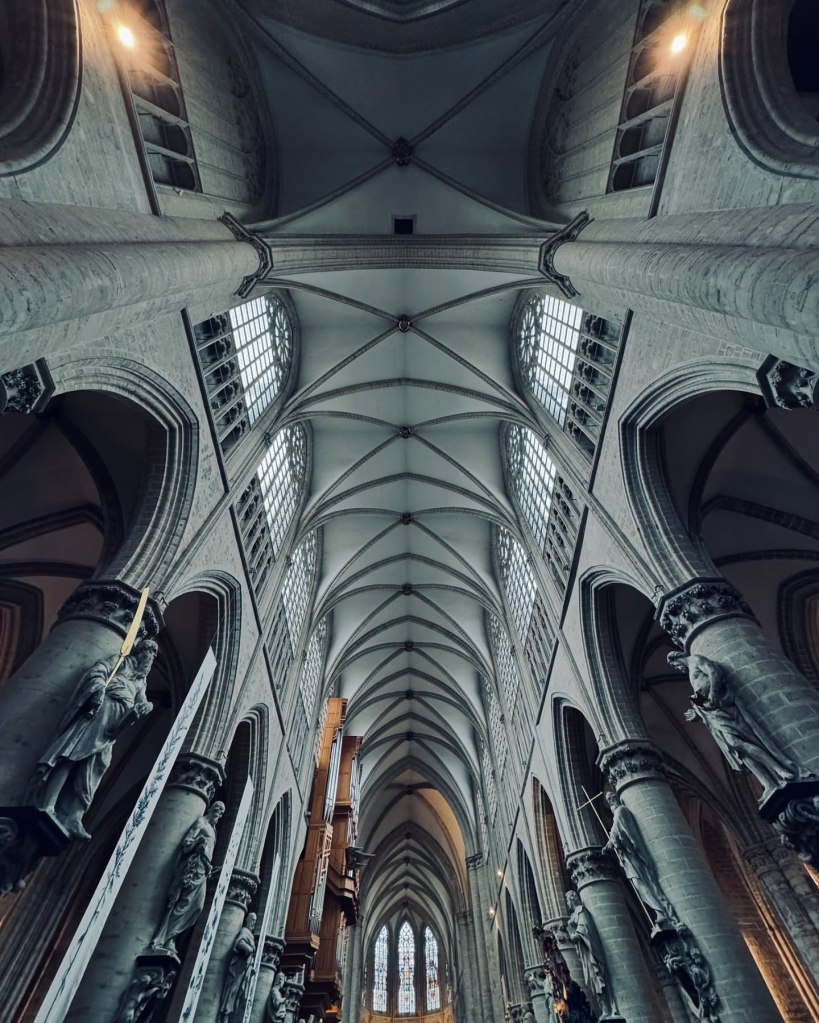
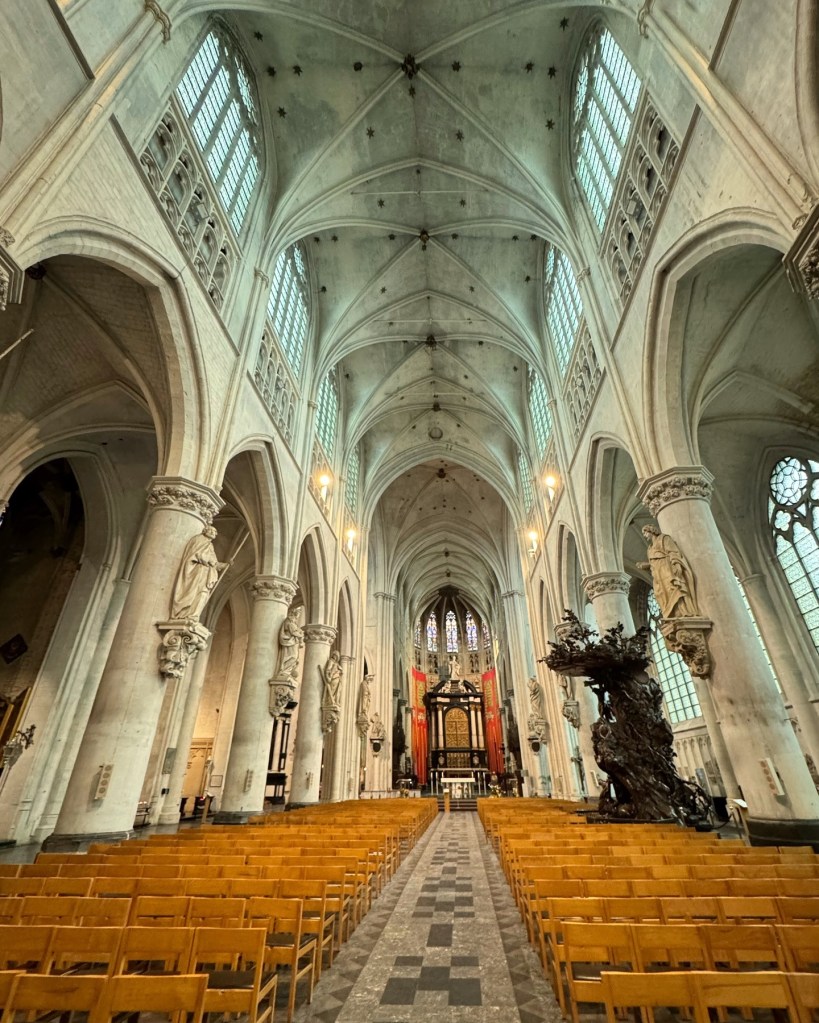
The Cathedral of St. Michael and St. Gudula in Brussels has a rich history rooted in its establishment in the 11th century on the foundations of an earlier Romanesque church. Construction of the current structure began in 1226 under the direction of Duke Henry II of Brabant and continued for 300 years, culminating in the early 16th century. Vertical lines and restrained decorations characterise its Brabantian Gothic style. The western façade features two towers and three portals without a rose window. The towers, probably designed by Jan Van Ruysbroeck (1470-1485), remain unfinished but showcase the intended verticality and intricate openwork.
The cathedral’s nave, supported by cylindrical columns with cabbage leaf capitals, houses 12 statues of apostles. Created in the 17th century by sculptors Luc Fayd’herbe (1617-1697), Jérôme Duquesnoy the Younger (1602-1654), Johannes van Mildert (1588-1638), and Tobias de Lelis (1641-1660), these statues replaced those destroyed during the Calvinist iconoclasm of 1566.
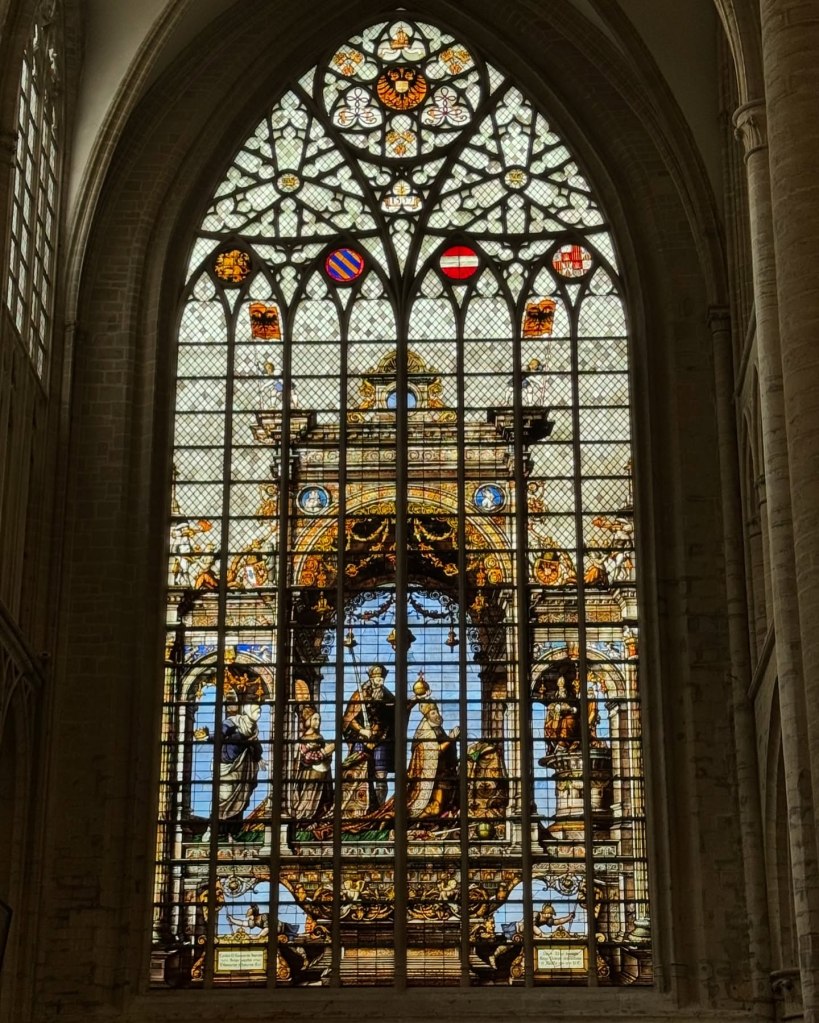
The 17th-century Baroque pulpit by Hendrik Frans Verbrugghen (1654-1724) stands out within the cathedral. Its base depicts Adam and Eve’s expulsion from Eden, while the Virgin and Child at the top symbolise redemption. The cathedral also features 16 side chapels with 19th-century stained glass windows by Jean-Baptiste Capronnier, some of which tell the story of the church’s patroness, St. Gudula.
St. Gudula, a 7th-century saint, is a patron saint of Brussels alongside St. Michael. Born into a saintly family in the 8th century, her mother was St. Amalaberga, her brother St. Emenbert, her sisters St. Pharaildis and St. Rainelda, and her aunt was St. Gertrude. As the daughter of the Duke of Lotharingia, St. Gudula promoted Christianity during her lifetime. In art, she is typically depicted as a young woman holding a lantern, symbolising her role in bringing light to the darkness.
The Cathedral of St. Michael and St. Gudula in BrusselsThe Cathedral of St. Michael and St. Gudula in Brussels Michiel Coxie (c.1499 – 1592?) , The Crucifixion, oil on oak, : 280 x 355 cm, the Cathedral of St. Michael and St. Gudula in BrusselsThe Cathedral of St. Michael and St. Gudula in BrusselsThe Cathedral of St. Michael and St. Gudula in Brussels
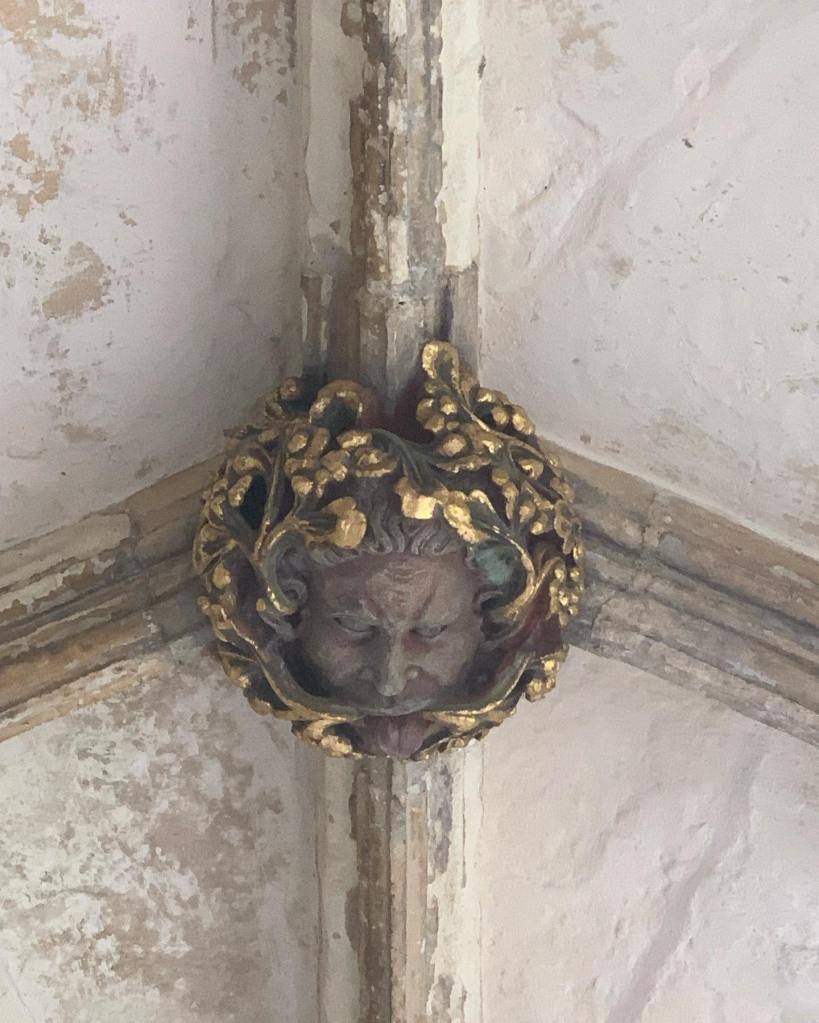
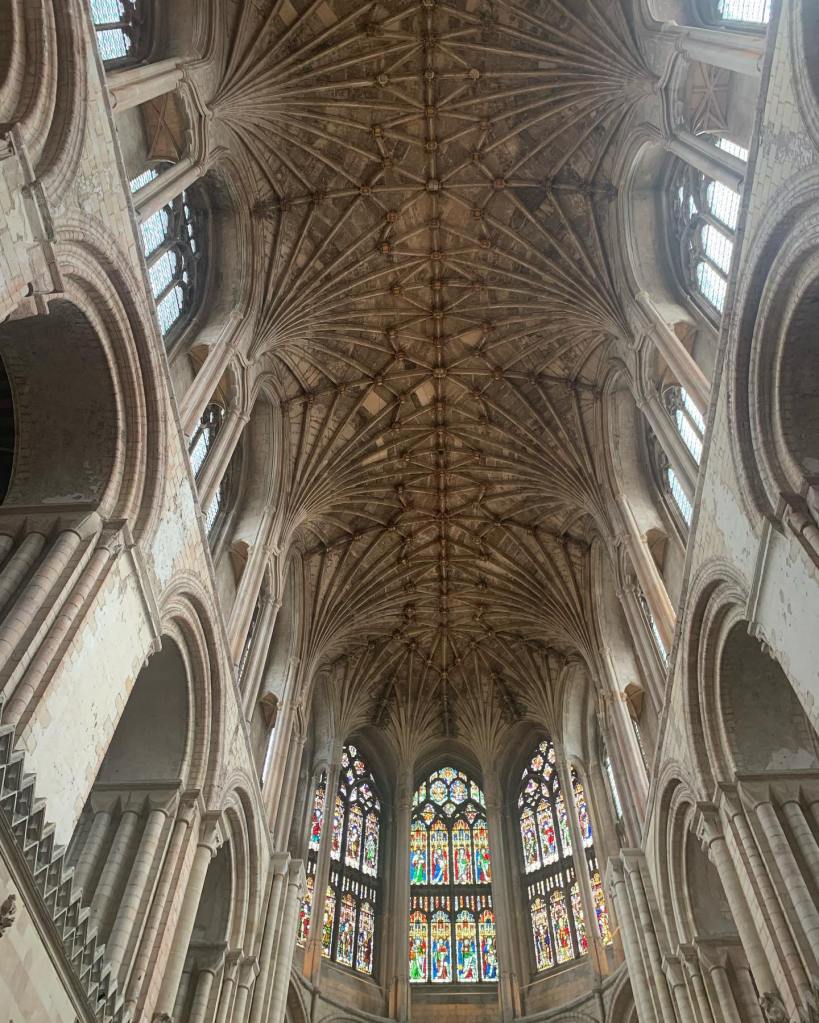
Norwich Cathedral possesses one of the largest surviving ensembles of Gothic roof bosses in Europe, an exceptional corpus of medieval sculpture both in scale and in preservation. Dating largely from the fourteenth and fifteenth centuries, the bosses number over one thousand and display a striking breadth of subject matter. Biblical narratives, Christological cycles, saints’ lives and allegorical themes are set alongside images drawn from bestiaries, folklore and scenes of everyday life, creating a visual register that combines sacred instruction with secular wit. Their survival is particularly remarkable in light of the waves of destruction that swept through English churches: the Reformation of the sixteenth century and the mid-seventeenth-century Puritan iconoclasm claimed countless examples of medieval imagery, yet the bosses of Norwich endured with comparatively little loss. Collectively they form not merely an ornamental ceiling scheme but a unique visual archive of late medieval thought, devotional practice and imaginative culture, offering scholars an invaluable witness to the interplay of sacred and secular traditions in the later Middle Ages.
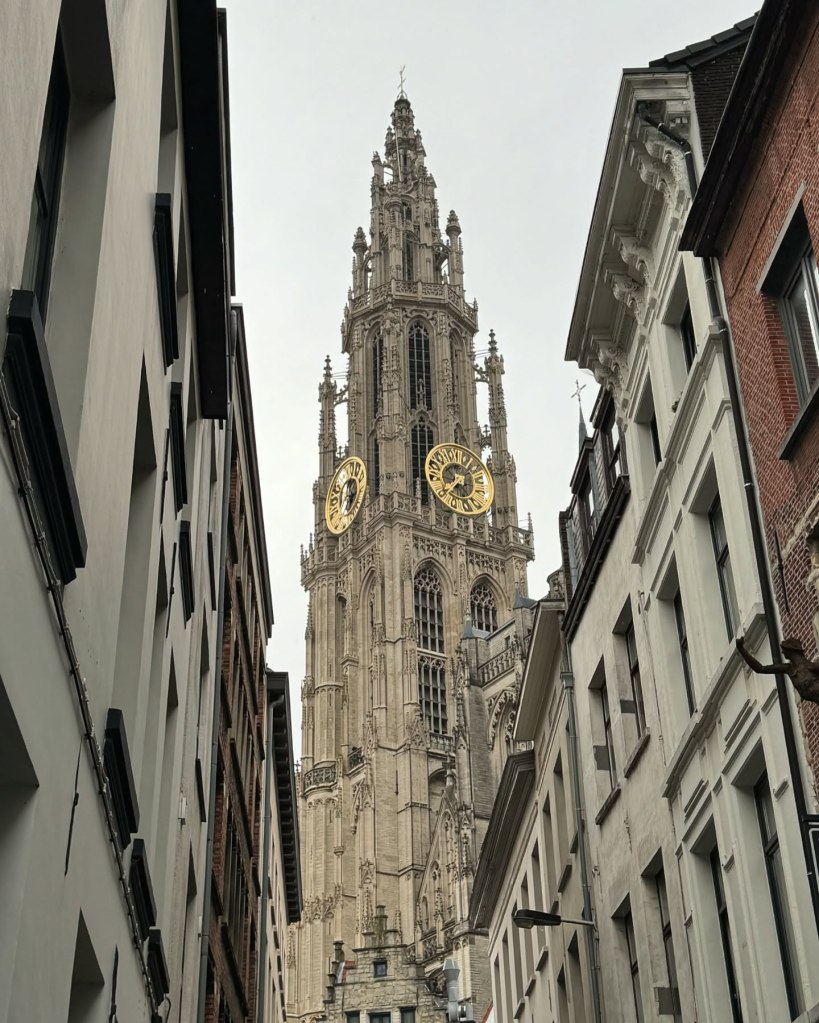
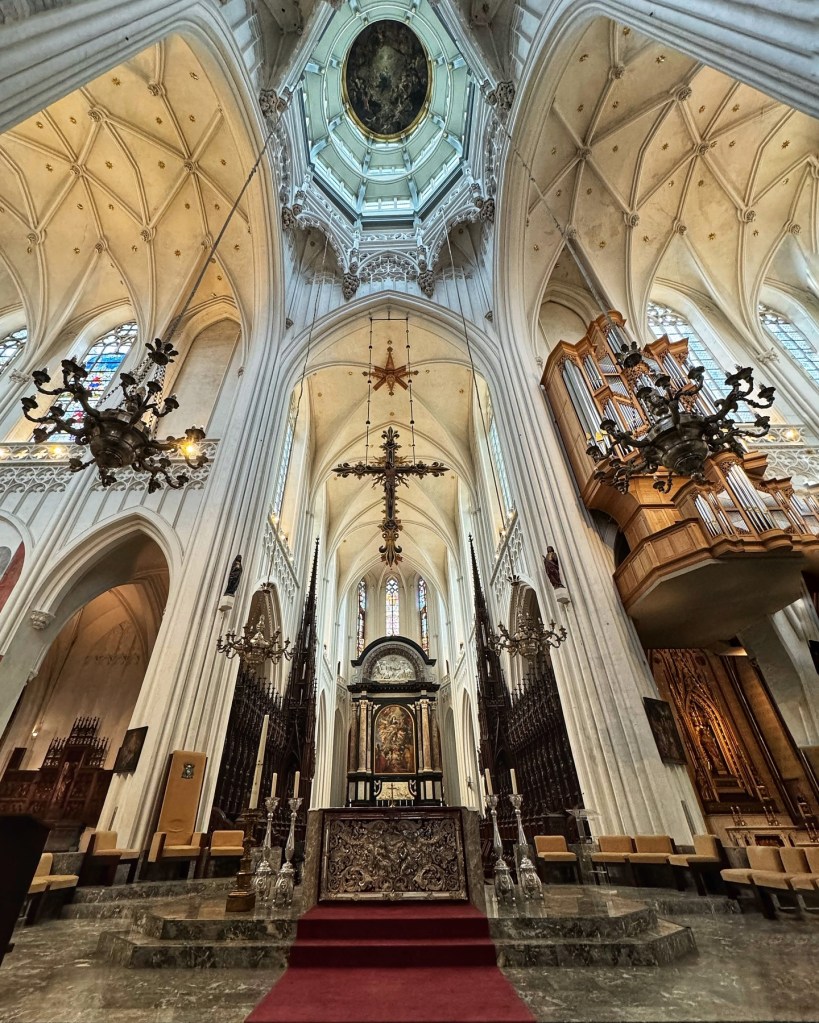
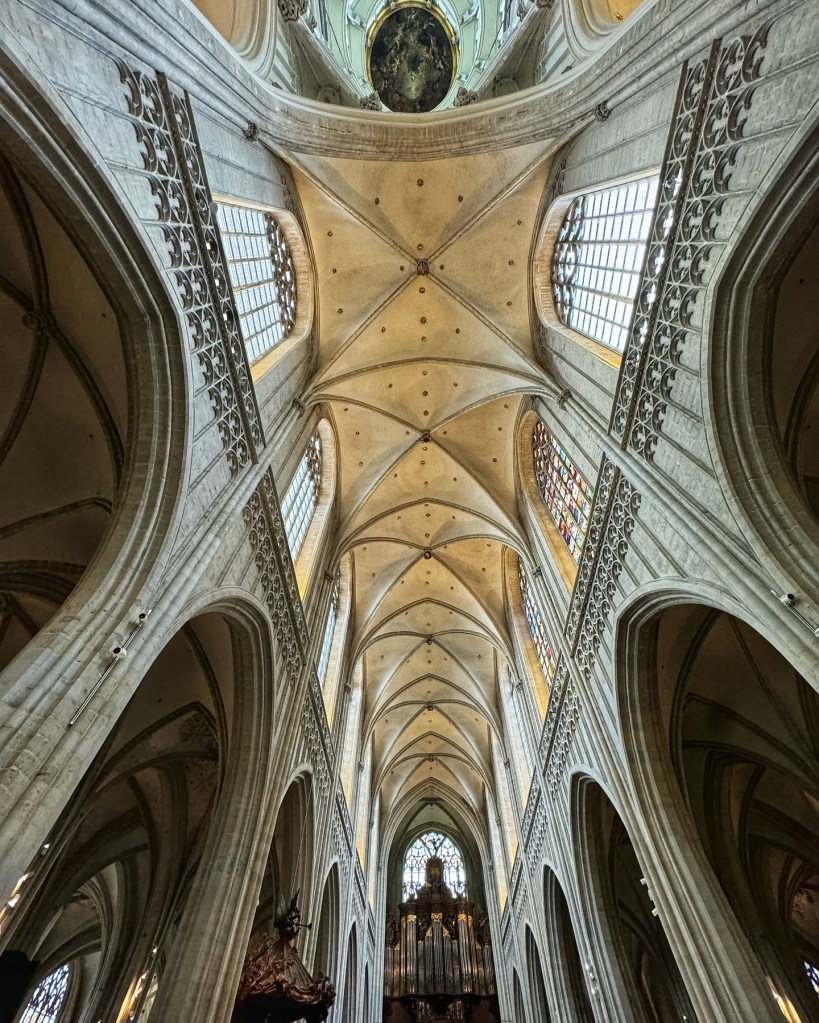
The current building of the Cathedral of Our Lady in Antwerp began construction in 1352 and was completed only in 1521, taking nearly 170 years to finish. This extended construction period led to a fusion of architectural styles.
Master builders Jan Appelmans (1352–1430), Pieter Appelmans (1373–1445), and Rombout II Keldermans (1460–1531) were instrumental in shaping the cathedral’s distinctive design. The octagonal part of the tower, designed by Herman de Waghemakere, was built in 1507. The tower was finally complete in 1518 when his son Damien de Waghemakere realised its magnificent spire.
Constructed from natural stone, the Cathedral features a high northern tower with spire-like stone lacework tracery, a lower southern tower, an octagonal lantern with an onion-shaped top, seven aisles, and multiple chapels. The exceptionally wide sash arches between the nave and side aisles further enhance the sense of openness within the interior. Notably, the traditional triforium is omitted and replaced by a decorative strip of meshwork above the arches, emphasising verticality and lightness.
The cathedral’s interior serves as a dynamic gallery of the city’s artistic heritage. Significant works include masterpieces by Peter Paul Rubens (1577–1640): ‘The Raising of the Cross’ (1609–1610), ‘Descent from the Cross’ (1611–1614), ‘Triptych with the Resurrection of Christ’ (1611–1612), and ‘Assumption of the Virgin’ (1625–1626). Other important artworks include ‘The Assumption of the Virgin’ by Anthony van Dyck (1599–1641), as well as contributions from Jacob de Backer (c. 1555–1585), Otto van Veen (1556–1629), Maerten de Vos (1532–1603), Hendrick van Balen I (1575–1632), Cornelis Schut I (1597–1655), and Artus Quellinus II (1625–1700).
The Cathedral of Our Lady in AntwerpThe Cathedral of Our Lady in AntwerpThe Cathedral of Our Lady in AntwerpThe Cathedral of Our Lady in AntwerpThe Cathedral of Our Lady in AntwerpThe Cathedral of Our Lady in Antwerp
The cathedral is dedicated to St Rumbold of Mechelen, a Celtic missionary whose relics are believed to rest within the building. It is a three-aisled cruciform church whose construction began in the 13th century and which was consecrated in 1312. Around 1335, a new campaign of enlargement was undertaken, introducing the choir with its seven radiating chapels. This design is possibly attributable to Jean d’Oisy (1310–1377), the influential master builder credited with adapting the French Rayonnant style to the Low Countries and shaping what became known as Brabantian Gothic. In St Rumbold’s, this phase established a spacious ambulatory with pointed arches and slender piers opening gracefully onto the choir, while the refined window tracery reflected the emerging geometrical precision of the style. The arrangement enhanced liturgical processions and demonstrated Mechelen’s growing prestige, for major ecclesiastical projects in the fourteenth century often served as both religious and civic statements. The vault of the choir, however, was not completed until 1451.
The construction of the monumental tower began in the 1450s under the direction of the Keldermans family, one of the most distinguished dynasties of architects in the Low Countries and central to the development of Brabantian Gothic. Jan II Keldermans provided the initial design, followed by the supervision of his son Andries I Keldermans (1400–1488). Substantial contributions were also made by Antoon I Keldermans (c.1440–1512), Antoon II Keldermans (d.1515), Rombout II Keldermans (c.1460–1531) and Laurens II Keldermans (d.1534). Their work gave the tower its ambitious verticality, intended to reach over 160 metres but left incomplete in height. In 1559, Sint-Romboutskerk was elevated to cathedral status, reflecting the city’s ecclesiastical importance.
The cathedral endured considerable damage during the religious and political upheavals of the late sixteenth century. In 1580, during the English Fury, it suffered serious losses, and in the Calvinist period between 1580 and 1585 it was used for Protestant worship, during which much of its art was destroyed or dispersed. The Catholic restoration after 1585 initiated a programme of redecoration that transformed the Gothic interior with new furnishings and altarpieces. Key to this renewal was the contribution of Michiel Coxcie (1497/1501–1585), known as the ‘Flemish Raphael’ for his Italianate compositions inspired by Raphael’s harmony and colour. Several of Coxcie’s final works, created in the 1580s, replaced altarpieces lost during the iconoclastic years, restoring both the visual richness and the devotional function of the cathedral.
Among the cathedral’s later treasures is the high altar designed by Lucas Faydherbe (1617–1697) in 1665, a masterwork of sculptural and architectural integration. The collection also includes Anthony van Dyck’s (1599–1641) ‘Christ on the Cross’ and paintings by other leading Flemish Baroque masters, underscoring the cathedral’s dual identity as a major Gothic monument and a repository of seventeenth-century religious art.
The builders of the great cathedrals of medieval Europe rarely lived to see the completion of their work. These vast projects were always conceived as undertakings that would stretch across generations, so that the act of building was understood as both practical and spiritual. Constructing a cathedral was never simply a technical task: it shaped the local economy, employed many crafts and trades, and gave visible form to the devotion of whole communities. In the Judeo-Christian tradition, the temple is never just a structure of stone. It is a centre of worship, a bond that holds a community together, and a commitment renewed through time. In this sense, a temple is never truly finished. It grows with the people it serves, reflecting both their continuity and their change. The words of Psalm 127:1, ‘Unless the Lord builds the house, those who build it labour in vain,’ express this belief, reminding us that the truest temple is first raised in the hearts of the faithful, even while it takes form in stone.
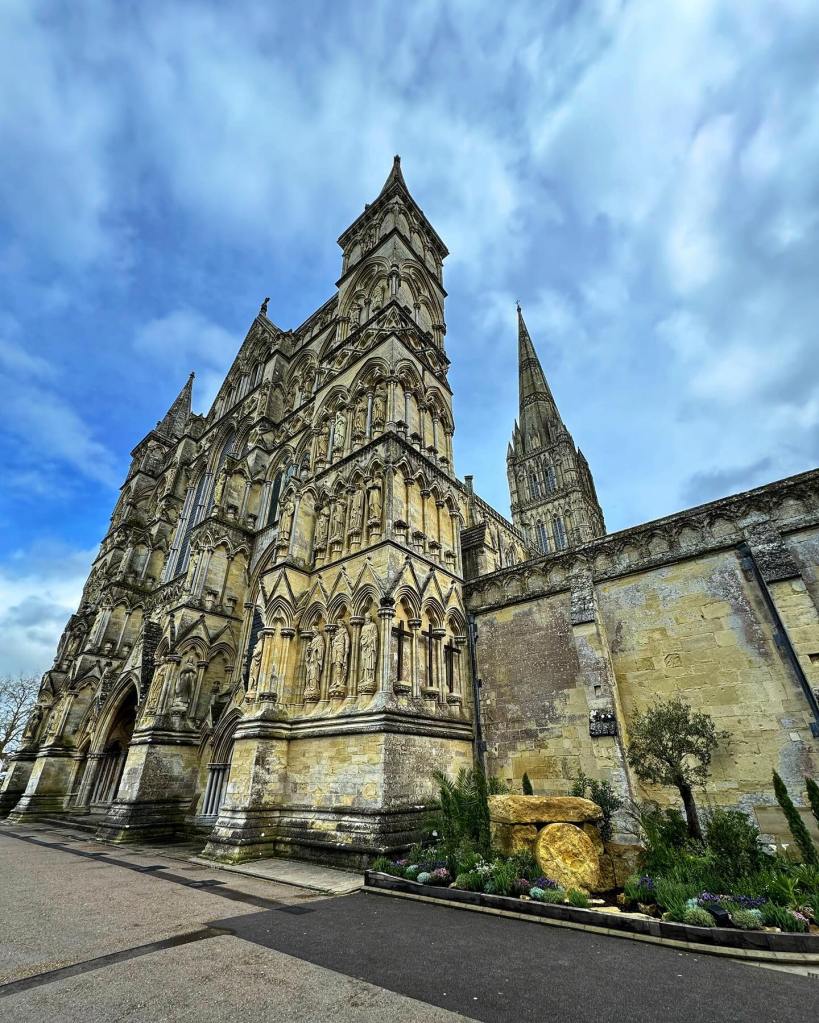
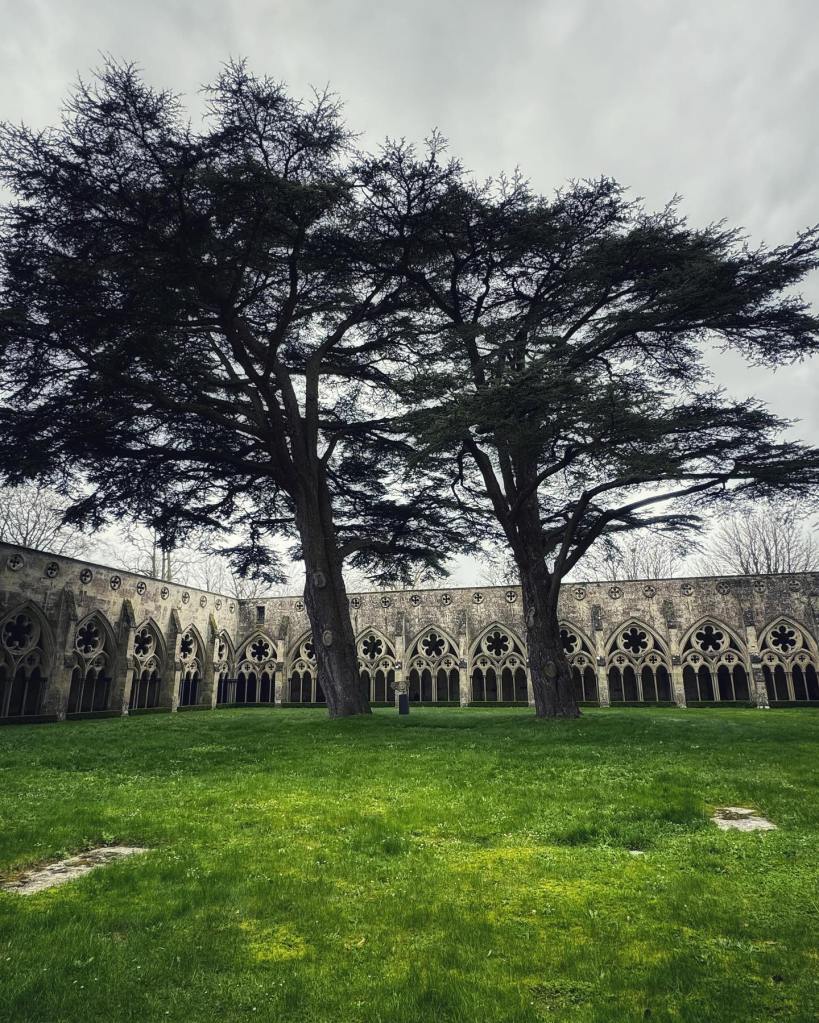
Salisbury Cathedral, one of the masterpieces of English Gothic architecture, shows this principle clearly. Begun in the early thirteenth century and completed more than seven hundred years ago, it has absorbed many additions and alterations that mark the passing of time and the changing needs of worship. The great spire that dominates the building, the reshaping of its interior for new liturgical practice, and the ongoing conservation work all bear witness to the life of the community it serves. Saint Augustine’s words, ‘We are the times: such as we are, such are the times,’ are especially fitting here. They remind us that the cathedral is not only an ancient landmark but also a living sign of faith and continuity, sustained by the collective spirit of generations.