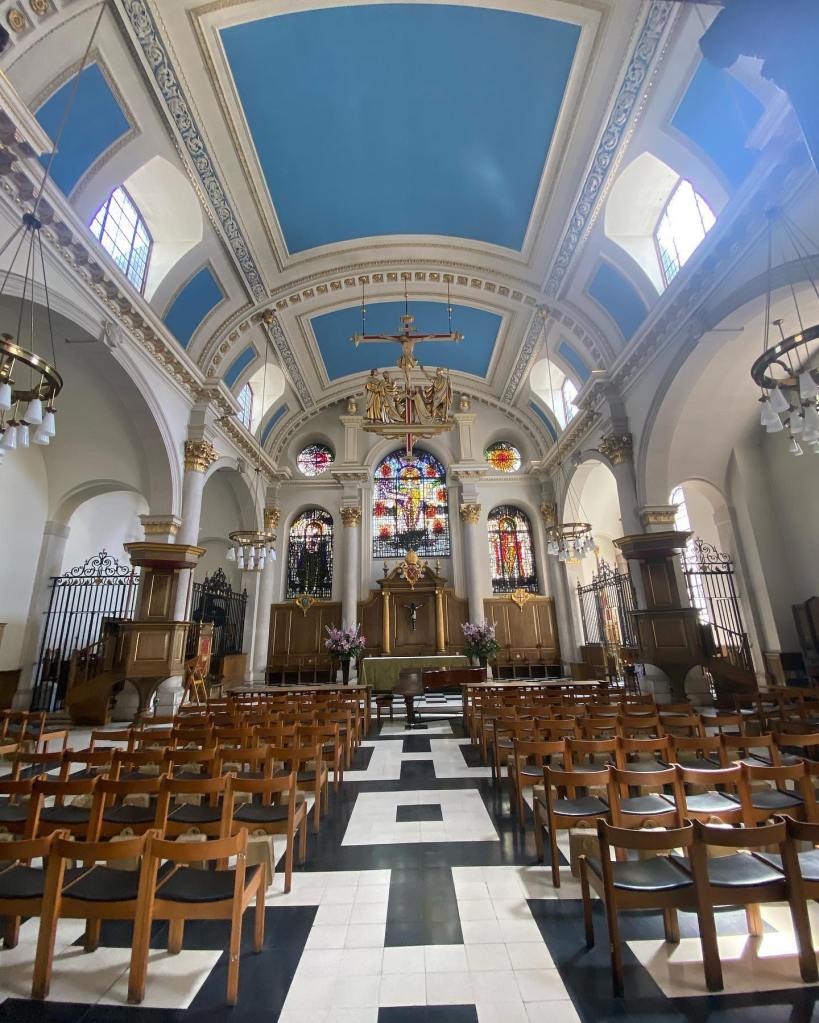
The present church of St Mary-le-Bow, completed in 1673, was one of Christopher Wren’s first large-scale reconstructions after the Great Fire. The medieval structure, distinguished by its Norman crypt with massive stone arches or bows, was lost in the conflagration. For its rebuilding Wren employed what may be called his ‘neoclassical’ formula: a scheme indebted to Roman precedent, particularly the vaulting of the Basilica of Maxentius, and to French contemporary design, notably the entrances of the Hôtel de Conti in Paris. Unlike the eclectic, sometimes picturesque solutions he devised for smaller parish churches, here the architectural language is austere and monumental, signalling his ambition to align the City’s skyline with European classicism.
The tower and spire, added in the 1670s, demonstrate Wren’s skill in adapting baroque verticality to the London context. Rising through successive stages to an emphatic spire, the structure was for two centuries one of the principal markers of Cheapside. It also carried the Bow Bells, which had already acquired a cultural resonance beyond the parish. From the fourteenth century their nightly ringing signalled the end of the apprentices’ working day and the closing of the City gates. By the seventeenth century the phrase ‘born within sound of Bow Bells’ had become a defining measure of London identity, embedding the church within the folklore of the City.
Within Wren’s oeuvre the building belongs with St Mary-at-Hill and St Bride’s Fleet Street as an example of his synthesis of Italian and French baroque principles with the demands of London parochial worship. The emphasis on clear geometry, monumental entrances and disciplined façades marks a deliberate departure from the medieval irregularity of the site, while still accommodating the crypt as a surviving remnant of the earlier church.
Badly damaged by bombing in 1941, St Mary-le-Bow was rebuilt under Laurence King in the 1950s. The modern interior has altered the liturgical arrangement, but the external form remains one of the most articulate examples of Wren’s early classicism, in which the lessons of antiquity, filtered through continental baroque, were re-cast for the civic and spiritual needs of London after the Fire.


