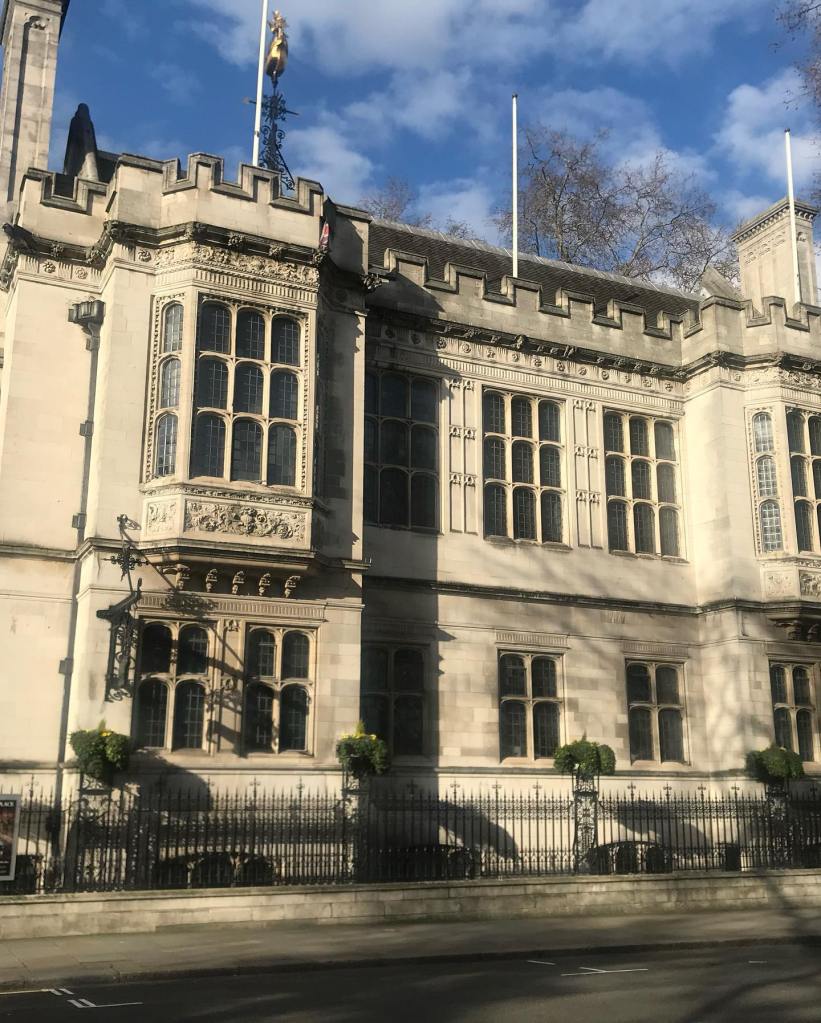

Two Temple Place is one of the most remarkable neo-Gothic buildings in London, constructed between 1892 and 1895 for William Waldorf Astor (1848–1919), the American millionaire who had recently moved to England. Designed by John Loughborough Pearson (1817–1897), one of the leading architects of the Gothic Revival, the house served as Astor’s private estate office, but it was conceived less as a workplace than as a monument to wealth, cultural ambition, and self-fashioning.
Astor, whose uneasy relations with his native United States had prompted his relocation, used the building to inscribe his identity into the cultural fabric of London. Pearson was given an effectively unlimited budget, and the result was an architectural fantasy in stone, marble, and wood, blending the Gothic idiom with the language of the late Victorian age. Two Temple Place does not merely revive the medieval but reimagines it as a setting for Astor’s own biography and ideals.
The interior decoration is particularly revealing. Its friezes and carvings, carried out by leading sculptors of the time, draw directly on Astor’s favourite literary works, from Shakespeare to the romances of Sir Walter Scott. The building thus became a kind of architectural library, where literature was transformed into stone and wood, and where Astor’s private passions acquired monumental form. This was no simple pastiche of the Middle Ages, but a late nineteenth-century attempt to fuse personal taste, artistic craftsmanship, and the iconographic richness of the Gothic Revival into a coherent statement of cultural aspiration.