Rembrandt van Rijn (1606–1669), Simeon in the Temple , before October 1669, Oil on canvas, 98.5 × 79.5 cm, National Museum, Stockholm
On 5 October 1669, the day after Rembrandt died, notary Gerrit Steeman arrived at the small rented house on the Rozengracht in Amsterdam to take stock of what was left. In the entrance hall he counted twenty-two paintings, listed simply as ‘both finished and unfinished’. More unfinished canvases, their number unrecorded, stood in the parlour. The dead painter’s only company during his final days had been his daughter Cornelia (1654–after 1684), not yet fifteen, his sole surviving child by Hendrickje Stoffels (c.1626–1663), who had herself died six years earlier. Hendrickje and Rembrandt had never married, which meant that Cornelia, as their illegitimate daughter, held no legal claim to his belongings. Present at the inventory was also Magdalena van Loo (c.1641–1669), the widow of Rembrandt’s son Titus (1641–1668), who had died barely a year before his father. Magdalena would herself be buried in the Westerkerk just sixteen days later, on 21 October. The notary sealed the rooms, pocketed the keys, and noted that the heirs had not yet decided whether to accept the inheritance, a hesitation that, given Rembrandt’s lifelong pattern of debt and compulsive collecting, was entirely understandable. That hesitation has also robbed us of any certain knowledge of what stood on his easel.
The painting now in Stockholm is almost certainly the canvas described in a sworn notarial document, published by Abraham Bredius (1855–1946) in 1909, in which two Amsterdam painters, Allaert van Everdingen (1621–1675) and his son, the playwright Cornelis van Everdingen (dates uncertain), testified that they had seen Rembrandt at work on a painting of ‘Simeon’ in the months before his death. The same document identifies the patron who had commissioned it: a businessman named Dirck van Cattenburch (1616–1704). The painting was not, then, an unbidden private meditation, as the romantic reading of it prefers, but a paid commission. How far Rembrandt had taken the canvas before he died, and how much of what we now see belongs to his own hand, remain questions that have never been fully settled.
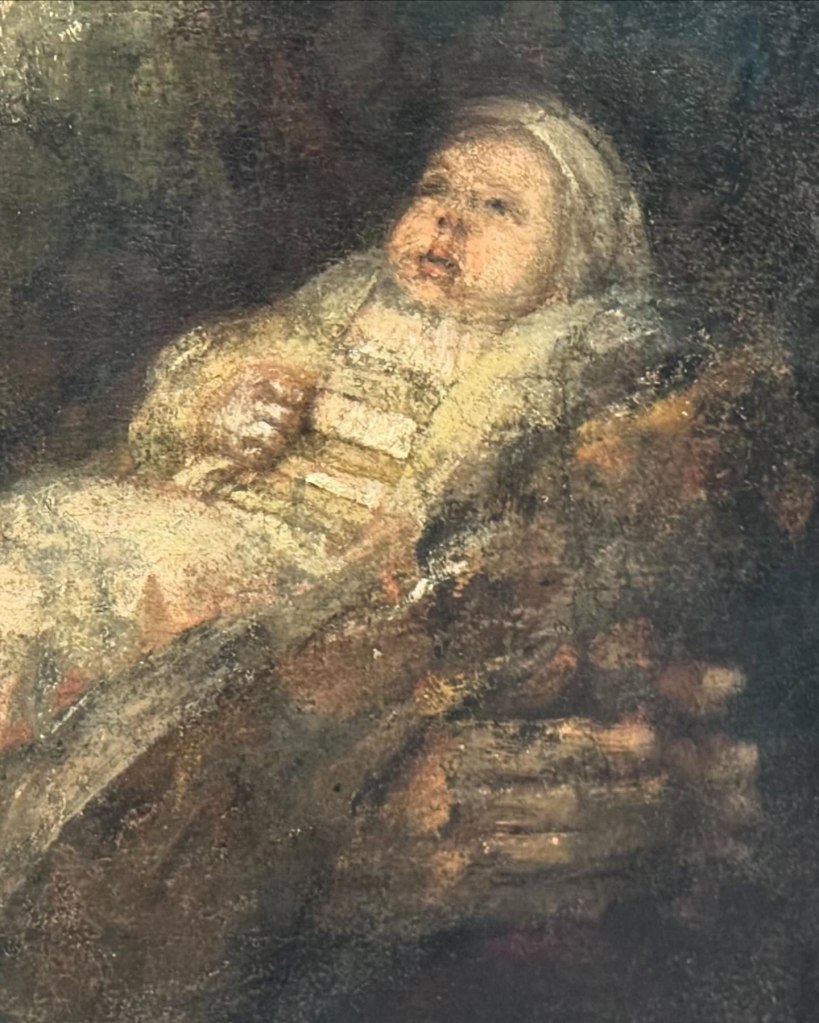
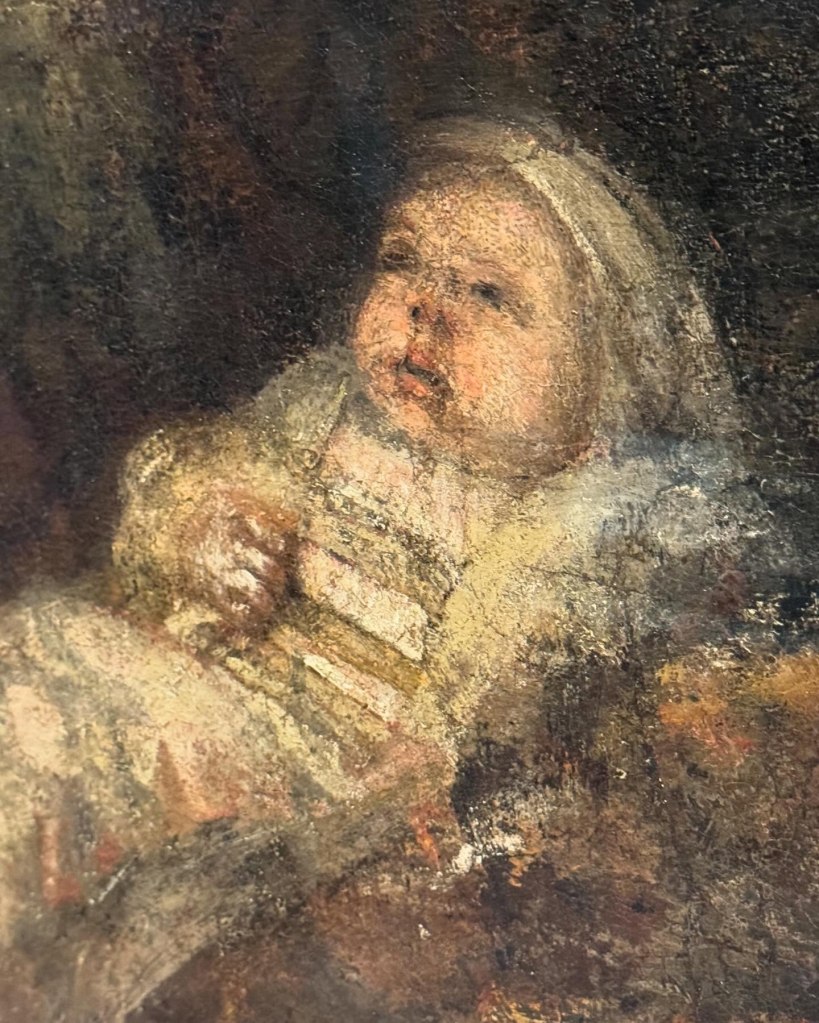
The canvas, fragile and badly deteriorated, nevertheless bears all the marks of his late manner. Its sketch-like surfaces, the stripped-down design, and the sombre, damaged palette reveal an artist working with extreme concentration and economy of means. The composition turns all attention upon Simeon, who cradles the infant Christ in his arms. The figures are reduced to essentials, eliminating the grand architectural settings or surrounding narrative detail familiar in earlier treatments of the Presentation in the Temple. A female figure, partially visible in the background, is generally identified as either the Virgin Mary or the prophetess Anna. She has long troubled scholars. The finish and handling of this figure differ from those of the foreground group, and she may have been added after Rembrandt’s death by an unknown hand working in or near his circle. The problem is further complicated by the painting’s later provenance: it was once owned by Sir Joshua Reynolds (1723–1792), who, as the Gemäldegalerie in Berlin demonstrated in a small exhibition in 2015 devoted to Rembrandt’s Susanna and the Elders (also formerly in Reynolds’s collection), was in the habit of scraping, retouching, and overpaining Rembrandt canvases he considered unfinished or improvable. Whether Reynolds left his mark on the Stockholm painting too remains an open question, and until it is resolved, as Gary Schwartz has argued, all judgements about the level of craftsmanship visible in this canvas must be treated with caution.
The subject, drawn from Luke 2:25–33, had occupied Rembrandt across the full span of his career. His earliest treatment of the theme, Simeon and Anna in the Temple (c.1627–1628, oil on panel, 55.4 × 43.7 cm, Hamburger Kunsthalle), is a small, crowded panel from his Leiden years, packed with figures, architectural detail, and the carefully finished surfaces of a young painter eager to display everything he could do. A few years later, Simeon’s Song of Praise (1631, oil on panel, 60.9 × 47.9 cm, Mauritshuis, The Hague), painted in the year Rembrandt moved to Amsterdam, expands the scene into a vast, shadowy temple interior, the figures dwarfed by soaring columns and deep pools of chiaroscuro. Both paintings are performances of skill, calculated to impress. In 1661, Rembrandt returned to the subject in a small drawing in pen, brush, and brown ink with white bodycolour (12 × 8.9 cm, National Library, The Hague), made as a contribution to the friendship album (album amicorum) of Jacobus Heyblocq (1623–1690), rector of a Latin school in Amsterdam. The composition of the drawing is close to that of the Stockholm painting: Joseph has been dropped, the Virgin moved into the background, and Simeon stands rather than kneels. Interestingly, the Simeon in the painting echoes the pose and position of the Joseph in the drawing, as though Rembrandt transferred the attitude from one figure to another as the composition evolved. In both drawing and painting, the cavernous temple, the priests, the crowds, and the prophetess Anna have all been stripped away. There is no setting, no context. The figures are pushed towards us, spare and unmediated.
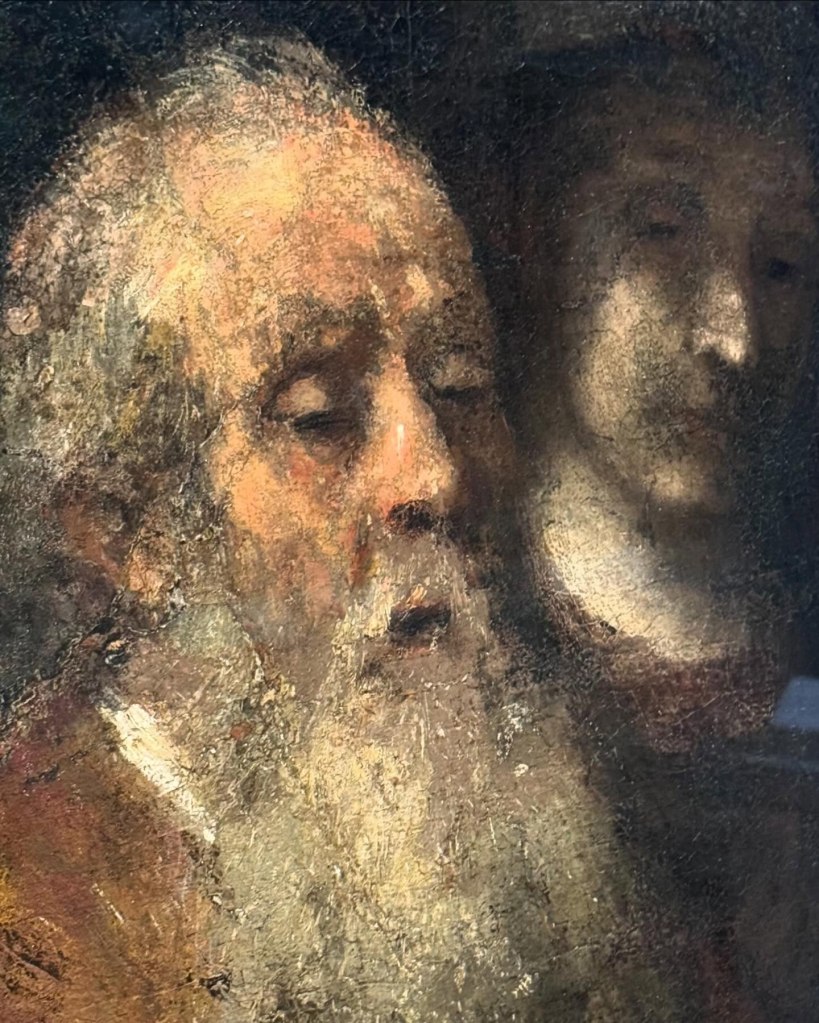
According to the evangelist, the Holy Family brought Jesus to the temple in Jerusalem to present him to the Lord and to offer sacrifice, in compliance with the Mosaic law (Leviticus 12:1–8; Exodus 13:2). There they encountered Simeon, a righteous man to whom it had been revealed by the Holy Spirit that he would not die until he had seen the Messiah. In this final version, Rembrandt places the old man at the centre, his eyes nearly closed, his mouth just parting, as if on the verge of uttering the Nunc dimittis: ‘Lord, now lettest thou thy servant depart in peace, according to thy word: for mine eyes have seen thy salvation.’ His expression conveys a deep inner stillness, something beyond relief or joy, closer to the physical sensation of release. The light that falls across the figures is even and diffuse, mysterious rather than dramatic, and this is itself a departure. In the earlier paintings, Rembrandt used directed shafts of light to isolate the Christ child as the brightest point in the composition, following the scriptural metaphor of ‘a light for revelation to the Gentiles’ (Luke 2:32). Here, the light belongs to no single source. It envelops rather than points.
Jonathan Bikker and Gregor Weber, in the catalogue for the exhibition Rembrandt: The Late Works (National Gallery, London, 15 October 2014 – 18 January 2015; Rijksmuseum, Amsterdam, 12 February – 17 May 2015), have argued that Rembrandt’s so-called late style did not emerge from old age or infirmity but was in development from about 1651, when the painter was only forty-five. The concentration, the thick tactile surfaces, the suppression of descriptive detail, the pathos: these belong to the work of a mature artist at the height of his powers, and the common reading of the late paintings as products of decline or withdrawal is, in their view, misleading. The Simeon in the Temple may be the one exception. Here, in the very last canvas, the unfinished surfaces, the lack of definition, and the roughness of execution could well reflect the painter’s failing health rather than deliberate artistic choice, or perhaps both at once, since it is very difficult to separate the two. Is the blurred indistinctness of Simeon’s face an intentional evocation of a life fading, or simply a passage that Rembrandt never lived to resolve? The painting refuses to answer.
As Rembrandt’s final work, its personal resonance is hard to set aside, however much we remind ourselves that it was a commission and not a private act of devotion. A last painting is never only another canvas; it reads as a threshold, a reckoning. Simeon’s readiness for death speaks, inevitably, to the painter’s own situation. After a lifetime of triumphs and calamities, of bankruptcy and bereavement, of a house emptied first of possessions and then of people, Rembrandt was painting a man for whom death was not a catastrophe but a permission. He painted as a man laying down his gift, leaving behind not a commodity for the market but a confession of vocation: art as his reason for being, the sum of his burdens and achievements, the costly price of vision, and the quiet peace with which he finally let it go.

References
Bertrand, R. (2001) Étude iconographique et théologique du dernier tableau de Rembrandt, Siméon glorifiant l’enfant Jésus au temple. MA thesis. Université du Québec à Trois-Rivières. Available online at, https://depot-e.uqtr.ca/id/eprint/2716/1/000682150.pdfc(Accessed 3March 2024)
Bikker, J. and Weber, G.J.M. (2014) Rembrandt: The Late Works. Exhibition catalogue. London: National Gallery Company / Amsterdam: Rijksmuseum. Yale University Press.
Bredius, A. (1909) ‘Rembrandtiana’, Oud Holland, 27, pp. 65–76.Available online at,https://oudholland.rkd.nl/images/backissues/Oud_Holland_1910_vol_028.pdf( Accessed 1 March 2024)
Dirkx, M. (2019) ‘Rembrandt, 350 years after his death’, Rembrandt’s Room [blog], 5 October.Available at, https://arthistoriesroom.wordpress.com/2019/10/05/rembrandt-350-years-after-his-death/ (Accessed 1 March 2024)
Schwartz, G. (2015) ‘Latest Rembrandt’, Gary Schwartz Art Historian [online], no. 339, 13 April.Available at, https://www.garyschwartzarthistorian.nl/339-latest-rembrandt/ (Accessed 02 marhc2024)
Perlove, S. and Silver, L. (2009) Rembrandt’s Faith: Church and Temple in the Dutch Golden Age. University Park, PA: Pennsylvania State University Press