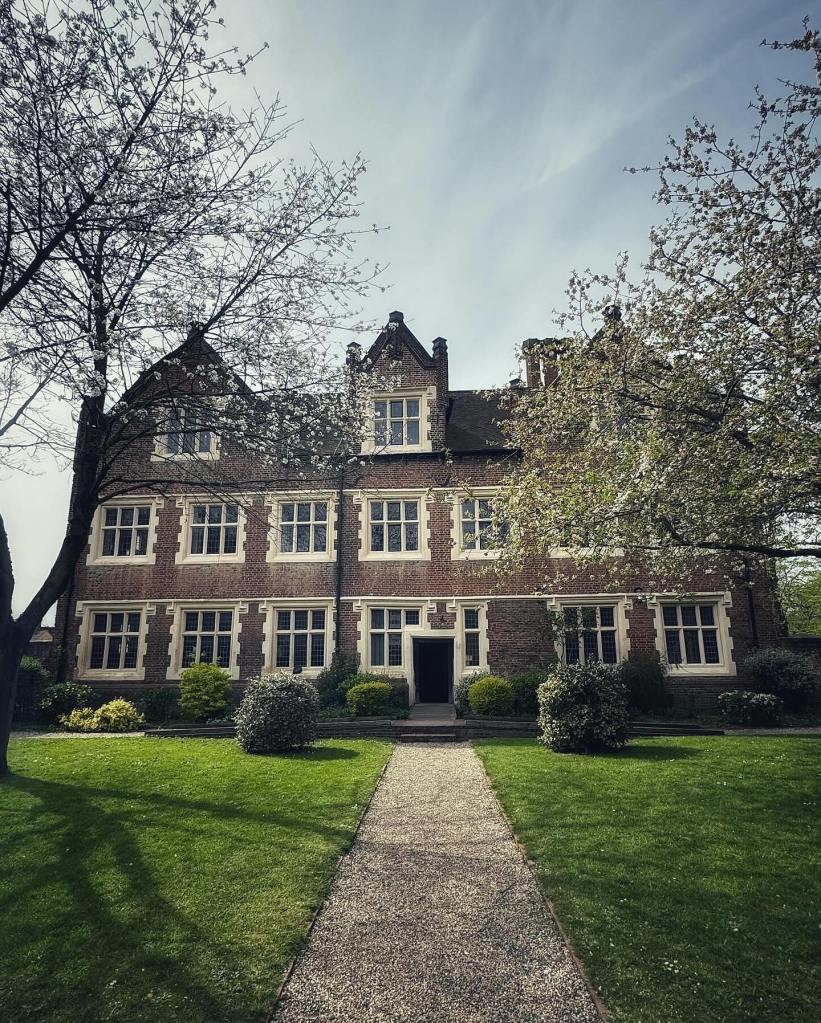
Eastbury Manor House, Eastbury Square, Barking, Greater London.
Eastbury Manor House in Barking, Essex, is one of the most compelling survivals of Elizabethan domestic building in London, remarkable not only for its preservation but for what it tells us about the ambitions of its founder. It was raised in the 1570s by Clement Sysley (c.1520–c.1580), a London merchant of substance but not of noble birth, who sought through architecture to secure his family’s place in the social hierarchy of Tudor England. In a period when brick was still associated with wealth and prestige, Sysley’s decision to commission a large manor in warm red brick, patterned with grey diaper work, was a clear declaration of status. Its tall chimneys and broad windows—glass itself being costly—spoke of prosperity and modern taste, aligning his household with the new architectural language that defined Elizabethan aspiration.
The house was more than a dwelling: it was constructed as a text of symbols. The most striking emblem is the heart motif built into the façade, interrupting the geometry of the brickwork with a deliberate sign that has prompted multiple interpretations. It may have stood for love, for the heart of the household, or even for the pastime of card play—whatever its precise intention, it demonstrates the Tudor delight in embedding meaning within design. Such motifs were not mere ornament but devices that allowed a building to participate in the wider culture of allegory, where surface decoration invited the viewer to read beyond what was visible. Local tradition has long spoken of further concealed signs, hidden beneath or within the house, an echo of the period’s fascination with secret messages and emblematic thought.
Though centuries have diminished Eastbury’s original splendour, crucial fragments of its decorative scheme remain. Surviving wall paintings disclose something of the visual environment in which Sysley and his family lived. Floral arabesques, pastoral vignettes, and heraldic motifs reveal both the impact of Renaissance decorative vocabulary and the persistence of local vernacular taste. In these painted surfaces, Sysley presented himself as a man not only of means but of cultivated sensibility, able to bring the sophistication of metropolitan fashion into a suburban setting. Such decoration functioned as an extension of the house’s symbolic architecture: a medium through which identity, aspiration, and permanence could be projected.
Eastbury is therefore more than an isolated architectural relic. It belongs to the broader narrative of Elizabethan domestic building, when wealthy merchants and courtiers alike used architecture as a means of self-fashioning. Houses such as Eastbury show how new men, enriched by trade and city enterprise, translated their fortunes into brick and glass, ensuring their presence in the cultural landscape. In Sysley’s case, the manor endures as the single most eloquent testimony of his ambition, one that continues to speak across the centu