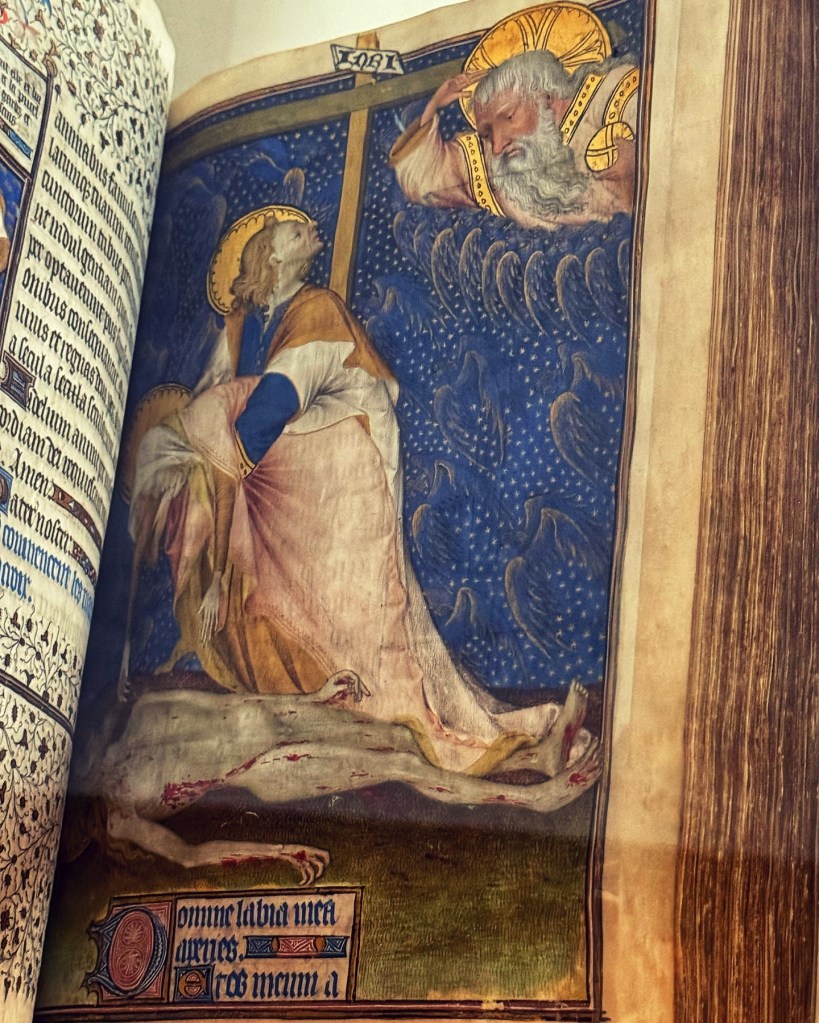
Master of Rohan (active in the 1430–1440s), Lamentation of the Virgin (f. 135, Pl. 57) from the Hours of the Cross in The Grandes Heures de Rohan, 1430–1435, tempera and golden leaf on parchment. Bibliothèque Nationale, on short-term loan to Musée de Cluny, Paris
Master of Rohan (active c.1430–c.1445), Lamentation of the Virgin (f. 135, Pl. 57) from the Hours of the Cross in The Grandes Heures de Rohan, 1430–1435, tempera and golden leaf on parchment. Bibliothèque Nationale, on short-term loan to the Musée de Cluny, Paris
The Grandes Heures de Rohan, produced between 1430 and 1435 by the elusive Master of Rohan and his workshop, is striking for the emotional intensity and spiritual gravity it brings to late medieval illumination. Unlike many Books of Hours of the period, which balance decorative splendour with devotional content, the Rohan Hours is consumed by pathos, its imagery unfolding in sombre and dramatic tones. Nowhere is this more apparent than in the Lamentation of the Virgin, where the grieving Mother of Christ collapses in anguish, inconsolable despite the presence of the Apostle John, who turns his gaze upwards in distress towards a sorrowful God.
The Master of Rohan’s art lies in his ability to translate human emotion into pictorial form. Facial expression, gesture, the tilt of the Virgin’s head, the sweep of her veil, and the sharp, angular poses of the supporting figures transform the scene into a meditation on grief and redemption. Rather than offering a static devotional image, he presents an urgent, almost theatrical confrontation with the themes of death and suffering.
Placed in the wider context of French manuscript illumination of the 1430s, the Rohan Hours appears radical. The Bedford Master, active at the French court in the same decade, worked in a refined International Gothic style—brilliant colours, elegant contours, and careful ornament that celebrated clarity and beauty. Even moments of sorrow in the Bedford Hours remain codified, contained within the expected decorum of aristocratic art. The Master of Rohan, by contrast, rejected elegance in favour of psychological immediacy. He pressed figures up against the surface of the page, distorted their proportions, and abandoned strict spatial coherence, producing compositions where raw emotion overwhelms formal order.
In this the Rohan Master anticipated the visual strategies of Netherlandish painters such as Rogier van der Weyden (c.1399–1464), whose great altarpieces of the 1440s made human grief palpable through tears, twisted bodies, and gestures of lament. Both artists belonged to a culture of affective piety, shaped by movements such as the Devotio Moderna, which encouraged meditation on the Passion through vivid empathy rather than detached contemplation. The Rohan Hours shares this impulse: its images demand not admiration of craftsmanship alone but emotional participation in Christ’s suffering and the Virgin’s grief.
Patronage, too, shaped this departure. The manuscript was probably commissioned for a member of the circle of Yolande of Aragon (1384–1442), one of the most influential female rulers of the period and a central figure in the politics of Charles VII’s court. In such a milieu, devotion was inseparable from questions of power, lineage, and personal salvation. The intensity of the Rohan imagery reflects this environment: it is a manuscript not designed to flatter but to confront, a book of private prayer whose illuminations carry the weight of tragedy as much as hope.