Quentin Massys (1465/66- 1530), Christ on the Cross with Donors, c. 1520, Oil on oak, 156 x 92,7 cm (central panel), 158,8 x 42,2 cm (wings), Museum Mayer van den Bergh, Antwerp

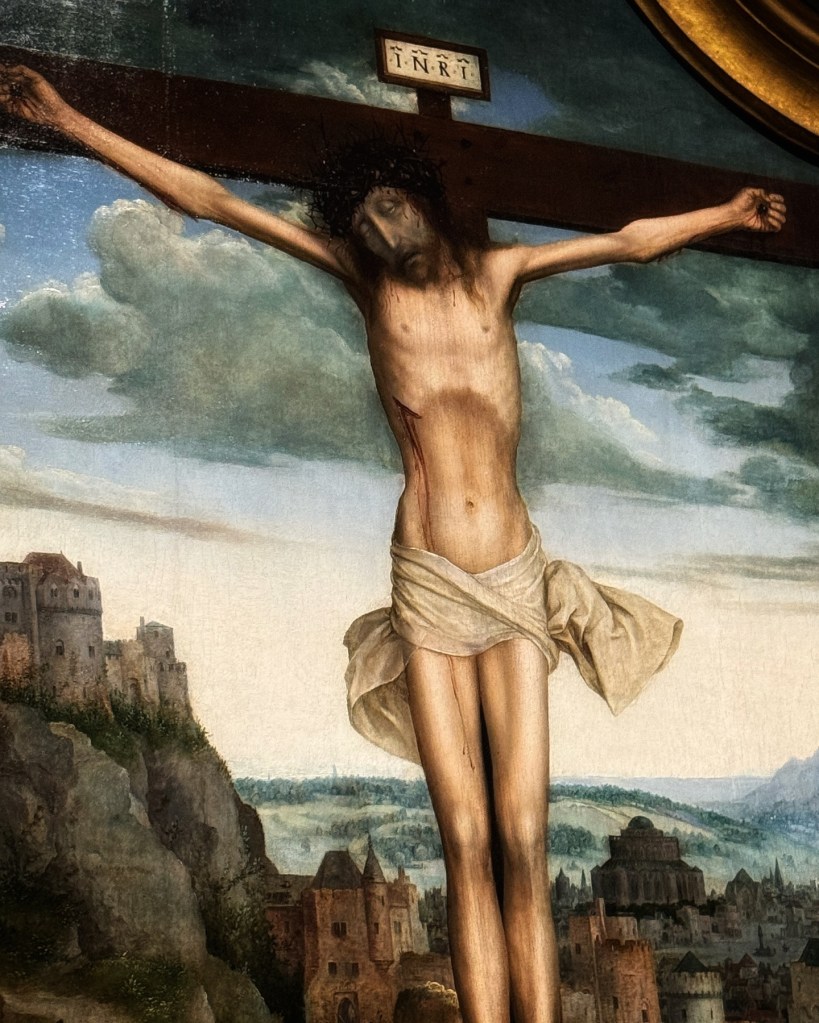


Quentin Massys was one of the defining painters of the early sixteenth century in the Low Countries, bridging the technical refinement of the fifteenth-century Netherlandish tradition with the emerging humanist sensibilities of the Renaissance. Christ on the Cross with Donors, painted around 1520, exemplifies the qualities that made him central to Antwerp’s rise as the leading artistic hub of the Burgundian–Habsburg Netherlands. By this date, Antwerp had supplanted Bruges as the principal mercantile and cultural centre, its painters catering to an increasingly international clientele. Massys was at the forefront of this shift, adapting the meticulous detail and luminous surfaces inherited from Jan van Eyck and Rogier van der Weyden to new demands for greater emotional immediacy, spatial coherence, and narrative clarity.
The ‘secret’ of Massys’s formula lay in this fusion of the old and the new. In Christ on the Cross with Donors, the central panel presents a balanced yet emotionally charged Crucifixion, the grieving Virgin and St John flanking the cross in a clear, harmonious arrangement that allows the donor portraits to be integrated without disrupting the devotional focus. The wings reinforce the pious programme, offering further points of contemplation when open, while closed they would have formed a more private, meditative image. Massys’s mastery of physiognomy, precise rendering of textures, and sensitive control of light created a believable sacred space in which the donors themselves could ‘participate’ in the Passion. This blend of vivid realism, persuasive spatial construction, and devotional intensity appealed to Antwerp’s wealthy merchant elite, who sought works that signalled both worldly status and piety. In doing so, Massys helped define the Antwerp altarpiece format that would dominate Netherlandish painting for many years.
References
Silver, L. (1984) The Paintings of Quinten Massys with Catalogue Raisonné. Montclair, NJ: Allanheld & Schram