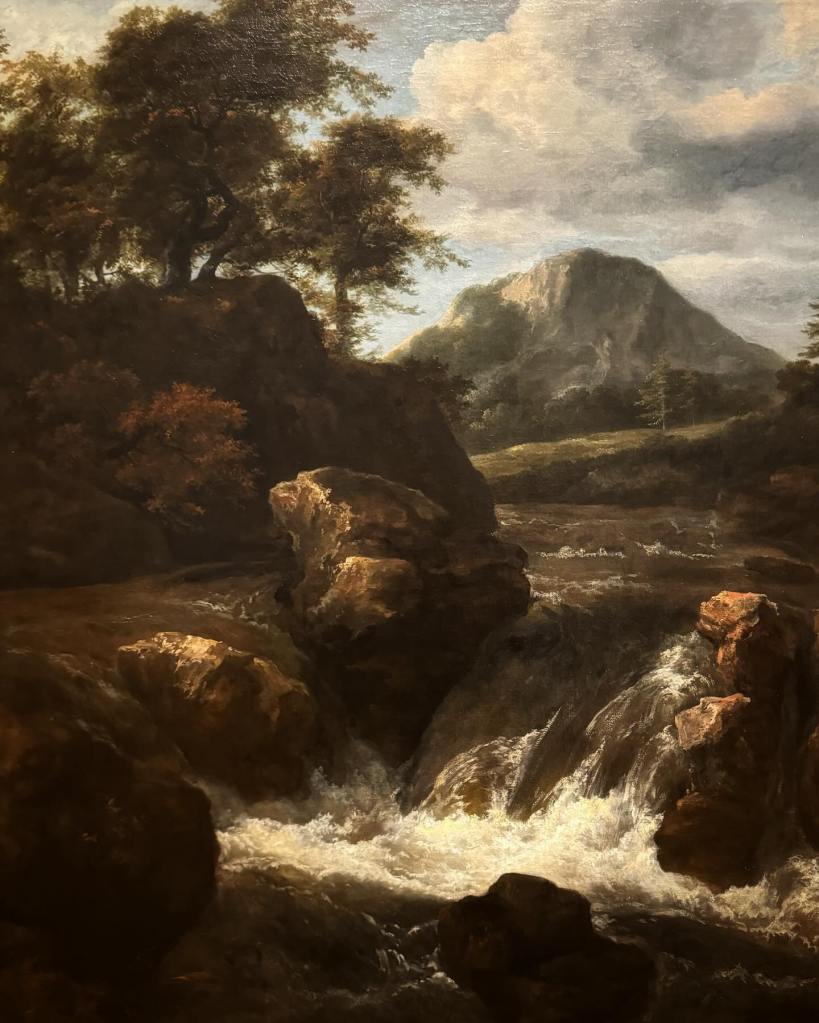
Jacob Isaacksz. van Ruisdael (1628/1629–1682), A Waterfall, 1670–79, Oil on canvas, 98.5 x 83.4 cm, Dulwich Picture Gallery, London
During the Dutch Golden Age, Jacob van Ruisdael played a key role in popularising the Scandinavian landscape theme, a distinctive sub-genre in landscape painting. This work showcases dramatic scenes of mountains, cascading waterfalls, and forests growing on the rocks. Interestingly, Ruisdael never travelled to Scandinavia himself. His native Netherlands is predominantly flat, with only a few low hills along the German border, so such landscapes were far removed from his everyday surroundings.
Ruisdael’s inspiration for Scandinavian scenery came from travel accounts, sketches, and the work of other artists who had journeyed north. Among these influences was Allart van Everdingen (1621–1675), who visited Norway and Sweden in the 1640s. Van Everdingen returned with sketches and descriptions of the landscapes he had encountered, which he incorporated into his paintings and which soon gained popularity in the Netherlands. These depictions ignited Ruisdael’s imagination, leading him to create his own interpretations of Nordic landscapes—often entirely imaginary yet powerfully evocative. Through his work, Ruisdael introduced audiences to a sublime northern wilderness, a vision that resonated deeply and continued to influence landscape painting long after his time.