The architectural ensemble of Piazza San Matteo in Genoa marks the centre of the Doria family’s influence over the city. It reflects the particular structure of the Genoese Republic, where the authority of noble families outweighed that of the communal state. Unlike Florence and Venice—where power was consolidated through guilds or strong civic institutions—Genoa remained dominated by urbanised feudal dynasties.
The Doria quarter, centred on Piazza San Matteo, brings together palazzi from the 13th to the 16th centuries and a family chapel, preserving a sequence of styles from medieval Genoese building to Renaissance forms.
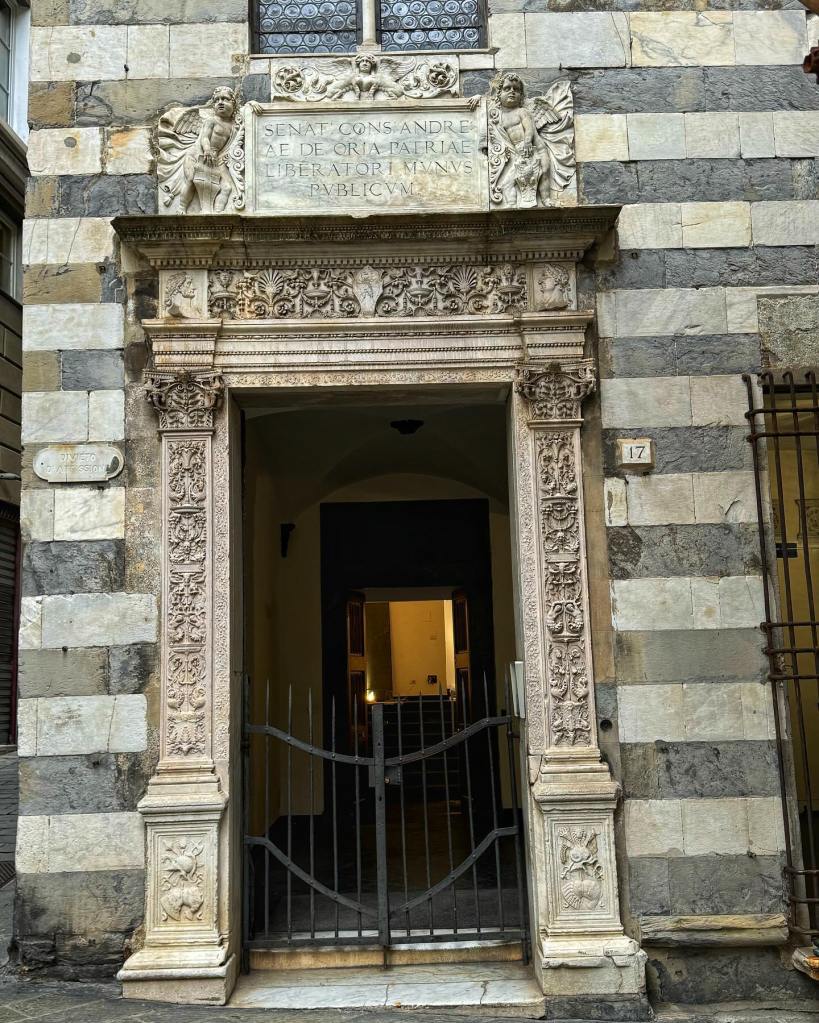
The palace dedicated to Andrea Doria (1466–1560), completed in 1528, represents the transition between medieval traditions and Renaissance style. It was presented by the Senate to honour Andrea Doria’s role in freeing the city from French control. The portal, attributed to Niccolò da Corte (active c. 1530–1552) or his workshop, is built in the black-and-white marble characteristic of Genoese Gothic and decorated with high-relief motifs—mermaids, monstrous fish, peacocks, gryphons, and lion heads—symbols of Doria’s maritime standing. Above, an inscription reads: SENAT: CONS: ANDREA DE ORIA PATRIAE LIBERATORI MVNVS PVBLICV. The frieze combines Renaissance ornament with Gothic elements, such as floral tendrils, birds, and dolphins, motifs deeply rooted in Genoese iconography.
Other structures on the piazza reinforce the dynasty’s presence. The Loggia degli Abati (early 14th century), donated by Guglielmo Doria (died 1311), became the seat of doge elections. The Palazzo Branca Doria (late 13th century) preserves the memory of Branca Doria (1225–after 1295), whose notoriety was immortalised by Dante Alighieri (1265–1321) in the Inferno. The Palazzo Lamba Doria (13th century) commemorates the naval victory of Lamba Doria (1245–1323) over Venice. The so-called Domenicaccio Doria Palace (14th century), with its distinctive two-tone marble, reflects Genoese Gothic design and adds further architectural variety to the square.
Taken together, these buildings form a carefully articulated programme of dynastic authority. Their stylistic range, from medieval Gothic to Renaissance, mirrors the family’s endurance across centuries, while their inscriptions, symbols, and siting within the heart of the city proclaimed Doria dominance in both civic life and artistic patronage. Unlike Florence, where Medici power was anchored in civic institutions and monumental projects linked to the republic, or Venice, where architecture expressed the sovereignty of the state over individual families, Genoa displayed its political order through the architectural presence of ruling dynasties. Piazza San Matteo thus functioned as a dynastic manifesto in stone, embedding the Doria’s supremacy within the urban fabric and making their family power inseparable from the city’s architectural identity.