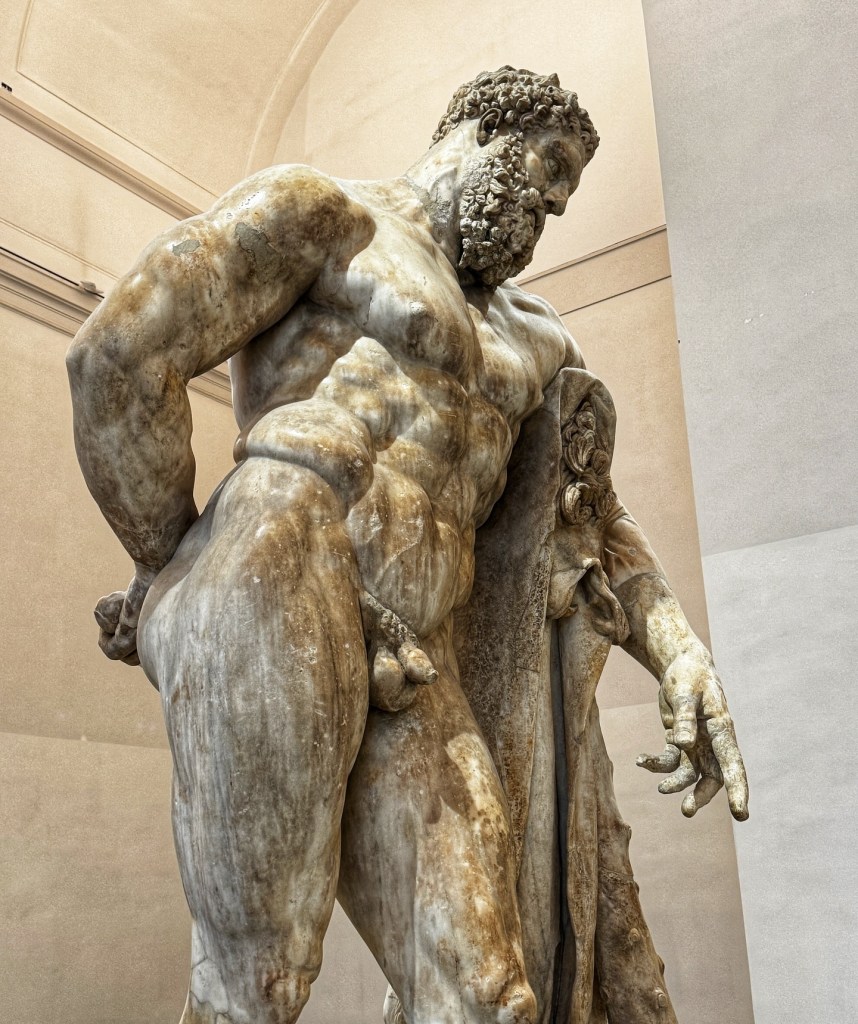
Glycon the Athenian (before 200 AD-c. 250 AD?), Farnese Hercules, c. 216 AD, after the original by Lysippus (fl. ca. 370 BC- ca. 300 BC), Marble sculpture, 317 cm, Museo Archeologico Nazionale, Naples

‘Farnese Hercules’ is one of antiquity’s most celebrated sculptures, renowned for depicting Hercules’ immense strength. It was commissioned for the Baths of Caracalla in Rome and created by the sculptor Glykon as an enlarged marble copy of a Greek bronze original by Lysippos, dating to the late 4th century BC. The statue’s base bears a Greek inscription attributing the work to Glykon, who was described as an Athenian sculptor. Built on Lysippos’ legacy, a leading artist of Classical Greece, he was famed for creating sculptures that emphasised human emotion, dynamic forms, and the heroic ideal—qualities reflected in many later copies.
Discovered in 1546 during excavations of the Baths of Caracalla, the sculpture became a prized treasure and was acquired by Cardinal Alessandro Farnese for his collection.
Hercules embodies strength and weariness by leaning on his club, draped with the skin of the Nemean Lion from his first labour. Behind his back, he holds the golden apples of the Hesperides, symbolising the culmination of his heroic journey. The exaggerated muscularity reflects the Hellenistic aesthetic of idealised male anatomy and divine strength, while his tired posture conveys vulnerability and humanises the hero.
The marble carving demonstrates meticulous detail, particularly in the anatomical precision of muscles, veins, and skin textures. Standing over three metres tall, the statue’s monumental proportions heighten Hercules’ superhuman qualities.
This marble copy has inspired countless other European copies and adaptations, especially during the Renaissance and Baroque periods, when it symbolised strength, endurance, and the heroic spirit. It also influenced painting, drawing, and anatomical studies, becoming central to academic art training and cementing its status as a definitive heroic nude.