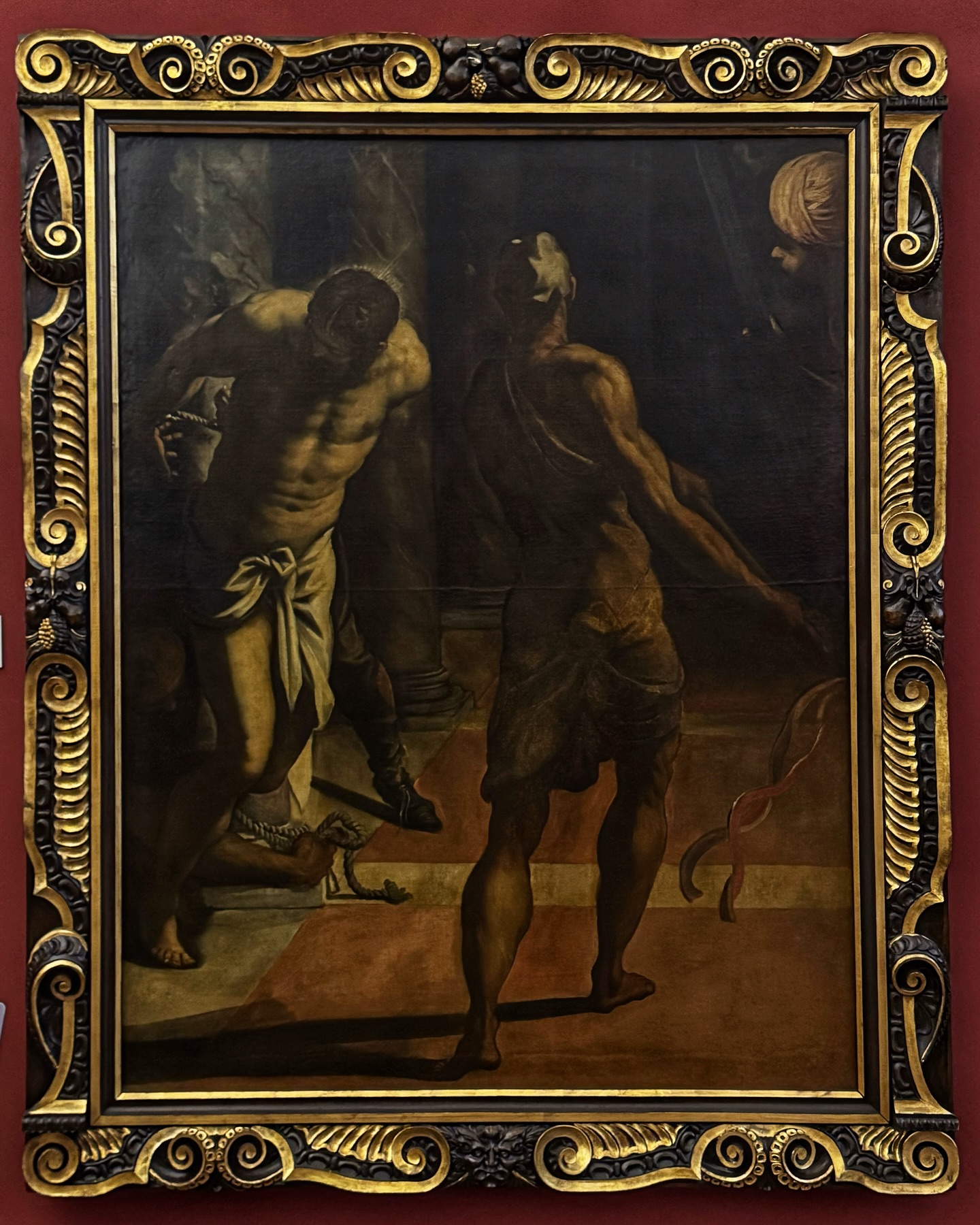
Jacopo Robusti called Jacopo Tintoretto (1518-1594), The Flagellation of Christ, 1555, Oil on canvas, 162.3 × 126.4cn, the Prague Picture Gallery

When Tintoretto painted The Flagellation of Christ around 1555, he was in his late thirties, an ambitious, fiercely imaginative artist asserting his place in a Venetian art scene still dominated by the ageing yet immensely powerful Titian.
While Titian was revered for his sensuality, chromatic mastery and aristocratic subtlety, Tintoretto approached painting with a raw, kinetic energy that shocked and enthralled. His aim was not to comfort the viewer but to immerse them. Here, this is achieved through his signature visual strategies: sudden foreshortenings, deep recessional space and a dramatic interplay of torchlight and shadow. These methods, experimental and emotionally charged, were foundational to the emergence of the Baroque half a century later.
In the painting, Christ is bound within a vast architectural void, likely intended to recall the cold grandeur of Venice’s Scuole Grandi, where religious ritual met civic display. The depth of the setting is established by receding marble columns and enveloping shadow, with a single torch lighting the pale, exposed body of Christ. His sculptural stillness — poised, silent, resolute — becomes the emotional anchor of the composition. Around him, flagellants erupt into motion, their violence framed by the chiaroscuro that defines the psychological weight of the scene.
And yet, this painting is only a fragment. It has been severely mutilated over centuries: two figures on the left and part of the upper structure were cut away, transforming it into its current format. With these cuts, Tintoretto’s full architectural vision, his spatial drama and compositional symmetry were largely destroyed. What survives is a compressed, yet still electrifying, remnant.
Despite this loss, the painting still delivers Tintoretto’s original intent. It remains not only a scene of biblical violence, but a meditation on divine suffering and human cruelty, rendered in a language of light, architecture and movement that would echo across Europe for centuries to come.