Traditionally attributed to Marcus Gheeraerts the Younger (1561–after 1636), Rainbow Portrait of Elizabeth I, Oil on canvas, 128 x 101 cm, Hatfield House, Hertfordshire
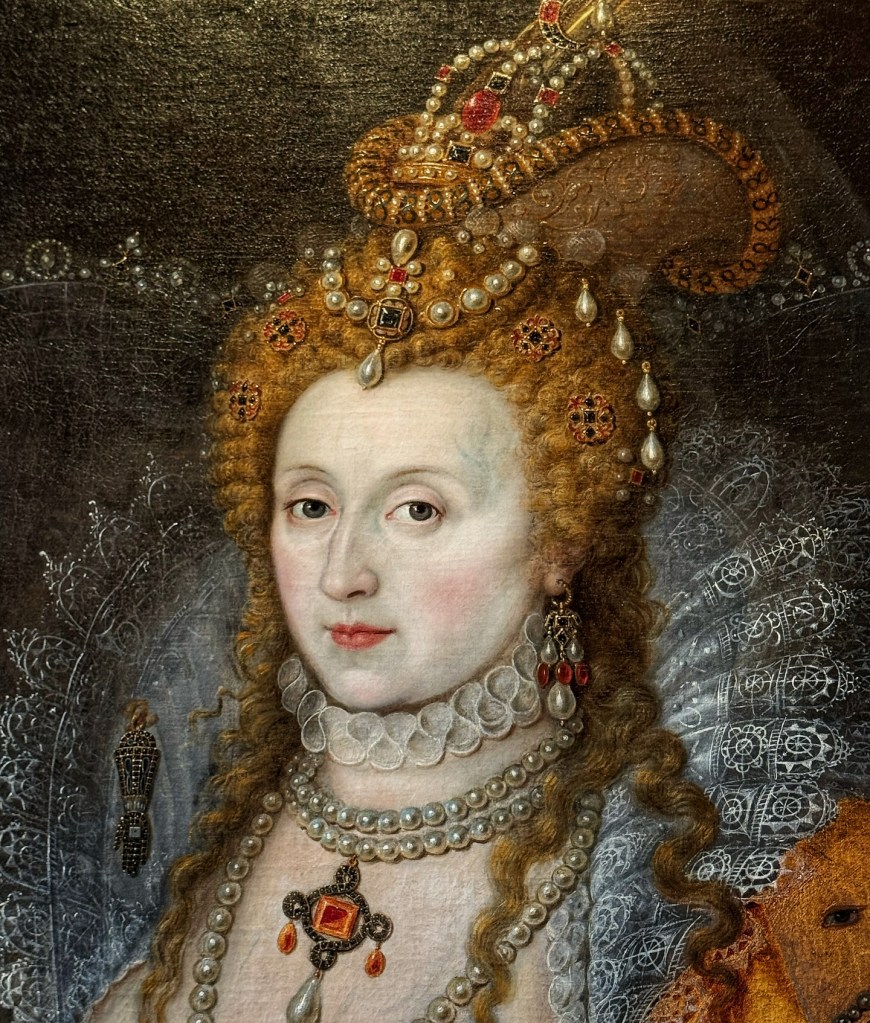

This masterpiece was probably commissioned by Sir Robert Cecil (1563–1612), one of Elizabeth I’s most powerful ministers in her final years and a central organiser of her later intelligence operations. For centuries it hung at Hatfield House, the Cecil family seat, which Robert Cecil built between 1607 and 1611 after exchanging his former residence at Theobalds with James I. The portrait is generally dated to around 1600–1602, placing it at the very close of Elizabeth’s reign and lending the image a quality of deliberate, almost valedictory, political statement.
The face shows evidence of pattern transfer — most likely by means of a stencil or pounced cartoon — a technique typical of elite portrait production in late Elizabethan England, where the standardisation of the royal image across multiple versions was as much a matter of political control as of studio practice. The result is the so-called ‘mask of youth’: a smooth, ageless countenance that bears no relation to the aged reality of a queen who was in her late sixties when the portrait was made. While traditionally attributed to Marcus Gheeraerts the Younger — who had trained in the Low Countries before arriving in England as a Protestant refugee from Bruges and who later became the dominant court portraitist of his generation — alternative attributions have included Isaac Oliver (c.1565–1617), John de Critz (c.1551–1642), and Robert Peake the Elder (c.1551–1619). The attribution to Gheeraerts is complicated by his family connections to the de Critz workshop, having married the sister of John de Critz, which makes the attribution landscape here unusually entangled. Oliver, primarily known as a miniaturist, and Peake, who held the office of Sergeant Painter, represent equally plausible candidates given the collaborative and somewhat fluid nature of royal studio production at the time.
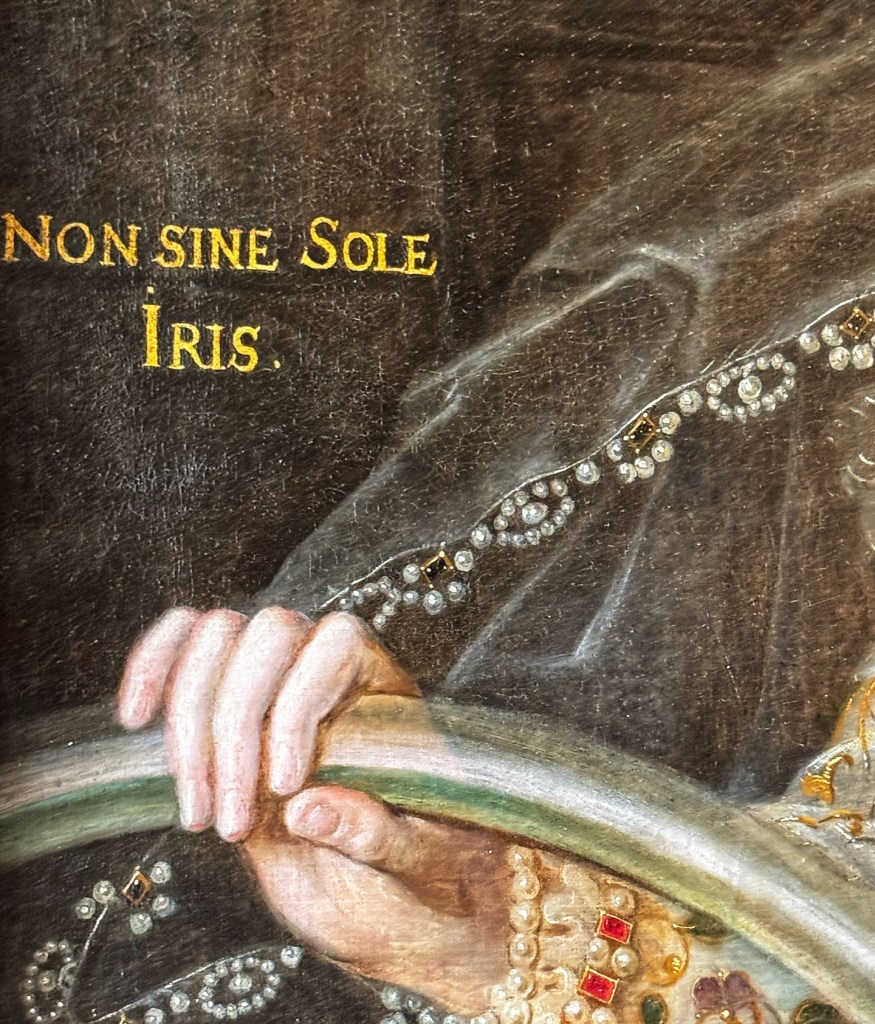
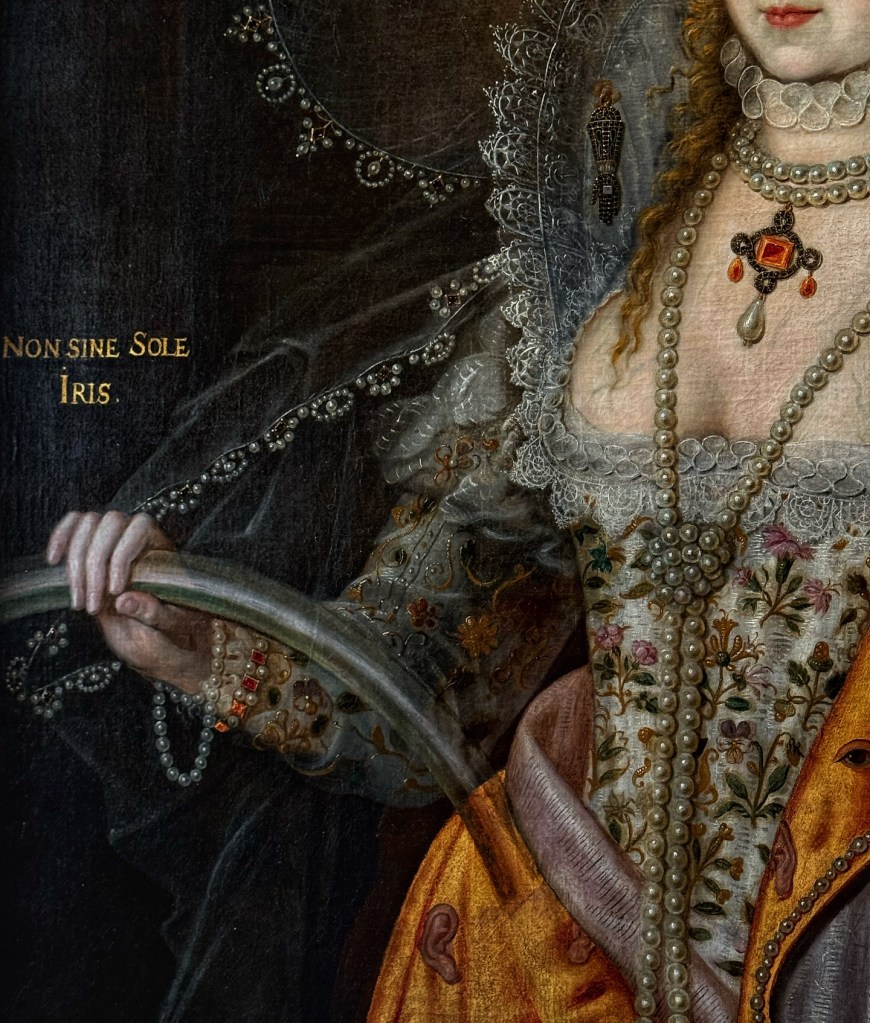
Elizabeth is shown holding a rainbow, a deliberate symbol of peace and harmony. The Latin inscription beside it, Non sine sole iris (‘No rainbow without the sun’), proclaims that peace — the rainbow — can only exist under her authority, figured here as the sun. The emblem-and-motto pairing was familiar from contemporary emblem books, including Geoffrey Whitney’s A Choice of Emblemes (1586) and the influential Latin collections of Andrea Alciato, ensuring that the intended meaning would be instantly understood by informed viewers. The rainbow itself, in the classical tradition associated with Iris, the divine messenger between heaven and earth, adds a further theological resonance: the queen as cosmic intermediary, dispensing harmony from above.
Her gown is lavishly embroidered with eyes and ears — an image of monarchical omniscience that alludes to the Queen’s vigilance and the reach of her intelligence network. This system, first developed under Sir Francis Walsingham and later expanded by Robert Cecil, was capable of infiltrating Catholic conspiracies, intercepting ciphered correspondence, and uncovering assassination plots. Walsingham’s network exposed the Babington Plot in 1586, which led directly to the execution of Mary, Queen of Scots, while Cecil’s operations in the 1590s and early 1600s maintained the same rigorous surveillance, securing Elizabeth’s authority until the end of her reign. The embroidered motifs therefore function not merely as decorative ornament but as a kind of wearable political manifesto: the queen clothes herself in the instruments of her own power.
The serpent on her sleeve symbolises wisdom and prudence, themes well established in Renaissance Neoplatonic and emblematic imagery, where the motif also carried moral and political associations. Notably, the serpent appears to hold a heart-shaped ruby in its mouth, a detail that sharpens the allegory considerably: reason — embodied by the serpent — governs passion, figured by the heart. The elaborate fan behind her head, possibly of lace or set with jewels, serves a visual function akin to a radiant halo, reinforcing her image as a solar monarch in line with the broader Renaissance tradition of equating sovereign authority with the sun. Her headdress, meanwhile, incorporates a crescent-moon ornament, drawing on the parallel Elizabethan iconography of the queen as Cynthia or Diana — the chaste moon goddess — a persona cultivated with particular intensity by the poets of her court, among them Sir Walter Raleigh and Edmund Spenser. The coexistence of solar and lunar symbolism within a single portrait is characteristic of the studied polyvalence of Elizabethan royal imagery, in which no single meaning was ever permitted to exhaust the icon.
Jewels and pearls, distributed throughout the composition, allude to virginity and purity — qualities central to the quasi-religious cult of Elizabeth’s self-fashioning as the ‘Virgin Queen’. Pearls, long associated with the Virgin Mary as well as with chastity more broadly, appear in her headdress, her earrings, and across the surface of her gown, accumulating into something close to a devotional language of the body. Taken together, the portrait synthesises political theology, emblematic wit, and conspicuous magnificence into one of the most carefully constructed images of sovereign power that the Elizabethan age produced.


References
Frye, S. (1993) Elizabeth I: The Competition for Representation. Oxford: Oxford University Press
Hackett, H. (1995) Virgin Mother, Maiden Queen: Elizabeth I and the Cult of the Virgin Mary. Basingstoke: Macmillan