

More than 350 years have passed since the death of Rembrandt, yet few artists remain so vividly present in scholarly debate, in the quiet obsessions of connoisseurs, and in the private reveries of those who stand before his paintings and feel that strange, inward tremor. His legacy is not a fixed monument but a restless field of questions.
His career was a lifelong inquiry. He tested formulas, revised compositions, returned to motifs, corrected himself, contradicted himself. Each artwork feels like an argument conducted in paint. Each carries the trace of preparation and doubt, of experiment and self-evaluation. Only a handful of landscape paintings survive from his hand: with the reattribution of this panel in 2022, the accepted number rose to eight, a figure that conveys how rarely he turned to the genre and how deliberate each attempt must have been.
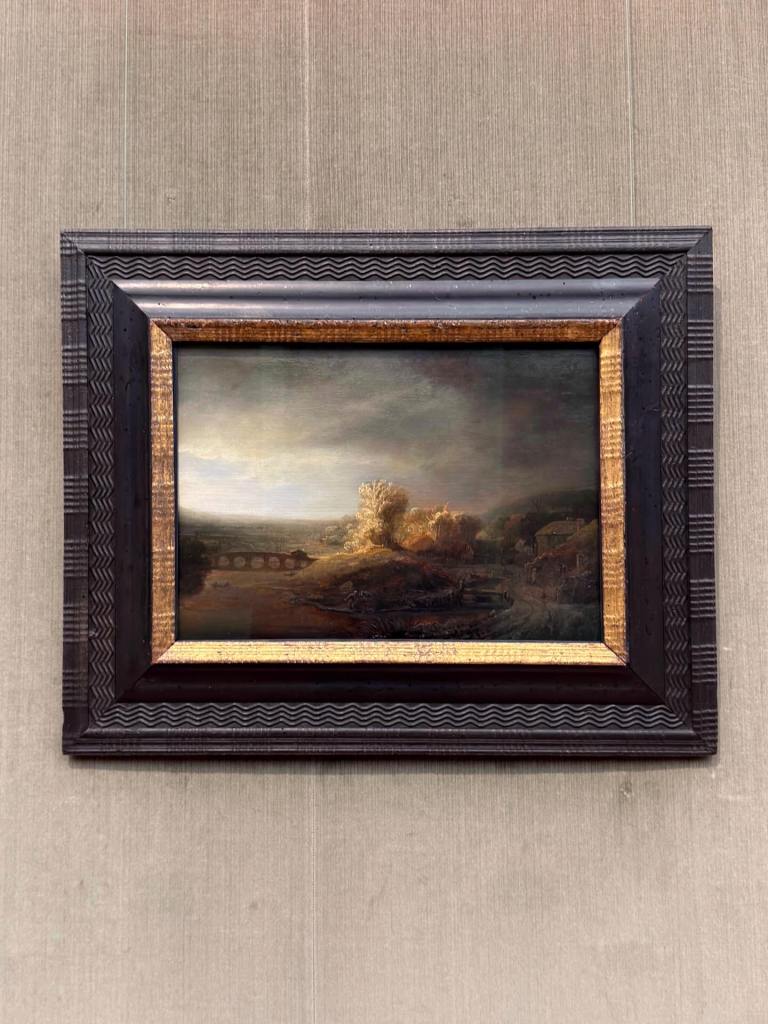
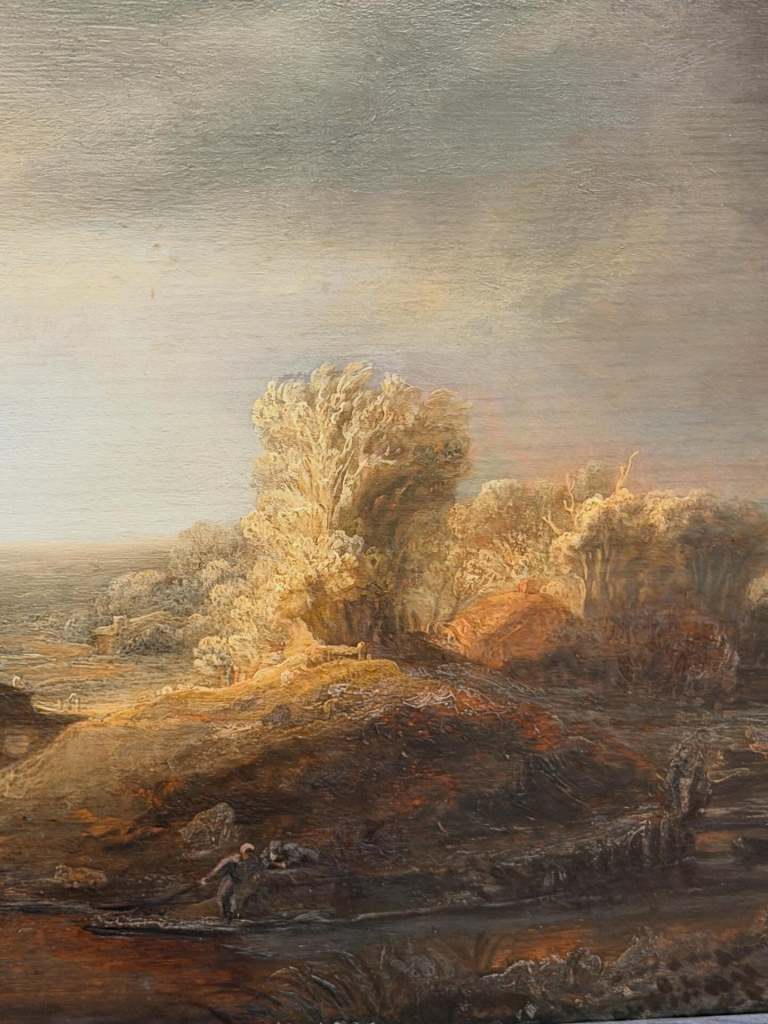
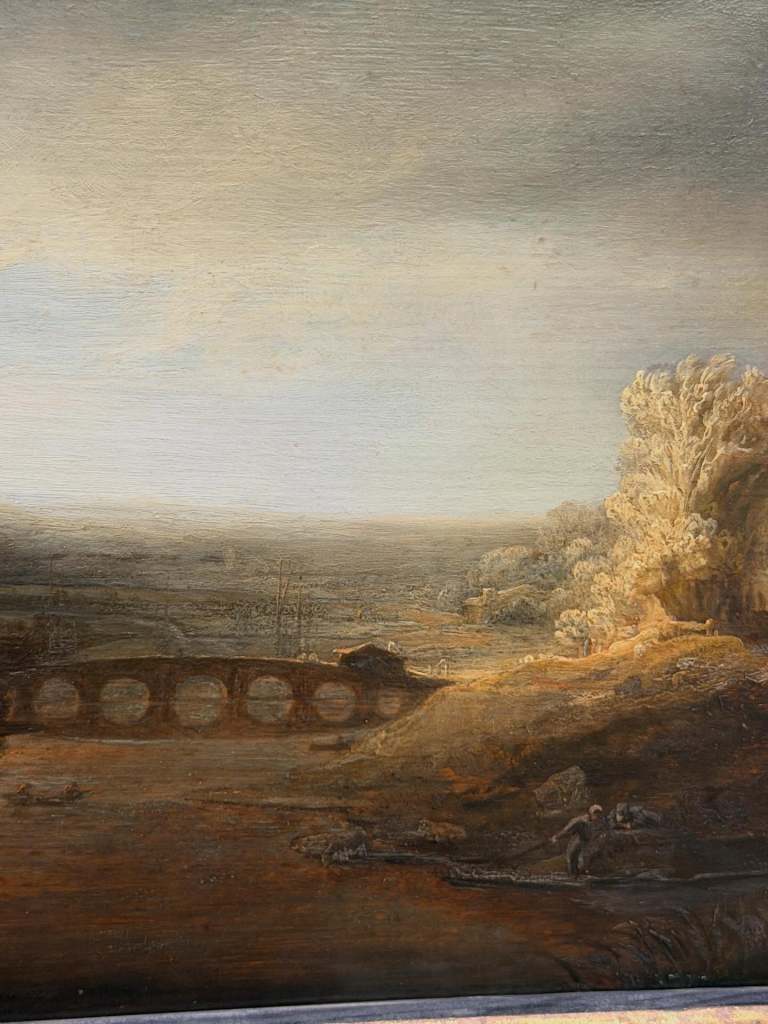
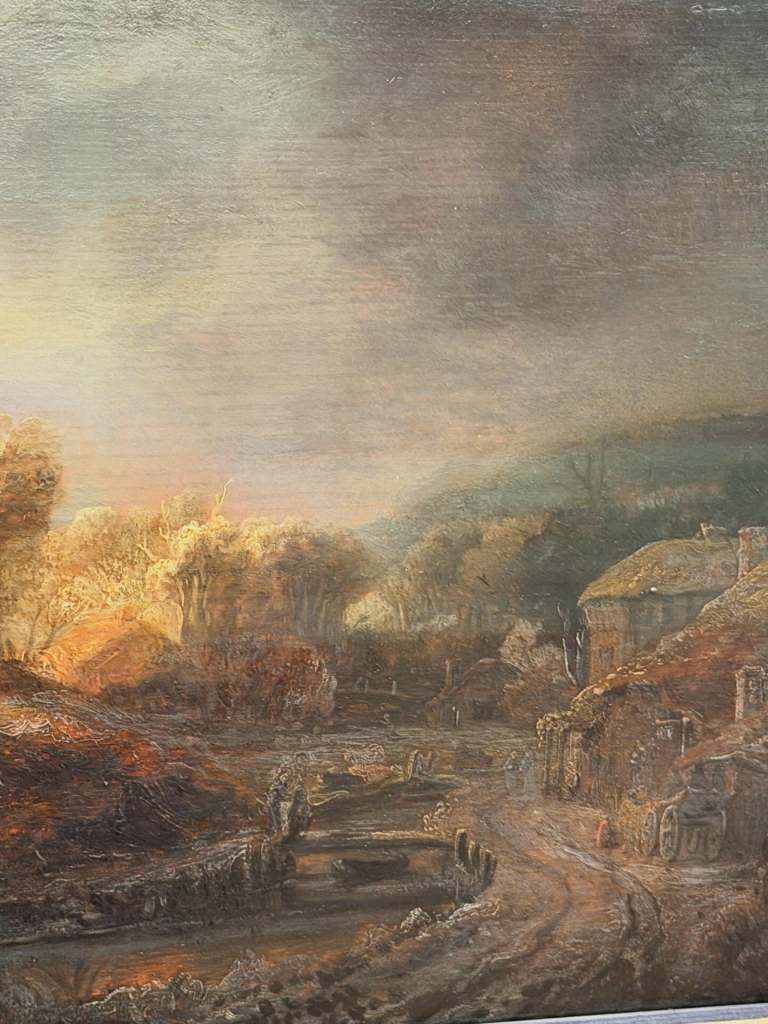
This small, melancholic landscape with a bridge was for more than thirty years thought to derive from the Rijksmuseum’s closely related Landscape with a Stone Bridge (c. 1638, oil on panel, 29.5 × 42.5 cm) and was accordingly attributed to his gifted pupil Govert Flinck (1615–1660). The painting had entered the Berlin collections in 1924 from the dispersed holdings of Grand Duke Friedrich August von Oldenburg (1852–1931), acquired through the dealers Paul Cassirer and Julius Böhler in exchange for three works from the museum’s own collection, since the Gemäldegalerie no longer had funds for outright purchase. For Wilhelm von Bode (1845–1929), then Director-General of the Royal Museums and one of the foremost Rembrandt scholars of his generation, the acquisition fulfilled a long-standing ambition: it closed a gap in Berlin’s landscape holdings and rounded out what was already one of the most important Rembrandt collections in the world.
The panel was accepted as autograph until 1989, when the Rembrandt Research Project, in the course of preparing the third volume of A Corpus of Rembrandt Paintings (published 1989), reassigned it to Flinck. The grounds were stylistic and thematic: the RRP pointed to what it called the ‘astonishingly far-reaching’ similarities between the Berlin picture and the Amsterdam Stone Bridge, and concluded that the former was a derivative work by a pupil.
Yet Rembrandt resists such tidy narratives. Recent research by the Gemäldegalerie’s scholars, drawing on neutron autoradiographic images made at the Helmholtz-Zentrum Berlin in 1995 and evaluated systematically for the first time, has established that the Berlin panel predates the Rijksmuseum painting long regarded as the prototype. Dendrochronological analysis of the oak support confirmed a later date of origin for the Amsterdam panel, and therefore the Berlin picture cannot be a later interpretation by Flinck. It is most likely the earliest treatment of this rare motif within Rembrandt’s oeuvre. The autoradiographs revealed extensive pentimenti: Rembrandt shifted the storm clouds from left to right, flattened the hill at the right edge, reduced the scale of the trees, and repainted passages thickly, working the composition into its final state through a process of sustained revision. The Amsterdam version, by contrast, shows far fewer alterations, its surface more resolved, its handling more translucent and precise. The chronology turns quietly, and what once seemed obvious dissolves.
Such reversals are not exceptions in the case of Rembrandt; they are almost the rule. Paintings once doubted return to him. Others once embraced drift away. Dates shift by decades. Surfaces reveal earlier intentions beneath later interventions. The scholar who approaches him with certainty often leaves with questions. In Rembrandt’s world, clarity and contradiction pretty much coexist.
References
Kleinert, K. and Laurenze-Landsberg, C. (2025) ‘Material Experimentation and Virtuoso Performance: Observations on the Painting Technique of Rembrandt’s Works in the Gemäldegalerie Berlin’, Art Matters: International Journal for Technical Art History, special issue no. 2: Rembrandt as a Painter. New Technical Research, pp. 69–79. Available at, https://www.researchgate.net/publication/394900751_Material_Experimentation_and_Virtuoso_Performance_Observations_on_the_Painting_Technique_of_Rembrandt’s_Works_in_the_Gemaldegalerie_Berlin ( Accessed 11 February 2026)
Bruyn, J., Haak, B., Levie, S.H., van Thiel, P.J.J. and van de Wetering, E. (1989) A Corpus of Rembrandt Paintings, vol. III: 1635–1642. Dordrecht, Boston and London: Martinus Nijhoff
Scallen, C.B. (2004) Rembrandt, Reputation, and the Practice of Connoisseurship. Amsterdam: Amsterdam University Press
Van de Wetering, E. (2014) A Corpus of Rembrandt Paintings, vol. VI: Rembrandt’s Paintings Revisited – A Complete Survey. Dordrecht: Springer
CODART (2022) ‘Berlin Painting Attributed to Rembrandt Instead of Govert Flinck’. Available at: https://www.codart.nl/art-works/berlin-painting-attributed-to-rembrandt-instead-of-govert-flinck/ (Accessed 10 February 2026)
RKD – Netherlands Institute for Art History (n.d.), Landscape with a seven arched bridge, c. 1638 RKDimages database entry no. 203522 (not updated) . Available at: https://rkd.nl/images/203522 (11 Febrauary 2026)