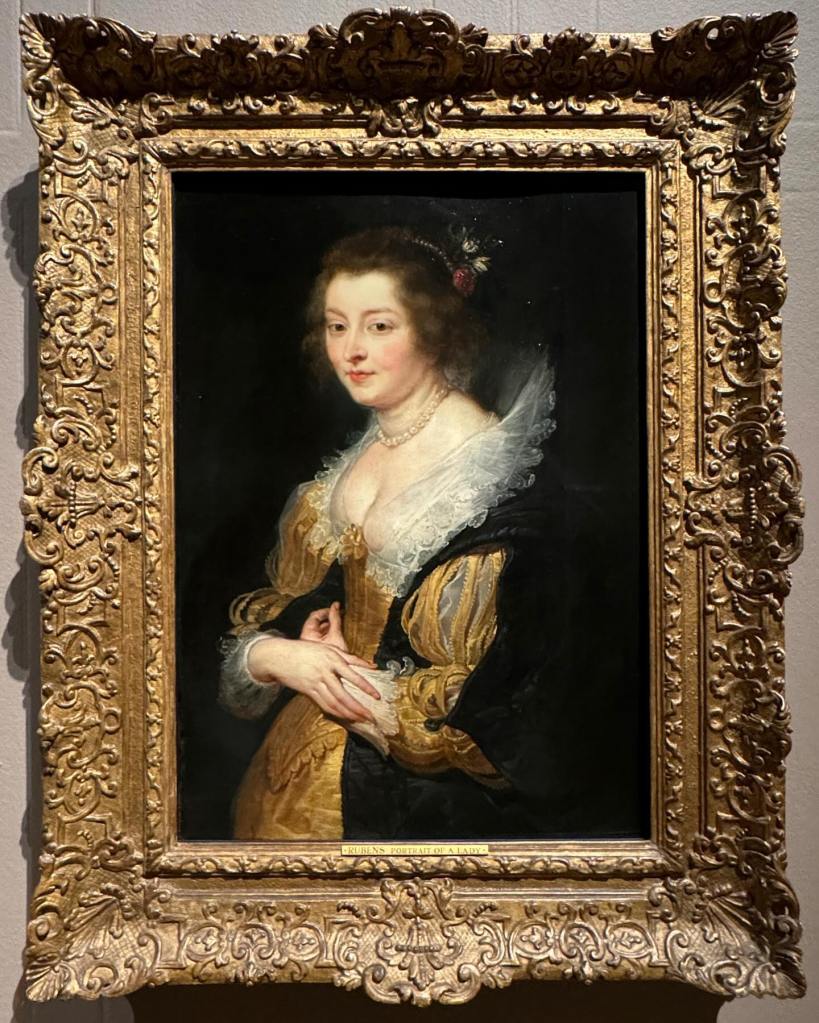
Peter Paul Rubens (1577-1640), Portrait of a Woman (Possibly portrait of Elizabeth Fourment), c. 1625-30, oil on panel, 86.8 x 59.3 cm, Royal Collection of King Charles III, on short-term loan to The Dulwich Gallery, London

In July 1630, writing to explain his second marriage, Rubens was unusually candid. He had chosen Hélène Fourment (1614–1673), the sixteen-year-old daughter of an Antwerp silk and tapestry merchant, partly because he feared what he called ‘pride, that inherent vice of the nobility, particularly in that sex.’ He wanted someone ‘who would not blush to see me take my brushes in my hand.’ The phrase carries a specific weight. The women of his household were also the subjects of his work, and how they looked, what they accepted, how they sat and were perceived, were questions he understood on entirely painterly terms that no patron could set for him. In that freedom lay something genuinely new in northern European portraiture.
The Flemish portrait tradition Rubens inherited was built around social distance. Anthonis Mor (c.1519–1577) and Frans Pourbus the Younger (1569–1622) had perfected a type in which the sitter presents herself: body angled slightly, gaze frontal, hands placed with deliberate care, costume declaring rank. Expression withholds feeling. It is a portrait language that serves hierarchy with perfect efficiency. Rubens used this language in his public commissions without abandoning it, and his grand formal portraits of Genoese noblewomen from the early 1600s work fully within it. What he introduced in his private work, beginning with his first wife Isabella Brant (1591–1626) and continuing with the Fourment circle through the 1620s and 1630s, was different in kind. The head inclines rather than faces squarely forward. The hands rest without performing. The gaze turns toward the viewer, but carries no social performance. The sitter has not arranged herself for the occasion; she has simply turned toward you. It is an almost theatrical informality, and it was entirely new.
The technical means through which Rubens achieved this were as important as the compositional ones. He built flesh tones on oak panels from a warm imprimatura through successive cool glazes, a method learned from Titian (c.1488–1576) whose female portraits and mythological paintings he had studied during his Italian years from 1600 to 1608 and again during his diplomatic stay in Madrid in 1628–29. The warm ground showing through cooler glazes gives the skin a luminosity that canvas and different methods would not produce. The black dress worn by the sitter in this panel, as by almost all of the Fourment women across the same decade, functions as a deliberate foil: it throws the warmth of the face and the light of the lace collar into heightened relief. The result is a portrait that reads as simultaneously more personal and more beautiful than the formal tradition it grows out of, and which, critically, made beautiful women of the Flemish merchant class look as warm and present as any Venus or goddess Rubens was painting at exactly the same time.
That last connection is not incidental. The largest public commission of this decade, the cycle of twenty-four paintings glorifying the life of Marie de’ Medici (1575–1642) delivered to the Luxembourg Palace between 1622 and 1625, surrounded the French queen mother with allegorical figures drawn from ancient mythology: gods, nymphs, the Three Graces, river personifications, all rendered with the same warm sensuous physicality as the private portraits of the household. The goddesses in the Medici cycle look like the Fourment women because they were painted in the same visual language, from the same internalised ideal of female beauty, in roughly the same years. What Rubens established in that vast public commission was that a living queen could inhabit a world of mythological sensuality without scandal, that the register of beautiful fantasy and warm physical presence he had developed in private was culturally legitimate at the highest level. His authority as diplomat, court painter, and the most celebrated artist in Europe made it acceptable; what was acceptable to Rubens became, without controversy, a new normal for everybody else. The static, distance-enforcing portrait of the earlier tradition had been replaced, at least as an aspiration, by something warmer, more intimate, and more fully alive to its own subject.
In Het Pelsken [The Little Fur Coat] (c.1636–38, Kunsthistorisches Museum, Vienna), Rubens pushed this to its furthest private extreme. Helena stands wrapped only in fur, painted with the same technique of luminous glazed flesh as the clothed portraits, but stripped of every social prop. Recent technical examination has revealed that Rubens initially included, and then overpainted, a fountain figure of a urinating boy drawn from antique Bacchic sources, which would have confirmed what the fur alone already suggests: that the portrait consciously invokes Venus, that Helena and the goddess were, in his mind and on his panel, the same figure. He specified in his will that she should have it as a personal gift, marking it as private. Yet the same fusion of living woman and beautiful ideal that makes Het Pelsken unrepeatable is present at a quieter register in all of the household portraits of this period, including this one.
If these were private works, why were they copied? The question has a straightforward answer and a more interesting one. Rubens’s studio produced copies of successful compositions as a matter of course, and a work retained in the studio did not remain permanently enclosed from the market. The copy recorded at the Musée d’arts de Nantes mentioned in the RKD entry (image no. 28430) for this panel confirms that the composition circulated beyond the family circle, as did variants and related works across multiple European collections. But the more important answer is that the compositions had become desirable in themselves. Collectors who wanted a Rubens portrait of a beautiful woman were not always asking for a specific likeness; they were asking for a type. The warmth, the ease, the luminosity, the quietly animated pose, these qualities had become a recognisable Rubens signature, and the women of his household circle were understood as its primary embodiment.
This is what earlier collections registered when they described this panel simply as a portrait of Helena Fourment: not necessarily a claim about the specific identity of the sitter, but a recognition that the painting belonged to a particular mode, a particular aesthetic of intimate female beauty, whose most famous embodiment was Rubens’s own wife. The Corpus Rubenianum (Part XIX.2, 1987) places the portrait among identified sitters, which means the identification as Elisabeth Fourment (c.1609–1667) was considered sufficiently grounded at publication. The 2023 Dulwich catalogue maintains the tentative identification while acknowledging the difficulty of distinguishing between sisters who shared colouring and bearing, and whose faces Rubens painted repeatedly without much anxiety about which was which. Elisabeth, if this is her, would have been between about sixteen and twenty-one during the likely date range of the portrait, and would have married Nicolas Pycqueri in October 1627. Whether the apparent age of the sitter squares with that is a question the painting does not settle.
What it does make clear, more plainly than any debate about identity, is where it sits in the development of European portraiture. The settled ease of the pose, the warmth of the flesh building up from the panel’s ground, the hands resting without ceremony, the face turned toward the viewer with an attention that registers as personal rather than performed: these are the marks of the most influential portrait manner of the seventeenth century, developed by Rubens in his own household and exported from there into the imagination of a continent.
References
Belkin, K.L. (1998) Rubens. London: Phaidon Press
Magurn, R.S. (ed.) (1955) The Letters of Peter Paul Rubens. Cambridge, MA: Harvard University Press
RKD – Netherlands Institute for Art History (n.d.) Rubens, Portrait of a Woman, c.1625–30. Records copy: Musée d’arts de Nantes (n.d.) [After Rubens?], Portrait of a Woman, inv. 434. Nantes: Musée d’arts de Nantes. RKDimages, image no. 28430. The Hague: RKD – Netherlands Institute for Art History. Available at: https://rkd.nl/en/explore/images/28430 (Accessed: 5 January 2024).
Royal Collection Trust (n.d.) Rubens, Portrait of a Woman (RCIN 400118). Available at: https://www.rct.uk/collection/400118/portrait-of-a-woman (Accessed: 5 January 2024).
Thuillier, J. and Foucart, J. (1969) Rubens’ Life of Marie de’ Medici. New York: Abrams
Van Beneden, B. and Orrock, A. (eds.) (2023) Rubens & Women. London: Paul Holberton Publishing in association with Dulwich Picture Gallery.
Van der Stighelen, K. (ed.) (2012) Rubens in Private: The Master Portrays His Family. Antwerp: Rubenshuis/Openbaar Kunstbezit in Vlaanderen
Van der Stighelen, K. and Vlieghe, H. (2021) Portraits of Unidentified and Newly Identified Sitters Painted in Antwerp. Corpus Rubenianum Ludwig Burchard, Part XIX, 3. London: Harvey Miller/Brepols.
Vlieghe, H. (1987) Portraits of Identified Sitters Painted in Antwerp. Corpus Rubenianum Ludwig Burchard, Part XIX, 2. London: Harvey Miller
White, C. (1987) Peter Paul Rubens: Man and Artist. New Haven and London: Yale University Press