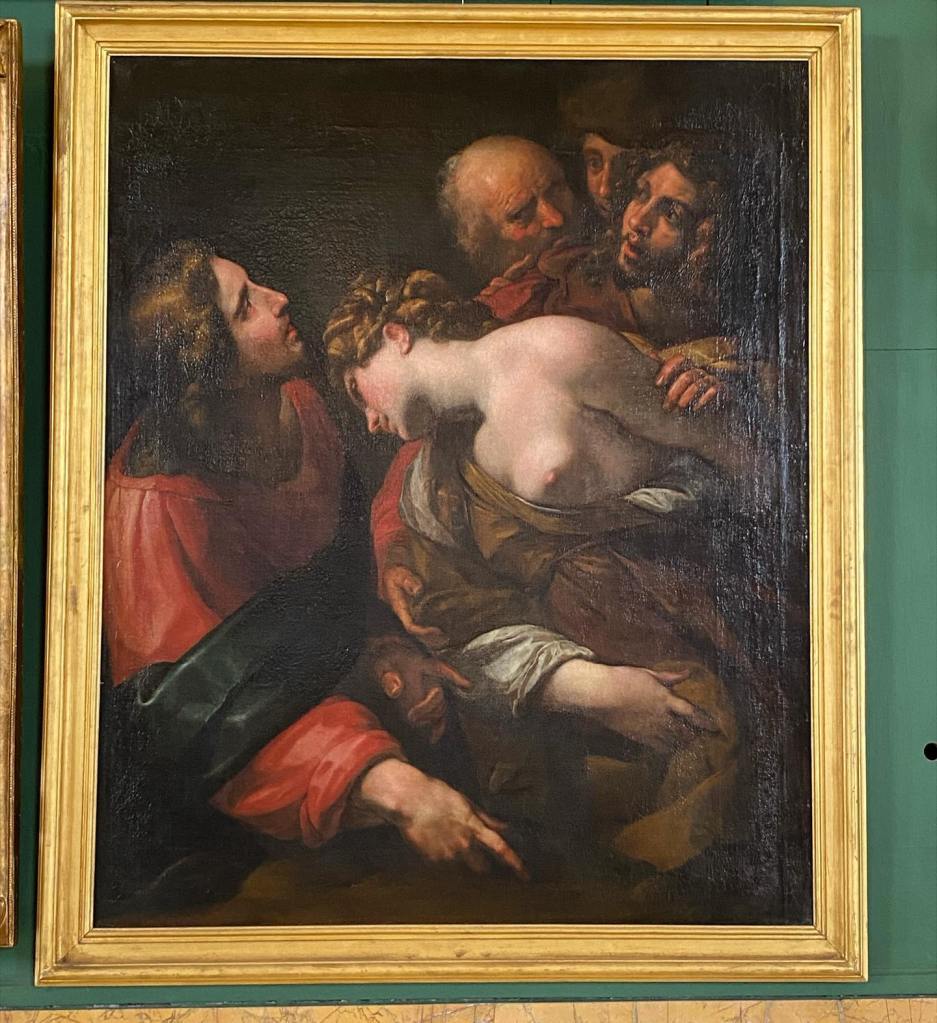
Giulio Cesare Procaccini (1574–1625), Jesus and the Woman Taken in Adultery (Pericope Adulterae), c.1620, Oil on canvas, Bildergalerie Sanssouci, Potsdam
Giulio Cesare Procaccini, originally trained as a sculptor in Bologna, became one of the most prominent painters active in Milan in the early seventeenth century. His style reflects both the refined sensuality of Correggio (1489–1534) and the dramatic force of Peter Paul Rubens (1577–1640), assimilated into a Lombard idiom responsive to the demands of the Counter-Reformation.
This painting belongs to his late period and illustrates the Pericope Adulterae (John 7:53–8:11), in which Christ, confronted with a woman accused of adultery, challenges the crowd with the words: ‘He that is without sin among you, let him first cast a stone at her.’ Procaccini stages the episode with a strong sense of immediacy: the accusers are grouped tightly around Christ, the gestures are sharply defined, and the contrast of shadow and light underscores the drama of the confrontation. The restrained palette of earthy tones heightens the sense of solemnity.
The work exemplifies the didactic clarity encouraged by Milanese reforming bishops, above all Carlo Borromeo (1538–1584) and his cousin Federico Borromeo (1564–1631), who sought an art capable of moving ordinary believers without obscuring its message. Procaccini’s figures, marked by dignity and compassion, embody this pastoral programme while also reflecting the broader current of Catholic Baroque painting, where clarity and emotional accessibility were essential.
In this context, Christ appears as the embodiment of merciful authority, while the accused woman represents the sinner’s redemption through forgiveness rather than condemnation. The painting thus fuses scriptural narrative with the theological imperatives of the Counter-Reformation, confirming Procaccini’s place at the forefront of Lombard sacred painting in the decades around 1620.