Antoon van Dyck (1599-1641), Head Study of a Man in a Ruff (Portrait of a Magistrate), Oil on canvas, 52.9 × 42.5 cm, c. 1634 Sotheby’s London, Old Master Paintings & Works on Paper Day Auction, 2 July 2026, Lot 334
Titian (c. 1488/90–1576) died in Venice in 1576, twenty-three years before van Dyck was born in Antwerp. The formation that shaped van Dyck’s practice as a portraitist was therefore retrospective. The sketchbook van Dyck kept across his Italian years, now in the British Museum, records the young artist’s obsession with Titian. What he was absorbing a compositional formula, but also a way of understanding what paint could do to the surface of a face: how warmth could be generated from within a picture rather than described on it, how form could accumulate through transparent layers rather than be fixed by line, how the appearance of presence in a portrait is not the same thing as the description of an appearance. That understanding had a technical consequence.
The Brussels magistrates’ head studies share an unusual ground preparation: a scumbled grey wash applied over a layer of red bole. This is not standard Flemish workshop practice. The red bole beneath the grey creates a warm undertone that is never entirely suppressed by the paint placed above it — inflecting flesh tones, holding the shadows from going cold, allowing the face to glow rather than sit inert on the surface. It is a Venetian solution to the problem of painting a face in a limited palette under time pressure,. The economy of means the ground makes possible is precisely what these rapid life studies required: a single sitting, a restricted palette, and the obligation to capture a man’s particular quality of attention before he left the studio.
Antoon van Dyck (1599-1641), Head Study of a Man in a Ruff (Portrait of a Magistrate), Oil on canvas, 52.9 × 42.5 cm, c. 1634 Sotheby’s London, Old Master Paintings & Works on Paper Day Auction, 2 July 2026, Lot 334Antoon van Dyck (1599-1641), Head Study of a Man in a Ruff (Portrait of a Magistrate), Oil on canvas, 52.9 × 42.5 cm, c. 1634 Sotheby’s London, Old Master Paintings & Works on Paper Day Auction, 2 July 2026, Lot 334
References
Alsteens, S. (2016) in Alsteens, S. and Eaker, A. (eds) Van Dyck: The Anatomy of Portraiture, exh. cat. New Haven and London: Yale University Press
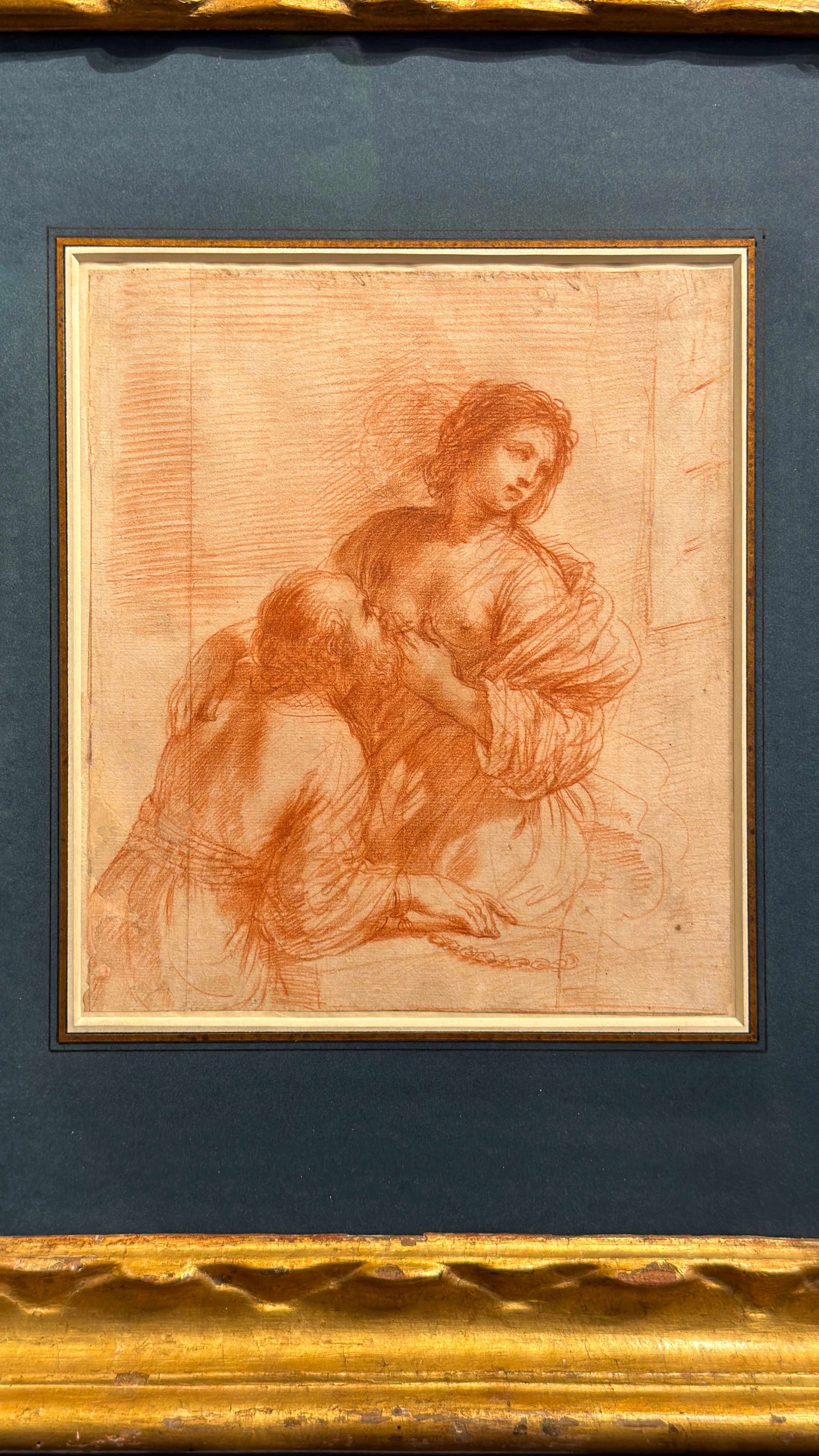
Guercino (1591–1666), Roman Charity, c. 1639, Red chalk on paper, 25.1 x 23.6 cm, Christie’s, London, 2 July 2026, Lot no. 55
Caritas Romana (Roman Charity) was one of the most repeated subjects in Baroque art and is today one of the least understood. Rubens painted it at least three times, and thousands of artists across Italy, France, Flanders, the Dutch Republic, and Spain returned to the same subject. It crossed every medium and every register of production — bronze, marble, maiolica, engraving, drawing — from confraternal altarpieces to pharmaceutical jars, palace ceilings to cabinet pictures, prints circulated well beyond the collecting class.
Pero feeds her imprisoned father Cimon from her breast, a story from Valerius Maximus (c. 49 BCE–c. 37 CE) held up as the most uncomfortable demonstration of pietas. For Counter-Reformation confraternities it carried doctrinal weight: Pero’s act compressed two corporal Works of Mercy — feeding the hungry and visiting the imprisoned — into a single scene, and the parallel with the Catholic Church as a nursing mother sustaining her flock needed no annotation for any trained viewer.
A theme absorbed so thoroughly into the visual fabric of Baroque culture stops being legible as a theme at all. It becomes simply the way certain ideas look, the way certain things take form, and the viewer who recognised this scene without consciously reaching for Valerius Maximus or the Works of Mercy was a trained viewer — trained by centuries of repetition into a fluency so thorough it required no effort and left no awareness of itself as fluency. That is how allegory functions when it is alive: not as a code to be broken but as a language spoken without thinking about grammar.
References
Shackleton Bailey, D.R. (ed. and trans.) (2000) Valerius Maximus: Memorable Doings and Sayings, 2 vols. Loeb Classical Library. Cambridge, MA: Harvard University Press
Wardle, D. (trans. and comm.) (1998) Valerius Maximus: Memorable Deeds and Sayings, Book 1. Oxford: Clarendon Press
Turner, N. and Plazzotta, C. (1991) Drawings by Guercino from British Collections. London/Rome: British Museum Press
Payne, E. (ed.) (2025) Guercino: Virtuoso Draftsman [exhibition catalogue]. New York: The Morgan Library & Museum
Freyhan, R. (1948) ‘The Evolution of the Caritas Figure in the Thirteenth and Fourteenth Century’, Journal of the Warburg and Courtauld Institutes, 11, pp. 68–86. Available at, https://www.jstor.org/stable/i230408 (Accessed 28 June 2026)
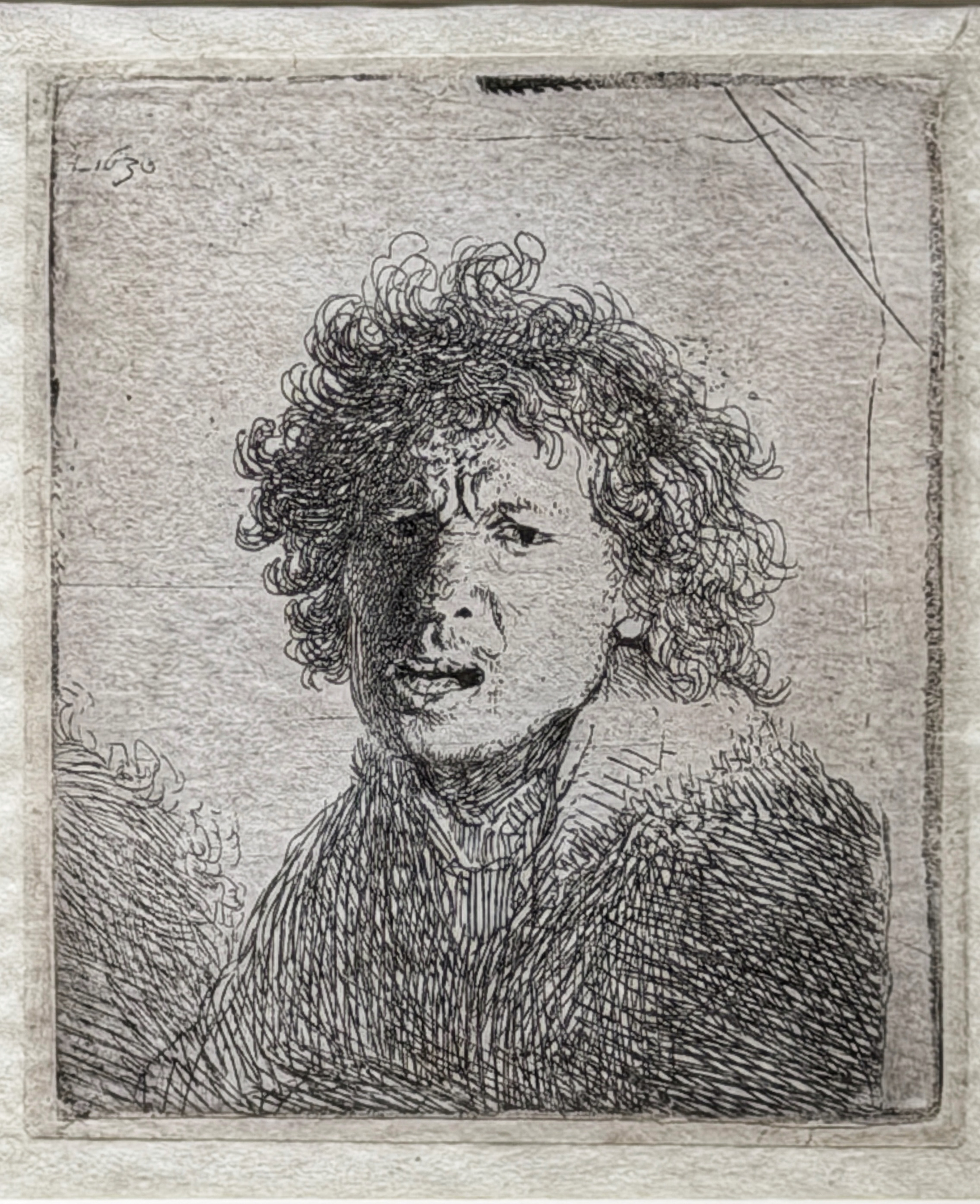
Rembrandt Harmenszoon van Rijn (1606-1669), Self-Portrait open mouthed, as if shouting: bust, Etching on laid paper: 7,0 × 5,9 cm, Signed in monogram and dated upper left: RHL 1630, Catalogued in Bartsch 13; The New Holstein 67, Second state (of III) , Douwes Fine Art, Amsterdam, Treasure House Fair , London
The tronie was an established genre long before Rembrandt, a head study built around a single emotional state or character type rather than the identity of any particular sitter. In Leiden, working alongside Jan Lievens (1607–1674), Rembrandt drew on the faces around him, family members, friends, neighbours, people from the street, as well as his own face studies, building a repertoire of human types across a range of emotional registers: surprise, grief, rage, laughter, suspicion, or, as in this sheet where the mouth falls open mid-shout and the features tighten around it, raw vocal urgency.
When Rembrandt used his own face within this practice the function was no different from any other available model, one more emotional state captured and held in reserve. Each sheet added another solved problem that could be recalled and repositioned when a history painting required a prophet crying out, a figure recoiling in fear, a crowd caught in the instant before it turns, an apostle overcome with grief, or a face registering the precise moment that doubt becomes certainty.
References
Dickey, S.S. (2019) ‘Printmaking in Leiden c. 1630: Rembrandt, Lievens, and Van Vliet’, in Coutré, J.N. (ed.) Leiden circa 1630: Rembrandt Emerges [Exhibition catalogue]. Kingston: Agnes Etherington Art Centre, Queen’s University
Gottwald, F. (2011) Das Tronie. Muster – Studie – Meisterwerk. Die Genese einer Gattung der Malerei vom 15. Jahrhundert bis zu Rembrandt [The tronie. Pattern, study and masterwork. The genesis of a genre of painting from the fifteenth century to Rembrandt]. Munich/Berlin: Deutscher Kunstverlag
Hirschfelder, D. (2008) Tronie und Porträt in der niederländischen Malerei des 17. Jahrhunderts [Tronie and portrait in seventeenth-century Netherlandish painting]. Berlin: Gebr. Mann Verlag
Van de Wetering, E. (2005a) A Corpus of Rembrandt Paintings, Volume IV: The Self-Portraits. Dordrecht: Springer
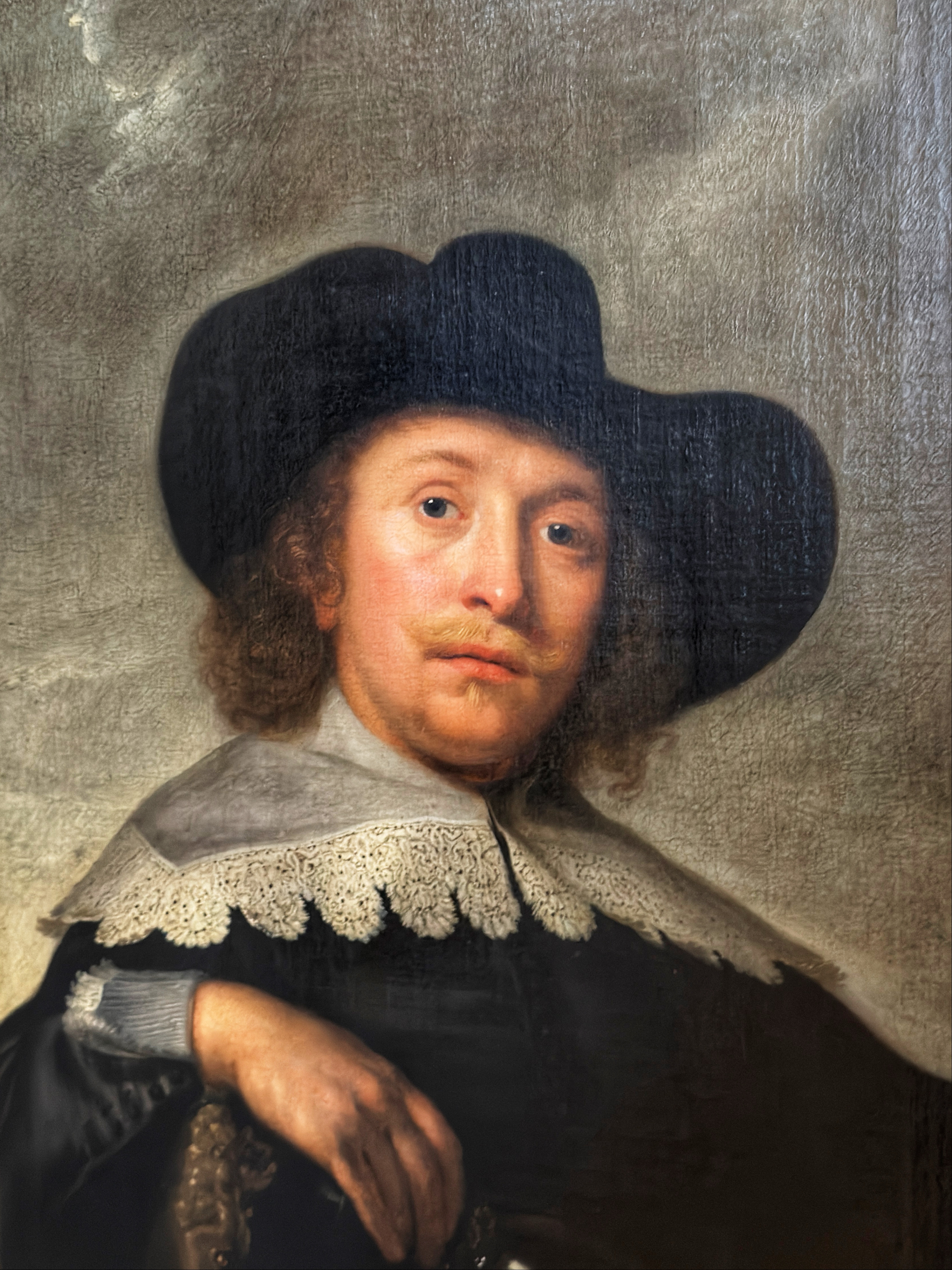
Bartholomeus van der Helst (Dutch, 1613–1670), Portrait of a Man with an Empty Wineglass, 1649, oil on canvas, 99 × 82 cm, Schwarzenberg Palace, Národní galerie Praha, Prague
It is easy to imagine the Amsterdam art market of the late 1640s as a ladder with Rembrandt at the top, but that is not quite how it worked. He had been one of the city’s most sought-after portraitists in the 1630s, so the impression of his pre-eminence rests on something real; it is only that the market was wider and more divided than any single reputation suggests. The historians who have studied Amsterdam’s surviving inventories describe a large and specialised trade in which painters tended to settle into a particular niche, and build a clientele within it (Bok, 1994). Competition at the upper end, where the larger commissions and the portraits of well-to-do sitters were decided, was real but involved a relatively small group of well established names. Van der Helst belonged to that group, and his work of these years is best understood in relation to it rather than against Rembrandt alone. Part of what set him apart was a kind of elegance that did not originate in Amsterdam at all.
By 1649 Rembrandt (1606-1669) was in any case taking on little portrait work. That October he appeared before the Amsterdam Commissioners of Marital Affairs to answer a breach-of-promise claim from Geertje Dircx (c. 1610-1656), who had nursed his son and shared his household after after his wife Saskia’s death. The case has sometimes been read as the scandal that drove away his clients, but there is little to support that. Patrons continued to commission him in the following years, among them Jan Six and the city government, which is hard to reconcile with a damaged reputation (Crenshaw, 2006). The more likely explanation is simply that his interests had shifted. He had painted few commissioned single or group portraits since the militia piece now known as the Night Watch of 1642, and the prevailing view, which ranked history painting above portraiture, fitted his own preference for the former (Turner, 2000). The opening this left in the portrait market was genuine, but it owed more to his choices than to any loss of standing.
Into it stepped a younger man who wanted precisely the work Rembrandt was setting aside. Bartholomeus van der Helst (1613-1670) had reached the front rank of Amsterdam portraiture by the late 1640s, a position put beyond doubt when the crossbowmen’s civic guard chose him to record their banquet for the Peace of Münster, held on 18 June 1648 (van Gent, 2011). The treaty that ended eighty years of war for independence had been signed that January, and the large group portrait van der Helst made from the banquet, now in the Rijksmuseum, remains the image through which that civic moment is usually remembered. This Prague portrait followed in 1649.
Taste in these years was moving away from Rembrandt’s manner, and several painters were moving with it. Jacob Backer (1608-1651) had trained alongside Govert Flinck (1615-1660) under Lambert Jacobsz in Leeuwarden before both men, together with Ferdinand Bol (1616-1680), worked in Rembrandt’s circle at Hendrick van Uylenburgh’s studio. By the later 1640s all three were lightening their palettes and clarifying their surfaces, winning commissions that an earlier decade might have sent to their teacher Rembrandt. Van der Helst’s response to the same competition was a manner contemporaries and later cataloguers found more elegant and more immediately flattering than its Amsterdam rivals, and its source was most probably Flemish. The example was Antoon van Dyck (1599- 1641), whose way of arranging a sitter had become, in the years after his death in 1641, something close to a common European language for portraying the wealthy (van Gent, 2011). The manner was Flemish in origin, but its appeal travelled well beyond Flanders. Van Dyck spent his last decade at the court of Charles I, and the easy aristocratic grace of his English portraits shaped how the wealthy expected to be painted for a generation afterwards, in England most of all (Hearn, 2009). The interesting part is the clientele to which van der Helst applied it: merchants, guardsmen and regents with no claim to old aristocratic rank, who wished all the same to be seen with the ease van Dyck had devised for those who had it.
The debt to van Dyck shows in the pose. The sitter leans on the gilt arm of a chair, his body turned three-quarters towards us, the wide black hat and loose shoulder-length curls framing a face that meets the viewer directly. The bearing is relaxed in a way the stiffer Amsterdam portrait of the 1630s rarely permitted, and instead of placing the figure against a wall, van der Helst sets him before a clouded sky broken by a single shaft of pale light at the upper left, an unusually informal setting for a sober Amsterdam likeness of these years (Ekkart and Buvelot, 2007). The dress is austere, unrelieved black relieved only by a broad linen collar edged in deep scalloped lace and a soft pleated cuff at the wrist. One hand rests on the chair. The other, lower in the canvas, curls loosely around a pale glass. The grace of the arrangement has a clear hint of van Dyck’s legacy; the gravity of the dress is Amsterdam’s own, and the meeting of the two is what this portrait formula is really about.
The glass invites reading, and there is a settled tradition for it. A held or emptied drinking glass in seventeenth-century Dutch painting carried associations of sociability and good company, and in still life and merry-company scenes an empty or overturned roemer could also strike a quieter note about how briefly such pleasures last. Van der Helst knew that language from the inside, having spent a decade composing the collective drinking of civic guard banquets, and the single glass in a single portrait brings a trace of that companionable warmth into a format that allows the sitter no company. Is the emptiness meant to carry the fuller weight of transience, or does it simply mark a pause in good company? It would probably be a mistake to force too much of a vanitas reading.
For all the borrowed Flemish polish of the pose, those heavy, striking eyes do something the elegant formula never asks for. They are the one part of the picture that seems to belong to the man rather than to the manner, the place where the practised arrangement of hat, collar and easy turn gives way to something the painter found rather than composed. Rembrandt would have gone looking for whatever sat behind them, pressing the face until it yielded a thought or a mood. Van der Helst plainly did not, and that is the curious thing, because the weight is there even so, surfacing without being sought. It is not melancholy; it is closer to the ordinary heaviness that settles into a face when the sitting runs long and the man stops performing for the painter. In a portrait built to flatter, it arrives almost by accident. Whatever it is, the sitter keeps it to himself, and stays just out of reach.
Bartholomeus van der Helst (Dutch, 1613–1670), Portrait of a Man with an Empty Wineglass, 1649, oil on canvas, 99 × 82 cm, Schwarzenberg Palace, Národní galerie Praha, PragueBartholomeus van der Helst (Dutch, 1613–1670), Portrait of a Man with an Empty Wineglass, 1649, oil on canvas, 99 × 82 cm, Schwarzenberg Palace, Národní galerie Praha, Prague
Crenshaw, P. (2006) Rembrandt’s Bankruptcy: The Artist, His Patrons, and the Art Market in Seventeenth-Century Netherlands. Cambridge: Cambridge University Press
Ekkart, R. and Buvelot, Q. (eds.) (2007) Dutch Portraits: The Age of Rembrandt and Frans Hals. The Hague: Royal Picture Gallery Mauritshuis / London: National Gallery
Hearn, K. (2009) Van Dyck and Britain. London: Tate Publishing
Middelkoop, N. (2019) Bartholomeus van der Helst (1613–1670): Portrait of the Golden Age. Rotterdam: Museum Boijmans Van Beuningen / Zwolle: WBOOKS
Montias, J.M. (2002) Art at Auction in 17th Century Amsterdam. Amsterdam: Amsterdam University Press
Ševčík, A.K. (ed.), Bartilla, S. and Seifertová, H. (2012) National Gallery in Prague: Dutch Paintings of the 17th and 18th Centuries. Prague: National Gallery in Prague
Sluijter, E.J. (2015) Rembrandt’s Rivals: History Painting in Amsterdam, 1630–1650. Amsterdam and Philadelphia: John Benjamins
Turner, J. (ed.) (2000) From Rembrandt to Vermeer: 17th-Century Dutch Artists. New York: St Martin’s Press
van Gent, J. (2011) Bartholomeus van der Helst (ca. 1613–1670): een studie naar zijn leven en werk [Bartholomeus van der Helst (ca. 1613–1670): A Study of His Life and Work]. Zwolle: Waanders
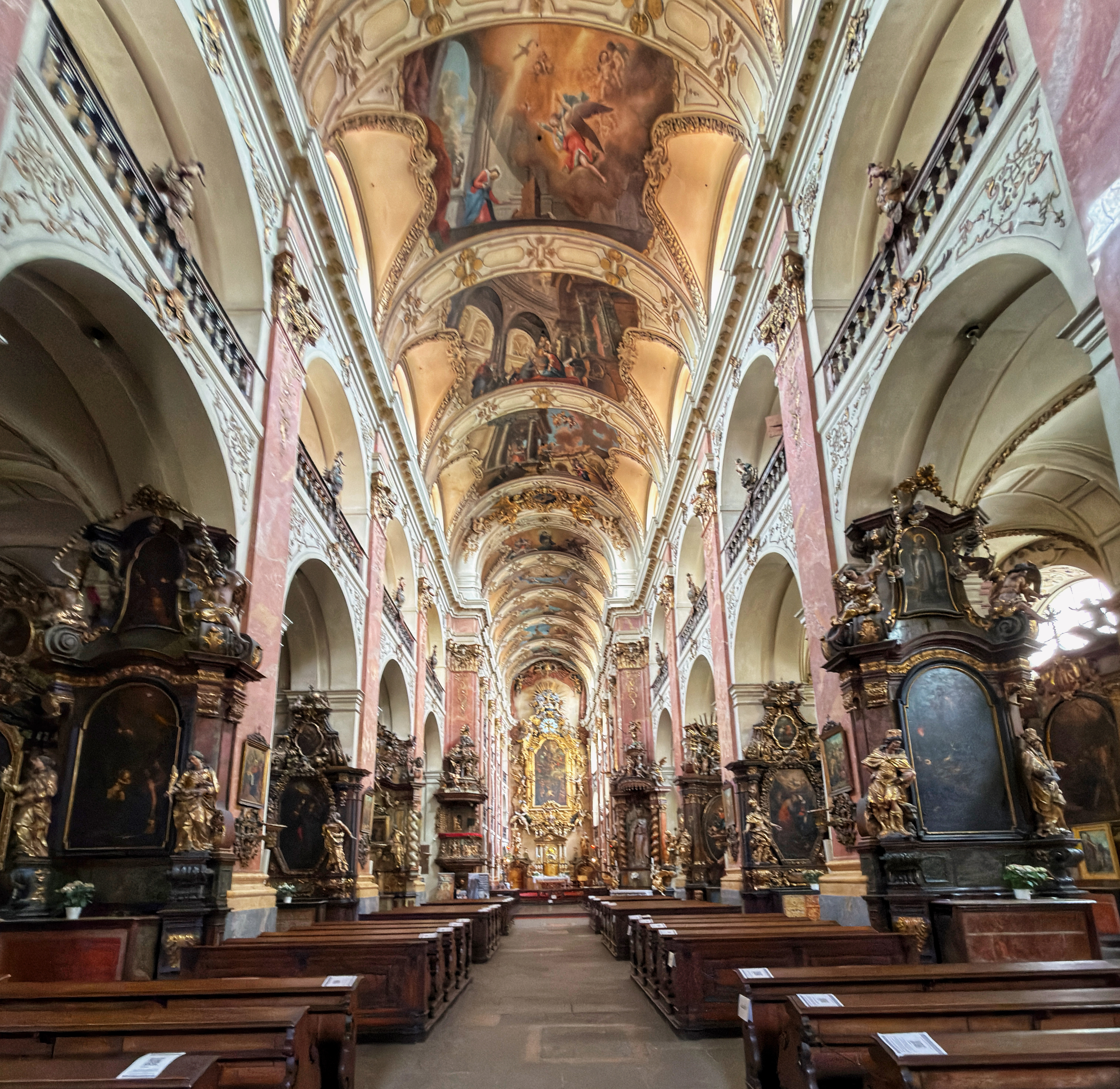
The Basilica of St James the Greater (Bazilika svatého Jakuba Většího), Prague
‘Baroque’ is rather an unstable term to use as a period name. Derived from barroco, Portuguese jewellers’ jargon for a misshapen pearl, it circulated for two centuries as a term of disparagement before Heinrich Wölfflin, in Renaissance und Barock (1888), reorganised it into a formal category defined by opposition to Renaissance proportion (Wellek, 1946). The reorganisation gave the term analytical purchase without resolving its ambiguity: applied across Europe as a category of style, it made its own inconsistencies more visible, since the same forms carried different histories and different political weights depending on where they landed.
‘Bohemian Baroque’ compounds that instability. As a period label it names the Catholic rebuilding campaign that reshaped churches, monasteries, and palaces acrossBohemia from the 1620s to the 1760s, and the chronology is the least disputed part; almost nobody quarrels with when this happened, only what it means. Whether what arrived from Rome and Vienna was adopted, adapted, or simply imposed is the question the style reading has been arguing for decades without settling. Nineteenth-century Czech nationalism bypassed the formal question and named the whole period as foreign darkness laid over a defeated land, turning the Baroque from a style into evidence of cultural dispossession, a verdict that outlasted the scholarship that eventually dismantled it. The most recent views is that imported form and local memory became so entangled in the actual practice of building that the two cannot be separated.
Prague preserves a large number of Gothic churches and monasteries recast in Bohemian Baroque form across the seventeenth and eighteenth centuries, the older structures settled within their new surfaces rather than erased by them, each carrying in its fabric the record of a transformation that was neither wholesale nor painless.Bazilika svatého Jakuba Většího (the Basilica of St James the Greater) in the Old Town is a particularly sharp case, and one with an unusually broad European reach. The clearest way to see what that means is to follow the building’s history rather than the term’s, starting with the fire that nearly destroyed it.
On the night of 21 June 1689 a blaze swept the Old Town and the Jewish quarter and destroyed several hundred houses, with the church among the worst affected (Vlček, 1996). Czech tradition calls it the francouzský požár (the French fire) and lays it at the door of arsonists working in the French interest during the Nine Years’ War of 1688 to 1697, when Louis XIV (r. 1643–1715) stood against the Grand Alliance led by the Emperor Leopold I (r. 1658–1705). The belief, unsubstantiated, took root at once and persisted for centuries, so that the rebuilding answered a fire and an accusation together.
The accusation drew its plausibility from a wider reputation. Louis XIV was the foremost architectural patron of his age, and the French Baroque he presided over was among the most ordered and classical versions, the manner of Versailles, the Louvre colonnade, and Les Invalides. The same reign carried out the most deliberate destruction of other cities’ architecture in the period. In 1684, during the War of the Reunions and with no formal declaration, a French fleet under Abraham Duquesne (c.1610–1688) bombarded Genoa for ten days, some fourteen thousand projectiles levelling roughly half the city, after which the Doge was made to travel to Versailles in 1685 and apologise in person, a humiliation the king had recorded in paint for the palace (Château de Versailles, 2018). In the winter of 1688 and 1689 the devastation of the Palatinate, planned as a deliberate policy of destruction within the cabinet strategy of Louis XIV, his war minister Louvois (1641–1691), and the strategist Chamlay (1650–1719), burned Heidelberg and more than twenty substantial towns, and the revulsion it provoked across the Empire helped consolidate the coalition it was meant to weaken (Cénat, 2005). In 1695, as a diversion from the siege of Namur, the artillery of Marshal Villeroi (1644–1730) destroyed a third of Brussels, the Grand-Place with it, in the most destructive single event of that city’s history. A reign that produced one of Europe’s most disciplined Baroques was at the same time erasing the urban fabric of its rivals, and it was that record, more than any evidence, which made Prague so willing to believe French agents had lit its fire.
The fire took a great deal. This Gothic church had been among the most ambitious in Prague. Founded in 1232 for the Conventual Franciscans, under Wenceslas I (r. 1230–1253), it was rebuilt as a long triple-naved basilica with an extended choir after the Old Town fire of 1291, the presbytery raised by the 1320s and the nave completed under Charles IV (r. 1346–1378), who saw it consecrated in 1374 by Archbishop Jan Očko of Vlašim (d. 1380). The building was also a recurring setting for royal ceremony. The coronation feast of John of Bohemia (r. 1310–1346) and Elisabeth of Bohemia (1292–1330) was held here in 1311, and the body of Charles IV lay in state beneath five hundred candles in December 1378 (Vlček, 1996). The fire destroyed a long sediment of dynastic and civic memory along with the stone that carried it, and the rebuilding would have to decide what to do with what was left.
The reason the church suffered worst was probably circumstantial. The building stood wrapped in scaffolding for repairs to its plaster, and the timber casing fed the flames and carried the fire into the body of the church. The frontal gable fell and the Gothic vault came down, and the interior was lost apart from three objects pulled clear: a Gothic Pietà, a painting of St Anthony, and a statue of the Suffering Christ (Vlček, 1996).
A surprising amount of the medieval church survived below the level of its furnishings. The eastern clock tower, the long choir, and the cross-vaulted Gothic sacristy remained, and the ground plan that still governs the interior is older than any surface laid over it (Vlček, 1996; Národní památkový ústav, n.d.). How much of this was kept by intention and how much by the plain economy of building on standing foundations is not clear, and the answer would change how the whole should be read.
The reconstruction began at the end of 1690 and was entrusted to Jan Šimon Pánek (also recorded as Pannetius, d. 1721), an architect of the New Town whose other work lay chiefly in fortification. The main fabric was finished by about 1702, with the decoration of the interior carried out between 1736 and 1739. Pánek kept the medieval disposition, though he shortened the choir to correct an axial deviation that Baroque symmetry could not tolerate, lowered the ceiling, and threw a barrel vault with lunettes across the nave, placing tribune galleries above the side aisles (Vlček, 1996). The exterior lost its Gothic character, but the interior kept the proportions of the older church, its unusual length most of all. Whether Pánek preserved the plan as a deliberate gesture of continuity or simply because rebuilding on the old foundations was the faster and cheaper course, the records do not say. More interesting is the observation that the rebuilt disposition has been read against the model of the main Jesuit church of Il Gesù in Rome, the type church of the Counter-Reformation, so that the same plan which conserves the medieval choir also leans toward a Roman confessional model, and continuity and a newer Catholic rhetoric inhabit the same walls. The dates of the rebuilding, 1690 to 1739, sit squarely inside the long Catholic century that gives ‘Bohemian Baroque’ its plainest meaning.
It is exactly this kind of rebuilding, a damaged Gothic church given a new, Rome-leaning skin by the same religious order that had occupied it for centuries, that nineteenth-century Czech nationalism would read as proof of its own case: the epoch after the defeat of the Bohemian estates at White Mountain in 1620 became, in that telling, the temno (the darkness), a period of foreign Catholic absolutism imposed on a subdued people. The temno reading has proved the most persistent of these, because it was built to be unforgettable. The image was fixed in the national imagination, for example, by Alois Jirásek (1851–1930), whose novel Temno [Darkness], serialised from 1913 and published in 1915, portrayed early eighteenth-century Bohemia under re-Catholicisation as spiritual and cultural suffocation; the book was extremely popular, went through several further editions, and partly influenced how generations understood this historical period (Jirásek, 1915; Vlnas, 2001). In that reading the Baroque was the visible instrument of oppression, and the native Gothic past its victim.
Part of what the temno image carried was true, and it should not be waved away. The Thirty Years’ War was a demographic catastrophe for the Bohemian lands, with heavy population loss, displacement, and the flight of the Protestant elites, and the first phase of re-Catholicisation after 1620 was coercive, marked by confiscation, the burning of Czech books, and the expulsion of those who would not convert. The temno reading described this much accurately. Its failure lay in freezing the whole following century and a half at its worst moment, treating an entire epoch as unbroken night. The evidence, however, resists it. The population of the Bohemian lands rose from roughly 959,000 in 1626 to some 2,777,000 by 1790, architectural treatises in Latin, German, and Italian had circulated in Czech libraries since the late fifteenth century, and the lands were neither sealed off nor in continuous decline (Kalina, 2010). The catastrophe was real, but the darkness that supposedly followed it was a literary and ideological construction, and a later one than the events it claimed to describe.
Dismantling the temno reading took the scholarship somewhere more complicated than a revised verdict on the period. By the later seventeenth century the methods of Catholic restoration had grown subtler than the harsh, largely foreign, Jesuit-led campaigns of the decades after the White Mountain. The older monastic orders, the Cistercians and Benedictines with their centuries of settled presence in Bohemia, took the lead, and their abbots promoted a Catholicism that drew on local memory, liturgical and architectural alike, so that the restored faith might appear rooted rather than freshly imposed (Salviucci Insolera, 2011). The architect whose work made this most visible in stone was Jan Blažej Santini-Aichel (1677–1723), the figure the scholarship returns to when it needs to show what entanglement actually looks like in practice. His fusions of Baroque geometry with Gothic vocabulary at the abbeys of Sedlec, Kladruby, and Žďár answered the abbots’ desire to resurrect the imagined greatness of medieval Bohemia, a greatness then being recovered in the patriotic histories of the Jesuit scholar Bohuslav Balbín (1621–1688). Even this resists a simple reading. The abbots who commissioned such work knew the word gotico chiefly from liturgical texts and antiquity rather than as a label for high medieval building, and Santini’s revived ribs were structurally calculated rather than decoratively quoted, reinforcing the vaults at their most loaded points (Kalina, 2010). The invocation of the Gothic past was a Catholic strategy carried out with imported learning, and the two things the temno reading had held apart were entangled in the practice of building from the start.
Sv. Jakub’s own rebuilders were doing something much less considered than this, and the gap between the two is where the building belongs in the larger argument, and where it should not be overclaimed. Sv. Jakub keeps its medieval plan and enshrines its rescued medieval image, and it does so in the same decades when the great abbeys were making the Bohemian past a deliberate instrument of Catholic renewal. Yet there is no sign that the Minorites and their architect were doing anything so considered. A fortification engineer rebuilding at speed on inherited foundations, retaining a choir and a tower because they stood and a Roman plan because it was the available idiom, is some distance from Santini calculating Gothic ribs for a Cistercian abbot steeped in Balbín. The conservatism of the church can be read as purposeful, a restraint fitting for a building understood to be recovering from an act of aggression, and the reading is attractive. It should be held loosely. The building shares the materials of the period’s most sophisticated argument about memory and faith without obviously sharing its intent, and that gap is the most honest thing to be said about it.
Ottavio Mosto (1659–1701), Glorification of St Francis Seraphic (Glorifikace Františka Serafínského), 1695, stucco relief. North relief, façade of the Basilica of St James the Greater (Bazilika svatého Jakuba Většího), Staré Město, Prague Ottavio Mosto (1659–1701), Glorification of St Anthony of Padua (Glorifikace Antonína Paduánského), 1695, stucco relief. South relief, façade of the Basilica of St James the Greater (Bazilika svatého Jakuba Většího), Staré Město, Prague Ottavio Mosto (1659–1701), Glorification of St James the Greater (Glorifikace svatého Jakuba Většího), 1695, stucco relief. Central relief, façade of the Basilica of St James the Greater (Bazilika svatého Jakuba Většího), Staré Město, Prague
The façade is where the rebuilding reaches highest, and where the imported-style reading becomes physical fact rather than argument. Its three tall stucco compositions, set around the windows above the portals, were made in 1695 by Ottavio Mosto (1659–1701), a sculptor and stuccoist from Padua who came to Prague by way of Salzburg and is generally regarded as the first to bring the manner of Gian Lorenzo Bernini (1598–1680) into Bohemian sculpture (Vlček, 1996). They show St James the Greater at the centre, with St Francis of Assisi and St Anthony of Padua to either side, and they are worked spatially rather than in flat relief, the central portions receding into the wall, the faces generalised, the detail given up in favour of a single upward movement. The handling is openly Roman and rare in Prague at this date, and it sets a small puzzle. The street is too narrow to allow the composition to be read whole, so an illusionism designed to be taken in from a distance is met instead at close and oblique range. Whether Mosto and his patrons misjudged the setting, or whether the prestige of a Roman manner counted for more than its legibility, cannot be settled here, though the mismatch is a real one.
Behind the façade the decoration grows quieter. The nave is articulated by pilasters of artificial marble, with stucco by Abondio Bolla, beneath the barrel vault and its lunettes. The ceiling frescoes by František Maximilián Vogel set out the life of the Virgin and the mystery of the Trinity (Vlček, 1996). The side altars, more than twenty in time, carry one of the larger bodies of Baroque painting in Bohemia, with work by Petr Brandl (1668–1735), Jan Jiří Heinsch (1647–1712), and Michael Václav Halbax (1661–1711). The church holds the third largest collection of Brandl’s paintings of any church, after Kostel Panny Marie Vítězné (the Church of Our Lady Victorious) and Bazilika svaté Markéty (the Basilica of St Margaret) at Břevnov (Encyklopedie českých klášterů, 1997). The high altarpiece, The Beheading and Glorification of St James, was painted in 1739 by Václav Vavřinec Reiner (1689–1743), four years before his death.
The treatment of the salvaged Pietà returns the building to the question of memory. The late fifteenth-century Gothic group, one of the three objects carried from the fire, was set within a later retable and kept at the devotional centre of the high altar, the medieval image held inside the Baroque frame (Vlček, 1996). A statue of the Virgin on the high altar had drawn pilgrimage as a miraculous image until the Josephine reforms closed the monastery’s public life. One reading places the gesture beside the period’s wider use of medieval relics and forms as proof of an unbroken Catholic devotion, the local past pressed into the service of the restored church. Another holds that a working shrine simply keeps its miraculous image where the faithful expect it, with no argument intended. The evidence at sv. Jakub does not force a choice, and the more deliberate programmes elsewhere should not be read back into a Minorite rebuilding that may have meant nothing so elaborate.
The organ on the west gallery, built in 1705 by Abraham Starck of Loket (1659–1709), is the largest instrument in the country by its number of pipes, and the length of the nave gives it an acoustic that has kept the church in use as a concert hall for three centuries (Encyklopedie českých klášterů, 1997).
One work in the building stands apart from all of this. The tomb of Count Johann Wenzel Wratislaw von Mitrovice (1670–1712), High Chancellor of Bohemia, in the left aisle, is usually called the finest Baroque sepulchre in Prague. The Count died in Vienna in December 1712, and his remains were brought to Prague and interred within the fortnight. What is actually visible today is not the burial itself but a cenotaph built over his grave years later, designed between 1714 and 1716 by Johann Bernhard Fischer von Erlach (1656–1723), the leading architect of the Viennese imperial court, in the same years he was building the Clam-Gallas Palace across the city, and carved by Ferdinand Maximilian Brokof (1688–1731) (Aurenhammer, 1973). A sandstone effigy of the Count is raised on a red marble base by a personification of Glory, with Kronos and his hourglass set alongside. Its subject is the one the rest of the church leaves alone: Glory lifting the dead Chancellor against devouring Time, the highest office in the kingdom set against the certainty of its ending. The tomb speaks an imperial court idiom imported whole from Vienna, just as the façade speaks a Roman one imported from Padua and beyond, while the body of the church speaks the plainer, conservative Baroque of a local rebuilding on a Gothic plan.
It is tempting to say that each century simply read the Baroque to suit itself, the nineteenth needing a foreign darkness against which to define a suppressed nation, later scholarship preferring a quieter story of accommodation. These conflicting readings arise from the nature of Bohemian Baroque itself, which was made out of rupture and recovery at once, defeat and endurance, the imported and the inherited. A church like sv. Jakub holds all of it in one fabric, so the darkness and the settlement are both there to be found, because both went into the building.
The ceiling frescoes of the Basilica of St James the Greater (Bazilika svatého Jakuba Většího), attributed to František Vogel of Kadaň and dated 1736, with later nineteenth-century restoration, showing scenes from the life of the Virgin over the nave and the glorification of the Holy Trinity over the choir. The high altarpiece of the Basilica of St James the Greater (Kostel svatého Jakuba Většího), The Beheading and Glorification of St James (Stětí a glorifikace svatého Jakuba), painted in 1739 by Václav Vavřinec Reiner (1689–1743). The martyrdom occupies the lower scene, the saint’s glorification the upper, within a frame whose angels were carved by Matyáš Schönherr (1701–1743) in 1738–1739.The high altarpiece of the Basilica of St James the Greater (Kostel svatého Jakuba Většího), The Beheading and Glorification of St James (Stětí a glorifikace svatého Jakuba), painted in 1739 by Václav Vavřinec Reiner (1689–1743). The martyrdom occupies the lower scene, the saint’s glorification the upper, within a frame whose angels were carved by Matyáš Schönherr (1701–1743) in 1738–1739.The organ on the west gallery of the Basilica of St James the Greater (Kostel svatého Jakuba Většího), built in 1705 by Abraham Starck of Loket (1659–1709),The organ on the west gallery of the Basilica of St James the Greater (Kostel svatého Jakuba Většího), built in 1705 by Abraham Starck of Loket (1659–1709),The ceiling frescoes of the Basilica of St James the Greater (Bazilika svatého Jakuba Většího)), attributed to František Vogel of Kadaň and dated 1736, with later nineteenth-century restoration, showing scenes from the life of the Virgin over the nave and the glorification of the Holy Trinity over the choir.The ceiling frescoes of theBasilica of St James the Greater (Bazilika svatého Jakuba Většího)), attributed to František Vogel of Kadaň and dated 1736, with later nineteenth-century restoration, showing scenes from the life of the Virgin over the nave and the glorification of the Holy Trinity over the choir.Johann Bernhard Fischer von Erlach (1656–1723), designer, and Ferdinand Maximilian Brokof (1688–1731), sculptor, Tomb of Count Johann Wenzel Wratislaw von Mitrovice, 1714–1716, marble and sandstone. Left aisle, Basilica of St James the Greater (Bazilika svatého Jakuba Většího), Staré Město, Prague
References
Aurenhammer, H. (1973) J. B. Fischer von Erlach. London: Allen Lane.
Cénat, J.-P. (2005) ‘Le ravage du Palatinat: politique de destruction, stratégie de cabinet et propagande au début de la guerre de la Ligue d’Augsbourg’ [The devastation of the Palatinate: destruction policy, cabinet strategy and propaganda at the beginning of the War of the League of Augsburg], Revue historique, 633(1), pp. 97–132. Available at: https://shs.cairn.info/revue-historique-2005-1-page-97?lang=fr&tab=auteurs (Accessed 16 June 2026)
Encyklopedie českých klášterů [Encyclopaedia of Czech Monasteries] (1997). Edited by P. Vlček, P. Sommer and D. Foltýn. Prague: Libri
Hempel, E. (1965) Baroque Art and Architecture in Central Europe. Harmondsworth: Penguin
Jirásek, A. (1915) Temno [Darkness]. Prague: J. Otto.
Kalina, P. (2010) ‘In opere gotico unicus: the hybrid architecture of Jan Blažej Santini-Aichel and patterns of memory in post-Reformation Bohemia’, Umění / Art, 58(3), pp. 198–217. Available at: https://www.academia.edu/4506255 (Accessed: 14 June 2026).
Opačić, Z. (ed.) (2009) Prague and Bohemia: Medieval Art, Architecture and Cultural Exchange in Central Europe. British Archaeological Association Conference Transactions 32. Leeds: Maney. Available at: https://www.academia.edu/73023473 (Accessed: 14 June 2026).
Poche, E. (1985) Prahou krok za krokem [Through Prague step by step]. Prague: Panorama, pp. 190–193.
Salviucci Insolera, L. (2011) ‘Bohemian Baroque culture and folk devotion: Johann Santini Aichel’s Nepomuk church in Žďár’. Available at: https://www.academia.edu/10621757 (Accessed: 14 June 2026).
Řezníková, L. (2016) ‘Beyond ideology: representations of the Baroque in socialist Czechoslovakia as seen through the media’, Journal of Art Historiography, 15, pp. 1–23. Available at: https://www.academia.edu/42293454 (Accessed: 22 June 2026).
Vlček, P. (ed.) (1996) Umělecké památky Prahy. Staré Město, Josefov [Artistic Monuments of Prague: The Old Town, Josefov]. Prague: Academia.
Vlnas, V. (2001) ‘Beyond ideology: representations of the Baroque in the Czech lands’, in The Glory of the Baroque in Bohemia. Prague: National Gallery.
Wellek, R. (1946) ‘The concept of Baroque in literary scholarship’, The Journal of Aesthetics and Art Criticism, 5(2), pp. 77–109. https://www.jstor.org/stable/425797 (Accessed 16 June 2026)
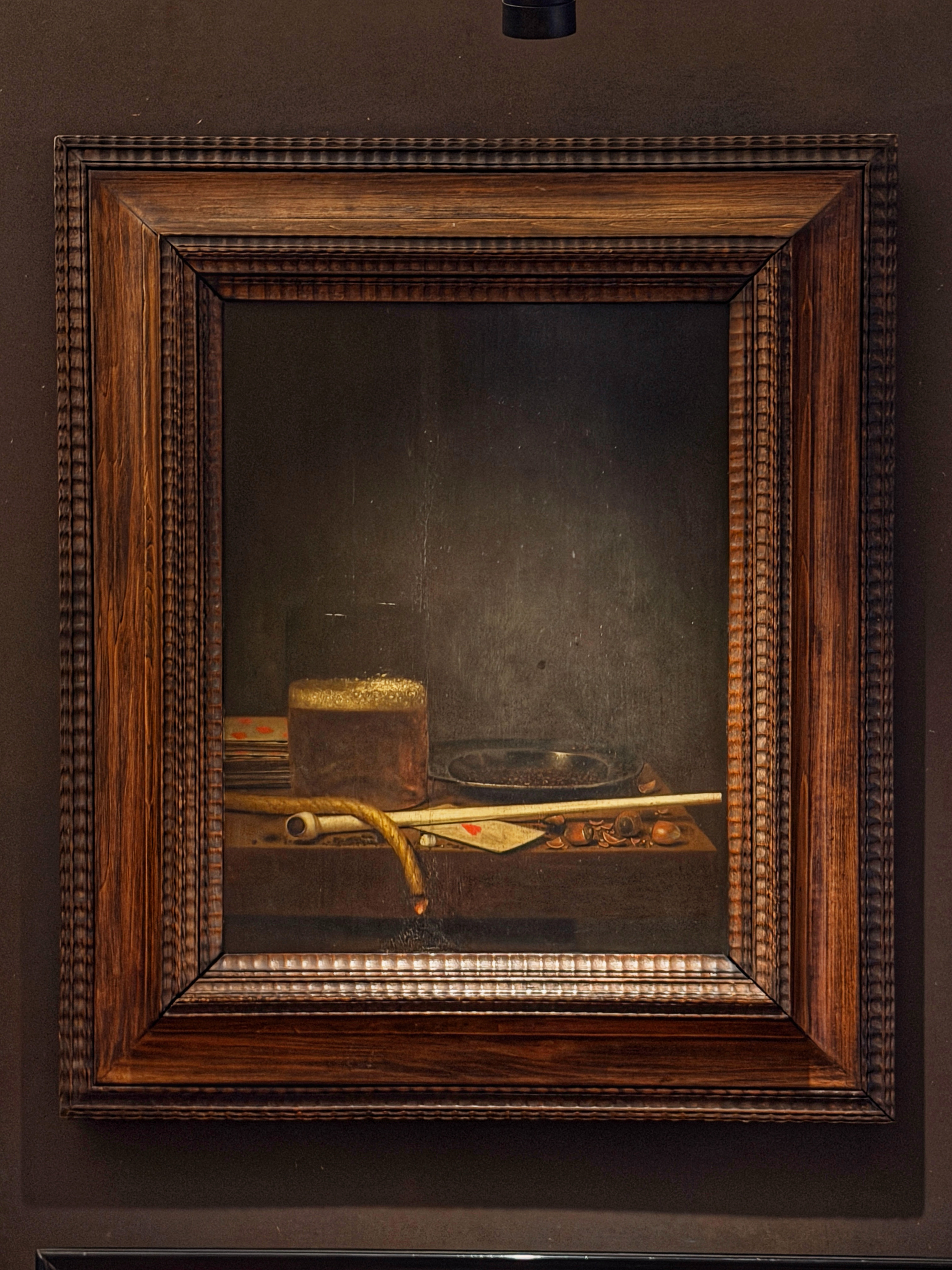
Jan Jansz van de Velde III (c.1620 – 1662), Still Life with a Beer Glass, Pipe, Playing Card, Chestnuts and Smoker’s Requisites, c.1647, Oil on oak panel, 40 × 31 cm, Národní galerie, Sternberg Palace, Prague
A herbarium published in Antwerp in 1576 recorded that seamen returning from the Americas were already smoking tobacco to satisfy their hunger, renew their strength and lighten their mood. It came in through the ports and the inns where sailors and soldiers gathered, spreading through the commercial networks of Europe. By 1630 the habit had reached all levels of Dutch society. Within another generation a painter in Haarlem or Amsterdam could build an entire career around depicting its equipment. Van de Velde III is today almost entirely forgotten, with only around 35 signed and dated works so far identified, despite coming from one of Haarlem’s most prominent artistic dynasties.
On this small panel he arranged a foaming pasglas — a ringed beer glass passed from hand to hand in drinking games, each player required to drink exactly to the next mark, not a drop more — alongside a clay pipe with a slow match draped across it, a pewter plate, a playing card showing a heart, and chestnuts, some split open and scattered on the table, a cheap autumn street food, warming and seasonal. The slow match — a length of treated hemp cord that soldiers carried to ignite their weapons on the battlefield — is here reduced to lighting a pipe on a tavern table, though it has not entirely lost where it came from. The pipe was smoked for company and for solitude alike, a remedy against melancholy as much as an invitation to it.
Jan Jansz van de Velde III (c.1620 – 1662), Still Life with a Beer Glass, Pipe, Playing Card, Chestnuts and Smoker’s Requisites, c.1647, Oil on oak panel, 40 × 31 cm, Národní galerie, Sternberg Palace, PragueJan Jansz van de Velde III (c.1620 – 1662), Still Life with a Beer Glass, Pipe, Playing Card, Chestnuts and Smoker’s Requisites, c.1647, Oil on oak panel, 40 × 31 cm, Národní galerie, Sternberg Palace, Prague
References
Seifertová-Korecká, H. (1966) ‘Jan Jansz. van de Velde’s Stilleben in der Kreisgalerie in Liberec’ [Jan Jansz. van de Velde’s still lifes in the Regional Gallery in Liberec], Oud Holland, 81, pp. 51–54. Available at, https://rkddb.rkd.nl/rkddb/digital_book/18750176_081_01_s008_text.pdf (Accessed 12 jUNE 2026)
RKD – Netherlands Institute for Art History (n.d.) Jan Jansz van de Velde III, RKDartists no. 79780. The Hague: RKD – Netherlands Institute for Art History. Available at: https://rkd.nl/en/explore/artists/79780 (Accessed: 12 June 2026).
de l’Obel, M. (1576) Plantarum seu stirpium historia [History of plants]. Antwerp: Christophe Plantin. Available at: https://archive.org/details/gri_33125009313699 (Accessed: 20 June 2026).
Chong, A. and Kloek, W.Th. (eds) (1999) Still-Life Paintings from the Netherlands, 1550–1720. Amsterdam: Rijksmuseum / Cleveland: Cleveland Museum of Art
Václav Vavřinec Reiner (1689–1743), Allegorical Variation on the Vision of Pope Innocent III with the Collapsing Lateran Basilica, Defended by Dominican Saints against the Attack of Heretics, 1734–35, fresco, nave vault, Kostel svatého Jiljí (Church of Saint Giles), Prague.
Václav Vavřinec Reiner (1689–1743), Allegorical Variation on the Vision of Pope Innocent III with the Collapsing Lateran Basilica, Defended by Dominican Saints against the Attack of Heretics, 1734–35, fresco, nave vault, Kostel svatého Jiljí (Church of Saint Giles), Prague.Václav Vavřinec Reiner (1689–1743), Allegorical Variation on the Vision of Pope Innocent III with the Collapsing Lateran Basilica, Defended by Dominican Saints against the Attack of Heretics, 1734–35, fresco, nave vault, Kostel svatého Jiljí (Church of Saint Giles), Prague.
The Battle of White Mountain on 8 November 1620 lasted approximately just two hours. A Bohemian Protestant army, drawn from the estates in open revolt against the Habsburgs since the Defenestration of Prague on 23 May 1618, was broken outside the city by a combined imperial and Catholic League force. The confessional pressure behind that morning arguably had building been in the Bohemian lands since the Hussite wars of the early fifteenth century.What happened to the Kostel svatého Jiljí between 1339 and 1620 is a compressed history of the religious tensions that preceded Bohemian re-Catholicisation; what was painted over its vault in 1734–35 can only be read against that history in full.
In the months that followed White Mountain, Ferdinand II revoked the Letter of Majesty, the charter of 9 July 1609 by which Rudolf II had guaranteed religious freedoms to the Bohemian estates, reportedly tearing the document with his own hands. The war became a demographic catastrophe of battle, famine, epidemic, and the forced movement of people. The Empire as a whole lost roughly a quarter of its people (Wilson, 2009), the Bohemian lands by most estimates much more, though the higher the figure the harder it becomes to say who died and who simply left, carrying their faith across the border ahead of re-Catholicisation (Cerman, 1994). On 21 June 1621, twenty-seven leaders of the uprising were executed in the Old Town Square, three noblemen, seven knights, and seventeen burghers. Twelve of their heads were fixed to the Old Town Bridge Tower, and some still hung there in 1631.
By 1625 Ferdinand had handed the Kostel svatého Jiljí (St Giles), a Gothic church a short walk from that square, to the Dominican order. This was not just any confiscated parish: the building had been Hussite and Utraquist for two hundred years; before that it had housed the preacher from whom the whole Bohemian theological reform descends; and a generation before him it was raised by a bishop who had spent eleven years in Avignon answering a Dominican’s accusations of protecting heretics. Every layer of its history ran against the order that received it. What that order subsequently commissioned for the ceiling in the eighteenth century does not erase that history so much as arrange its own story in front of it, choosing what to mourn, what to claim, and what to leave completely.
The beginning is the bishop. A collegiate chapter is documented on the site from at least 1238, attached to a Romanesque church whose foundations lie beneath the present one, and the Gothic structure that replaced it was begun in 1339 at the commission of John of Dražice (c.1260–1343), penultimate Bishop of Prague. His eleven years at the papal court were spent not in Rome but in Avignon, where the papacy had settled in 1309 under French pressure and would stay for nearly seventy years, to the disgust of contemporaries who read the whole arrangement as proof of its capture by the French crown. The accusations that took him there in 1318 came from Jindřich ze Šumburka, the Dominican provost of Litoměřice and a long-standing personal adversary: disobedience to the pope, simony, indulgence toward heretics, obstruction of inquisitors in their work (Hledíková, 1991, cited in Marin, 2020). The curia was in no hurry to clear him; a case left running drew money from the defendant for as long as it lasted, and his ran eleven years. He was fully acquitted and back in Bohemia by 1329, having watched, in the meantime, the building boom that was remaking the new papal city. What he commissioned at home shows it: a three-aisled basilica without a separate presbytery, broad and rectangular in the French Gothic hall manner, buttressed walls, pointed arches, paired towers at the west front.
John died in 1343 with the church unfinished. His successor Arnošt of Pardubice (1297–1364), the first Archbishop of Prague, carried the work on, and the completed building was consecrated on 4 May 1371 by the second archbishop, Jan Očko of Vlašim (d.1380), with Charles IV of Luxembourg (1316–1378) in attendance, Holy Roman Emperor and King of Bohemia, under whom Prague had become the political and cultural centre of the empire. By then the man later historiography would call the father of the Bohemian reform had already arrived.
Jan Milíč of Kroměříž (Latin Milicius de Chremsir, d.1374) came to the church in 1364, while it was still a building site, and brought with him the abandoned career that made his preaching news: until 1363 he had moved through some of the most coveted appointments open to a Prague churchman, registrar, then corrector in the imperial chancery, then a canonry at St Vitus cathedral with the rank of archdeacon, and he gave up all of it for the pulpit (Morée, 1999; Janega, 2015). He preached in Czech language, which in that period was a reforming act in its own right, and went after clerical wealth and lax morals with a directness that made him enemies in the chapter and beyond. In 1372 the preaching produced something solid. A number of Prague’s prostitutes left their business under his influence, and Charles IV granted him a working brothel in Konviktská Street, known as Venice, with the plots around it. On the site Milíč raised a chapel to Mary Magdalene and housing for the women, and named the whole foundation Jerusalem (Mengel, 2004). The community kept a common life of prayer there until his death.
He had been to Rome in 1367, convinced that the condition of the Church announced the imminent coming of Antichrist. Urban V had briefly brought the papal court back from Avignon to Rome, and Milíč pinned to the door of St Peter’s cathedral a notice for a sermon on Antichrist he intended to deliver before it. The Inquisition arrested him first. In confinement he wrote the Libellus de Antichristo, placed it before Urban V on the pope’s return in October 1367, and was released on the pope’s order. The pope went back to Avignon in 1370 and died there on 19 December. The new pope Gregory XI, elected on 30 December, kept the court in France, and it was to Avignon that Milíč was summoned in Lent 1374, after the Prague clergy had drawn up twelve articles against him (Janega, 2015). He was cleared there too, and licensed to preach before the assembled cardinals, and died in Avignon on 29 June 1374. Gregory XI brought the papacy back to Rome only in January 1377.
Within a generation Jan Hus (c.1369–1415) had carried the reforming impulse Milíč launched from this pulpit into a collision with the Council of Constance, which burned him in 1415. The movement that formed around his memory set the Bohemian estates against the Holy Roman Empire and turned back five successive crusades between 1420 and 1431 (Fudge, 2010); from the mid-1420s the Hussites went further, launching their own incursions into neighbouring territories, making the conflict something other than a purely defensive struggle. The Compactata that eventually followed were the institutional Church’s first negotiated concession to a movement it had condemned as heretical; nothing on that scale would test papal authority again before Luther. The concession did not hold. Pope Pius II annulled the Compactata in 1462, and a second phase of crusading warfare followed from 1467, though Utraquism survived both and remained the dominant confession in Bohemia under the Jagiellonian kings through the late fifteenth and early sixteenth centuries, its position resting less on papal recognition than on the political facts of the kingdom.
The community of canons John of Dražice had established at the church ceased to exist in 1420 and the building passed into Utraquist hands as a parish, where it would remain for two centuries.The word Protestant , however, does not belong here, though it is often reached for, and the confusion is consequential when the ceiling comes to be read. Utraquism predates the Reformation by a century, and its central demand was older and narrower than anything Luther would raise: sub utraque specie, under both kinds, the insistence that the laity receive the Eucharist in wine as well as bread, which Rome had condemned since Constance. In everything else the Utraquists stayed Catholic: the same liturgy, the cult of the saints, an unbroken episcopal succession. Their representatives reached terms with the Council of Basel, ratified in the Compactata signed at Jihlava in 1436, conceding the chalice within Bohemia and Moravia (Kaminsky, 1967). That concession was a formal recognition, however reluctant, of a liturgical variation Rome had chosen to absorb rather than continue fighting. Under the Compactata, the Utraquists at St Giles in the century that followed were not, in any strict canonical sense, outside the Catholic Church. The fresco programme installed above their former nave in 1734–35, whose governing image is the defeat of heresy, was therefore directed, in a precise historical sense, at a congregation whose position Rome had already ratified. The Dominicans did not deal in such distinctions. They had been the papal Inquisition’s chief instrument since Gregory IX appointed them to it in 1231, charged with policing the line between Catholic orthodoxy and everything beyond it (Given, 1997). A church that gave its laity the chalice stood on the wrong side of that line, whatever else it kept. Centuries later, Lutheran ideas crossing the border complicated the picture further, and the estates who defended the Letter of Majesty in 1618 were a mixed body, Lutherans, the Unity of the Brethren, Utraquists of several shades. The congregation that took St Giles in 1420 was none of those later things.
The Utraquists held the building through the sixteenth century, through the Reformation that transformed the lands around Bohemia and through the Council of Trent that answered it. What secured them at the end of that century was political: the Letter of Majesty, which Rudolf II conceded to the estates in 1609 and which guaranteed the religious freedoms they already exercised. The guarantee lasted only nine years, and it broke on a question of property. Two Protestant churches had been built on land the Catholic Church claimed as its own, and Ferdinand II (1578–1637), elected King of Bohemia in 1617 and set on full Catholic uniformity, confirmed the hard line already taken against them, one closed, the other demolished, the petitioners who protested arrested. The estates’ appointed Defensors gathered in Prague, and on 23 May 1618 a group of nobles threw two of the regents who had backed those measures from a castle window. White Mountain came two years later. The church changed hands within five.
By 1731, when the redecoration began, the re-Catholicisation of Bohemia was substantially complete. Patient cultural replacement had done most of the work: history rewritten, ecclesiastical interiors rebuilt, noble families won over through Jesuit schooling, a Utraquist landowning class displaced by Catholic newcomers loyal to the Habsburgs (Louthan, 2009). The Utraquist estates were gone, their libraries scattered, their children raised in the faith their grandparents had died resisting. At St Giles the work fell to the builder Václav Špaček under the architect František Maxmilián Kaňka (1674–1766), who kept the Gothic shell and remade everything inside it. The broad flat vault, a Czech placka without transverse arches, was conceived from the start to carry monumental fresco. The commission went to Václav Vavřinec Reiner (1689–1743), the stucco to Bernardo Spinetti, an Italian settled in Bohemia. The cycle was finished in 1734–35.
The convenient name for the main vault, the Triumph of the Dominican Order over Heresy, undersells it. The proper subject is an allegorical reworking of the vision of Pope Innocent III, the collapsing Lateran Basilica defended by Dominican saints against an assault of heretics. Before approving the order, the legend runs, Innocent dreamed the Lateran falling and saw it held up by a friar he later recognised as Dominic. The Franciscans tell the same dream of Francis. Reiner opened the vision across the vault in illusionistic perspective, the basilica tilting, Dominic at its threshold, Thomas Aquinas and the Dominican saints holding the line, the heretics below with their books overturned at their feet, the old iconographic sign of defeated doctrine. The lesser vaults praise Dominic and his attributes, the dog with the flaming torch from his mother’s dream among them. Saint Giles has a vault to himself, the French hermit whose only companion was a hind, lamed for life by a hunter’s arrow meant for the animal, later patron of the disabled. The high altar, carved by Ignác František Weiss (fl.1730s–1760s), holds a Crucified Christ Venerated by Dominican Saints painted by Antonín Stevens (fl.1650s–1680s) in 1660–62.
Two scenes in the cycle record what the order lost, and they hang apart from the triumph. One shows the murder of John of Schwenkenfeld, the papal inquisitor for Silesia, stabbed in Prague in 1341 and venerated by the Dominicans as a martyr; the order sought his canonisation and never obtained it. The other depicts the plundering of the convent of St Clement by the Judith Bridge — the Dominicans’ principal Prague house, stormed by Hussite forces on 8 August 1420 and never restored to its former scale [Havrda, Kovář and Žďárská, 2017] — after which the order held the damaged site for another five generations before ceding it to the newly arrived Jesuits in the 1550s, who raised the Clementinum, the largest Jesuit college in Bohemia, over its ruins, leaving the Dominicans without a major Prague foundation until they came to St Giles in 1625.The Schwenkenfeld fresco does something no chronicle would permit: it folds the inquisitor’s death into the storming of the convent, eighty years apart, one image, as though the order’s injuries were a single continuous wound. Which they were not. The murder and the storming belong to different centuries, different political contexts, different stages of the Bohemian reform; collapsing them is a choice, and the choice is the same selection at work in the vault above, where the Church holds and the heretics fall and no painting acknowledges the two centuries this particular nave spent on the other side of the argument.
The fresco programme was designed for a Catholic congregation raised entirely within the re-Catholicised order, for whom the building’s two-hundred-year history as something other than a Dominican church was a sealed archive. The triumph on the vault required no opposition. Selection works most efficiently when the other side has already been removed, and by 1731 it had been, thoroughly and for a long time.
Reiner lies in front of the altar of Saint Vincent, beneath the ceiling he painted. From Husova street the church shows a plain Gothic front and gives no sign of what was painted inside, or why.
Fudge, T. A. (2010) Jan Hus: Religious Reform and Social Revolution in Bohemia. London: I. B. Tauris
Given, J. B. (1997) Inquisition and Medieval Society: Power, Discipline, and Resistance in Languedoc. Ithaca, NY: Cornell University Press
Havrda, J., Kovář, M. and Žďárská, A. (2017) ‘Dominikánský klášter sv. Klimenta v Praze na Starém Městě’ [St Clement Dominican monastery in the Old Town of Prague], Staletá Praha, 33(2), pp. 2–[closing page]. Available at: https://www.staletapraha.cz/pdfs/pha/2017/02/01.pdf (Accessed: 10 June 2026).
Hledíková, Z. (1991) Biskup Jan IV. z Dražic (1301–1343) [Bishop John IV of Dražice (1301–1343)]. Prague: Karolinum
Janega, E. A. (2015) Jan Milíč of Kroměříž and Emperor Charles IV: Preaching, Power, and the Church of Prague. Doctoral thesis, University College London
Kaminsky, H. (1967) A History of the Hussite Revolution. Berkeley: University of California Press
Louthan, H. (2009) Converting Bohemia: Force and Persuasion in the Catholic Reformation. Cambridge: Cambridge University Press
Marin, O. (2020) ‘The Early Bohemian Reform’, in Van Dussen, M. and Soukup, P. (eds.) A Companion to the Hussites. Leiden: Brill, pp. 25–62.
Mengel, D. C. (2004) ‘From Venice to Jerusalem and Beyond: Milíč of Kroměříž and the Topography of Prostitution in Fourteenth-Century Prague’, Speculum, 79(2), pp. 407–442. Available at: https://www.jstor.org/stable/20462893 (Accessed: 11 June 2026).
Morée, P. C. A. (1999) Preaching in Fourteenth-Century Bohemia: The Life and Ideas of Milicius de Chremsir (†1374) and His Significance in the Historiography of Bohemia. Heršpice: EMAN
Preiss, P. (2013) Václav Vavřinec Reiner: dílo, život a doba malíře českého baroka [Václav Vavřinec Reiner: The Work, Life and Times of a Czech Baroque Painter]. 2 vols. Prague: Academia and Národní galerie v Praze
Wilson, P. H. (2009) Europe’s Tragedy: A History of the Thirty Years War. London: Allen Lane