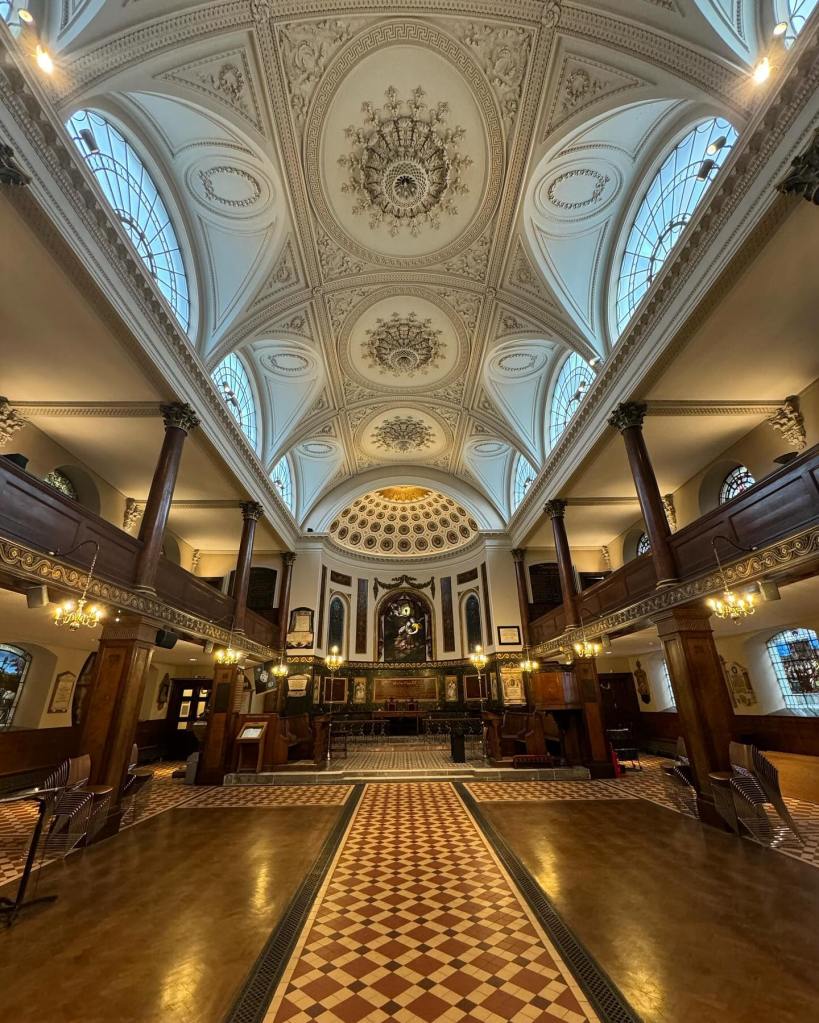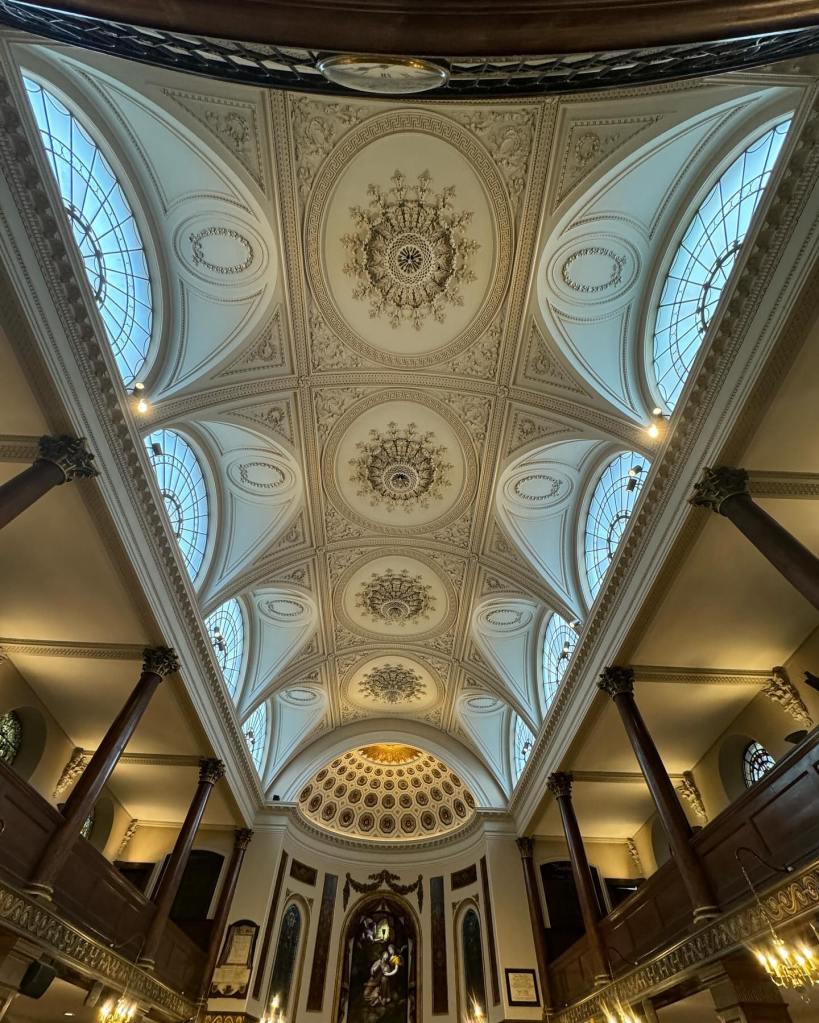
St Botolph without Aldersgate is one of the three remaining medieval churches dedicated to St Botolph in the City of London. It was also one of four churches erected at the City gates, symbolising St. Botolph’s role as the traditional patron saint of travellers before St. Christopher assumed the title. The church’s origins can be traced back to around 1050, with its first documentation appearing in 1291. Remarkably, it withstood the Great Fire of London. From 1788 to 1791, Nathaniel Wright led significant reconstruction, preserving only the old east wall—this effort aimed to fix structural damage and facilitate the adjacent street’s expansion.
This Georgian-era reconstruction introduced wooden galleries, a domed semi-circular apse, and intricate plasterwork alongside an organ installed in 1788 by Samuel Green. Despite these major changes, the church maintained its 16th and 17th-century memorials, including a notable baroque tribute to Sir John Micklethwaite, a physician knighted by Charles II. Integrating memorials from the 16th and 17th centuries within a primarily Georgian architectural framework reflects a profound respect for historical continuity. It bridges the past with the present and future congregations, honouring the contributions and spiritual paths of those who came long before us.