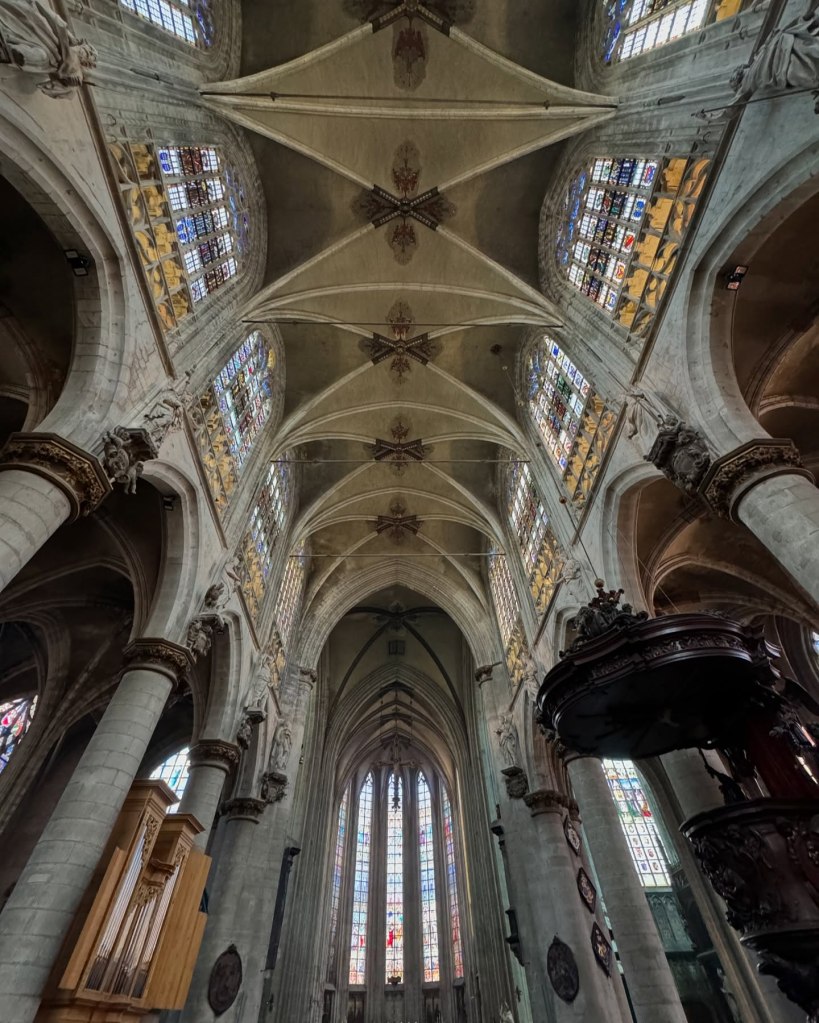
Notre-Dame du Sablon is probably the region’s most harmonious representation of Brabantian Gothic, characterised by its pointed arch architecture, colourful stained glass windows, slender columns, and high windows. It was built during the 14th and 15th centuries. The choir was completed in 1435, and the north transept was finished around 1450. Work was interrupted during political instability following the death of Charles le Téméraire (1433 – 1477) when the male line of the Valois dukes of Burgundy became extinct and resumed at the end of the century. The church was completed only in 1550, though plans for a tower were never realised. Numerous baroque monuments inside the church highlight Brussels’ significance within the Habsburg Empire, as the area was home to aristocratic families who held prominent positions in the Habsburg court for centuries.
The church’s fame is rooted in a medieval legend involving a woman named Beatrijs Soetkens, who, guided by a vision, stole Antwerp’s Madonna statue and brought it to Brussels in 1348. This event initiated the annual ‘Ommegang’ procession, which remains integral to Brussels’ identity. Such legends were typical in the Middle Ages, often justifying the location of new religious sites and drawing pilgrims, as was the case with the Healing Madonna at Sablon.