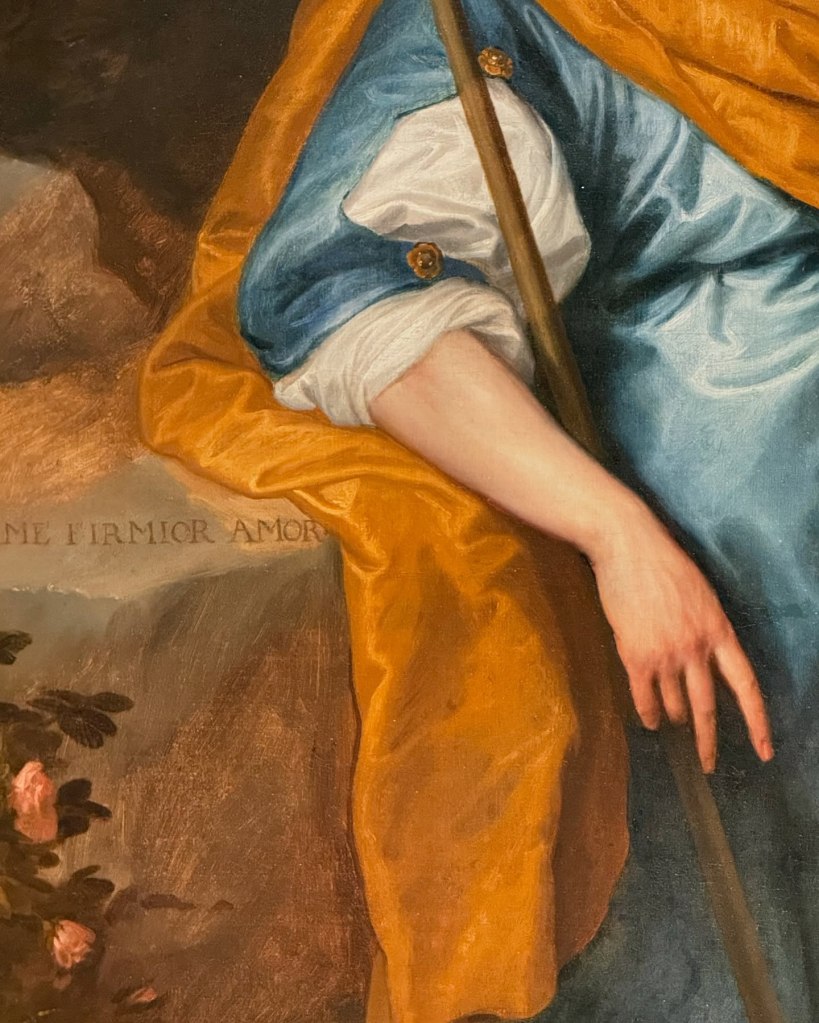
Antoon van Dyck (1599-1641), Portrait of Lord George Stuart (1618 – 42), c.1638, Oil on canvas, 218.4 x 133.4 cm, National Portrait Gallery, London

George Stuart, 9th Seigneur d’Aubigny (1618–1642), had a Latin phrase carved into a rock in his portrait: Me firmior amor, ‘Love is stronger than I am.’ It was, as far as anyone can tell, a personal declaration, placed in plain sight in a painting that would hang in public rooms, addressed to no one in particular and understood by everyone at court. Stuart had married Lady Katherine Howard (c.1622–1650) in secret, defying both her family and his guardian, the king Charles I (1600–1649). He was twenty. Antoon Van Dyck painted him around 1638, and the portrait does something unusual: it lets a young man confess in oil what he could not say aloud.
The composition borrows freely from the vocabulary of melancholic portraiture that Van Dyck had refined across his career, the leaning pose, the averted gaze, the loosely draped satin catching the light. But the mood here is not a stock convention applied to a paying sitter. Stuart’s face is pale and lit with uncomfortable clarity against the darker landscape behind him, and his expression refuses to settle into anything readable. He is not brooding in the theatrical Italian manner. He is simply elsewhere, looking past the viewer at something he is not sharing. The hand rests without tension. The body leans as though tired of standing in its own story.
Behind him, Van Dyck sets a pastoral landscape of the kind he had absorbed from Titian (c.1488–1576) and reworked throughout his English period: soft hills, open sky, scattered trees. It is tempting to treat every element as a personal emblem, to read the wild roses as love and the thistles as Scotland, and the tradition of botanical symbolism in courtly portraiture was certainly alive in the 1630s. But Van Dyck’s landscapes tend towards a generalised Arcadian mood rather than itemised allegory, and pushing every plant into service as a symbol can take interpretation past what the painting actually asks of us. What matters more is the register: the sense of a setting that is beautiful and remote and not quite real, as though the world Stuart inhabits in this portrait has already begun to recede.
He was killed at Edgehill in October 1642, twenty-four years old, among the first prominent casualties of the English Civil War. Katherine survived him, held to the Royalist cause through the war, and was eventually exiled to France after the execution of Charles I in 1649. She died there in 1650. Van Dyck himself had died in December 1641, before any of it. There is no prophecy in the painting. But the inscription on the rock does something that most courtly portraits carefully avoid: it tells the truth about its sitter, in his own words, and dares anyone looking to take it seriously.

References
Barnes, S.J., De Poorter, N., Millar, O. and Vey, H. (2004) Van Dyck: A Complete Catalogue of the Paintings. New Haven: Yale University Press
Hearn, K. (ed.) (2009) Van Dyck & Britain. London: Tate Publishing
Millar, O. (1982) Van Dyck in England. London: National Portrait Gallery
Wheelock, A.K., Barnes, S.J. and Held, J.S. (1990) Anthony van Dyck. Washington, D.C.: National Gallery of Art