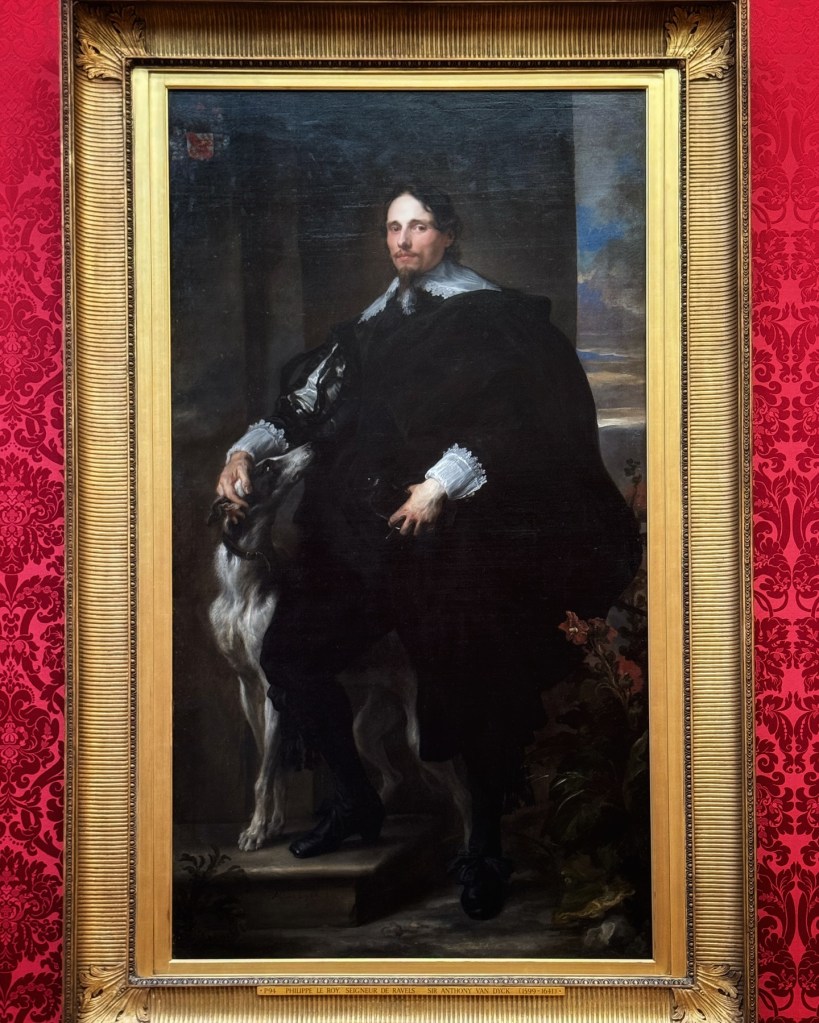
Antoon van Dyck (1599–1641), Portrait of Philippe Le Roy, 1630, Oil on canvas, 213.3 × 114.5 cm, The Wallace Collection, London

Van Dyck’s grand manner of portraits adhered to a formula that portrayed the sitter as both dignified and approachable, balancing idealisation with lifelike detail. The painting exemplifies Van Dyck’s signature style, with an unmatched rendering of the lace collar and hands that few in the 17th century could equal. Van Dyck’s portrait of Philippe Le Roy captured not only his wealth and status but also embodied the political aspirations of the Flemish Catholic elite aligned with the Spanish Crown.
Philippe Le Roy (1596–1679), the illegitimate son of a Flemish nobleman, rose to prominence through wealth, marriage, and a distinguished diplomatic career, eventually securing one of the highest aristocratic titles. From 1618, he succeeded his father as general commissioner of gunpowder and saltpetre, steadily ascending within the royal administration of the Spanish Netherlands. In 1631, he married his aristocratic cousin, Marie de Raet. In 1630, in preparation for his marriage, Le Roy commissioned Antoon Van Dyck to paint his portrait, followed by a portrait of Marie de Raet the next year. Both works are now housed in the Wallace Collection.
Le Roy’s career continued to thrive, affirming the ambitions so masterfully expressed in this ‘grand manner’ portrait, which positioned him firmly within the ranks of the wealthy and powerful elite. In 1642, he was appointed general superintendent of army supplies. In 1646, he played a significant diplomatic role in preparing for the Peace of Westphalia, which ended the Thirty Years’ War. He successfully led covert political operations to convert the agreement between the Habsburgs and the United Provinces in Münster into a peace treaty while actively sabotaging parallel negotiations between the United Provinces and France, which threatened Spain.
Le Roy’s efforts were recognised by Philip IV, leading to his knighthood in 1647. Emperor Leopold I granted him the title of Baron of Broechem in 1671, which Queen Mariana of Austria reaffirmed in 1675.
References
Barnes, S.J., De Poorter, N., Millar, O. and Vey, H.(2004) Van Dyck: A Complete Catalogue of the Paintings. New Haven and London: Yale University