Michelangelo Merisi da Caravaggio (1571–1610), Boy Bitten by a Lizard, c. 1594–1596, Oil on canvas, 66 cm × 49.5 cm, The National Gallery, London
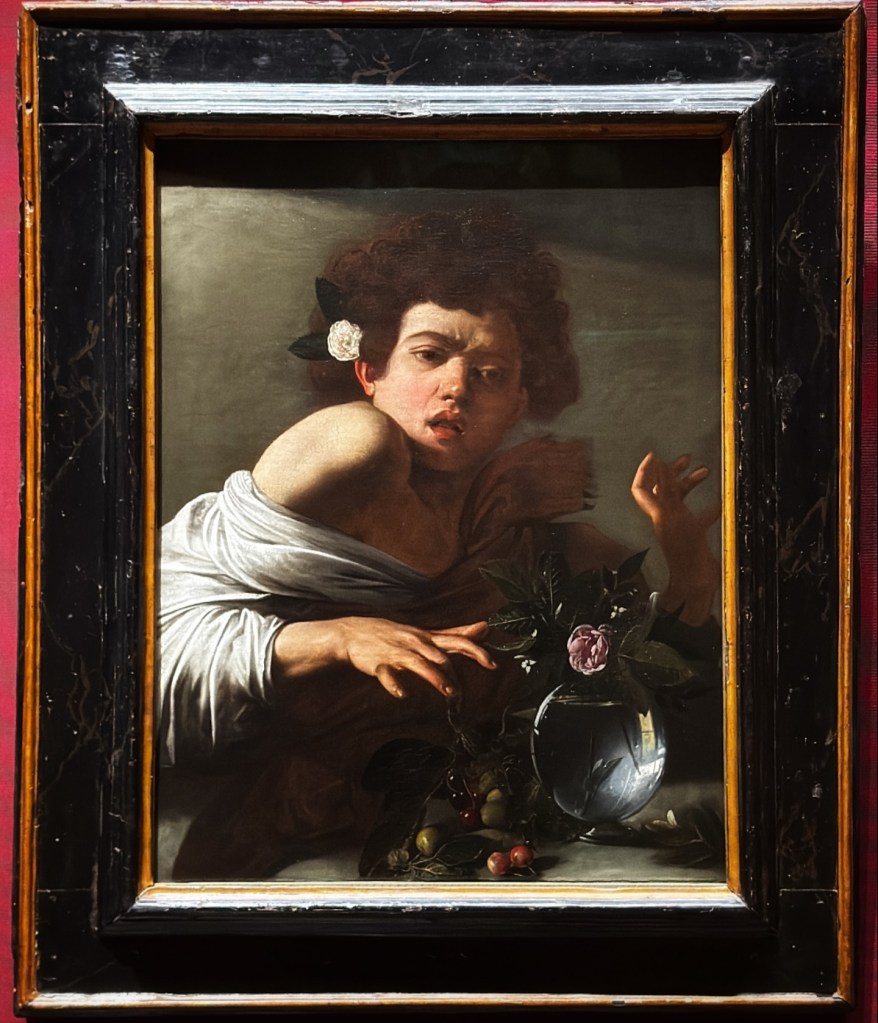
When Caravaggio arrived in Rome sometime in 1592, he was twenty years old, recently orphaned, and almost certainly short of money. The city’s art market was crowded, fiercely competitive, and not particularly welcoming to a young Lombard without connections. He needed pictures that could do work for him, and Boy Bitten by a Lizard, painted probably around 1594–96, looks very much like a painting made with that purpose in mind. The subject is modest, even comic: a boy reaches towards a dish of cherries and recoils as a lizard, concealed among the fruit, clamps onto his finger. But the way Caravaggio handles the moment, freezing a flinch of pain with the precision of someone who understood exactly how shock moves through a body, turns an anecdote into a declaration of ability.
The painting exists in two versions, one in the National Gallery, London, the other in the Fondazione Roberto Longhi, Florence. Both are now generally accepted as autograph. Roberto Longhi placed the picture close to the period when Caravaggio entered the household of Cardinal Del Monte, though the National Gallery’s own catalogue suggests it was made for the open market, without a specific patron in mind. The distinction matters. Was this a picture designed to please a cardinal, or a picture designed to stop one in his tracks? The two things are not quite the same.
What interested Longhi was Caravaggio’s gift for seizing what he called the ‘instantaneous psychological reflex,’ and he traced the motif back to Sofonisba Anguissola’s drawing Boy Bitten by a Crab (c. 1554), where a child’s distress at a small creature’s bite plays out with a similar mix of comedy and discomfort. Anguissola’s drawing, though, belongs to the tradition of the physiognomic exercise, a study in fleeting expression. Caravaggio took the same idea and made it feel like something that had actually just happened. Giovanni Baglione, his bitter rival, admitted as much in 1642 when he observed that the viewer can ‘almost hear the boy scream.’ Coming from Baglione, that is practically a love letter.
Andrew Graham-Dixon, in his 2011 biography, argued that Caravaggio’s method was essentially theatrical, even proto-cinematic: he composed by staging scenes, or fragments of scenes, under directed lighting, and knitted them together on the canvas, using shadow to conceal the joins. That description fits Boy Bitten by a Lizard well. The boy’s face and shoulder are caught in a fall of light that feels staged, almost artificial, while the background drops into near-darkness. The chiaroscuro here is still measured, not yet the brutal instrument it would become in the Contarelli Chapel, but the instinct is legible. Caravaggio was already learning that darkness could do narrative work, that what you cannot see can be as eloquent as what you can.
But what, exactly, does the picture mean? This is where the scholarship becomes genuinely fascinating, and occasionally rather revealing about the scholars themselves. Leonard J. Slatkes, in 1976, connected the lizard to the Apollo Sauroktonos attributed to Praxiteles, arguing that in early modern usage the lizard and the salamander were often conflated, carrying associations of fire, danger, and phallic energy. There is also the Martial epigram (‘Spare this lizard crawling towards you, treacherous boy; it wants to die between your fingers’), which gives the image an openly playful, even flirtatious, classical undertone. Whether Caravaggio or his circle would have known these sources is a reasonable question. Whether a picture needs to know its sources to carry their charge is perhaps a better one.
Donald Posner, in a 1971 article that reshaped much of the subsequent conversation, argued that the boy was one of the most pronounced homosexual figures in Caravaggio’s early work, reading the effeminate dress, the bare shoulder, and the bitten middle finger (the digitus impudicus of Roman gesture) as sexually coded. Creighton Gilbert pushed back in 1995, arguing that the bare shoulder was simply classical, and that the painting belonged to the world of the Martial epigram rather than to any homosexual subculture around Del Monte. Michael Fried was blunter, dismissing Posner’s reading as ‘crude and ahistorical.’ One might ask, though, whether the sharpness of the disagreement does not itself suggest that the picture touches something genuinely ambiguous. Posner may have overstated his case, but Gilbert’s insistence that the shoulder is merely classical feels a little too tidy. Bodies in Caravaggio are never merely anything.
Fried’s own reading, in The Moment of Caravaggio (2010), moved in a different direction altogether. He was interested not in what the painting depicts but in how it addresses its viewer, in the tension between what he called ‘absorption” (the boy lost in his own sensation, unaware of being watched) and “specularity’ (the painting’s consciousness of being looked at). He also proposed that the picture is a disguised self-portrait, the boy’s hands mirroring the position of a painter holding palette and brush. It is a bold suggestion, and not easily proved. But it raises a question that none of the iconographic readings quite touches: is this a picture about pleasure and its consequences, or is it a picture about what it means to paint, to be stung into attention by the sheer strangeness of the visible world?
The vanitas reading remains available, of course. Ripe cherries, cut flowers, a sting beneath the surface of pleasure. In late sixteenth-century Rome, where syphilis was widespread and widely feared, known with characteristic mutual blame as ‘the French disease’ in Italy and ‘the Neapolitan disease’ in France, the idea that pleasure bites back would have carried a distinctly physical edge. But to leave the painting there, neatly filed under moral warning, would be to do exactly what Caravaggio spent his whole career refusing to do: to make things simple.
References
Bauer, L. and Colton, S. (2000) ‘Tracing in Some Works by Caravaggio’, The Burlington Magazine, 142(1168), pp. 434–436. Available online at: https://www.academia.edu/37300278/Tracing_in_Some_Works_by_Caravaggio (Accessed: 5 November 2024)
Christiansen, K. (1986) ‘Caravaggio and “L’esempio davanti del naturale”‘, The Art Bulletin, 68(3), pp. 421–445. Available at: https://www.researchgate.net/publication/271402942_Caravaggio_and_L’esempio_davanti_del_naturale (Accessed: 3 November 2024)
Fried, M. (2010) The Moment of Caravaggio. Princeton: Princeton University Press.
Gilbert, C. E. (1995) Caravaggio and His Two Cardinals. University Park, PA: Pennsylvania State University Press
Graham-Dixon, A. (2011) Caravaggio: A Life Sacred and Profane. London: Allen Lane
Longhi, R. (1998) Caravaggio. English edn. Florence: Giunti Editore
Posner, D. (1971) ‘Caravaggio’s Homo-Erotic Early Works’, Art Quarterly, 34, pp. 301–324.Available online at, https://www.yumpu.com/pt/document/read/2186684/caravaggios-homo-erotic-early-works-williamapercycom/11 (Accessed 3 Novemebr 2024)
Posner, D. (1981) ‘Lizards and Lizard Lore, with Special Reference to Caravaggio’s Leapin’ Lizard’, in Barasch, M. and Sandler, L. F. (eds) Art the Ape of Nature: Studies in Honor of H. W. Janson. New York: Harry N. Abrams.
Costello, J. (1981) ‘Caravaggio, Lizard, and Fruit’, in Barasch, M. and Sandler, L. F. (eds) Art the Ape of Nature: Studies in Honor of H. W. Janson. New York: Harry N. Abrams