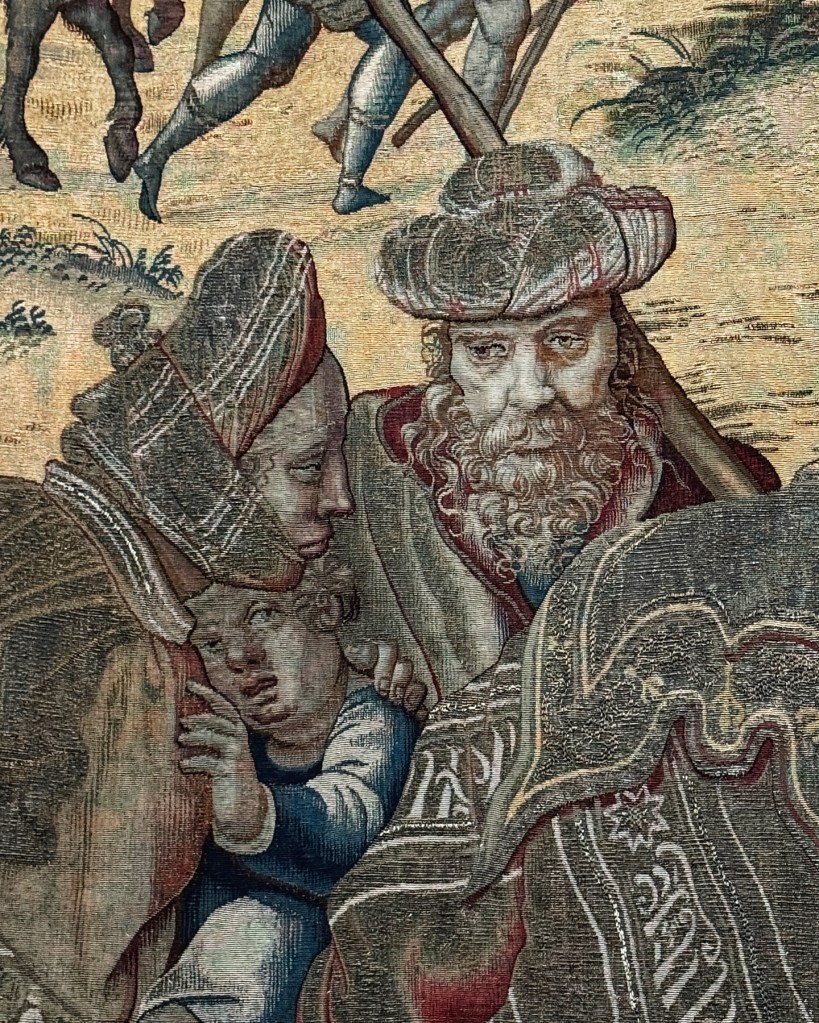
Brussels workshop of Willem de Pannemaker (c. 1510 – 1581),’ The Departure of Abraham’, after designs by Pieter Coecke van Aelst ( 1502–1550), c. 1540 – 1543
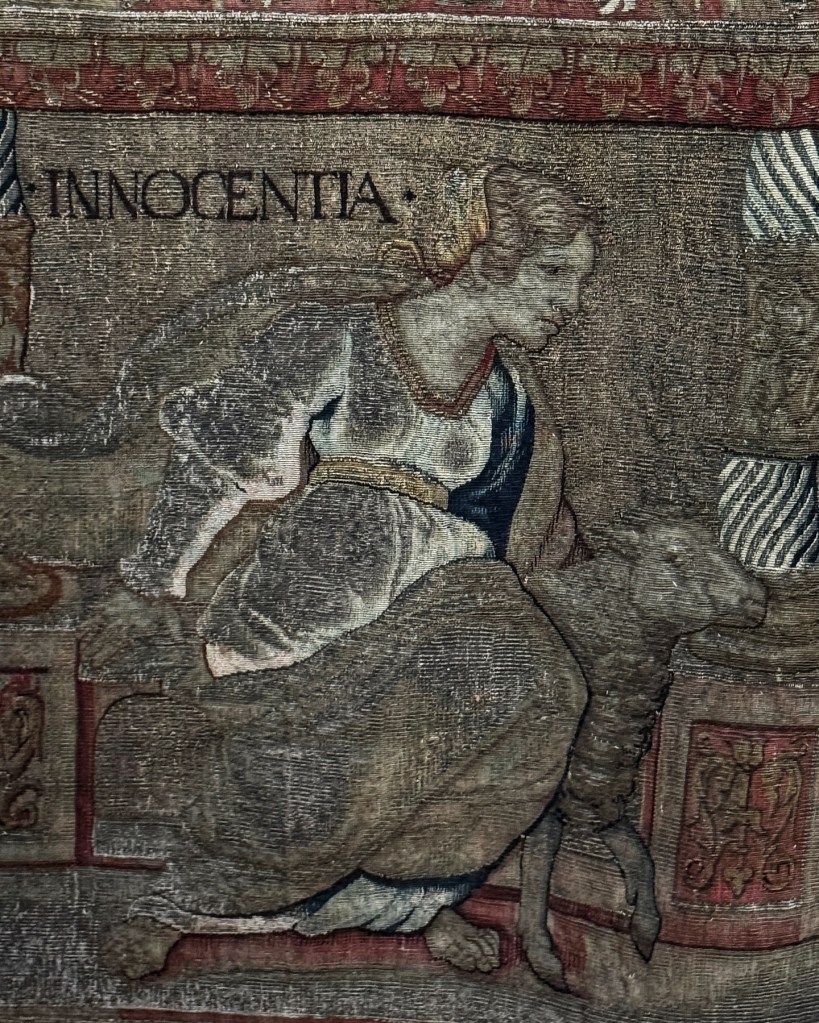
Brussels workshop of Willem de Pannemaker (c. 1510 – 1581),The Departure of Abraham, after designs by Pieter Coecke van Aelst ( 1502–1550), c. 1540 – 1543, Woven wool and silk tapestry with gilt metal-wrapped thread, 482 x 770 cm, Hampton Court Palace, Richmond upon Thames, Greater London
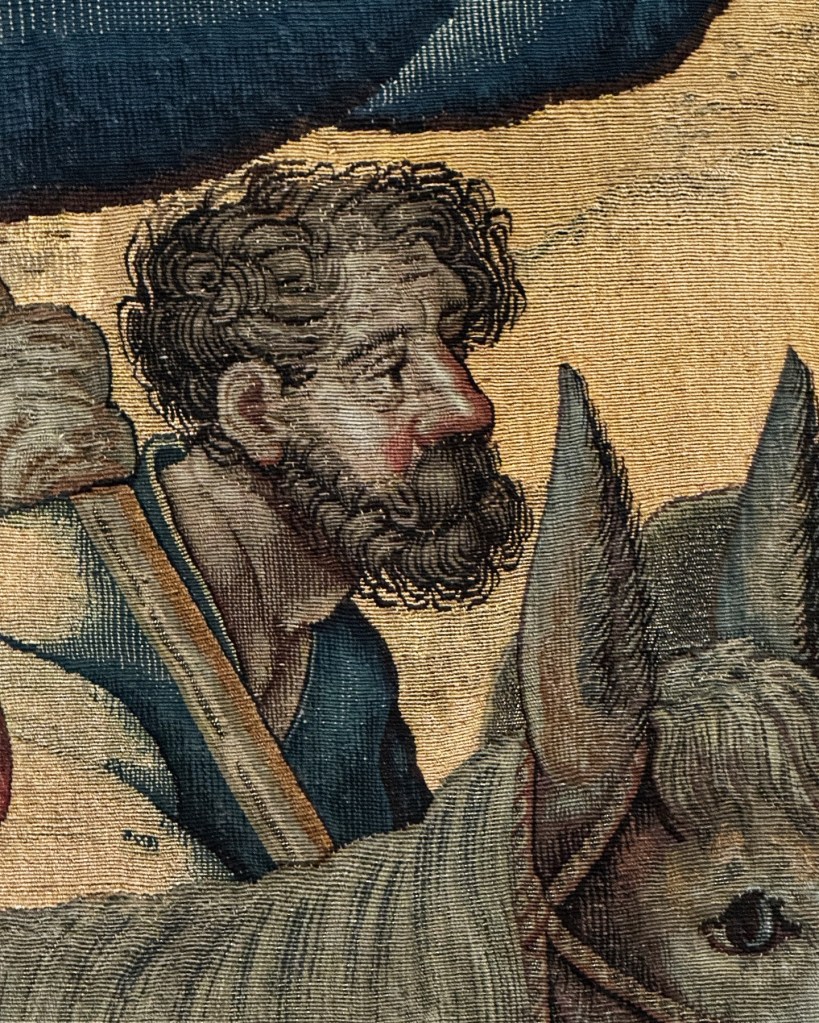
Brussels workshop of Willem de Pannemaker (c. 1510 – 1581),The Departure of Abraham, after designs by Pieter Coecke van Aelst ( 1502–1550), c. 1540 – 1543, Woven wool and silk tapestry with gilt metal-wrapped thread, 482 x 770 cm, Hampton Court Palace, Richmond upon Thames, Greater London
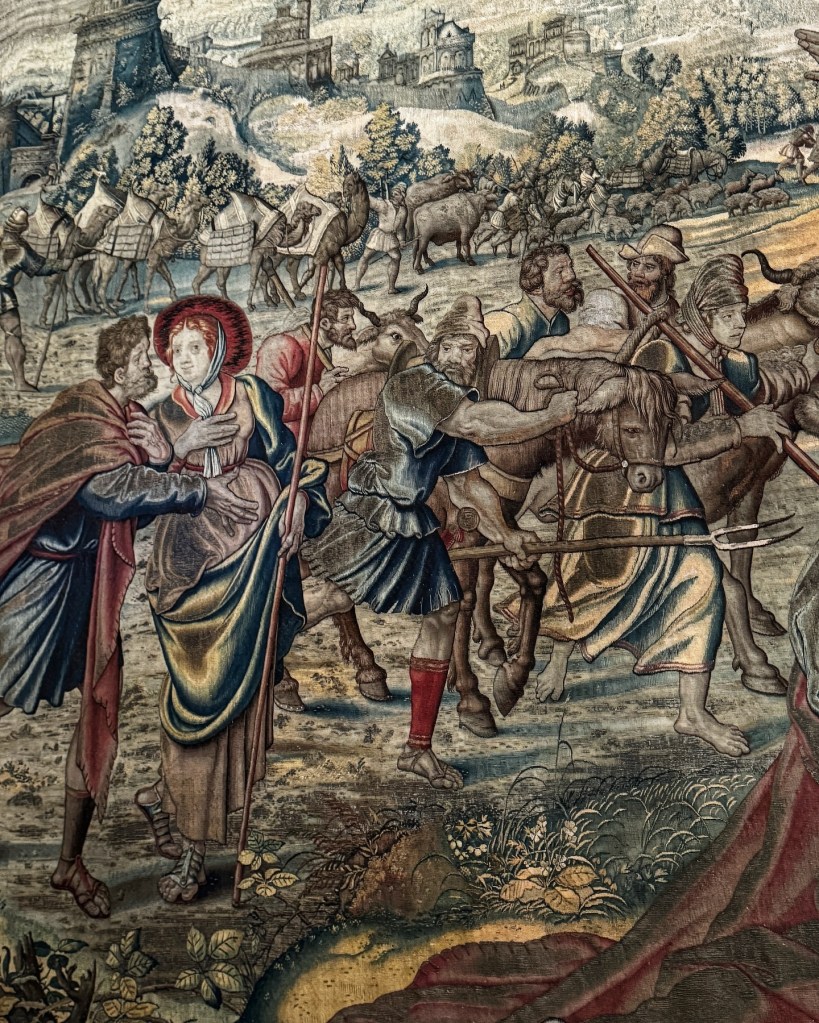
When Henry VIII died in 1547, his household inventories recorded well over two thousand tapestries, a collection unmatched by any other European sovereign. Among the finest were a set illustrating the life of Abraham, woven in Brussels after designs by the Antwerp painter and architect Pieter Coecke van Aelst. The Departure of Abraham belongs to this series: a monumental hanging, nearly eight metres wide, executed in wool and silk with gilt metal-wrapped thread, the most costly material available to the weaver’s craft.
The workshop responsible was that of Willem de Pannemaker, whose looms in Brussels served the Habsburgs, the Valois, and the Tudor court in close succession. De Pannemaker’s name appears in the accounts of Charles V and later Philip II, for whom he wove the celebrated Conquest of Tunis series in the 1550s. That the same master weaver supplied tapestries to courts openly competing with one another was no secret, and no embarrassment. The expense of gilt thread alone placed such commissions beyond the reach of lesser patrons; to own a De Pannemaker hanging was to demonstrate access to the restricted circle of those who could command his workshop’s time.
Coecke van Aelst, who supplied the preparatory designs, was himself a figure of considerable range. Trained under Bernard van Orley in Brussels, he established a busy workshop in Antwerp, published translations of Vitruvius and Sebastiano Serlio, and travelled to Constantinople in 1533, an expedition that produced a remarkable series of woodcuts documenting Ottoman life. His cartoons for the Abraham tapestries draw on the spatial ambitions of Italian Renaissance composition, staging densely populated biblical scenes within expansive architectural and landscape settings. Whether Coecke ever saw this particular hanging completed is uncertain; he died in 1550, and the relationship between a cartoon designer and the weaving workshop that interpreted his work was rarely straightforward.
Brussels workshop of Willem de Pannemaker (c. 1510 – 1581),The Departure of Abraham, after designs by Pieter Coecke van Aelst ( 1502–1550), c. 1540 – 1543, Woven wool and silk tapestry with gilt metal-wrapped thread, 482 x 770 cm, Hampton Court Palace, Richmond upon Thames, Greater LondonBrussels workshop of Willem de Pannemaker (c. 1510 – 1581),The Departure of Abraham, after designs by Pieter Coecke van Aelst ( 1502–1550), c. 1540 – 1543, Woven wool and silk tapestry with gilt metal-wrapped thread, 482 x 770 cm, Hampton Court Palace, Richmond upon Thames, Greater LondonBrussels workshop of Willem de Pannemaker (c. 1510 – 1581),The Departure of Abraham, after designs by Pieter Coecke van Aelst ( 1502–1550), c. 1540 – 1543, Woven wool and silk tapestry with gilt metal-wrapped thread, 482 x 770 cm, Hampton Court Palace, Richmond upon Thames, Greater LondonBrussels workshop of Willem de Pannemaker (c. 1510 – 1581),The Departure of Abraham, after designs by Pieter Coecke van Aelst ( 1502–1550), c. 1540 – 1543, Woven wool and silk tapestry with gilt metal-wrapped thread, 482 x 770 cm, Hampton Court Palace, Richmond upon Thames, Greater LondonBrussels workshop of Willem de Pannemaker (c. 1510 – 1581),The Departure of Abraham, after designs by Pieter Coecke van Aelst ( 1502–1550), c. 1540 – 1543, Woven wool and silk tapestry with gilt metal-wrapped thread, 482 x 770 cm, Hampton Court Palace, Richmond upon Thames, Greater LondonBrussels workshop of Willem de Pannemaker (c. 1510 – 1581),The Departure of Abraham, after designs by Pieter Coecke van Aelst ( 1502–1550), c. 1540 – 1543, Woven wool and silk tapestry with gilt metal-wrapped thread, 482 x 770 cm, Hampton Court Palace, Richmond upon Thames, Greater LondonBrussels workshop of Willem de Pannemaker (c. 1510 – 1581),The Departure of Abraham, after designs by Pieter Coecke van Aelst ( 1502–1550), c. 1540 – 1543, Woven wool and silk tapestry with gilt metal-wrapped thread, 482 x 770 cm, Hampton Court Palace, Richmond upon Thames, Greater LondonBrussels workshop of Willem de Pannemaker (c. 1510 – 1581),The Departure of Abraham, after designs by Pieter Coecke van Aelst ( 1502–1550), c. 1540 – 1543, Woven wool and silk tapestry with gilt metal-wrapped thread, 482 x 770 cm, Hampton Court Palace, Richmond upon Thames, Greater LondonBrussels workshop of Willem de Pannemaker (c. 1510 – 1581),The Departure of Abraham, after designs by Pieter Coecke van Aelst ( 1502–1550), c. 1540 – 1543, Woven wool and silk tapestry with gilt metal-wrapped thread, 482 x 770 cm, Hampton Court Palace, Richmond upon Thames, Greater LondonBrussels workshop of Willem de Pannemaker (c. 1510 – 1581),The Departure of Abraham, after designs by Pieter Coecke van Aelst ( 1502–1550), c. 1540 – 1543, Woven wool and silk tapestry with gilt metal-wrapped thread, 482 x 770 cm, Hampton Court Palace, Richmond upon Thames, Greater London